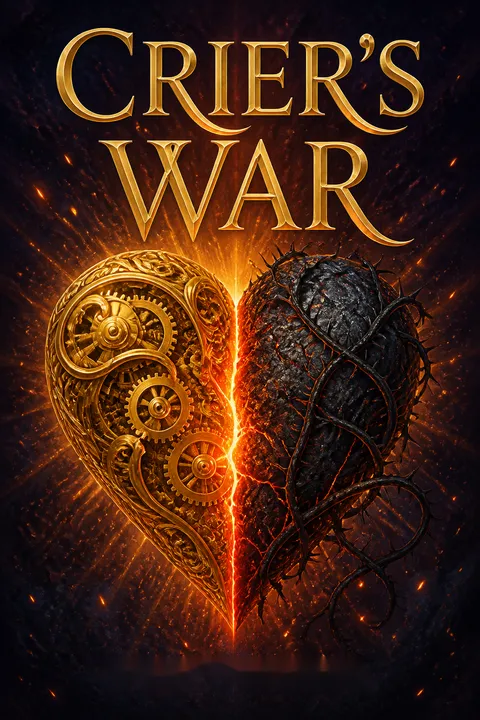


Plot Summary
Prologue
Before the Automa Era, Queen Thea of Zulla grieved her inability to have a child. After her husband died, she offered wealth and royal influence to any Maker who could build a humanlike heir.
The Makers considered the task impossible, but Thomas Wren proved them wrong by creating Kiera, the first Automa. The account frames Automa history as beginning not with a people’s birth, but with a ruler’s private longing and a human invention.
The prologue makes political history intimate before the main story begins. Automa society traces its origin to a queen’s grief, so its later claims to self-sufficiency rest on a distinctly human need. The historical account also quietly unsettles its own certainty: it describes human reproduction with detached superiority, yet the founding act it records was driven by desire. Crier inherits that contradiction. Her world treats feeling as a human weakness, even though emotion helped create the very order that now denies it.
A Fifth Pillar
During a ceremonial Hunt, Crier, heir to Sovereign Hesod, learns from her fiancé, Scyre Kinok, that Midwife Torras falsified another Automa’s Design. Torras helped make Crier, so the news turns a political ritual into a private threat. Kinok gives Crier the old plans he obtained, presenting the gesture as proof that he supports her ambitions.
Alone in the gardens, Crier compares the final blueprint with her own body and finds a fifth pillar, Passion, added to the four that should govern an Automa mind. She fears the hidden difference could shame her father, threaten his rule, or get her terminated. The discovery leaves Crier questioning whether she can trust the design of her own identity.
Crier’s fear begins with a document, but its deeper force is the collapse of a sanctioned self-image. She has been taught that an Automa’s Design determines both capacity and social place. A fifth pillar therefore feels less like an added trait than an accusation that she is illegitimate. Kinok’s apparent assistance sharpens the problem: knowledge can be care, but in a court built on leverage it can also become a leash. The blueprint turns inwardness into political evidence. Crier’s first response is not to embrace Passion, but to imagine how its discovery might endanger her father and the order that defines her.
Ayla’s Vow
Ayla, a human servant working Sovereign Hesod’s orchards, sells flowers in Kalla-den beside her friend Benjy. Luna’s body is gone, but the white dress left hanging in the market still warns humans what the rulers can do. Ayla knows the violence personally: years earlier, Hesod’s soldiers raided her village of Delan, killing her parents and twin brother Storme.
Rowan rescued the starving child Ayla and trained her to survive, then found her palace work so she could reach Hesod. When Rowan brings word of another southern uprising, Benjy wants to join. Ayla refuses, convinced that a doomed revolt will only produce more bodies. She stays because she is close to the palace and to Crier, Hesod’s daughter, whom she means to kill.
Ayla has converted grief into a plan because grief alone once threatened to stop her from living. Her refusal to join the uprising is not indifference to collective freedom; it is distrust of strategies that spend human lives without changing power. Yet revenge narrows her moral imagination. She sees Crier first as the nearest instrument of Hesod’s pain, not as a person with choices of her own. Benjy’s loyalty unsettles that isolation, while Rowan offers a broader cause. Ayla accepts the cause only when it can serve her personal reckoning, revealing how survival can make even solidarity feel like a risk.
The Cliffside Rescue
While spying on Hesod and Kinok near the palace cliffs, Ayla overhears that Kinok once guarded the secretive Iron Heart, the mine that supplies Automae with heartstone. Nearby, Crier secretly listens to the same conversation, loses her footing as the cliff crumbles, and hangs above the rocks. Ayla grabs her wrist and hauls her to safety, though for an instant she considers letting her fall.
Crier’s guards arrive and seize Ayla, but Crier says the human saved her and orders them to release her. The next morning, Crier summons Ayla, asks why she did not report her forbidden locket, and appoints her personal handmaiden. Ayla gains access to the palace. Crier gains a human witness to her tears and secrets.
The rescue makes their relationship morally unstable from its first moment. Ayla saves the person she has trained herself to kill, while Crier protects a servant when the political reflex of her household is to punish her. Neither act is pure: Ayla sees an opportunity for infiltration, and Crier wants to keep a person who has witnessed her vulnerability close. Still, their choices exceed the roles assigned to them. The cliff is a literal failure of secure ground, but also a first breach in the assumption that power determines every response. Each girl discovers that the other can act outside expectation.
The Human Web
Ayla uses Crier’s engagement ball to slip into Kinok’s chamber and search for information about the Iron Heart. Behind a tapestry she finds a chart linking human servants through family, friendship, and love, including a red thread between herself and Benjy.
Faye, Luna’s sister, appears beside a scratched-out face, making Ayla suspect that Luna was killed to punish Faye. Ayla accidentally leaves Nessa’s handkerchief in Kinok’s room.
The next morning, Nessa is dead after resisting guards who tried to take her child, and her shoes and the bloodied handkerchief are displayed as warnings. Guilt makes Ayla realize Kinok can turn human attachment into a weapon. Malwin hints that the sun apple shipments matter, and Ayla learns Kinok has a hidden study.
Kinok’s chart is more than surveillance: it is an attempt to translate human care into exploitable data. The lines make relationships legible to power, but they cannot explain what those bonds mean to the people who live them. Ayla’s mistake with the handkerchief gives this abstraction a body and a consequence. Nessa’s death is not merely a warning from the regime; it forces Ayla to confront the cost of her own secrecy. Her guilt does not end her mission, but it changes its shape. To resist Kinok now means protecting people whose lives are not interchangeable with the cause.
A Seat Denied
At the engagement ceremony, Crier and Kinok cut their arms and bind their blood before Hesod’s court. Crier notices many guests wearing Kinok’s black armband, a sign that his Anti-Reliance Movement has spread farther than she understood. Three days later, at her first Red Council meeting, Hesod leaves Crier standing by the door while Kinok takes the vacant seat of the missing Councilmember Reyka.
Crier speaks against the council’s violence toward humans, but her father dismisses her contribution. Kinok then uses her hidden Passion as a private threat, making clear he knows about the fifth pillar. Crier’s hopes of serving on the council collapse, and her prospective husband becomes a danger rather than an ally.
The ceremony binds Crier’s body to Kinok’s at the same moment the council denies her a political voice. That contrast exposes how institutions can celebrate unity while preserving hierarchy. Crier’s public intervention is ethically serious but structurally powerless: she can name cruelty without gaining the authority to change it. Kinok, by contrast, turns private knowledge into leverage and occupies the seat she imagined as her own. His success reveals that Crier’s education has prepared her to understand governance, not to participate in it. Her disappointment is therefore also a dawning political awareness.
The Fox’s Story
On the Reaper’s Moon, Crier watches Ayla dance with Benjy at an illegal harvest gathering instead of reporting the servants. Ayla leads Crier away from the crowd, and the two sit beside a tide pool. Crier tells a story about a princess trapped in a snowstorm, though she changes its bleak ending when Ayla demands a happier one.
The encounter gives them a fragile intimacy neither can explain. Later, Crier breaks into Kinok’s study looking for her Design papers. She finds notes about Thomas Wren and the phrase Yora’s heart, but no proof of what it means. The clue deepens her suspicion of Kinok, while Ayla’s challenge to the story lingers as Crier’s first glimpse of a life beyond obedience.
The story exchange makes narrative itself a form of negotiation. Crier begins with an inherited tale of sacrifice and loss, while Ayla refuses to accept an ending that leaves the sacrifice meaningless. Crier responds by revising the ending, offering comfort but also exposing her own desire to imagine a different future. Their closeness is not yet trust; Ayla still has strategic reasons to stay near her. But both begin to affect the other’s sense of what is possible. The unexplained note in Kinok’s study links that private shift to the larger mystery, joining desire and political danger without resolving either.
The Queen’s Adviser
Queen Junn arrives from Varn with her human adviser, and Ayla recognizes the man as Storme, her twin brother whom she believed died in the raid on Delan. He sees her too, but cannot explain himself in public. Crier arranges better rooms for Faye, hoping to help the traumatized servant, while Faye mutters about sun apples and shipments.
In private, Junn warns Crier that Kinok wants a new Automa society built without humans and seeks another source of power. She asks Crier to help stop him. Crier also discovers Junn’s intimacy with Storme, then sends the queen a coded sign of alliance. For Ayla, Storme’s return cracks open old grief; for Crier, Junn’s warning turns Kinok’s politics into an immediate threat.
Storme’s return destabilizes Ayla’s most settled conviction: that the past is fixed and the dead remain beyond reach. His presence offers reunion, but not the simple repair she longs for, since his allegiance and absence are unexplained. Junn, meanwhile, unsettles Crier’s inherited categories. The queen’s public image as a monster conflicts with her political sophistication and private attachment to a human. These contradictions matter because both girls have learned to read people through labels imposed by power. Junn’s request forces Crier to act on evidence rather than defer to her father, while Ayla must face the difference between remembering someone and knowing who they became.
Nightshade in Apples
Ayla confronts Storme, who says he was taken in after the raid and sworn to keep away from her; he leaves with Junn without resolving their estrangement. Meanwhile, Kinok’s guards bring Ayla to his study after finding her in Crier’s room. He questions her about her family, then lets her go without punishment. There Ayla spots her locket on a shelf and locates a concealed safe, but cannot open it.
Rowan returns from the South bruised and reports that the promised uprising never existed. Someone inside the palace fed her a false report to map Resistance connections. Benjy finds crates marked as sun apples filled with black dust, and Ayla connects the shipments to Faye. The group suspects Kinok is using her and plans to break into his study.
The failed uprising reveals that information itself has become a weapon. Kinok does not need to defeat a rebellion in battle if he can make its members expose one another through false expectations and controlled movement. Rowan’s bruises give this strategy a human cost, while the black dust suggests the threat extends beyond political manipulation. Ayla’s encounter with Storme parallels the Resistance’s predicament: both are forced to act without knowing whom they can trust. The hidden safe offers a concrete target, but reaching it requires cooperation among people whose fear, grief, and secrets have already been turned against them.
A Memory Opens
After Ayla spends a troubled night in Crier’s bed, her locket slips loose. Crier pricks herself on its clasp and is thrown into a vision of a burning city, where a woman named Siena gives a blue stone to Leo before returning to the flames. Guards respond to Crier’s distress chime and drag Ayla away.
Hesod agrees to release her only if Crier wears Kinok’s black armband, making her apparent support for Anti-Reliance the price of keeping Ayla near. Crier secretly signals Junn. Later, she and Ayla activate the locket together and witness Siena, Ayla’s grandmother, discussing her own designs. Crier returns the pendant, but Ayla recoils from their kiss and flees. Their shared memory deepens the mystery Kinok is pursuing.
The locket makes inherited history physically accessible, but its memories arrive as fragments rather than a reliable explanation. Crier and Ayla must interpret what they see while carrying different emotional stakes: Crier wants to protect Ayla, while Ayla is struggling not to trust the person she has been sent to exploit. Their kiss briefly gives that conflict a bodily form, then Ayla’s retreat restores its danger. Crier’s bargain with Hesod shows how care can become politically costly; she accepts a public mark of allegiance to preserve Ayla’s place. The object binds intimacy, ancestry, and state power in one unstable mechanism.
Three Names, Three Deaths
Crier learns that Councilmembers Laone and Shasta, along with Lord Foer, have been killed. She had named all three as Kinok supporters in her message to Junn, and the deaths make her fear that the queen acted on her information. Crier persuades Hesod to let her visit Foer’s promised wife, Rosi, and brings Ayla south.
Rosi’s blackened veins and altered appearance reveal the damage caused by Nightshade, the dark powder Kinok distributes in place of heartstone. She explains that Foer was investigating Thomas Wren and discovered the first Automa may have been created by a woman, not Wren. Crier then diverts the carriage to Elderell, where Reyka was last seen. Her attempt to investigate has made her complicit in lethal politics.
Crier’s first covert intervention produces consequences she cannot contain. She wanted information to weaken Kinok, but Junn’s swift violence converts names into targets. The resulting guilt is more than fear of punishment; it is recognition that resistance does not automatically make its methods just. Rosi’s condition gives Nightshade visible bodily stakes, connecting Kinok’s political project to the alteration of Automa dependence. The discovery about Wren also unsettles the official origin story, suggesting that power has been built on stolen knowledge. Crier must now decide whether truth is worth pursuing when every piece of it can become an instrument of harm.
The Feathered Box
At the Green River Inn in Elderell, Crier learns that Reyka visited regularly and left a wooden box behind. It contains green feathers, the signal Junn uses with allies. Ayla recognizes the code from a feather Storme gave her, so Crier admits she is working with the queen and fears Kinok caused Reyka’s disappearance.
They compare what they know: Kinok charts human relationships, ships Nightshade as sun apples, and may have manipulated the uprisings. Their argument turns into a kiss, then Crier returns Ayla’s locket and the two activate it together.
They witness Siena, Ayla’s grandmother, discussing the creation of Yora, a humanlike being. Before they can make sense of the revelation, a human mob surrounds the inn’s carriage. Rowan appears in the crowd, and guards kill her as she tries to restrain a rebel.
The feathers turn private suspicion into a network of potential allies, but they do not guarantee safety; Reyka’s absence makes the code feel as fragile as the people who use it. Crier and Ayla’s kiss follows their decision to exchange information, so intimacy is neither separate from politics nor a substitute for trust. The memory of Siena and Yora opens a new historical possibility just as Rowan’s death closes Ayla’s most important source of care. The sequence forces private discovery and public violence together. The girls gain a shared past to investigate, but lose the mentor who might have helped them decide what to do with it.
The Midnight Knife
Grieving Rowan, Ayla and Benjy decide there is no time left: Kinok’s Nightshade could soon make an attack on the Iron Heart useless. They organize a palace raid, using a stable fire to draw guards away while Benjy and other rebels enter Kinok’s study. Ayla is assigned to trigger Crier’s distress chime by killing her.
At midnight, she stands over Crier with a knife, but sees the locket in Crier’s hand and cannot strike. Crier wakes, and Ayla runs. The rebels escape with the safe, but it contains only a scrap bearing the names Leo, Siena, and Tourmaline, not the compass they sought. Ayla and Benjy become fugitives, injured and empty-handed, while Crier is left behind and Kinok’s plans remain intact.
Ayla’s failure is not a sudden rejection of the cause; it exposes a conflict between the revenge that has sustained her and the attachment she has tried to deny. The locket makes the cost of killing Crier personal, while Rowan’s death has made violence feel more urgent than ever. Benjy’s participation also reveals that love can motivate action without guaranteeing agreement about its risks. The raid secures a clue but not the tool the rebels need, so the plot’s practical stakes remain unresolved. Their escape is a narrow survival, not a victory, and their new knowledge carries them toward a more complicated history.
Yora’s Blue Heart
Ayla and Benjy hide from Hesod’s guards and set out for Varn, hoping Storme can explain the names on the scrap. Crier travels to the Midwifery and learns that her supposed fifth pillar was a forgery: her official Design contains only four.
Kinok fabricated the evidence to control her, but Crier’s feelings for Ayla remain real. Using Ayla’s locket, Crier sees Siena give Leo a blue stone called Tourmaline and identifies it as Yora’s heart, a source of power that could free Automae from heartstone.
Kinok would become almost unstoppable if he finds it. Then Junn’s message reveals that she killed Reyka and orders Crier to proceed with the wedding, where Kinok and his supporters will gather. Crier is left choosing between escape and an attempt to destroy Kinok from within.
The revelation that Crier’s Design was forged separates biological origin from emotional truth. She has been manipulated into treating love as evidence of defect, yet removing that explanation cannot undo what she feels. The blue heart offers a possible escape from Automa dependence, but also concentrates power in whoever controls it. Junn’s message makes clear that opposing Kinok does not mean serving justice: the queen’s strategy has already consumed an ally. The ending refuses a clean moral refuge. Crier and Ayla are moving toward different dangers, and the information that might liberate one people could give another ruler the means to dominate them.
Analysis
Crier’s War makes political ideology intimate by placing it inside bodies, families, and acts of attention. Automae claim superiority over humans while depending on a human-made history, human labor, and heartstone extracted through a guarded network. Crier’s education teaches her to admire human culture as an object of study, but Ayla’s presence turns that study into a relationship that demands ethical response. The novel’s central conflict is therefore not simply coexistence versus separation. It is whether a person can revise inherited systems while still benefiting from them.
Ayla and Crier begin from opposing forms of certainty. Ayla believes revenge will restore balance after the raid that destroyed her family; Crier believes order can be improved through study and responsible rule. Their bond does not erase that imbalance. Ayla remains a servant, Crier remains the sovereign’s daughter, and even their tenderness is shaped by unequal power. The story’s most consequential movement is their growing willingness to recognize the other as a person without pretending the political structure has vanished.
The parallel plots of hidden history and present-day conspiracy sharpen that question. Siena’s work and Yora’s heart suggest that official accounts have concealed human invention, while Kinok’s Nightshade project turns technological independence into a route toward domination. Junn offers an alternative political vision, but her willingness to kill allies shows that liberation can reproduce the coercions it opposes. No faction is granted moral purity merely because it challenges the existing order.
The ending preserves this instability rather than resolving it. Ayla and Benjy flee toward Varn with only a fragment of a clue; Crier discovers that Kinok fabricated her supposed flaw, yet her love remains; and Junn demands a wedding designed to gather her enemies in one place. The characters have learned that identity cannot be reduced to Design, loyalty, or ancestry. They have not yet found a safe way to act on that knowledge. The final promise is not peace, but a struggle over who gets to define power, history, and personhood.
Review Summary
Crier's War receives mostly positive reviews, praised for its compelling characters, slow-burn sapphic romance, and intricate world-building. Readers appreciate the exploration of themes like humanity and oppression. The political intrigue and plot twists keep readers engaged. Some criticize pacing issues and underdeveloped worldbuilding. Many reviewers express excitement for the sequel. While a few found it disappointing or boring, the majority consider it a strong debut with beautiful writing and a captivating enemies-to-lovers storyline.
People Also Read




Characters
Crier
The questioning heirCrier is the Automa daughter of Sovereign Hesod, educated to inherit political responsibility and shaped by his faith in Traditionalism. She studies human customs with genuine curiosity, but initially accepts the hierarchy that makes humans serve her household. Her habit of observing closely gives her a path toward independent judgment, while her isolation makes her hungry for a confidante who will answer honestly. Crier’s attention to Ayla is part intellectual fascination and part emotional awakening. She is not naturally rebellious; she has to learn that obedience and goodness are not the same thing, and that knowledge becomes meaningful only when she acts on it.
Ayla
The palace infiltratorAyla is a human servant from Delan whose family was destroyed in a raid ordered by Hesod. Rowan rescued her and taught her to fight, survive, and communicate with the Resistance. Ayla’s determination is formidable, but she relies on anger because it makes grief feel usable and keeps other people at a distance. Her friendship with Benjy challenges that strategy, while her assignment as Crier’s handmaiden puts her close to both the political power she wants to undermine and the person she expects to hate. Ayla is observant, resourceful, and fiercely protective, though she often mistakes vulnerability for a danger she can avoid.
Kinok
The ambitious ScyreKinok is a former Watcher of the Iron Heart, a Scyre, and the influential founder of the Anti-Reliance Movement. He presents himself as disciplined and farsighted, arguing that Automae should become independent of humans and of the heartstone that sustains them. His political skill lies in making control sound like preparation and exclusion sound like safety. Kinok studies both historical records and personal relationships, treating people as systems whose weaknesses can be located and used. His courtship of Crier is inseparable from his ambition, and his composure makes it difficult for others to tell where conviction ends and manipulation begins.
Hesod
The sovereign fatherHesod rules Rabu and raises Crier within a political philosophy called Traditionalism, which borrows selected human customs while maintaining Automa supremacy. He values order, ceremony, and family as instruments of social stability, and he can be warm toward Crier in private without granting her meaningful authority in public. His affection does not erase his willingness to punish humans or arrange his daughter’s marriage for political advantage. Hesod believes that a controlled society is a safe one. That conviction makes him an effective ruler and a difficult father for a daughter whose curiosity is beginning to challenge the limits he set for her.
Benjy
Ayla’s steadfast friendBenjy is a human servant and Ayla’s closest friend, raised at a temple before Rowan took him in. He wants to join the Resistance and believes that collective action, however dangerous, is necessary to end Automa rule. His warmth and loyalty contrast with Ayla’s defensive self-reliance, but he is not merely her comfort: he can organize others, take risks, and question the choices she makes. Benjy longs for connection and keeps reaching toward Ayla even when she pushes him away. His commitment to her does not prevent him from having his own grief, desire, and political judgment.
Rowan
The rebels’ mentorRowan is a seamstress in Kalla-den and a quiet organizer of human resistance. She gives abandoned children shelter, work, and training, then teaches them coded ways to communicate under surveillance. Rowan’s practical compassion is paired with a willingness to risk herself for a political future she believes can be built. She recognizes strengths in Ayla that Ayla herself struggles to name, especially her resilience, and pushes her toward work larger than personal vengeance. Her care is not sentimental: she prepares young people to survive a world that will not protect them, even when the struggle demands choices she cannot control.
Queen Junn
Varn’s feared reformerJunn is the young queen of Varn, a neighboring Automa realm rebuilding after war. Rumors describe her as unstable and brutal, yet she presents herself as a forceful political thinker who wants humans and Automae to live more equally. Her diplomacy combines warmth, sharp observation, and an unmistakable appetite for strategic advantage. Junn understands that fear can be useful, and she asks others to take risks while retaining control of her own plans. Her relationship with her human adviser complicates the public boundaries she is expected to uphold, making her a powerful but difficult ally to assess.
Storme
Ayla’s twin brotherStorme is Ayla’s twin, remembered from childhood as clever, protective, and close to her. His history is bound to the raid that separated their family, and his absence leaves Ayla with unanswered questions about survival and loyalty. When he reappears in Varn’s royal company, he is older, physically changed, and difficult for Ayla to recognize as the boy she lost. Storme is guarded about his past and careful about what he says within the palace, suggesting that his position carries risks he cannot explain freely.
Faye
The grieving laundry maidFaye is a human servant and Luna’s sister. After Luna’s death, Faye behaves erratically, speaks in fragments, and fixates on the sun apple shipments. Her distress makes her easy for others to dismiss as unstable, but her words contain information that the people around her initially fail to understand. Faye is shaped by grief and fear, and her guardedness reflects the danger of speaking openly in a household where servants are watched. Ayla sees in her both a person in need of help and a possible link to Kinok’s hidden operations.
Reyka
Crier’s absent mentorReyka is a long-serving member of Hesod’s Red Council and one of the few elders who showed Crier encouragement over the years. She brings the young heir small gifts and treats her political curiosity as worth taking seriously. Reyka’s interest in human welfare distinguishes her from many of her peers, though she works within a system that limits how far such concern can reach. Crier values her as a model of the thoughtful public servant she hopes to become.
Siena
Ayla’s Maker ancestorSiena is Ayla’s grandmother, a human with an extraordinary interest in alchemical making and the creation of artificial life. The locket preserves fragments of her history through memories connected to her family. In those fragments, Siena appears inventive, driven, and willing to pursue an idea beyond the limits others consider safe. Her work links Ayla’s family history to the origins of Automa creation and to a secret that powerful figures are desperate to uncover.
Leo
Siena’s devoted partnerLeo is Siena’s partner and the father of their daughter Clara. The locket preserves moments of his life during a period of catastrophe, revealing a man deeply attached to his family and frightened by Siena’s dangerous work. His perspective gives Crier and Ayla access to personal history that official accounts omit. Leo’s memories are not a complete record, but they make the costs of invention and ambition visible through one family’s love and fear.
Yora
Siena’s strange creationYora is a humanlike being created by Siena, with gold eyes and a voice unlike a human’s. The memories show her as a dependent presence in Siena’s household, cared for with tenderness but regarded uneasily by Leo. Yora is central to the buried history behind Tourmaline and the making of Automae. Her existence raises questions about what separates a designed body from a person, and about whether affection can be directed toward a creation without granting it a life of its own.
Torras
The implicated MidwifeTorras is the Midwife who helped create Crier and later becomes associated with a scandal involving falsified Designs. The possibility that she altered Crier’s plans gives her an unseen but consequential presence in the story. Midwives occupy a delicate position between Makers, families, and the newly created Automae, with responsibilities that are both practical and ethical. Torras’s reputation makes Crier question whether the institution entrusted with her creation can be trusted.
Rosi
Kinok’s devoted supporterRosi is an Automa noblewoman and Crier’s closest social companion. Her engagement to Foer connects her to the political circles surrounding Kinok, whom she admires for protecting her household during human uprisings. Rosi is eager to be seen as important and valued, and she takes pride in having access to information others lack. Her loyalty makes her a revealing observer of Kinok’s movement, while her need for approval leaves her vulnerable to the movement’s promises.
Nessa
The palace’s head servantNessa supervises the human servants and raises her child while working inside Hesod’s palace. She is direct, capable, and accustomed to managing power from a precarious position. Her marriage to Thom and her care for her baby demonstrate the ordinary attachments that Automa authorities attempt to monitor and control. Nessa’s practical help to Ayla during a humiliating chore shows that solidarity can appear in small acts, even among people who are not close.
Malwin
The wary former handmaidenMalwin previously served as Crier’s handmaiden and knows the palace’s routines better than Ayla does. She resents losing her position and warns Ayla that attention from Kinok can bring danger. Her caution is shaped by long experience in a place where servants survive by withholding information and avoiding notice. Malwin’s fear does not make her generous, but it gives Ayla a practical clue about the Scyre’s hidden study and the importance of the sun apple shipments.
Midwife Jezen
The keeper of recordsJezen is a Midwife at the institution where Crier was created. She safeguards the official records of Automa Designs and speaks plainly when Crier asks for help. Jezen’s knowledge of past experiments gives her a grounded view of what a Design can and cannot contain, making her an important check on Crier’s assumptions.
Finn
Benjy’s old temple friendFinn is a human who knew Benjy at the temple and reconnects with him during the Reaper’s Moon gathering. Their easy affection reveals that Benjy has ties beyond the palace grounds. Finn’s brief visit reminds Ayla that human connection can survive distance and danger.
Luna
Faye’s lost sisterLuna is a human servant whose death is marked by a white dress left in the marketplace. Her fate becomes an early warning to Ayla that the regime punishes people publicly and unpredictably. Luna’s bond with Faye helps Ayla recognize how the authorities can use one person’s attachment to control another.
Plot Devices
Heartstone and Nightshade
Automa power and dependenceHeartstone is a red mineral mined from the Iron Heart and processed into the substance Automae need to keep functioning. Its supply chain is both an economic foundation and a strategic vulnerability, making the mine a central concern for the human Resistance. Kinok’s black Nightshade is distributed in crates disguised as sun apples and appears to replace ordinary heartstone, though it harms users. The competing substances turn a technical question into a political contest: whoever controls Automa power can reshape the balance between humans and their rulers.
Siena’s locket
A family memory archiveAyla’s forbidden gold locket bears a Maker’s symbol and a red stone. When activated by blood, it lets Crier and Ayla witness fragments of memories connected to Ayla’s family. Its contents reveal the existence of Siena’s creation, Yora, and the blue stone called Tourmaline. The locket gives the protagonists access to a history missing from official records, but the memories are partial and must be interpreted. It is simultaneously an heirloom, a key to a buried origin story, and a physical link between Crier and Ayla.
The relationship chart
Human attachments as targetsHidden behind a tapestry in Kinok’s room, the chart connects human faces with colored threads indicating family, friendship, and romantic bonds. It makes visible how Kinok studies the servants not only as workers but as a network of attachments that can be exploited. Ayla recognizes herself and Benjy on it, then connects the chart to the punishment of Faye through Luna. The chart converts private care into a map of political vulnerability, and it explains why the Resistance cannot assume that secrecy alone will keep its members safe.
Green feathers
A covert alliance signalRowan teaches Ayla and Benjy to communicate through coded objects and ordinary-looking messages. In Varn, Queen Junn uses green feathers to signal alliance. Storme gives Ayla one, and Crier later uses the same code to contact Junn. The feathers connect separate political actors without relying on open correspondence, but they cannot guarantee that a message will remain safe or that an ally’s aims are just. Their simplicity makes them easy to carry and easy to misunderstand.
The hidden safe and compass
A route toward the Iron HeartAyla discovers a small safe concealed in the back of a bookshelf in Kinok’s study. Its lock uses Maker symbols that Benjy can read, so opening it requires knowledge neither Ayla nor Crier possesses alone. Crier mentions Kinok’s unusual compass, which Ayla believes may point toward the Iron Heart rather than north. The Resistance risks a palace raid to obtain the safe, but the object it contains is only a scrap naming Leo, Siena, and Tourmaline. The missing compass keeps the route to the mine unresolved.
Crier's War Series

Download PDF
Download EPUB
.epub digital book format is ideal for reading ebooks on phones, tablets, and e-readers.








