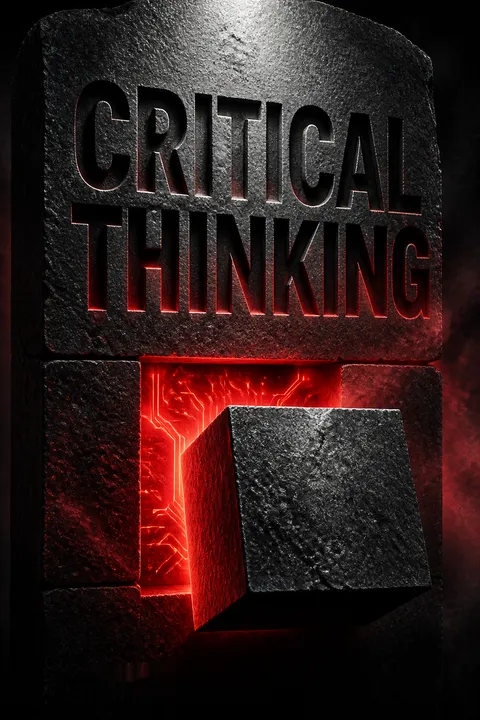


Key Takeaways
Treat every claim as a case to examine, not a cue to agree.
Pause before belief. Critical thinking means breaking a claim into its parts, checking how they fit together, and judging whether the evidence supports the conclusion. Its historical thread begins with Socrates, who challenged confident speakers by probing their assumptions. Francis Bacon later described habitual distortions in thought as idols, including biases rooted in human nature, poor instruction, misleading words, and custom. Descartes urged systematic doubt: even a familiar perception, such as a stick appearing bent in water, may mislead.
This tradition is not a demand to reject authority or creativity. It asks for reasons before assent, and for conclusions that can change when better evidence appears.
What's valuable is the distinction between skepticism and cynicism. Skepticism asks what would justify a belief; cynicism assumes that nothing is trustworthy. The former supports both science and ordinary cooperation, because it makes disagreement answerable to shared reasons. Yet complete objectivity is an aspiration, not a switch: people choose which questions matter and which costs they will accept. Critical thinking therefore requires examining values alongside evidence, rather than pretending values have disappeared.
Ask questions that make assumptions, evidence, and consequences visible.
Probe the structure. Socratic Questioning is a method of clarifying an issue through deliberate questions rather than accepting its first description. The book organizes useful questions around five targets: assumptions, evidence, the exact problem, alternative perspectives, and likely consequences. Ask where information came from, whether it still applies, and what would change if someone with an opposing view framed the issue. A broad complaint can often be divided into smaller questions that are easier to answer.
The point is not to interrogate people for sport. In a workplace discussion, questions about the evidence behind a proposal, the conditions it assumes, and the risks of failure can expose gaps before a team commits time or money.
Questions shape what a group can know. A question that presumes a cause can quietly exclude other explanations, while a question about what evidence would distinguish competing explanations keeps inquiry open. This connects critical thinking to research design: the quality of the answer depends partly on how the problem is framed. There is also a social skill involved. Questions work best when they invite clarification, not when they are disguised accusations designed to win a debate.
Label facts, inferences, judgments, and opinions before trusting a conclusion.
Sort the claim. A fact is something that can be checked, such as the day of the week. An inference interprets facts and points toward a conclusion without proving it. A judgment may add an assumed explanation: if Jonny misses a Saturday commitment, saying he was busy with work is only one possible account; illness could also explain his absence. An opinion expresses a person's belief and may or may not rest on strong experience.
These categories are easy to blur in conversation. Separating them helps reveal where more information is needed. Instead of repeating that someone missed an appointment because they were careless, first establish the verifiable event, then identify the explanation as a hypothesis rather than a fact.
This sorting habit resembles the distinction between observation and interpretation used in science and in careful reporting. It is especially useful when a story feels emotionally complete: a plausible explanation can feel like a verified one. Still, a label does not settle credibility. An opinion from a specialist may carry more evidential weight than a casual guess, but expertise is not infallibility. The next question remains how the claim was formed, what supports it, and what might disconfirm it.
Use deduction to test rules, and induction to build cautious patterns.
Know the direction. Inductive reasoning starts with particular observations and proposes a broader pattern. Seeing one tree cast a shadow does not establish that every tree does, though repeated observations may support that generalization. Deductive reasoning starts with a general premise and applies it to a case. Its conclusion follows if the premises are true and the reasoning is valid.
The book uses a camera to show how conditional logic can go wrong. If dropping a camera in water ruins it, that does not mean every ruined camera was dropped in water. Nor does keeping it dry guarantee it will remain intact. The converse and inverse of a conditional are not automatically true. Its contrapositive, which reverses and negates both parts, is logically equivalent to the original statement.
The distinction is fundamental because people often mistake a pattern for a rule, or a possible cause for the only cause. Induction is indispensable for learning from experience, but its conclusions remain open to revision as new cases appear. Deduction offers certainty only conditionally: flawless reasoning cannot rescue a false premise. The camera example makes that dependency concrete. A practical thinker therefore checks both the inference and the quality of the starting assumptions.
Define the real problem before spending effort solving it.
Follow the problem through. The book's decision process begins by identifying the central issue, then analyzing whether it is real and how serious it is. A situation that initially looks like a problem may turn out to be a misunderstanding or a misdescription. If a real problem remains, generate plausible responses, compare them in context, choose one, and act. Input from capable colleagues can widen the options, especially when the issue exceeds one person's knowledge.
Action does not always mean intervention. The book points to medical decisions where careful assessment may support monitoring rather than treatment. The important thing is to make the choice deliberately and explain its reasons. An elegant analysis that never leads to a decision leaves the original challenge untouched.
This sequence guards against solutionism, the impulse to fix the first visible symptom. In complex systems, a poorly defined problem can make every proposed remedy look ineffective or even harmful. The insistence on implementation is equally important: reasoning is a tool for action, not a substitute for it. The exception is worth keeping visible. Choosing not to intervene is still a decision, but it should be tied to evidence, a time horizon, and clear signs that would prompt reassessment.
Match decision effort to stakes, evidence, and the number of options.
Spend attention wisely. For consequential choices, compare likely benefits and costs, research the relevant facts, and seek informed advice from people who understand the situation. For minor choices, set a short deadline and move on. The book also recommends narrowing an overwhelming set of options; considering every imaginable alternative can invite regret without improving the decision.
A useful sequence is to ask what is at stake, what information is missing, and how much time the choice deserves. Buying a home calls for more investigation than choosing a television program. A list of advantages and drawbacks can clarify trade-offs, but the final choice remains the decision-maker's responsibility rather than a vote delegated to friends or reviews.
This is a practical form of bounded rationality: human attention and information are limited, so the aim is not perfect optimization but a defensible choice at an appropriate cost. Decision analysis adds a useful nuance: the size of a risk is not the only consideration; reversibility matters too. A low-cost choice that can be undone may not deserve prolonged study, while a difficult-to-reverse commitment merits more scrutiny. Too few options can also hide a better alternative, so narrowing should simplify, not predetermine.
Invite dissent, then judge every viewpoint by the same evidence.
Make disagreement useful. Fair-mindedness means applying consistent standards to competing arguments while staying willing to revise a conclusion. The book pairs this with intellectual humility, curiosity, integrity, perseverance, and courage to question comfortable beliefs. In groups, disagreement is inevitable, so participants should clarify the decision and its details before conflict hardens into a contest. When no one is guiding the discussion, taking responsibility can keep the group from wasting time.
A team can also broaden its view by consulting people with different experiences and ages. The goal is not to collect opinions for their own sake. It is to uncover assumptions, alternatives, and consequences that the original group might miss, then assess them against relevant evidence.
Dissent improves decisions when people can challenge ideas without being punished for challenging status. Research on group decision-making often distinguishes genuine task disagreement from personal conflict; the former can surface information, while the latter tends to consume attention. Equal standards help, but equal airtime alone is not enough: claims differ in expertise, evidence, and relevance. A strong discussion makes those differences explicit and gives quieter participants a real route to contribute, rather than treating the loudest voice as the group's conclusion.
Read for claims and connections, not merely familiar words.
Look beneath the sentence. Ordinary reading can recognize words without evaluating what they assert. Critical reading tracks the main idea, its supporting reasons, the assumptions it relies on, and the implications that follow. Vocabulary and experience matter because unfamiliar terms or contexts can make a sentence seem clearer than it is. The reader should distinguish relevant information from details that merely attract attention.
The book applies the same discipline to news and everyday claims. A report heard from a reliable source deserves different treatment from neighborhood gossip, and information circulating online still needs checking. Rather than accepting a familiar explanation, compare it with alternatives and ask what evidence would make it credible. Reading critically means testing meaning, not just decoding language.
This is an important extension of literacy in an information-saturated environment. Fluency can create false confidence: a reader may understand every word yet miss an unsupported causal claim or a source's incentive. Source checking is therefore necessary but not sufficient. Reputable outlets can make errors, and marginalized or local sources can hold valuable knowledge. The better standard is traceability: can the claim be followed to evidence, checked against other accounts, and understood in context?
Keep your mind flexible through novelty, rest, movement, and play.
Give thought room. The book recommends challenging familiar routines through learning, puzzles, creative activities, new experiences, and sustained curiosity. It also encourages enjoyable physical exercise, play, concentration, and sleep. One cited animal study found more newly formed cells in the hippocampus of mice that voluntarily ran than in inactive mice. The book also reports that sleeping after learning can improve recall by 20 to 30 percent. These claims support its broader message that mental performance depends partly on how the brain is used and cared for.
The recommendations are varied rather than magical: try a new skill, ask questions about ordinary events, and choose music or movement that helps attention rather than forcing a prescribed routine.
The strongest principle here is behavioral, not miraculous: curiosity and varied practice make learning part of ordinary life. Sleep and physical activity also matter to attention and memory, so critical reasoning cannot be separated entirely from the condition of the person doing it. The evidence deserves calibration, however. A mouse study does not prove that a particular exercise makes humans smarter, and findings about music or diet can be overstated when detached from their methods. The habits are sensible; sweeping brain-boosting promises require stronger evidence.
Analysis
The book's most durable contribution is not a single technique but a sequence of intellectual moves: identify the claim, expose its assumptions, inspect its evidence, distinguish observation from interpretation, consider alternatives, and decide what action follows. Its history, from Socratic inquiry through Bacon's account of mental distortions and Descartes's systematic doubt, gives that sequence a useful lineage. The practical chapters then translate it into work, reading, personal choices, and group discussion.
The material is uneven. Historical sketches are compressed, some explanations of grammar and brain function are simplified, and the collection of advice sometimes places well-grounded habits beside claims that need more qualification. The book also treats critical thinking as if reason can reliably govern emotion. A more careful view is that emotion can distort judgment, but it can also signal priorities, risk, and social meaning. Good reasoning examines those signals rather than dismissing them.
The key tension is between open-mindedness and the need to conclude. Questioning everything indefinitely is not wisdom; it can become delay, or a performance of sophistication. The book's emphasis on proportionate effort and action helps resolve this tension: investigate in proportion to the stakes, then make a reasoned choice, including a choice to wait or do nothing. Its framework is most useful when treated as a repeatable discipline rather than a promise of perfect neutrality. The reader does not become bias-free. The reader becomes better at noticing where a belief rests on evidence, where it rests on assumption, and what new information could change it. That is a modest claim, but a powerful one for decisions made under uncertainty.
Review Summary
Reviews of Critical Thinking are mixed, with an average rating of 3.25/5. Some readers found it concise and helpful as an introduction to critical thinking, praising its practical insights and exercises. Others criticized its brevity, lack of depth, and high price for a short book. Several reviewers felt it offered nothing new or impressive, describing it as clichéd and lacking real-world examples. A few positive reviews noted its value as a starting point for those new to the topic, while negative reviews cited poor organization and writing quality.
People Also Read


Glossary
Socratic Questioning
Questions that test assumptionsA method of examining a claim or problem through focused questions. It probes assumptions, evidence, the definition of the problem, alternative perspectives, and possible consequences. The purpose is to uncover gaps or inconsistencies and clarify what would justify a conclusion, rather than accepting a confident assertion at face value.
Idols
Habitual distortions in thoughtFrancis Bacon's term for recurring sources of error that can distort judgment. The book describes biases rooted in human nature, poor instruction or intellectual systems, misleading language, and unquestioned customs. Recognizing these influences helps a thinker ask whether a belief reflects evidence or merely a familiar way of seeing and speaking.
Inductive reasoning
Patterns from specific observationsReasoning that starts with particular observations and develops a broader generalization or prediction. Repeated examples can make a pattern more plausible, but they do not automatically prove that it holds in every case. The method is useful for learning from experience, provided its conclusions remain open to revision when new evidence appears.
Deductive reasoning
Cases derived from general premisesReasoning that begins with general premises and applies them to a particular case. When the premises are true and the logical form is valid, the conclusion follows from them. Deduction cannot establish that its starting premises are true, so those premises must be checked separately.
Bloom Taxonomy
Levels for shaping questionsA framework the book attributes to educator Benjamin Bloom for organizing questions by the kind of thinking they invite. The text emphasizes recalling knowledge, understanding and interpreting it, applying it, analyzing and evaluating it, and combining ideas to form a new response. It encourages questions that require more than a simple yes or no.
Contrapositive Statement
Equivalent reversed conditionalA transformation of a conditional statement that reverses and negates both its premise and conclusion. If the original statement says that if P, then Q, its contrapositive says that if not Q, then not P. Unlike the converse and inverse, the contrapositive is logically equivalent to the original conditional.
Download PDF
Download EPUB
.epub digital book format is ideal for reading ebooks on phones, tablets, and e-readers.








