


Key Takeaways
Your crushing is winemaking, not destruction, in God's hands
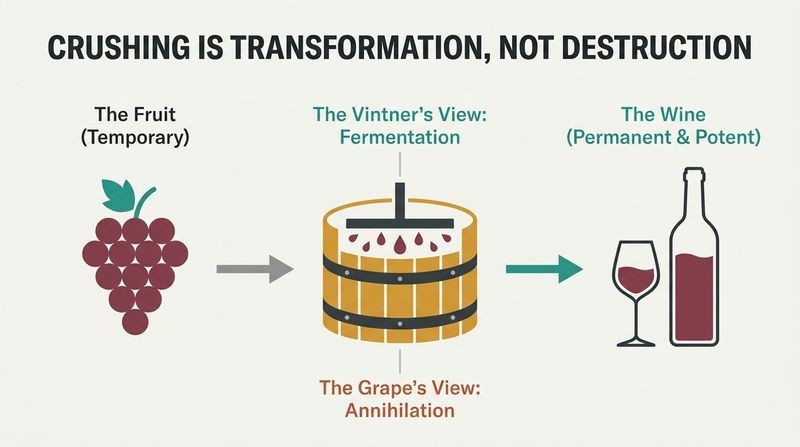
Grapes must be crushed to become wine. Jakes builds his entire book on this agrarian metaphor. A grape only sees its fruit trampled and its juice drained underfoot as annihilation. The vintner sees the first step toward something rarer, more potent, and longer-lasting than fruit ever was. The fruit was never the goal; the wine was.
Jakes opens with two blows landing at once: his mother's slow death from Alzheimer's and his thirteen-year-old daughter Sarah's pregnancy, confessed on the family porch. He felt like a failed father and pastor. Years later, Sarah co-pastors a church with her husband and his grandson has become a man. What felt like ruin fermented into what he calls a trophy vintage. The question in suffering, he insists, is not whether it hurts but whether it ends you. His answer is no.
The reframe is ancient and cross-cultural. Nietzsche's "what does not kill me makes me stronger" and the Japanese art of kintsugi (repairing broken pottery with gold) share the same instinct: damage can become the site of value. Modern psychology calls it post-traumatic growth, documented by Tedeschi and Calhoun, where roughly half of trauma survivors report deepened relationships and purpose. The caution worth naming: the metaphor works retrospectively. Jakes tells Sarah's story from the far side of a happy ending. In the acute moment, insisting suffering has a purpose can shade into spiritual bypassing, minimizing pain that deserves to be simply mourned first.
Great blessings and deep anguish often arrive holding hands

Joy and loss cohabitate. Jakes rejects the tidy expectation that faith or success insulates you from the darkest places. During the very season his mother's mind was vanishing, his books hit bestseller lists and Hollywood came calling to film Woman, Thou Art Loosed. He would have traded every accolade for her cure. His son Jamar's heart attack struck while Jakes stood backstage in Lagos, Nigeria, about to preach to nearly a million people. The phone buzzed with the worst news at the height of his platform.
The point is not that blessings cancel grief but that they refuse to wait their turn. He invokes Jesus's parable of wheat and weeds growing together, and Romans 8:28: God works in "all things" for good, not just the pleasant ones. Pretending you must feel only one thing at a time distorts reality.
This resonates with what researchers call emotional complexity or dialectical emotion, the capacity to hold joy and sorrow simultaneously. Studies by Hershfield and colleagues link mixed emotional experience to psychological resilience and even physical health over time. Cultures with words like the Portuguese saudade or the German Weltschmerz encode what English resists: that longing and loss saturate even good moments. Jakes's honesty here is his strongest move as a public figure. By admitting he stared out windows crying while his ministry exploded, he dismantles the prosperity-gospel caricature that faith should produce frictionless triumph, and gives readers permission to stop performing wholeness.
Resist the microwave mind: real transformation refuses to be rushed

Quality demands the luxury of time. Jakes, who loves to cook without recipes, compares spiritual formation to a Thanksgiving meal nobody wants to wait for yet everyone wants to taste. A seed planted today yields no harvest tomorrow. Fine wine may age for decades before its peak. Our culture of fast food, instant messaging, and one-click friendships has trained us to accept diminished quality as the price of speed.
He warns that aborting the development process compromises the promise inside you. Taking one right step toward your destiny tonight does not mean you see the finished vision by morning. Jakes waited seven years as a minister, preaching to bars of soap in the shower and laying hands on trees in the West Virginia woods, before delivering his first real sermon. The delay was not idleness; it was cultivation.
Behavioral economists would recognize this as a plea against hyperbolic discounting, our wired tendency to overvalue immediate rewards and undervalue distant ones. Walter Mischel's marshmallow experiments and Angela Duckworth's work on grit both suggest that tolerance for delay predicts long-term outcomes. The seven-years-to-first-sermon detail is the most concrete evidence Jakes offers, and it lands harder than any abstraction. One tension: not all waiting is cultivation. Sometimes delay is dysfunction, avoidance, or a system failing a person. The wisdom is discerning which is which, a distinction the metaphor alone cannot always make.
When life feels like a grave, you may be getting planted
Being buried and being planted feel identical. The difference is what happens next. A seed shoved into dark, filthy soil experiences it as suffocation, yet that same dirt is precisely what lets it sprout. Jakes argues God relocates the people He is developing into unfamiliar, uncomfortable fields on purpose, because nothing grown wild receives the vinedresser's careful hand.
He points to Nelson Mandela's twenty-seven years of wrongful imprisonment. From the outside, an obscene waste. Viewed across Mandela's whole life, prison became the field where the patience and moral authority that made him president were cultivated. Jakes adds a startling image: sometimes God adds not more nourishment but more manure, citing Jesus's parable of the barren fig tree the gardener fertilizes with dung. The mess, the instability, the dirty place is the fertilizer, not the punishment.
The planted-versus-buried distinction is genuinely useful as a cognitive reframe, close to what psychologists call benefit-finding. But invoking Mandela risks a survivorship-bias trap: for every Mandela, countless innocents were imprisoned and destroyed, their suffering yielding no redemptive arc. Jakes would likely respond that the eternal frame differs from the earthly one, which is theologically consistent but empirically unfalsifiable. The stronger, portable insight is practical: disorientation and discomfort frequently accompany real growth, so their presence is not automatic evidence something has gone wrong. The stability ball anecdote, where instability forces dormant muscles to engage, captures this crisply.
Pruning follows the harvest, so success invites the shears
God cuts what bears fruit, not what fails. Jakes distinguishes pruning from punishment by intention alone. A knife wound from a mugger and a surgeon's scalpel produce nearly identical pain, but one destroys and one heals. Pruning, he insists, always happens after a harvest, not before. Jesus said every fruitful branch gets cut back so it bears more.
During the 2008 collapse, Jakes went from a booming church to laying off forty employees. Staring out his window, he demanded, "Why me, Lord?" The answer that came back reframed everything: "Why not you?" He realized he was not being disciplined for wrongdoing. He was being pruned because he had done something right: he produced. He counsels a man named Michael, fired despite doing everything correctly, who a year later thanks that layoff for launching the entrepreneurship he loved.
The "why not you" reversal is the book's sharpest rhetorical turn, dismantling the assumption that suffering must be earned punishment. It parallels the biblical book of Job and challenges what psychologists call the just-world hypothesis, the deep human bias that people get what they deserve. That bias fuels victim-blaming; Jakes's framing actively resists it. The scalpel-versus-dagger image is clarifying but carries a risk: it can be weaponized to reinterpret genuinely harmful circumstances as loving discipline. Discernment matters. Not every cut is a surgeon's. Still, for high achievers blindsided by loss after success, the reframe that productivity itself attracts pruning is both consoling and motivating.
Your miracle hides in what remains, not in what was taken
Stop grieving the loss; inventory the remnant. Jakes argues that when God prunes, He deliberately leaves a remnant that will produce next season's fruit. The value was never in what was stripped away. He points to biblical figures reduced to almost nothing: the widow down to a single jar of oil, the boy with five loaves and two fish. That scarcity was exactly enough for God to multiply.
His logic is bracing: if you truly needed what was removed, God would not have removed it. What is gone was often weight you would have dragged into the next leg of the journey, baggage that could trap you in a past season. He reframes loss as precise tailoring, God trimming your life down to only what you need to reach where He is taking you. The instruction is to look at what is left and get to work.
This is a durable principle beyond its theological frame. Stoic philosophers practiced negative visualization, deliberately contemplating loss to sharpen gratitude for what remains, and modern gratitude research (Emmons, McCullough) links this orientation to measurable wellbeing gains. Entrepreneurs know it as constraint-driven creativity: limited resources often force the pivot that succeeds. The claim's soft spot is the reassuring inference that if God removed it, you did not need it. Applied to bereavement or catastrophic loss, that can ring hollow or even cruel. The transferable wisdom is agentic and forward-facing: fixating on the trampled fruit blinds you to the seeds still in your hand.
You do not love what costs you nothing, so pain has a price tag
Transformation costs everything. Jakes borrows evangelist Kathryn Kuhlman's blunt answer about what her calling cost her: everything. He reframes pain not as pointless but as the price of appreciation, quoting C.S. Lewis that God whispers in pleasures but shouts in pain, His megaphone to rouse a deaf world.
His central image is the pearl. Jesus compared the kingdom to a pearl of great price, and Jakes notes pearls only form when an irritant, a grain of sand or a parasite, lodges inside an oyster. The creature coats the intruder in layer after layer until beauty emerges from the wound. A pearl, he writes, is pain wrapped in perfection. He confesses years of financial terror while pastoring, using paper towels and duct tape for diapers, returning bottles for grocery change, all while preaching "get ready" to thousands without knowing what he was getting ready for.
The pearl is biologically accurate and one of nature's cleaner metaphors for adversity-into-value. There is also research support for the appreciation mechanism: hedonic-adaptation studies show that ease breeds indifference, while contrast and effort amplify meaning and enjoyment. The duct-tape-diapers detail humanizes a now-wealthy megachurch pastor and preempts the charge that he preaches from comfort. The philosophical risk is instrumentalizing suffering, treating all pain as secretly good, which can slide into justifying preventable harm. Jakes hedges by insisting God is not a sadist and takes no pleasure in our pain, which keeps the claim from tipping into masochism.
God hides you in private while the real work happens unseen
Fermentation is the waiting room of transformation. After the crush, wine sits and ferments while nothing appears to happen. Jakes calls the emotional version an aftershock, the tremors of anxiety and hypervigilance that follow being crushed, resembling post-traumatic stress. In this holding pattern, transition feels like idleness but is actually progress, like a plane moved from fortieth to second in line while still circling.
He reads Jesus's silent second day in the tomb, between crucifixion and resurrection, as the model. Real change happened in the darkness where no one could see. Fermentation must occur in private, he argues, both so others are not harmed by the toxic byproducts we release (he notes fermenting vats emit carbon dioxide that has knocked people unconscious) and so we are not corrupted before we are ready. Joseph in prison, Moses in the desert, David in the pastures: all hidden until ripe.
The insight that people become volatile and even ugly during transition, and therefore need protective solitude, is psychologically astute. Transitions researcher William Bridges called the disoriented middle stage the "neutral zone," a fertile but destabilizing in-between that people rush to escape too soon. The carbon-dioxide detail doubles as a warning about processing pain in isolation from those it could poison. One counterpoint worth holding: solitude heals some and harms others. For the depressed or traumatized, forced isolation can deepen the wound, and connection is often the medicine. The wisdom is matching the season to the need, not universalizing hiddenness.
Freedom means being drawn toward love, not just away from bondage
Getting Egypt out of you takes longer than getting you out of Egypt. Jakes reads Israel's forty years wandering the wilderness not as mere punishment but as God courting a traumatized people, feeding them manna, guiding them by cloud and fire, wooing them into relationship. Four centuries of slavery had lodged Egyptian identity deep inside them; the wilderness was decontamination.
He invokes Stockholm syndrome, the psychological bond captives form with captors, which he witnessed counseling an abused woman who defended her abuser. People cling to familiar pain because it is recognizable. Newly freed, we grope backward for old comforts, the pornography that ended a marriage, the alcohol destroying an organ, the lover who left bruises, because the unfamiliar terrifies us more than the destructive. God frees us not merely from something but toward intimacy with Him, worship being the destination, not just escape.
The from-versus-toward distinction echoes Isaiah Berlin's famous split between negative liberty (freedom from constraint) and positive liberty (freedom to pursue a purpose). Berlin worried positive liberty could justify coercion, but Jakes's pastoral application is sound: escape without a new attachment leaves a vacuum quickly refilled by the old master. Addiction research reinforces this. Removing the substance is the easy part; rebuilding environment, identity, and belonging is the hard, decisive work, as Bruce Alexander's Rat Park studies suggested when connection, not just abstinence, reduced relapse. The Stockholm-syndrome frame for why we return to what hurts us is genuinely illuminating for anyone stuck in a destructive cycle.
God quietly fixes troubles you never even knew you had
The Cana miracle addressed an invisible crisis. At a wedding in Cana, the hosts ran out of wine, a social catastrophe that would have shamed the family for years. Only Mary, Jesus, and a few servants knew. Jesus turned six stone jars of water, twenty to thirty gallons each, into wine finer than what was served first, quietly averting a humiliation most guests never detected. Jakes puzzles over why Jesus chose such a modest, private act as His first public miracle.
His answer reframes the whole book. God routinely resolves problems we cannot see and softens flaws we never tracked, removing fear or hardness of heart between one day and the next. And the master of the feast's remark, that everyone serves the best wine last, becomes Jakes's closing promise: against human custom of leading with your best, God saves the finest for the end. What feels like unbearable delay is the vintage still maturing.
The observation that much of what helps us happens beneath awareness has a secular parallel in the psychology of nonconscious processing and in survivorship of near-misses we never register. Gratitude, Jakes implies, should extend to invisible mercies, an argument the Stoics anticipated when they counseled reflecting on catastrophes narrowly avoided. The Cana reading is theologically clever: choosing an understated miracle signals that God's power often operates in secret rather than spectacle. The "best for last" ending is emotionally satisfying and structurally smart, converting the reader's present impatience into anticipation. The honest caveat is that not every delay resolves in vintage; the promise is a posture of hope, not a guarantee of timing.
Analysis
Crushing belongs to the tradition of consolation literature, books written to reframe suffering rather than eliminate it, and its distinctive contribution is architectural. Jakes stakes the entire work on a single extended conceit, winemaking, and disciplines nearly every chapter to a stage of that process: planting, cultivation, pruning, crushing, fermentation, bottling, and the final tasting. This gives an otherwise devotional book the spine of an argument. The metaphor's power is that it is inherently teleological: a grape cannot evaluate its own crushing, but the vintner works toward a product the grape cannot imagine. That gap between the sufferer's perspective and the maker's intention is the engine of the whole book.
What distinguishes Jakes from prosperity-gospel peers is his refusal to promise exemption. He anchors abstract theology in raw autobiography: a daughter pregnant at thirteen, a mother lost to Alzheimer's, a son's heart attack mid-sermon, a business collapse, layoffs, diapers made of duct tape. This vulnerability is rhetorically shrewd and pastorally generous. It converts him from distant bishop to fellow sufferer and inoculates the message against the charge that faith should produce frictionless success.
The intellectual limits are the limits of all redemptive-suffering frameworks. The argument is retrospective and unfalsifiable; every outcome can be read as cultivation, pruning, or fermentation, which means the theory never risks disconfirmation. Applied carelessly, the scalpel-versus-dagger and planted-versus-buried distinctions can rationalize genuinely harmful circumstances or discourage people from escaping abuse and injustice. Jakes partially guards against this by insisting God is not a sadist and by his social conscience, evident in the Independence Day meditation on unfinished freedom. The book is most valuable not as a theodicy that solves the problem of pain but as a practical reorientation: inventory what remains, tolerate the unseen middle, and refuse to let the trampling be the final word.
Review Summary
Crushing by T.D. Jakes receives high praise from readers, with an average rating of 4.46/5. Many find it inspiring and transformative, particularly during difficult times. Readers appreciate Jakes' personal anecdotes, biblical references, and the metaphor of winemaking to illustrate spiritual growth through hardship. The book offers a fresh perspective on suffering, encouraging readers to trust God's plan. Some criticism includes repetition and occasional factual errors, but overall, it's seen as a powerful, comforting read for those experiencing challenges in life.
People Also Read







Glossary
Crushing
Suffering that produces transformationJakes's term for seasons of loss, pain, and pressure that feel like destruction but function as a necessary stage in God's process of transforming a person from something temporary into something eternal. Modeled on the winepress: grapes must be crushed to release the juice that becomes wine. The book's recurring refrain is that crushing is not the end but the beginning.
Master Vintner / Husbandman / Vinedresser
God as winemaker and cultivatorInterchangeable images Jakes uses for God drawn from Jesus's vine-and-branches teaching. The Vinedresser plants, cultivates, prunes, crushes, and ferments believers deliberately and skillfully, always toward a purpose the person cannot yet see. The framing casts every hardship as an intentional act of a caretaker producing wine, not an accident or abandonment.
Pruning versus punishment
Painful cutting that heals, not condemnsJakes's distinction between two experiences that feel identical but differ in intention, like a surgeon's scalpel versus a mugger's dagger. Pruning is God cutting back a fruitful life so it produces more, and it always follows a harvest rather than preceding it as penalty. His reframe of "why me" into "why not you" holds that productivity itself invites the shears.
Dirty places
Harsh environments that enable growthThe uncomfortable, humbling, or traumatic circumstances where Jakes says God plants people for cultivation. Like a seed pushed into dark soil, a person experiences these places as burial but they are actually the fertile ground required to sprout. Jakes even describes God adding manure, extra mess and instability, to stimulate stalled growth, citing Jesus's parable of the barren fig tree.
Spiritual fermentation
Hidden, patient season of changeThe waiting stage after crushing when nothing visibly happens but transformation occurs internally and privately, modeled on Jesus's silent second day in the tomb. Jakes argues God hides people during this period both to protect others from the toxic byproducts they release and to keep them from being corrupted before they are ready, comparing it to wine sealed in a vat.
Aftershock
Emotional tremors following crushingJakes's borrowed earthquake term for the anxiety, hypervigilance, and dread that persist after a crushing experience, resembling post-traumatic stress. The mind braces for the next blow even when the primary trauma has passed. He counsels recognizing these tremors as residue of the past rather than prophecy of the future, since the crushing has already accomplished its work.
FAQ
1. What is "Crushing: God Turns Pressure into Power" by T.D. Jakes about?
- Transformation through Adversity: The book explores how God uses the painful, crushing experiences of life to transform individuals, much like grapes are crushed to make wine.
- Spiritual Growth Metaphor: T.D. Jakes uses the metaphor of winemaking—planting, pruning, crushing, fermenting, and bottling—to illustrate the stages of spiritual growth and personal development.
- Personal and Biblical Stories: The author shares personal stories, biblical narratives, and practical insights to show how suffering can lead to greater purpose and power.
- Encouragement for the Broken: The book is designed to encourage readers who feel overwhelmed by loss, disappointment, or hardship, assuring them that crushing is not the end but the beginning of something new.
2. Why should I read "Crushing: God Turns Pressure into Power" by T.D. Jakes?
- Hope in Hardship: The book offers hope and perspective for anyone going through difficult times, showing that pain can have a divine purpose.
- Practical Spiritual Guidance: Readers receive practical advice on how to navigate seasons of loss, disappointment, and waiting, grounded in Christian faith.
- Relatable and Honest: T.D. Jakes shares his own struggles and vulnerabilities, making the book relatable and authentic for readers at any stage of life.
- Biblical Wisdom: The book is rich in biblical references and spiritual wisdom, making it valuable for those seeking to deepen their faith during trials.
3. What are the key takeaways from "Crushing: God Turns Pressure into Power"?
- Crushing is Not the End: Difficult seasons are not meant to destroy you but to prepare you for greater purpose and blessing.
- God’s Process is Purposeful: Every stage of pain, loss, or waiting is part of God’s intentional process to bring out your potential, much like making fine wine.
- Transformation Requires Surrender: True growth and transformation come from surrendering to God’s plan, even when it’s uncomfortable or unclear.
- Your Best is Yet to Come: The book emphasizes that God often saves the best for last, and what feels like an ending may actually be a new beginning.
4. How does T.D. Jakes use the metaphor of winemaking in "Crushing: God Turns Pressure into Power"?
- Stages of Growth: Jakes parallels the stages of winemaking—planting, pruning, crushing, fermenting, and bottling—to the spiritual and personal growth process.
- Crushing as Transformation: Just as grapes must be crushed to become wine, people must sometimes endure hardship to reach their full potential.
- Fermentation as Waiting: The period of waiting or “fermentation” is necessary for character development and spiritual maturity.
- New Wine, New Purpose: The final product, new wine, symbolizes a transformed life ready to be poured out for God’s purposes.
5. What personal stories does T.D. Jakes share in "Crushing: God Turns Pressure into Power"?
- Family Challenges: Jakes recounts his daughter’s teenage pregnancy and his own emotional turmoil, illustrating how crushing moments can lead to unexpected blessings.
- Loss and Grief: He shares the pain of losing his mother to Alzheimer’s and the impact it had on his faith and family.
- Financial and Ministry Struggles: The author discusses seasons of financial hardship, near-bankruptcy, and public criticism, showing how these experiences shaped his ministry.
- Recovery and Redemption: Jakes highlights how, over time, these crushing experiences led to personal growth, stronger relationships, and greater spiritual insight.
6. What does "Crushing: God Turns Pressure into Power" say about suffering and God’s purpose?
- Suffering is Not Punishment: The book distinguishes between pruning (for growth) and punishment, emphasizing that God’s intent is always redemptive.
- Purpose in Pain: Jakes teaches that God uses suffering to refine character, deepen faith, and prepare individuals for greater assignments.
- Biblical Examples: The author references biblical figures like Job, Joseph, and Jesus to show that suffering often precedes promotion or breakthrough.
- All Things Work for Good: The message is rooted in Romans 8:28, affirming that God works all things—including pain—for the good of those who love Him.
7. How does T.D. Jakes address the concept of waiting and patience in "Crushing: God Turns Pressure into Power"?
- Fermentation Requires Time: Jakes likens waiting seasons to the fermentation process in winemaking, where transformation happens out of sight.
- Patience as Quality Control: He emphasizes that quality takes time, and rushing the process can lead to underdeveloped results.
- Hidden Work of God: The book reassures readers that God is working behind the scenes during periods of waiting, preparing them for what’s next.
- Embracing the Process: Readers are encouraged to trust God’s timing and not to despise the “dirty places” or hidden seasons of growth.
8. What practical advice does "Crushing: God Turns Pressure into Power" offer for those experiencing hardship?
- Surrender to the Process: Jakes advises readers to let go of control and trust God’s plan, even when it’s painful or confusing.
- Look for Growth Opportunities: He encourages finding meaning and lessons in adversity, rather than focusing solely on loss.
- Stay Connected to God: Maintaining a relationship with God through prayer, worship, and scripture is emphasized as essential during tough times.
- Value What Remains: The book teaches that miracles often come from what you have left after loss, not from what you’ve lost.
9. What are the main biblical principles and stories referenced in "Crushing: God Turns Pressure into Power"?
- The Parable of the Vine: John 15’s imagery of the vine, branches, and vinedresser is central to the book’s message about growth and pruning.
- Joseph’s Journey: The story of Joseph’s betrayal, suffering, and eventual rise to power illustrates how God can turn harm into good.
- Jesus’ Suffering and Resurrection: The crushing of Christ on the cross and His resurrection are presented as the ultimate example of transformation through suffering.
- Old Testament Sacrifices: The process of sacrifice, cleansing, and entering God’s presence is paralleled with the stages of winemaking and spiritual growth.
10. How does "Crushing: God Turns Pressure into Power" define and distinguish between pruning and punishment?
- Intention Matters: Pruning is for growth and future fruitfulness, while punishment is for retribution; God prunes out of love, not anger.
- Pain with Purpose: Both pruning and punishment can be painful, but pruning leads to greater strength and productivity.
- Biblical Support: Jakes references scriptures like John 15:2 and Proverbs 3:11–12 to show that God disciplines those He loves.
- Perspective Shift: The book encourages readers to see their losses and setbacks as divine pruning, not as evidence of God’s displeasure.
11. What are the best quotes from "Crushing: God Turns Pressure into Power" and what do they mean?
- “Crushing is not the end!” – This recurring phrase encapsulates the book’s core message that pain is a precursor to transformation, not a final destination.
- “Your miracle is never in what you lost—it’s in what you have left!” – Jakes urges readers to focus on remaining resources and opportunities, not on past losses.
- “A pearl of great price is our pain wrapped in God’s perfection.” – This quote highlights how God can turn suffering into something precious and valuable.
- “God never intended for your temporary to be your eternity.” – The author reminds readers that current hardships are not permanent and that God has a greater plan.
12. How does "Crushing: God Turns Pressure into Power" encourage readers to view their identity and future after hardship?
- You Are Not Your Pain: Jakes teaches that your identity is not defined by your crushing experiences but by God’s purpose and love for you.
- Transformation is the Goal: The book emphasizes that God’s ultimate aim is to transform you into “new wine”—a person of greater strength, character, and usefulness.
- Hope for the Future: Readers are encouraged to believe that their best days are ahead, and that God saves the best for last.
- Purpose Beyond Survival: The message is that, after enduring crushing, you are equipped to help others, fulfill your destiny, and experience deeper intimacy with God.
About the Author
Other books by T.D. Jakes


Download PDF
Download EPUB
.epub digital book format is ideal for reading ebooks on phones, tablets, and e-readers.








