

Key Takeaways
Treat culture as a shared inheritance, not a sealed possession.
Culture is shared work. Chauvet Cave, decorated over thousands of years beginning more than 37,000 years ago, shows generations adding to a symbolic world they did not create alone. People pass on know-how, practical skills and knowledge, as well as know-why, stories, rituals, and symbols that help explain existence. Culture depends on both kinds of inheritance, carried through people and objects.
Exchange keeps it alive. Puchner argues that cultures grow through contact with the past and with other societies. Borrowing may look like intrusion when culture is treated as private property, but circulation is a basic engine of cultural change. This does not erase the case for protecting communities from exploitation or seeking the return of stolen objects. It asks for a better account of culture than ownership alone.
The distinction between shared inheritance and unrestricted access matters. A culture can be open to influence while its communities still deserve control over sacred practices, vulnerable objects, and the terms of public display. The book is strongest when it shows that circulation is not the same as permission: artifacts have moved through trade, diplomacy, conquest, and theft, with radically different consequences. Cultural exchange becomes a useful description of history, but not an ethical blank cheque. The central question is not whether borrowing happens, but who has the power to choose, benefit, and refuse.
Build living chains of transmission, not just durable monuments.
Stone cannot explain itself. King Ashoka carved moral and political messages onto pillars in the third century BCE, intending them to endure. Centuries later, Sultan Firoz Shah moved one pillar to Delhi, but local scholars could not read its script. Oral accounts still connected the monument to Ashoka, while the writing remained unreadable until scholars deciphered it in the nineteenth century.
People carry the code. Xuanzang’s travel account preserved descriptions of Indian Buddhist sites after many of those places disappeared. In China, Ennin’s diary recorded monasteries and art threatened by anti-Buddhist persecution. Both examples show that storage needs interpreters, teachers, and repeat users. A surviving object or file is not yet living knowledge if no one can read it, teach it, or connect it to a community.
The pillar makes a useful distinction between preserving a medium and preserving meaning. Modern archives often measure success by whether data remains intact, but long-term access also depends on readable formats, context, and institutions capable of interpretation. Distributed memory can help: Xuanzang’s account survived when the buildings he described did not. Still, personal testimony is not a replacement for the material record. The lesson is redundancy across forms, not faith in a single solution. A resilient inheritance needs durable things and people who know what to do with them.
Borrow boldly, then transform what arrives into local expression.
Imports can become foundations. Rome conquered Greece but adopted Greek theater, literature, and gods. Roman writers translated Greek works and reshaped them, while Virgil used Homeric epic to tell a Roman story. Japan also deliberately imported Chinese writing, poetry, and Buddhism through official missions, then developed distinctive forms of literature, including women’s writing in the kana script.
Translation can create new knowledge. Baghdad’s scholars translated Persian, Indian, and Greek works into Arabic. Ibn Sina did not merely preserve Aristotle; he reorganized and adapted philosophical learning for his own intellectual world. These cases differ in scale and power, but each shows that receiving a tradition need not mean copying it unchanged. A borrowed form becomes culturally productive when people make it answer their own questions.
These examples unsettle the idea that cultural influence flows only from conqueror to conquered. Rome’s military victory did not prevent Greek culture from shaping Roman life, and Japan’s state-sponsored borrowing became a source of distinct literary innovation. Yet the celebratory language of creative borrowing can hide uneven conditions: translations may be encouraged by rulers, while other forms of exchange are coerced. The useful distinction is between influence and its circumstances. Cultural mixing is not inherently liberating, but a receiving society’s capacity to interpret and adapt what arrives can turn dependence into invention.
Use recovered fragments to question origins, not simply certify them.
Origins are often assembled. Plato’s story of Egyptian priests teaching Solon about an ancient Athens and the lost island of Atlantis gave Greece a glorious past that its records could not supply. The story was invented, but it expressed a real anxiety about cultural memory and Greece’s place in history.
Foundational stories do political work. Ethiopia’s Kebra Nagast linked its rulers to Solomon and explained how the Ark of the Covenant reached Aksum. The story helped create a shared national and Christian identity, even as it borrowed from and competed with Jewish tradition. Plato and the Ethiopian authors show how societies use fragments, inherited texts, and invention to make the past meaningful. Such stories can unite people, but they can also claim authority by excluding rival accounts.
A founding story is not simply a mistaken report to be corrected; it can be a social tool that organizes belonging and political legitimacy. The comparison between Plato’s invented Greek antiquity and Ethiopia’s Solomonic narrative shows how cultural memory is actively composed. That insight also calls for scrutiny: a story’s unifying force may depend on whose experience it leaves out. Historical analysis can explain why a narrative matters without treating its claims as fact or dismissing its significance. Both tasks are needed, especially when identity and authority rest on contested pasts.
Read cultural exchange alongside conquest, coercion, and resistance.
Not every transfer is voluntary. Spanish conquest destroyed Tenochtitlan, Moctezuma’s libraries, and much of the Aztec record. A Spanish friar, Bernardino de Sahagún, later assembled an oral history with Indigenous witnesses and images, preserving crucial knowledge while serving a colonial project that sought to convert them. The resulting record is valuable, but it is not neutral.
Ideas can change hands. In Saint-Domingue, Toussaint L’Ouverture and other revolutionaries used the language of liberty and equality against the French slave system. The French Convention abolished slavery in its colonies in 1794, though Napoleon later restored it. Haiti nevertheless became independent in 1804. The Enlightenment’s universal claims had been used to exclude enslaved people, then seized by them as arguments for freedom.
These histories resist a tidy division between cultural preservation and cultural destruction. Sahagún’s work conserved testimony within a project of colonial control; Enlightenment thought supplied both rationalizations for empire and language for revolt. The same object or idea can serve opposing purposes depending on who interprets it and who controls institutions. This does not make all uses equivalent. The destruction of a city and the reuse of a political ideal are different acts with different costs. A history of circulation must therefore track power, not just the movement of ideas.
Study the past on its own terms, not as a stage toward us.
Historical distance takes work. In Middlemarch, George Eliot portrays Edward Casaubon’s search for one key to all mythologies as intellectually outdated. Eliot’s own approach drew on the emerging science of history: examine evidence, understand how circumstances shape people’s beliefs, and resist assuming that people in the past thought like modern readers.
Archives have perspectives. Nineteenth-century museums arranged objects into narratives of artistic progress, while European collectors often acquired the objects through colonial power. Historians and novelists could challenge simplistic narratives, but the era’s confidence in progress also encouraged rankings that treated Europe as advanced and other societies as behind. The past needs close study, but even evidence is gathered, classified, and interpreted through institutions with their own assumptions.
Historical method offers a check on present-day projection, but it cannot eliminate it. Choices about which objects to collect, which voices to record, and which changes count as progress shape the archive before a historian begins. Eliot’s realism is a reminder that historical difference appears in ordinary lives and material conditions, not only in famous events. A useful practice is to ask two questions together: what did this evidence mean in its own setting, and who had the authority to preserve or describe it? Neither question cancels the other.
Make inherited forms answer local questions, even across unequal histories.
Mixture can be a form of independence. Nigerian playwright Wole Soyinka drew on Yoruba ritual and Greek tragedy to examine colonial ignorance, tradition, and change. In Death and the King’s Horseman, the British characters have rituals of their own, even as they misunderstand and disrupt Yoruba practice. Soyinka uses theater to show that cultural independence does not require pretending colonial influence never happened.
New audiences reshape old forms. K-pop grew from a mixture of musical influences and Korean popular traditions, then reached global audiences through online media. Its success did not make it a timeless or typical expression of Korean culture. Like Hokusai’s commercial woodblock prints, it shows how an art form can be locally made, widely circulated, and transformed through reception elsewhere.
Soyinka’s work avoids two easy answers: that colonial influence can simply be erased, or that inherited European forms must be accepted unchanged. His theater makes the encounter itself available for criticism. The comparison with popular media also widens the meaning of cultural achievement beyond museum-approved masterpieces. Wide circulation, however, can flatten context, turning a complex practice into a marketable symbol. Reuse is most interesting when it creates new interpretation rather than merely a recognizable style. Audiences matter because they do not just receive cultural forms; they help decide what those forms come to mean.
Preservation depends on future caretakers, not the archive alone.
The future is not a storage setting. The Future Library project began in Norway in 2014: writers contribute manuscripts that are kept unread until 2114, when they are meant to be printed using trees planted for the project. Margaret Atwood’s contribution made the delay part of the work itself. The project depends on a forest, a library, and people who continue to value the promise.
Even short gaps matter. The COVID-19 pandemic disrupted the annual handover only six years after the project began. Digital storage can also fail when formats become unreadable, while physical preservation can be undermined by war, neglect, or environmental change. The book’s final point is practical: preserve knowledge in multiple ways, and cultivate the people and institutions that will care enough to keep it available.
The Future Library turns preservation into a relationship between generations rather than a technical guarantee. Its sealed manuscripts make waiting visible, but the pandemic shows how easily even well-funded cultural plans depend on travel, attention, and cooperation. Digital copies can multiply access, yet multiplication does not automatically supply context or future readability. Physical objects can endure, yet survival alone does not ensure care. The project’s deeper test is whether future readers accept an imperfect inheritance as worth engaging with. Preservation is not passive storage; it is an ongoing decision to remain in conversation.
Analysis
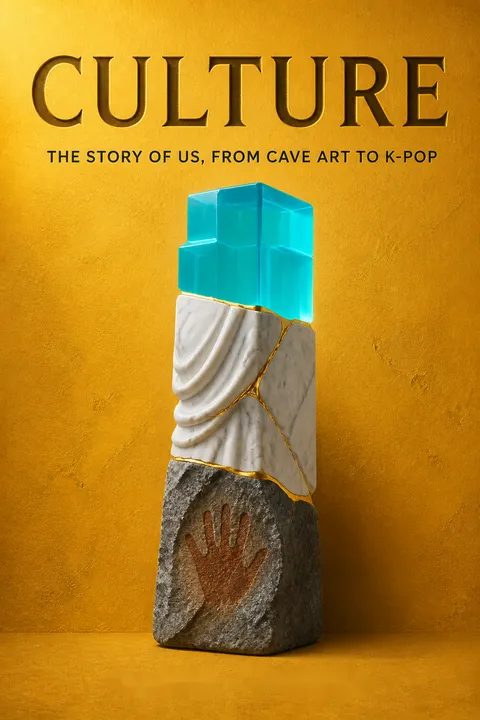
Culture: The Story of Us argues that human culture is neither a collection of sealed traditions nor a smooth march of progress. It is a fragile, cumulative process: people store meanings in images, texts, buildings, rituals, and institutions, then lose, misread, recover, and reuse them. The book’s wide-ranging episodes make that process tangible. A pillar can survive while its script disappears. A conquered literature can become a conqueror’s inheritance. An idea issued in the language of universal rights can be turned against the society that first restricted it.
The book’s strongest contribution is its insistence that cultural history requires more than tracing influence. It asks what happens during transmission: who carries a form, what changes in transit, and what new work it enables. This approach corrects histories that treat European culture as self-generated or presume that the victor dictates the cultural result. It also broadens the humanities beyond elite masterpieces to include oral memory, popular print, performance, and practices that acquire meaning through use.
A necessary caution follows from the same argument. If circulation is treated as culture’s natural condition, it can blur the distinction between creative borrowing and extraction. The book repeatedly shows that cultural exchange unfolds under unequal power, but readers should retain that distinction when applying its thesis. A society’s capacity to adapt an import does not make the conditions of its arrival fair. Nor does shared human inheritance eliminate the claims of communities whose objects and traditions were taken without consent.
The resulting account is not a defense of purity or a celebration of mixture for its own sake. It is a call to judge cultural contact by its histories and consequences, while resisting the fantasy that any society can thrive by cutting itself off from all external influence. The humanities matter here because they teach people to interpret fragments, expose the politics of memory, and make inherited materials answer present questions. Their work is not to freeze the past, but to keep its meanings available for argument, revision, and creation.
Review Summary
Culture: The Story of Us, From Cave Art to K-Pop explores how human cultures develop, borrow, and influence each other throughout history. Reviewers praised Puchner's engaging writing and fascinating examples, though some felt it lacked depth or oversold its premise. Many appreciated the book's global perspective and its argument against cultural purity. Critics noted its accessibility for general readers but potential disappointment for experts. Overall, reviewers found it an enlightening, thought-provoking look at cultural transmission and evolution, with most rating it positively despite some reservations.
Glossary
know-how
practical knowledge and skillThe practical knowledge humans use to understand and shape the world, including making tools, cultivating crops, and developing technologies. In the book, know-how is transmitted across generations through teaching, memory, and institutions. It is distinguished from know-why, which concerns the stories, rituals, and ideas people use to make existence meaningful.
know-why
meaning-making knowledgeThe ideas, stories, symbols, and rituals through which people interpret existence and their place in the world. Puchner uses the term to distinguish meaning-making from practical knowledge, or know-how. The distinction is not absolute: art and religion, for example, can help people orient themselves while relying on cultural techniques and institutions that preserve knowledge.
cultural graft
adopting and reshaping another cultureA process in which a society adopts cultural forms from another society and makes them part of its own traditions. Rome’s adoption of Greek literature and theater is a central example: Roman writers translated and adapted Greek models rather than merely reproducing them. A cultural graft can generate new work, while also raising anxieties about dependence, identity, and originality.
Storehouse of Wisdom
Baghdad’s translation and learning projectThe name associated with the Abbasid-era effort in Baghdad to collect, translate, and organize knowledge from different traditions. Greek, Persian, and Indian works entered Arabic intellectual life, alongside literature, mathematics, astronomy, and medicine. The phrase represents not only a place or library, but an approach to learning that treated foreign and earlier knowledge as useful resources.
summa
organized synthesis of knowledgeA comprehensive work that gathers and arranges knowledge into an intelligible system. Ibn Sina’s philosophical writing exemplifies the form: it organizes inherited thought, especially Aristotle, while adapting it to new questions and intellectual settings. In the book, the summa responds to the challenge of managing a growing body of translated and collected knowledge.
philology
historical study of textsThe close study of language and written documents to determine how, when, and where texts were produced, and how they changed in copying. Renaissance scholars used philology to compare versions and expose later additions or forgeries, as Lorenzo Valla did with the Donation of Constantine. The method helped establish a critical approach to cultural evidence.
historiography
evidence-based study of the pastThe systematic study and writing of history through evidence, tested interpretations, and attention to change over time. Puchner presents nineteenth-century historiography as a distinct method for reconstructing a past increasingly understood as different from the present. Its methods expanded historical knowledge, even as its practitioners could carry colonial assumptions about progress and civilization.
ukiyo-e
Japanese floating-world printsA Japanese commercial art form associated with the entertainment districts of Edo. Ukiyo-e prints depicted actors, performers, wrestlers, and other subjects using carved woodblocks, often in multiple colors. Their reproducibility made them accessible to broad audiences. Hokusai’s Great Wave became globally famous, although this popular print tradition was distinct from older ideals of Japanese painting.
Renaissance
recovery and reuse of the pastA term commonly used for the revival of classical learning in Italy, but which Puchner applies more broadly to repeated acts of cultural recovery and reuse. The Italian Renaissance was not an isolated rebirth: it built on earlier revivals and knowledge transmitted through other societies. The term therefore describes a recurring pattern, not a uniquely European return to antiquity.
About the Author
Other books by Martin Puchner
Download PDF
Download EPUB
.epub digital book format is ideal for reading ebooks on phones, tablets, and e-readers.








