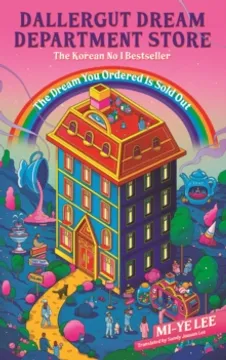


Plot Summary
Prologue
Penny, a local who hopes to work at the celebrated Dallergut Dream Department Store, studies the city’s founding story before her interview. The tale follows three disciples who choose the future, the past, and sleep; the Time God gives the third disciple the task of making people dream, so sleep can steady them between memory and possibility.
When Dallergut asks Penny why she wants to work for him, she argues that dreams should support waking life rather than replace it. Her answer earns her a job, and the city’s old myth becomes the first clue to how its dream trade works.
The founding myth functions as more than charming lore: it supplies the book’s psychological model. A person trapped in the future loses the past that gives ambition meaning; a person clinging to the past cannot tolerate change. Sleep offers neither escape nor a solution imposed from outside. Instead, it gives people a temporary space in which feelings can be reorganized. Penny’s interview answer shows that she already senses this distinction, even before she understands the store’s methods. Her new job begins with a useful tension: she believes dreams matter, but also insists that waking life must remain their measure.
Penny Claims the Front Desk
Penny arrives late on her first morning and finds the store nearly overwhelmed by customers. Weather, the veteran first-floor manager, pulls her behind the counter before showing her the five floors. Each manager offers a different lesson: Vigo Myers refuses to sell a dream to a distracted customer, Mogberry complains about the Leprechauns’ stock, Speedo overwhelms customers with sales pitches, and Penny’s old friend Motail hawks discounted leftovers.
Unsure where she fits, Penny overhears Weather telling Dallergut that the front desk needs another worker. She volunteers for it instead of choosing a floor. Weather accepts, and Penny begins learning the inventory, payment system, and Eyelid Scales that track regular customers’ sleep.
Penny’s choice is practical rather than glamorous, and that choice defines her way of entering the dream trade. She does not chase a prestigious floor or a famous manager; she notices an exhausted colleague and offers help. The tour also establishes that the store’s ethics are operational, not decorative. Myers protects customers from buying in the wrong state, while Motail treats the same shelves as opportunities for clever sales. By selecting the front desk, Penny places herself where these competing values meet: she must learn both how dreams are sold and when selling should stop.
Orders After Closing
On the day the store sells out, Penny expects to leave with the other employees. Instead, several regulars arrive with swollen eyes, unable to sleep after difficult days. One is trying to understand the pain of a recent breakup; another has been struck by grief for a sister who died when the customer was young.
A would-be writer fears she has no talent, while a seventy-year-old sorting through old photographs feels the cruelty of time passing. Dallergut gives them Deep Sleep Candy, listens, and records what each person needs from a dream.
He cannot promise an instant cure. He tells them that deep sleep is the only thing they must do while he prepares their orders, and Penny sees that the store’s work begins with attention, not merchandise.
This after-hours scene changes Penny’s understanding of the counter. The customers do not arrive as a market segment with predictable tastes; they arrive carrying experiences they cannot yet arrange into a story. Dallergut’s careful listening does not erase their distress or claim authority over it. It gives each person a way to ask for help without having to turn pain into a polished explanation. The scene also introduces the book’s central limit: a dream can create an encounter or shift perspective, but the sleeper must still do the waking work.
A Bottle of Flutter
A month into the job, Weather falls ill and sends Penny to deposit two bottles of dream payment. At the bank, a friendly stranger offers to help, then vanishes with one bottle of Flutter, a rare emotion with a high market price.
Penny returns with the other bottle, ashamed, but Dallergut says he can use it. Regular No. 201 has been buying Meeting Your Crush, and the dreams help Ah-young recognize her feelings for Jong-seok, a vendor who visits her office.
Meanwhile, Jong-seok keeps buying dreams about his former girlfriend, though he no longer feels attached to her. Dallergut gives him the remaining Flutter, and Jong-seok leaves newly open to starting again. Ah-young later sends him a message, turning her private longing into a real invitation.
The stolen bottle first makes emotion look like a commodity: it has a price, a container, and a vulnerable point of exchange. Dallergut’s use of the remaining Flutter complicates that image. He does not spend it to intensify a fantasy, but to help a customer stop mistaking an old attachment for a current one. Ah-young’s dream does not manufacture love; it gives her enough confidence to recognize it and act. The paired stories make the shop’s ethics concrete: dreams may illuminate a feeling, but a relationship only begins when someone risks a waking choice.
Babynap’s Future Fragments
When Babynap Rockabye, a celebrated maker of conception dreams, visits the store, she brings leftover dreams created from glimpses of future births. Penny learns that Rockabye descends from the disciple associated with the future, but these dreams show only brief, ordinary moments.
Dallergut turns away customers seeking lottery numbers or certainty about their lives. He instead offers a dream to Na-rim, an aspiring screenwriter who dislikes knowing what comes next.
Afterward, Na-rim experiences déjà vu while her friend Ah-young receives a call from her new boyfriend. The unexpected recognition gives Na-rim a story idea for a romantic screenplay. Customers begin paying for the dreams with Wonder and Curiosity, while Penny’s own curiosity about predicting the future grows.
Rockabye’s dreams expose the difference between foreknowledge and useful knowledge. Customers want a future they can control, but the product offers fragments too mundane to serve as instructions. Dallergut’s selective selling protects the dream from becoming a tool for certainty. Na-rim’s response is more revealing: because she resists prediction, the small glimpse becomes material for creativity rather than a verdict on her fate. The episode positions Penny at a similar threshold. She is tempted to treat mystery as a technique she might master, while Dallergut keeps redirecting her toward what people do with the present.
Maxim’s Unwelcome Dreams
Maxim’s Overcoming Trauma dreams provoke an angry crowd at the store. Customers have repeatedly dreamed of military reenlistment or school exams and demand refunds for the distress.
Dallergut brings them to a private room, shows them their signed purchase agreements, and explains that the dream is meant to help them face an old fear, not simply suffer it again. Half choose to cancel; the rest decide to continue, supported by his assurance that they can return if the process becomes too much.
Later, a former soldier sees his recurring army dream as proof that he survived, while a former high-achieving student loosens the pressure she still places on herself. Their payments arrive as Confidence and Self-Esteem. Penny then meets Maxim and recognizes the care behind his frightening craft.
The disagreement over Maxim’s product is not resolved by declaring that discomfort is secretly good. Customers retain the right to stop, and half do. That choice matters because therapeutic language can become coercive when it treats suffering as a necessary price of improvement. The customers who continue do so after hearing the terms and considering their own limits. Their eventual payments register changed self-understanding, not obedience to the seller. Penny’s encounter with Maxim completes her lesson: the maker’s intentions matter, but the meaning of a dream ultimately depends on what the sleeper can take from it.
The No-Show Problem
Penny accompanies Dallergut to the annual gathering of dreammakers at Nicholas’s snowy mountain home. The industry’s no-show losses have grown as customers stay awake for work, exams, games, and entertainment.
The Leprechauns propose offsetting lost sales with paralysis dreams, which earn stronger payments when sleepers wake relieved to move again. Dallergut recognizes that they have mislabelled products to exploit that reaction and threatens to cancel their contract if they continue. Instead of fining sellers for customers’ missed pickups, he asks the makers to consider why people postpone sleep.
Their conclusion is that dreams must become more compelling than the activities keeping customers awake. The gathering ends without a technical fix, but the problem shifts from customer blame to the industry’s own responsibility.
The meeting translates the book’s gentle dream economy into a debate about incentives. The Leprechauns understand the payment mechanism well enough to manipulate it, but their strategy mistakes a stronger emotional rebound for a better experience. Dallergut’s anger marks a boundary: a seller cannot engineer distress and then claim credit for relief. His answer to the no-show problem is deliberately modest. The store cannot force people to sleep, so the industry must make its offering worth choosing. The scene treats commercial success as an ethical design question, not merely a matter of maximizing sales.
Christmas Belongs to Nicholas
In December, Santa Claus, known in the village as Nicholas, floods the store with Christmas dreams, and Penny helps a worried child understand why adults use bedtime stories to get children to sleep. After the holiday rush, sales fall as tired customers seek rest rather than elaborate dreams.
Animora Bancho arrives with new animal dreams, including Taking a Walk for Leo, an old dog whose family has stayed out late. That night, Leo dreams of running; his returning family finds him asleep with his legs moving and takes him for a real walk.
Bancho’s attention to animals has turned a modest product into an emotional bridge between pet and family. Penny begins to understand why Dallergut expects Bancho, rather than Nicholas, to challenge the season’s bestselling record.
The Christmas episode places two kinds of care side by side. Nicholas’s success depends on a vast seasonal system that helps children and households coordinate sleep, while Bancho works from close observation of individual animals. Leo’s dream does not substitute for the walk he wants; it makes his longing visible to the family when they return. The dream’s value appears in the waking response it prompts. Bancho’s likely commercial success therefore grows from the same quality that makes his work ethically persuasive: he attends to the particular creature in front of him rather than treating animals as a marginal market.
Bancho Takes the Bestseller
At the year-end awards, the store staff watch together as Animora Bancho wins the December Bestseller prize, ending Nicholas’s long run. Bancho thanks the animal customers who made his work possible, then credits Nicholas for supporting him with food and firewood while he lived in the mountains.
The ceremony’s Grand Prix goes to Kick Slumber for a dream of flying as an eagle. Slumber, who uses crutches because one leg is shorter, explains how repeated attempts to perfect the dream shaped his understanding of freedom as limited but still reachable.
He also thanks Wawa Sleepland for creating its landscapes and names her as his partner. Penny celebrates with her coworkers as the store welcomes the new year, feeling part of the community she once hoped merely to enter.
The awards turn the dream economy into a visible community of dependence. Bancho’s public recognition rests on customers, a seller willing to stock his work, and Nicholas’s unadvertised material help. Slumber’s account of freedom avoids the fantasy that dreams erase bodily limits. His achievement comes from working within those limits without letting them dictate every possibility. Penny’s place in the crowd matters too: she is no longer only an applicant measuring herself against the store’s prestige. She belongs through daily acts of service and shared celebration, a quieter achievement than an award but central to her emotional development.
Sleep Gives the Song Shape
A struggling singer stays awake for two days trying to write a song for an audition. After reading about famous ideas that supposedly arrived in dreams, he visits the store demanding an inspiration dream, but Penny and the floor managers find no such product. Dallergut gives him Sleep Candy instead.
Once the singer finally rests, the melodies he has been laboring over fall into order, and he completes a song from his own experience. The audition goes well, and he returns to thank Dallergut, who explains that sleep helped organize work the singer had already done. The singer agrees to let Dallergut use his story as source material for a new dream line, Lives of Others.
The singer’s breakthrough revises the romance of sudden inspiration. He wants an external object that will deliver talent, but Dallergut offers the less dramatic condition his exhausted mind lacks: sleep. The resulting song is not a gift from nowhere; it emerges from effort that had become inaccessible under fatigue. This distinction preserves the singer’s agency while recognizing the body’s role in creative thought. His agreement to share his story also converts a private struggle into material for another customer, setting up a later question about how empathy works when people briefly inhabit lives unlike their own.
Fifteen Minutes as Do-hyun
Yasnoozz Otra builds the trial version of Lives of Others from the singer’s account of obscurity and creative frustration. Dallergut offers it to a different customer, an office worker who feels his routine life is dull after watching the newly famous singer Do-hyun Park on television.
The dream lasts only fifteen minutes of sleep, yet lets the customer experience fifteen days of Do-hyun’s cramped room, stalled music, unemployment, and guilt toward his family.
When he wakes, the singer’s success no longer looks effortless; the customer recognizes the years of difficulty beneath it and sees his own surroundings in a warmer light. The dream’s payment has not yet arrived, so Penny and Dallergut wait to learn whether the new perspective will last.
The dream does not simply teach the customer to be grateful or to abandon ambition. By placing him inside Do-hyun’s difficult years, it interrupts the comparison that had made celebrity look like proof of a superior life. The customer’s ordinary circumstances remain unchanged, but they become newly legible because he has encountered the labor and uncertainty hidden behind another person’s success. The unresolved payment is structurally important: insight is not treated as an instant transaction. Dallergut waits for the customer’s feelings to settle, allowing emotional meaning to emerge on the sleeper’s own timetable.
Dreams Left for the Living
A frail woman orders custom dreams for her husband, daughter, and parents, choosing ordinary family talk and a forest filled with white zinnias. Penny understands that the hospital-clad customer is preparing a final message, though the dreams will be delivered later.
Separately, Dallergut entrusts Penny with two carefully preserved Doje dreams for grieving customers. A man meets his late grandmother in a café and hears how she remembers her life; a couple meet their five-year-old daughter, who died after an illness, and share memories without pretending their grief has vanished.
The man wakes crying, while the couple lie awake holding hands. As Penny helps sort the old dream boxes, she tells Dallergut she loves her work and prepares a new Eyelid Scale for a regular.
These encounters distinguish remembrance from denial. The grandmother and child do not return to undo death or offer the living a permanent refuge; they give the bereaved a meeting that can be carried back into waking life. The couple remain sad, but they are no longer alone with separate grief. Penny’s work with the dying customer’s order adds another form of care: shaping a message around the routines that made a family intimate. By ending with Penny tending an Eyelid Scale, the novel brings its largest feelings back to a small, practical act of welcome.
Epilogue
The first epilogue reveals why Vigo Myers was expelled from college: while making a graduation dream for a lucid dreamer he loved, he placed himself inside it and broke a strict professional rule. Dallergut hires him anyway, keeping the explanation private and urging him to stay ready in case she returns.
In the second epilogue, Speedo’s carefully scheduled day off collides with a bank queue. He reports a suspicious man who is trying to steal queue tickets from elderly customers. The man’s arrest exposes a pickpocketing ring, and police recover stolen dream goods, including the Flutter bottle taken from Penny. Speedo never learns that his small intervention helped solve the earlier theft.
The two epilogues reward close attention to characters whom the main story first presents through their habits. Vigo’s immaculate floor management grows out of a past mistake and an attachment he has never resolved; Dallergut’s hiring decision gives him work without pretending that the rule he broke did not matter. Speedo’s efficiency, often comic or abrasive, becomes useful when he notices a pattern others might ignore. The recovered Flutter closes a practical loop opened by Penny’s early failure, but the resolution is incidental rather than heroic. Together, the endings suggest that people’s less attractive traits can coexist with loyalty, vulnerability, and unexpected forms of care.
Analysis
The novel treats dreams as a form of emotional infrastructure. Its fantasy economy makes that idea literal: feelings become payment, sleep is monitored, and dreammakers shape experiences that can alter a customer’s next waking choice. Yet the store’s most important resource is not its inventory or payment software. It is judgment. Dallergut screens customers, Maxim offers dreams that some sleepers refuse, and Rockabye’s future glimpses are kept from people who want certainty more than understanding. Each decision recognizes that a dream can affect someone without giving the seller control over what the experience means.
Penny’s development gives this system a human measure. She begins by believing that knowledge, preparation, and the right answer might secure her place. Her early blunders, from navigating the bank to judging which customer should buy a dream, expose how little can be solved by memorization. She grows by noticing consequences: Ah-young’s dream leads toward a real invitation, a former soldier changes how he interprets his fear, and Leo’s dream makes his family see what he still wants. In each case, the dream matters because it returns the sleeper to a relationship or decision beyond the dream.
The stories also resist two comforting simplifications. First, painful memories cannot always be erased; the bereaved couple’s grief remains even after they meet their daughter again. Second, accepting one’s life is not presented as a substitute for changing it. The customer who experiences Do-hyun’s years of obscurity sees fame differently, but the book leaves his response open. What it offers instead is a method of attention: look more closely at another person’s hidden effort, one’s own unfinished feelings, and the ordinary routines that make love recognizable. The store’s warmth comes from these acts of recognition, not from promising that sleep can repair everything.
Review Summary
Characters
Penny
The curious new clerkPenny is a local who wins a coveted job at the Dallergut Dream Department Store despite doubting her own competence. She is observant, earnest, and prone to anxious overthinking; her curiosity often makes her ask the question other employees have learned to leave alone. Rather than presenting herself as an expert, she learns through mistakes, close attention to customers, and the contrasting habits of the floor managers. Her work at the front desk brings her into contact with both the store’s elaborate systems and the private feelings those systems serve. Penny’s central motivation is to become useful without losing her humane instinct to notice what a customer may need.
Dallergut
The patient storekeeperDallergut runs the city’s best-known dream department store and carries the authority of a family lineage tied to its founding myth. He is gentle but not sentimental: he screens customers, protects dreammakers’ work, and accepts that some people should cancel difficult purchases. He dislikes technology, hoards old dream boxes, and uses humor to soften encounters without trivializing them. His experience allows him to recognize when a customer’s request conceals a different need, though he rarely explains the answer immediately. Dallergut’s guiding belief is that a dream should help people return to reality with more room to act, not keep them dependent on the store.
Weather
The veteran floor managerWeather manages the first floor and has worked alongside Dallergut for decades. She is practical, quick-witted, and fiercely capable under pressure, though the store’s workload leaves her visibly exhausted. She understands the regular customers as people with histories, not simply as numbered accounts, and she balances Dallergut’s intuitive methods with hands-on knowledge of inventory and payments. Her warmth toward Penny makes the newcomer’s transition easier, while her firm competence reveals how much invisible labor keeps the dream store running.
Assam
Penny’s furry local friendAssam is a Noctiluca, one of the furry workers who lends sleepwear to customers who arrive without pajamas. He is a longtime friend of Penny’s and a devoted fan of dreammaker Kick Slumber. Assam gives Penny the old book about the Time God and the three disciples, helping her prepare for her interview. His local knowledge and easy pride in his work make him an early guide to the city, while his practical job connects the fantastical dream trade to the small comforts of getting ready for sleep.
Vigo Myers
The exacting second-floor managerVigo manages the store’s orderly second floor and takes dreams seriously as both a science and a craft. His expertise makes him cautious about selling to customers who are distracted or unready, but his pride can make him condescending toward newcomers. He values precision, credentials, and control, qualities that help him curate a reliable department while also shielding a more vulnerable inner life. His difficult manner is not simple coldness: he is someone who learned to organize the work more easily than to speak about himself.
Mogberry
The animated third-floor managerMogberry oversees the colorful third floor, where customers shop for active, social, and romantic dreams. She is lively and youthful in manner, but decisive when a product or business practice threatens customers. Her open irritation with the Leprechauns’ sales tactics contrasts with her generous enthusiasm for dreammakers’ work. Mogberry brings a protective streak to an otherwise playful department and is willing to challenge colleagues when profit begins to outweigh product quality.
Speedo
The tireless nap managerSpeedo runs the fourth floor, which serves babies, animals, and other customers who need short naps. He talks quickly, pitches aggressively, and can exhaust both customers and coworkers, yet he is exceptionally fast and reliable at operational work. His worldview is built around careful scheduling and avoiding wasted time. Beneath the bluster is a practical intelligence that notices details others miss, especially when a plan or routine is threatened.
Motail
The opportunistic fifth-floor sellerMotail, Penny’s old school friend, works among the discounted and expired dreams on the fifth floor. He is energetic, theatrical, and naturally skilled at making overlooked merchandise sound desirable. His willingness to bend the rules makes him a risky colleague, but his instincts for what customers might love are unusually sharp. Motail represents the store’s less formal, more improvisational side, where a product can find new value after the rest of the building has rejected it.
Ah-young
The hesitant regular customerAh-young is a twenty-eight-year-old office worker and longtime customer who feels unsure how adult romance begins. Her dreams about a vendor she sees at work help her recognize feelings she has been trying to dismiss. She is conscientious and cautious, aware that a crush can remain one-sided and that private fantasy is not the same as mutual intimacy. Ah-young’s story shows how a dream can clarify desire without deciding what the dreamer should do with it.
Jong-seok
The careful office visitorJong-seok is a vendor who visits Ah-young’s workplace and becomes a focus of her growing affection. He is professional and dependable, but privately unsettled by recurring dreams of an ex-girlfriend. His discomfort reflects a common uncertainty: whether an old memory signals unresolved love or simply belongs to the past. Jong-seok’s story gives Ah-young’s romantic hopes a real person to meet, rather than leaving them inside the dream.
Na-rim
The aspiring screenwriterNa-rim works part-time at a cinema while trying to write a screenplay. She watches people closely and collects scraps of ordinary behavior, but struggles to turn observation into a story that feels alive. Her skepticism about foreknowledge protects her from treating a prediction as a guarantee. Na-rim’s creative instincts respond instead to an unexpected moment of recognition, showing how she transforms daily details into narrative material.
Maxim
The guarded nightmare makerMaxim makes vivid, frightening dreams in a dark back-alley studio. His work draws on the fears people would rather avoid, and he worries that such dreams may be useless or unwelcome. Although his workspace and products seem intimidating, he is polite, self-conscious, and receptive to honest criticism. Maxim’s craft is shaped by a protective impulse: he wants sleepers to be more prepared for hardship, even when he doubts that this intention is enough.
Babynap Rockabye
The maker of future glimpsesBabynap Rockabye is an acclaimed dreammaker known for conception dreams and a warm, grandmotherly manner. Her work depends on brief impressions of future births, not on choosing a future or guaranteeing an outcome. She is modest about her products despite their reputation and entrusts their sale to Dallergut, whose judgment she trusts. Rockabye’s presence links the city’s founding myth to the uncertain, everyday beginnings of new life.
Yasnoozz Otra
The lives-of-others creatorYasnoozz Otra is one of the industry’s most celebrated dreammakers, known for long dreams that let customers experience another person’s life. She is fashionable, exacting, and thoughtful about the emotional problem behind a commission. Her work is expensive and does not always sell as readily as its acclaim suggests. Otra cares about the distance between a striking concept and a dream that can genuinely help the person who experiences it.
Wawa Sleepland
The landscape dreammakerWawa Sleepland creates immersive scenery celebrated for its color, atmosphere, and visual detail. She is admired by Penny and respected by the other dreammakers, though she remains modest in public. Her landscapes support Otra’s work and show how dreammaking can involve collaboration between distinct artistic talents. Sleepland’s prominence makes her a source of wonder for Penny, who is discovering that the famous figures of her childhood are also working professionals.
Animora Bancho
The animal dreammakerAnimora Bancho makes dreams for animals and lives simply in the mountains with the creatures he cares for. He is generous, unassuming, and more interested in his animal customers’ comfort than in money or status. His ability to attend closely to their behavior informs his work, while his lack of commercial ambition leaves him dependent on sellers who believe in the value of his products. Bancho’s quiet devotion contrasts with the glamour surrounding other famous dreammakers.
Nicholas
The seasonal Santa dreammakerNicholas, known to customers as Santa Claus, specializes in Christmas dreams and works intensely during the season. He is generous with food and practical help, but also proud of his commercial success and fond of an elaborate home in the snow. His annual rhythm is a reminder that dreammaking can be seasonal labor rather than constant public visibility. Nicholas combines showmanship with genuine affection for children and fellow makers.
Kick Slumber
The award-winning eagle dreammakerKick Slumber is a celebrated dreammaker whose animal dreams allow human customers to experience forms of movement beyond ordinary life. He uses crutches because one leg is shorter, and his work reflects an understanding that freedom takes different forms for different bodies. Slumber is disciplined and persistent, willing to refine a dream through repeated effort. His public success rests on both his technical craft and the personal meaning he brings to it.
Doje
The reclusive dreammakerDoje is a famously private dreammaker whose preserved works include dreams of meeting the dead. He avoids public events and lives far from the city, giving his old products an air of mystery. His craft offers a careful fictional encounter with a lost person.
Plot Devices
The Dallergut Dream Department Store
Dreams sold before sleepThe store is a five-floor marketplace visited by customers as they fall asleep. Each floor specializes in a different kind of dream, from everyday memories to active adventures and naps. Customers usually cannot remember entering the store, so they interpret the dream as a product of their own minds. This arrangement lets the novel move between Penny’s work life and individual customers’ private experiences. It also gives Dallergut a setting in which he must balance inventory, business agreements, artistic judgment, and care for people whose requests may change once they wake.
Emotion as payment
Feelings settle the accountCustomers do not pay in advance with ordinary money. After dreaming, a portion of the emotion they feel becomes the payment, which the store tracks and collects through its dream-payment system. This makes the value of a product dependent on the sleeper’s response rather than its price tag alone. The mechanism allows a small dream to matter greatly to one person and a prestigious product to yield little if it produces no feeling. It also makes ethical selling essential: a seller must consider what a dream may stir up, not only how many boxes leave the shelf.
Eyelid Scales
A citywide sleep forecastThe scales behind the first-floor counter track regular customers’ likely sleep and visiting patterns. Their eyelid-shaped pendulums move through states of wakefulness and sleep, allowing staff to anticipate when familiar customers may appear. The scales give the store a practical way to manage a continuous flow of visitors across time zones, but they also make regulars feel individually known. Weather remembers how particular customers’ sleep changes as they age, and Dallergut warns Penny not to interfere with someone who may need to stay awake. The device turns routine observation into a quiet form of care.
Precognitive dream leftovers
The future arrives in fragmentsBabynap Rockabye’s conception dreams are made from brief impressions of future births. Her leftover products still contain small, sometimes mundane glimpses, but they cannot provide a chosen outcome or a reliable prediction. Dallergut therefore refuses customers who want to use them for lottery numbers or fixed answers and looks for sleepers with no demand for certainty. The device tests the difference between seeing something and knowing what it means. A fragment can become a source of creativity or recognition, but its value depends on the dreamer’s response after waking.
Custom and preserved dreams
Memory shaped for a sleeperSome dreams are made to order around a customer’s fear, a loved one, or a particular emotional need. Maxim’s trauma dreams repeat difficult situations under agreed conditions, while Doje’s old works offer encounters with the dead. Wawa Sleepland’s landscapes can also be incorporated into a custom commission. These products make the store more than a retailer of standard packages: Dallergut listens, records details, and considers when a dream should be delivered. Their different forms preserve the book’s central uncertainty, since no dream can dictate what a sleeper will feel or what they will choose to remember.
Download PDF
Download EPUB
.epub digital book format is ideal for reading ebooks on phones, tablets, and e-readers.








