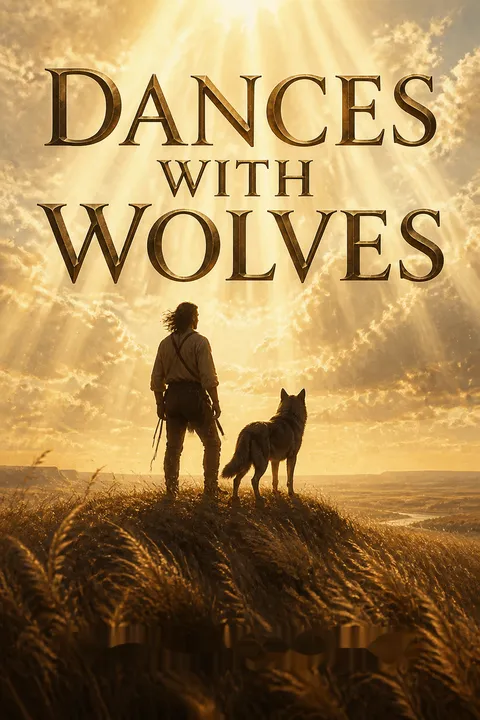


Plot Summary
The Frontier by Accident
During the Civil War, Lieutenant John Dunbar, wounded and desperate enough to invite enemy fire, rides across a battlefield on a buckskin horse named Cisco. His reckless charge helps break the standoff, and a grateful general offers him a post on the frontier. Dunbar chooses the distant Fort Sedgewick, drawn by a country he has never seen.
His orders are hastily written by Major Fambrough, a drunken officer whose mind is failing; the paperwork is misspelled, undated, and nearly illegible. Teamster Timmons carries Dunbar and his supplies west. On the trail, they find a skeleton pierced with arrows, a warning that the open prairie is not empty, even as Dunbar feels he has finally reached the life he wants.
Dunbar’s new life begins through a contradiction: the act that wins him a future is also an attempted death. His superiors read his ride as courage, while he knows it came from despair. The frontier posting therefore offers more than escape from the army’s routines. It gives him a place where his survival might acquire a meaning he did not choose for himself. Fambrough’s defective orders also make the assignment fragile from the start, tying Dunbar’s private reinvention to an institution already losing track of him.
Fort Sedgewick Stands Empty
While Dunbar travels toward Fort Sedgewick, Captain Cargill leads its starving remnant back toward Fort Hays. Comanche raids have taken the garrison’s horses, supplies have run out, and thirty-three soldiers have deserted; only eighteen remain. Cargill finally orders them to leave. He reaches Fort Hays, where the men praise his leadership and the army promotes him rather than punishing him.
The order to supply Sedgewick came from Fambrough, who has since been removed after a breakdown, so no one realizes Dunbar is heading there. When Dunbar and Timmons arrive, the post is abandoned. Dunbar refuses to turn back, makes Timmons unload the provisions, and accepts the ruined fort as his command, though no one is there to recognize it.
The fort’s abandonment turns a military assignment into a test of Dunbar’s own reasons for going west. His sense of duty is real, but it cannot explain why he stays when the post has no men, command structure, or functioning buildings. The army’s praise of Cargill while overlooking Dunbar exposes the gap between official record and lived experience: a successful report can matter more than the person actually left behind. Dunbar’s stubborn decision gives him room to act, but it also begins his separation from the institution that sent him.
Timmons's Last Fire
At twilight, Timmons leaves Dunbar alone at the fort and heads east with the empty wagon. The next morning, hungry after the journey, he lights a conspicuous fire. Six Pawnee raiders find him, kill him, take the horses and supplies they can carry, and burn the wagon. Dunbar does not know what has happened.
He spends his first days clearing garbage from the stream, improving the hut, and trying to invent duties for himself. A towering smoke column from the rubbish he burns makes the fort visible across the prairie, but no one comes. The growing quiet unsettles him. A gray wolf with white forepaws appears across the river, watches Dunbar, and returns often enough for him to give it the name Two Socks.
Timmons’s death removes Dunbar’s last human link to the route back east, while the missing wagon and horses leave him practically isolated. The fire he builds out of hunger is an ordinary mistake with lethal consequences, a reminder that the prairie’s apparent openness does not make its risks easy to read. Dunbar responds by cleaning and repairing the fort, converting helplessness into work. Two Socks offers a different kind of company: not rescue or conversation, but a repeated, voluntary presence that begins to loosen Dunbar’s fear of being alone.
The Naked Diplomat
Dunbar’s solitary routine is interrupted when Kicking Bird, a Comanche medicine man, rides to inspect the deserted fort. Dunbar is naked at the stream washing his clothes; when he returns, he surprises Kicking Bird beside Cisco. The startled Comanche bolts back to camp, convinced the strange white figure may mean something beyond an ordinary soldier.
The story unsettles the band, but its next test is practical: three boys steal Cisco, and the horse breaks away and returns. Later, warrior Wind In His Hair leads men to take him again. Dunbar stands his ground when Wind In His Hair charges close, and Cisco escapes once more. The failed raids leave the Comanches less certain that Dunbar is simply helpless or easily frightened.
The laundry encounter reverses the familiar pattern of who observes whom. Dunbar sees himself as a solitary soldier performing a mundane chore; Kicking Bird encounters a startling, unclassifiable figure and must fit him into Comanche knowledge. The horse raids then replace speculation with evidence. Cisco’s repeated returns suggest a bond the Comanches cannot explain, while Dunbar’s composure complicates their image of a vulnerable white man. Neither side has enough shared language to interpret the other accurately, so bodily gestures and consequences become their first means of understanding.
The Woman in the Grass
After learning that the Comanches are nearby, Dunbar rides out in full uniform carrying a flag, hoping to make a strong impression. Instead, he finds Stands With A Fist, a Comanche woman grieving her husband, who has taken a knife to herself during a solitary mourning ritual.
Dunbar uses part of his flag and his clothing to bind her wounds, then carries her on Cisco to the Comanche camp. The villagers panic at the sight of a white soldier, and Wind In His Hair takes Stands With A Fist from Dunbar without welcoming him. Dunbar rides back alone, devastated by their rejection. His good deed has returned one of their own, but he has not yet earned their trust.
Dunbar’s first deliberate approach fails as a performance of authority: polished uniform, flag, and military bearing cannot make the Comanches see him as a safe visitor. What changes the encounter is not his appearance but his care for Stands With A Fist. Yet even that act does not obligate the village to trust him, and the roughness with which she is reclaimed underscores how little control he has over the meaning of his gesture. His lonely return marks a painful shift from imagining contact to confronting another community’s boundaries.
Coffee Opens the Door
After discussing Dunbar’s return of Stands With A Fist, Ten Bears, the Comanche leader, sends Kicking Bird and Wind In His Hair to meet him peacefully. Dunbar welcomes them with coffee, using a grinder and sugar to make hospitality legible without shared speech. On a later visit to the village, Kicking Bird asks Stands With A Fist to help translate.
She initially recoils when Dunbar stands too quickly, but then retrieves simple English words and recognizes that he wants only to greet her. Kicking Bird’s plan gives her a new role: she will help him understand the white soldier. Dunbar begins learning Comanche, and the visitors return to the fort with the first fragile signs of mutual curiosity.
Hospitality here is not a universal code. Dunbar’s coffee is both an offer and an unfamiliar process, so the guests must infer its meaning before accepting it. The translation arrangement shifts the balance again: Stands With A Fist is not merely the subject of Dunbar’s concern but the person who can shape what he understands. Kicking Bird’s diplomacy depends on her skill, even as her fear makes the task costly. Their emerging relationship begins through acts of interpretation, with uncertainty acknowledged rather than magically erased.
The Buffalo Return
A distant brown haze that Dunbar mistakes for a prairie fire comes from the Comanche campfires of a band returning to its summer grounds. Their food is running short, and scouts have found almost no buffalo. When the herd finally thunders past the fort at night, Dunbar rides toward the village to share the news.
He arrives during a sacred dance, loses control of Cisco, and crashes into the gathering. The warriors knock him down before Kicking Bird recognizes that Dunbar is trying to announce the buffalo. The camp’s fear becomes celebration. Dunbar is welcomed into the group, not because he has mastered their customs, but because he has brought news that may keep families fed.
The buffalo’s return joins ecological survival to social belonging. Dunbar’s arrival at the dance is clumsy and dangerous, but the information he carries changes how the village receives him. His place is not secured by his uniform or by a carefully staged display of power; it emerges through a contribution the community urgently needs. The scene also makes clear that Comanche life is organized around collective dependence on the herd. Dunbar begins to understand that the land is not a backdrop to human action but a force shaping whether the community can endure.
A Celebration of Scalps
Traveling toward the buffalo grounds with the Comanche band, Dunbar crosses a killing site where white hunters have stripped hides and tongues from dozens of buffalo and left the rest to rot. The waste reminds him of a murder he witnessed as a boy. Later, returning to camp, he sees Wind In His Hair’s party celebrated with scalps taken from the white hunters who slaughtered the animals.
Dunbar cannot share the victory: he does not know whether the dead men deserved their fate, and he cannot accept the killing simply because his new companions rejoice. He slips away from the fires and sleeps alone on the prairie. In the morning, Wind In His Hair greets him without reproach, leaving room for their friendship to survive his doubt.
Dunbar’s moral discomfort prevents belonging from becoming a simple conversion story. He sees the buffalo slaughter as a crime, but the Comanche reprisal does not become uncomplicated justice in his eyes. His new community has motives and loyalties he values, yet it does not automatically share his judgments. The night alone marks the cost of that difference. Wind In His Hair’s easy greeting the next morning matters because it permits disagreement without instant expulsion. Friendship is becoming a practice of staying in relation, not a demand for identical beliefs.
A Name Earned Running
In the first buffalo hunt, Dunbar’s fast horse carries him into the stampeding herd. He fires at an animal that threatens Cisco, brings it down, and accepts a piece of its liver after Wind In His Hair presents it to him. His awkward participation delights the hunters, who share the butchering and feast with him. Dunbar gives away horses he wins in a camp game, strengthening his ties to Kicking Bird and Ten Bears.
Later, Kicking Bird watches Dunbar playfully chase Two Socks and sees a fitting name in their companionship. The Comanches begin calling the lieutenant Dances With Wolves. The name marks a new standing among them, earned through presence, generosity, and a bond with the wolf that first watched him across the river.
The hunt makes belonging physical. Dunbar cannot learn the community only by observing; he must ride into danger, make a consequential choice, and accept food within a shared ritual. His gifts of horses extend that participation beyond personal achievement. The name Kicking Bird gives him does not erase his army identity, but it offers a social description rooted in what others have seen him do. It also joins two forms of companionship, the human community that is beginning to accept him and the wolf that has accompanied his isolation.
The Bridge Learns Love
As Stands With A Fist helps Dunbar learn Comanche, she gradually remembers the English she has not spoken since childhood. She tells him how Pawnee raiders killed her settler family, how she survived capture, and how the Comanches became her home. Dunbar learns from Stone Calf that she is widowed; when he first asks her about marriage, she flees, still grieving.
Later they meet in private, admit their love, and begin a secret relationship while her mourning continues. Kicking Bird eventually releases her from widowhood, and he and Stands With A Fist marry. Their connection grows through her choice to translate and his patience with her past, not through a sudden return to the identity she once had.
Stands With A Fist’s recovered English is not a simple return to a lost self. Her childhood memories belong to a life she was forced to leave, while her Comanche identity was formed through survival, care, and chosen attachment. Translation lets her move between these histories without making either one unreal. Her love for Dunbar develops amid grief and social obligation, so the marriage depends on communal recognition as well as private desire. The novel treats language as an intimate power: she can open a past, but she decides when and how to do so.
The Warpath Refused
When a Comanche party prepares to travel against the Pawnee, Dunbar asks to join. Kicking Bird refuses: Dunbar has fought as a soldier, but he has not learned the Comanche way of war. Rather than leave him outside the community, Kicking Bird gives him a new lodge and asks him to help protect the family while the experienced warriors are away.
Stands With A Fist helps make the lodge ready. Dunbar accepts the decision, though he is disappointed, and takes part in the camp’s life as the party departs. His position changes from guest seeking permission to a man entrusted with a household, even while the war he wants to join moves beyond his reach.
Kicking Bird’s refusal separates military competence from cultural authority. Dunbar’s experience does not entitle him to a place in a Comanche war party, because the decision concerns more than fighting skill. Yet the new lodge and family responsibility are not consolation prizes. They recognize forms of service that Dunbar has not previously valued as highly as action. The choice also tests his capacity to accept a limit without interpreting it as rejection. His belonging now depends less on proving himself in combat and more on caring for people who have trusted him.
Rifles at Dawn
Kiowa survivors reach the camp with news that a large Pawnee force is approaching. With Kicking Bird and Wind In His Hair away, the Comanches face a dangerous imbalance in numbers. Dunbar remembers the rifles and ammunition he buried near Fort Sedgewick. He rides through a violent storm with Stone Calf and two others, finds the cache by its buffalo-rib marker, and returns just before dawn.
Ten Bears uses Dunbar’s advice to place riflemen behind the lodges. When the Pawnee charge through the mist, Comanche gunfire breaks their advance and the defenders drive them back. No Comanche fighters die in the battle. The victory makes Dunbar a celebrated warrior, though the returning war party had found no Pawnee and turned back after early snow.
The buried weapons convert Dunbar’s former military habits into tools for protecting his adopted community. Their use does not make him the sole author of the victory: Ten Bears listens, the warriors hold their positions, and the defense works because the camp acts together. The battle also complicates the distinction between soldier and Comanche. Dunbar applies battlefield knowledge, but his loyalty now determines whom he protects. His new status is earned through shared risk, while the absent war party’s return without a fight prevents the victory from becoming a simple tale of conquest.
A Wedding, Then Warning
After Kicking Bird and Wind In His Hair return, Kicking Bird ends Stands With A Fist’s mourning, and the Comanche community gathers horses so Dunbar can marry her. Their wedding is followed by a journey with Kicking Bird to a sacred grove. There they find felled trees, abandoned shacks, and piles of animal carcasses left by white hunters.
Dunbar tells Kicking Bird and Ten Bears about a dream in which soldiers destroy the Comanche camp. Ten Bears recalls earlier invasions and broken agreements, recognizes the danger, and orders the band to move to its winter camp. The newlyweds’ happiness is real, but their home is already threatened by the wasteful presence of people from Dunbar’s former world.
The marriage joins two personal histories, but the desecrated grove widens the story beyond private happiness. The white hunters have damaged a place held sacred by multiple peoples, and their waste anticipates an expansion that cannot be managed by goodwill alone. Dunbar’s dream turns that external threat into an image he can no longer dismiss, while Ten Bears’s memory supplies the historical pattern that the dream lacks. The decision to move is both practical and provisional: distance can buy safety, but it cannot reverse the pressure gathering around the Comanche homeland.
The Army Reclaims Dunbar
As the Comanches begin their move, Dunbar remembers that his journal and orders remain at Fort Sedgewick. He rides back for them and finds the fort occupied by soldiers. A frightened recruit shoots Cisco dead; the officers then arrest Dunbar as a suspected traitor, while the private who found his journal has hidden it.
The soldiers later taunt Dunbar with Two Socks’s dead body, and he attacks them before being chained. The Comanche band sends scouts, then Kicking Bird, Wind In His Hair, and others ambush the small escort taking Dunbar east. Dunbar fights with his chained hands and helps kill the guards. His friends free him, but he knows the army will now pursue him and may endanger the whole band.
The return of the army makes Dunbar’s old identity dangerous in a way he had hoped to outgrow. His papers should establish who he is, but a missing journal and compromised orders leave him at the mercy of officers who interpret his Comanche life as betrayal. Cisco’s death destroys the loyal partnership that carried him through both worlds, and the soldiers’ treatment of Two Socks turns his restraint into violence. The rescue restores his freedom, not his safety. His escape has created a new obligation: the army’s pursuit may follow him to the people who saved him.
Winter's Choice
The Comanches reunite at their winter camp, where Stands With A Fist runs to Dunbar as a blizzard closes in. After recovering from his injuries, he tells her he must leave because the army will hunt him and may punish the band for sheltering him. At a council, he explains that his choice to live as a Comanche makes him a traitor in army eyes.
Ten Bears rejects that logic: the soldiers may search for Lieutenant Dunbar, but they will find a Comanche husband, not the officer they seek. Dunbar stays with Stands With A Fist. The following spring the band establishes a remote camp and enjoys one more good season, though the book closes with the eastward tide of white settlement approaching.
Dunbar’s final choice is not a declaration that danger has passed; it is a decision about where responsibility lies. He would leave to protect the Comanches, but Ten Bears insists that the identity driving his fear no longer describes the person living among them. The elder’s answer gives Dunbar permission to stay without denying the army’s power or the risk it poses. The closing season offers shelter and ordinary life, not a permanent solution. Its approaching human tide leaves the personal resolution intact while refusing to pretend that the larger conflict is settled.
Analysis
Dances With Wolves is structured around a change in Dunbar’s scale of loyalty. He begins as an officer who imagines the frontier as a personal escape, but the empty fort strips away the routines that have told him who he is. Comanche relationships give him new responsibilities before they grant him easy acceptance: Kicking Bird tests his judgment, Stands With A Fist controls the terms of translation, and Ten Bears weighs the stranger against the safety of the band. Belonging is shown not as costume or sentiment but as repeated participation in work, food, risk, and care.
The novel’s animals are not decorative symbols. Cisco makes travel and trust possible; Two Socks remains a free companion; the buffalo sustain a community whose future depends on their continued presence. Against this ecology, the white hunters’ waste and the army’s return reveal different forms of intrusion. Dunbar’s prior military training can help defend the Comanches, yet the same institution interprets his chosen loyalties as treason. The plot therefore refuses a clean division between useful knowledge and dangerous power.
Stands With A Fist’s recovered language gives the story its most intimate version of this conflict. Her past does not cancel her Comanche life, and her role as a bridge does not make her a neutral instrument. She chooses when to remember, translate, and love. The romance grows within a community whose customs matter, rather than outside them.
The ending offers personal resolution without historical reassurance. Ten Bears allows Dunbar to remain, and the family reaches a season of relative peace, but the closing image of settlement advancing from the east makes clear that one household’s refuge cannot stop a larger force. The book’s emotional hope and political foreboding occupy the same landscape.
Review Summary
Dances with Wolves receives mostly positive reviews, averaging 4.24/5 across nearly 30,000 ratings. Many readers praise its sympathetic portrayal of Native American culture, vivid descriptions of frontier life, and emotionally engaging characters. Several reviewers note the book reads cinematically, with some feeling the film surpasses it. Common criticisms include shallow characterization, simplistic prose, and concerns about cultural appropriation and the "Noble Savage" trope. Readers familiar with the acclaimed film have mixed experiences, though most recommend the book to fans of westerns and Native American history.
People Also Read

Characters
John Dunbar, later Dances With Wolves
Restless frontier officerDunbar is a Union cavalry lieutenant whose longing for the frontier is deeper than his understanding of what he seeks there. He is capable of startling courage, but his battlefield heroism begins in despair, and he often confuses action with purpose. Alone at Fort Sedgewick, he works to make a home from a ruined post, then learns to observe, listen, and accept help from people whose language and customs are unfamiliar to him. His humor and practical skill help him build trust, but he is not free of the assumptions he inherited as a soldier. His central tension is between the identity his army assigned him and the life he chooses through service, friendship, and love.
Stands With A Fist
Comanche language bridgeStands With A Fist is a Comanche woman whose intelligence and self-command often conceal grief and fear. She has built her place in the community through work, loyalty, and a hard-won understanding of the world around her. Her relationship with Kicking Bird’s family gives her belonging, while the traces of an earlier life complicate any easy account of who she is. Asked to help Dunbar communicate, she becomes a participant in the political and personal consequences of translation. She does not surrender her Comanche identity when her memories return; instead, she must decide what parts of her past to recover and what relationships she is ready to risk.
Kicking Bird
Patient political healerKicking Bird is a Comanche medicine man, respected for his practical judgment as much as for his spiritual responsibilities. He tends to the band’s daily needs, weighs risk carefully, and prefers observation to displays of authority. Dunbar’s arrival troubles him because it may signal a larger danger, but he sees value in understanding the stranger before deciding how to respond. His diplomacy relies on patience and on recognizing other people’s capacities, including Stands With A Fist’s ability to translate. As a husband, father, leader, and mentor, he carries competing obligations without treating compassion as weakness.
Ten Bears
Steadfast elder leaderTen Bears leads the Comanche band with the authority of accumulated experience. He listens before committing, understands that decisions affect an entire community, and takes seriously the value of peace. His caution does not come from passivity: he remembers how white newcomers have made promises and broken them, and he knows that goodwill cannot erase the imbalance of power. He is willing to revise his judgment when events provide new evidence. Ten Bears’s strength lies in holding immediate needs, historical memory, and the uncertain future in view at once.
Wind In His Hair
Fierce, loyal warriorWind In His Hair is an experienced Comanche warrior, proud of his people and quick to answer perceived danger. His first encounters with Dunbar are tests of nerve, but his directness is balanced by humor and generosity. He judges people through action rather than polished claims, and he can accept a companion whose customs he does not share. His confidence makes him an influential figure among the younger fighters, while his loyalty to the band keeps his boldness tied to communal concerns.
Cisco
Trusted buckskin partnerCisco is Dunbar’s small, fast buckskin horse and his most constant companion on the prairie. He is spirited, intelligent, and difficult for other riders to control, repeatedly finding his way back to Dunbar after being taken. Their closeness reflects Dunbar’s ease with animals and gives him a first, wordless experience of loyalty beyond human institutions. Cisco also makes Dunbar’s encounters with the Comanches possible, carrying him into hunts, visits, and dangerous journeys.
Two Socks
A watchful prairie companionTwo Socks is an older wolf distinguished by the pale markings on his front paws. He first watches Dunbar from across the river, then gradually follows him across the grassland and accepts food. Their wary familiarity gives Dunbar companionship without domestication: the wolf keeps his own distance and choices. His presence becomes a bridge between the lonely fort and the Comanche name Dunbar will earn.
Timmons
Careless supply driverTimmons is the civilian teamster assigned to carry Dunbar and the provisions west. Crude and dismissive, he doubts the wisdom of staying at the abandoned fort. His practical skepticism contrasts with Dunbar’s idealism, though neither man fully understands the danger surrounding them.
Captain Cargill
Stranded fort commanderCargill commands the collapsing Fort Sedgewick through hunger, desertion, and repeated losses of horses. He is demoralized by the post’s failure but eventually chooses to lead the remaining soldiers back to safety. His story shows how survival and official reputation can diverge on the frontier.
Stone Calf
Patient combat mentorStone Calf is an experienced Comanche warrior who teaches Dunbar practical skills, including archery, scouting, and camp life. He is steady rather than showy, and his guidance helps Dunbar learn by doing. He becomes one of the people Dunbar trusts when the band faces danger.
Smiles A Lot
Dreaming horse keeperSmiles A Lot is a young Comanche who excels at caring for horses and prefers daydreaming to chores. His affection for the herd gives him a quiet competence that adults value, even when his reluctance to work frustrates them.
Major Fambrough
The failing army majorFambrough is an army administrator whose authority has outlasted his capacity for sound judgment. His careless handling of Dunbar’s assignment shows how an individual can disappear inside a bureaucracy that depends on paperwork it no longer checks.
Major Hatch
Suspicious field commanderHatch is the senior officer who arrives at Fort Sedgewick with a force tasked with recovering property and captives. He sees Dunbar’s unfamiliar appearance as a threat to military order and approaches him with suspicion rather than curiosity.
Plot Devices
Dunbar's orders and journal
Paperwork becomes a trapThe badly written orders that send Dunbar to Fort Sedgewick are easy for the army to lose track of, leaving him unrecognized when the post is abandoned. His journal records his arrival and early days, so it could verify his account when soldiers return. When the journal goes missing, the written record that might protect him instead deepens suspicion. The device links his private transformation to a bureaucracy that recognizes documents more readily than lived experience.
Cisco
A living bondCisco is more than transportation. His intelligence and loyalty let Dunbar travel alone, survive, and approach the Comanches; his speed also makes him central to the buffalo hunt. The horse’s repeated return after being stolen gives the Comanches a reason to question their assumptions about Dunbar. Cisco embodies a relationship built through trust and familiarity, offering Dunbar an enduring connection while his human ties are still forming.
Two Socks
A wild witnessThe wolf begins as a distant observer across the river and gradually becomes a regular presence near Dunbar’s fort. He is never reduced to a pet; his cautious choices preserve his independence. Dunbar’s attention to him helps establish his growing ease with the prairie and gives Kicking Bird the observation that inspires Dunbar’s Comanche name. The wolf connects solitude, animal kinship, and the community’s changing view of the stranger.
Stands With A Fist's translation
Speech becomes a bridgeKicking Bird asks Stands With A Fist to help Dunbar and the Comanches communicate. Recovering English is difficult for her, because it brings memories of a childhood and family she has not spoken about in years. Translation gradually becomes a shared practice rather than a one-way service: Dunbar learns Comanche, she regains access to her past, and both can express intentions that gestures alone cannot carry. This device drives diplomacy, personal revelation, and their growing intimacy.
The buffalo
The prairie lifelineThe buffalo determine whether the Comanche band can feed itself, and their arrival changes the mood and movement of the entire community. Hunting requires coordination and exposes Dunbar to risks he cannot understand from the sidelines. The discovery of animals wasted by white hunters gives the herd political significance as well as practical value. Its presence connects the Comanches’ way of life to the land, while its threatened abundance foreshadows the pressure brought by outsiders.
Dances With Wolves Series
Download PDF
Download EPUB
.epub digital book format is ideal for reading ebooks on phones, tablets, and e-readers.








