Key Takeaways
1. Elizabethan England: A Harsh and Culturally Barren Landscape
To a sophisticated Italian who traveled to England in the late sixteenth century, the island might not have appeared, as it had to the ancient Roman poet Virgil, “wholly separated from all the world.” But it would certainly have seemed bleak.
A disorienting realm. Late sixteenth-century England, in the grip of the Little Ice Age, presented a grim picture to foreign visitors. London, despite signs of wealth, was a city of stark contrasts, with grand dwellings giving way to malodorous tenements, and public mutilations and hangings a daily spectacle on London Bridge. The weather was a trial, roads were terrible, and popular entertainment often involved brutal animal fights, which one visitor remarked "is not very pleasant to watch."
Religious turmoil. The Reformation had left deep, violent scars, with official religion shifting dramatically under successive monarchs—Henry VIII, Edward VI, Mary, and Elizabeth I—each change accompanied by conspiracies, arrests, and executions. This constant religious upheaval meant that "in order to keep one’s head on, it made sense to keep one’s head down." Foreigners, especially, were advised to keep a low profile due to suspicious or hostile crowds.
Cultural backwardness. Culturally, England was considered a backwater. Little English literature had merited translation, and its universities lagged behind continental advancements in science and medicine. The queen, Elizabeth I, though celebrated as an ageless beauty in portraits, was seen as outlandish by foreigners, her court demanding romantic appeals from even sober advisors. Native English culture seemed artistically mediocre, with crude plays performed in newly built wooden theaters in the suburbs, far from the sophisticated entertainments of Italian courts.
2. Marlowe's Ascent: From Cobbler's Son to Cambridge Scholar
Born to a poor provincial cobbler, he was murdered at the age of twenty-nine.
An unlikely prodigy. Christopher Marlowe, born in Canterbury in 1564 to a shoemaker of modest means, defied the rigid social hierarchy of his time. His parents, with little formal education, had no connections to the gentry, and the ordinary path for young Kit would have been to follow his father's trade. Yet, at fourteen, he secured a full scholarship to the prestigious King's School, Canterbury, a feat that remains a mystery given his family's financial struggles and lack of social standing.
A world apart. This admission marked a "great separation" from his inherited world. The King's School, originally founded with the cathedral, offered an education typically reserved for the privileged, focusing on Latin and Greek. This rigorous academic environment, though demanding and often brutal, opened up a new sphere of life for Marlowe, a bridge no one in his family had ever crossed, leading him away from the "rough-and-tumble games of the children on the muddy lanes of his neighborhood."
University and ambition. In 1580, Marlowe continued his ascent, enrolling at Cambridge's Corpus Christi College on a scholarship endowed by Archbishop Matthew Parker. This all-male university environment, though still stratified by wealth, offered a relatively egalitarian intellectual space. It was a place where he could entertain unfamiliar ideas, fashion a new identity, and pursue ambitions far beyond the confines of his birth, even as his family remained rooted in their humble provincial life.
3. Classical Learning: A Gateway to Transgressive Thought
Very little that Kit studied in school during the week could be easily reconciled with what he heard from the pulpit on Sundays and holidays.
Pagan wisdom, Christian world. The core of Elizabethan education, particularly at the King's School and Cambridge, revolved around classical texts. Students like Marlowe immersed themselves in works by Virgil, Ovid, and Lucian, which chronicled:
- Extravagant sexual adventures of multiple gods
- Skeptical questioning of virtue and vice
- Exploration of diverse political arrangements
- Endorsement of scientific rationality
- Positing of atomism (universe of atoms and emptiness)
These pagan narratives often directly contradicted Christian doctrine, creating an intellectual tension that was both liberating and dangerous.
"Despoiling the Egyptians." Christian scholars had long grappled with integrating pagan learning, often using allegory to reinterpret myths as pious parables. By the sixteenth century, Renaissance humanism celebrated ancient authors for their style, encouraging students to absorb and imitate them. This approach, however, inadvertently exposed students to ideas that challenged the "whole suite of values and prohibitions that underlay the political and social order of medieval and Renaissance Europe."
The Italy of the mind. Roger Ascham, Queen Elizabeth's tutor, warned against the corrupting influence of Italy, where one could "embrace all religions, and become if he lust, at once, without any let or punishment, Jewish, Turkish, papish, and devilish." This "Italy of the mind" was precisely what Marlowe encountered in his classical studies, offering "free liberty to embrace all religions" and fostering the "devilish opinion" that would shape his life and work, as seen in his early translation of Ovid's sexually frank Amores.
4. The Spy's Path: Marlowe's Secret Service and Dangerous Alliances
Their Lordships’ request was that the rumor therefore should be allayed by all possible means and that he should be furthered in the degree he was to take this next commencement.
Mysterious absences. During his MA studies at Cambridge, Marlowe's prolonged, unexplained absences from college violated university rules. These disappearances, coupled with his increased spending upon return, hinted at a clandestine life beyond academia. In 1587, when the university initially denied his MA degree due to these absences, an extraordinary letter from the Queen's Privy Council intervened, certifying that Marlowe had been engaged in "good service" for Her Majesty.
Recruitment into espionage. The Privy Council's letter discreetly implied Marlowe's involvement in state intelligence, specifically addressing rumors that he intended to flee to the English College in Rheims, a seminary for Catholic priests plotting against Elizabeth. This suggests Marlowe was likely recruited by Sir Francis Walsingham, the queen's spymaster, to infiltrate Catholic circles. His role could have been:
- Courier for secret documents
- Double agent posing as a Catholic dissident
- Provocateur to uncover treasonous plots
A world of betrayal. This clandestine work plunged Marlowe into a world of dissimulation, where trust was a fatal luxury. He associated with figures like Richard Baines, a former priest turned double agent, and Robert Poley, a master of deceit. These relationships, built on mutual suspicion and the constant threat of exposure, mirrored the duplicity and betrayal that would later permeate Marlowe's plays, where characters navigate a treacherous landscape where "the person who appeared the most trustworthy could easily be the most treacherous."
5. Revolutionizing the Stage: Tamburlaine and the Mighty Line
View but his picture in this tragic glass, / And then applaud his fortunes as you please.
A theatrical revolution. Upon arriving in London in 1587, Marlowe, armed with his Cambridge education and clandestine experiences, offered Philip Henslowe, an ambitious theater entrepreneur, a play about Tamburlaine the Great. This play, a deliberate affront to the "jigging veins of rhyming mother wits" of contemporary theater, introduced a new, powerful dramatic language: unrhymed iambic pentameter, or blank verse. This "mighty line" instantly captivated audiences, making everything before it seem "wooden and old-fashioned."
The Scourge of God. Tamburlaine presented a baseborn shepherd who, through sheer eloquence, boldness, and ruthless ambition, conquers vast empires. The play's themes were audacious:
- Naked secular ambition, with power as its sole end.
- Impious breaking of every moral and religious rule.
- Glorification of violence and conquest.
- Religious skepticism, subtly questioning the divine.
Marlowe's play resonated with London's diverse audiences, from courtiers to apprentices, offering a vicarious experience of transgressive power and a voice to the lowborn.
A new kind of hero. The play's success was amplified by Edward Alleyn's charismatic portrayal of Tamburlaine, making him an overnight celebrity. Marlowe's blank verse, with its "peculiar charge of energy," propelled the narrative forward, demonstrating how "working words" could move the world. Despite its controversial themes and the author's anonymity in print, Tamburlaine cemented Marlowe's reputation as a groundbreaking dramatist, forever changing the landscape of English theater and inspiring rivals like Shakespeare.
6. Machiavellian Insights: The Jew of Malta and Ruthless Power
I count religion but a childish toy, / And hold there is no sin but ignorance.
Machiavelli on stage. Following Tamburlaine, Marlowe delivered The Jew of Malta to Henslowe's Rose Theater, a play that explicitly brought the banned and feared ideas of Niccolò Machiavelli to the public stage. The play's prologue, delivered by "Machevill" himself, declared religion a "childish toy" and asserted that "Might first made kings," stripping away divine right and moral pretense to reveal the naked pursuit of power.
A monster of cunning. The play's protagonist, Barabas, a wealthy Jew whose riches are arbitrarily seized by antisemitic Christians, embodies Machiavellian ruthlessness. He navigates a treacherous world through:
- Cunning and double-dealing
- Broken oaths and ruptured family bonds
- Murderous betrayals and sadistic glee
- A philosophy of self-preservation: "For so I live, perish may all the world."
Barabas's actions, though grotesque, served as a "spy's self-justification," reflecting the moral compromises inherent in Marlowe's own clandestine work.
A dark mirror for patrons. Marlowe's play offered a "cunningly sympathetic reflection" to patrons like Ferdinando Stanley, Lord Strange, whose family had historically navigated treacherous political waters through strategic duplicity. The play's vision of life as a struggle for survival by any means necessary, its contempt for "fatuous moralizing," and its "wry skepticism about all competing religious doctrines" resonated with the unspoken realities of power in Elizabethan England, even as it entertained the masses.
7. The Faustian Bargain: A Personal Tragedy of Knowledge and Desire
Why then belike we must sin, / And so consequently die. / Ay, we must die, an everlasting death. / What doctrine call you this? Che sarà, sarà, / What will be, shall be? Divinity, adieu.
The scholar's inner turmoil. In Doctor Faustus, Marlowe delved into the mind of a scholar, "born of parents base of stock" like himself, who rejects a safe clerical career for forbidden knowledge and power. The play's opening soliloquy, a groundbreaking exploration of inwardness, reveals Faustus's disillusionment with traditional disciplines—philosophy, medicine, law, and theology—each having reached its "end" for him. This mirrors Marlowe's own decision to abandon his divinity studies.
A pact with the devil. Faustus's turn to necromancy is driven by an insatiable desire for absolute knowledge and power, a "ravishing" passion akin to his earlier intellectual pursuits. He seeks to master the universe, "to resolve me of all ambiguities," and to achieve godlike status. This ambition, however, comes at a terrible cost: a formal compact with the devil, signed in his own blood, for twenty-four years of extraordinary power, a decision charged with the "unbearable intensity" of Marlowe's own life-changing choices.
Hell reimagined. The play confronts the traditional concept of hell, with Mephistopheles famously declaring, "Why this is hell, nor am I out of it." Marlowe reimagines hell not as an afterlife torment but as an earthly experience:
- A progressive loss of interest in once-fascinating subjects.
- The emptiness on the other side of forbidden knowledge.
- The despair fueled by Calvinist predestination.
- The realization that absolute power and knowledge are ultimately illusory.
Faustus's journey, from grand ambition to becoming a "glorified court entertainer," reflects Marlowe's own grappling with the limits and moral compromises of his chosen path.
8. Forbidden Loves: Edward II and the Open Secret of Desire
To hide those parts which men delight to see.
Staging transgressive desire. In Edward II, Marlowe explicitly explored an erotic, obsessive, and destructive relationship between the king and his favorite, Piers de Gaveston. Drawing on chronicler Holinshed's vague references to Edward's "heinous vices" and "wantonness," Marlowe left no doubt about the sexual nature of their bond. The play depicts Edward's open flaunting of his love, showering Gaveston with honors and gifts, despite the bitter hostility of his queen and the powerful barons.
The cost of indiscretion. The play delves into the consequences when an "open secret" of same-sex desire is no longer discreetly hidden. Edward's "unnatural" craving for his minions, Gaveston and later Spencer, leads to:
- Rebellion and civil war
- The banishment and murder of his favorites
- His own deposition and brutal imprisonment
- A horrific assassination, with a red-hot spit thrust into his anus, a method "particularly suited to the homophobic rage" his relationships had aroused.
A new kind of tragedy. Edward II is a tragedy of all-consuming, self-destructive love, challenging the social code of "don't-ask-don't-tell" that governed homosexual behavior in Elizabethan England. While the play depicts the disastrous end of such open passion, Marlowe's portrayal of Edward's unwavering devotion and the "erotic intensity" of his bonds gestures towards a new, dangerous understanding of love, one that "dared not speak its name" but found expression in his art.
9. A Poet's End: Murder, Mystery, and an Enduring Legacy
The manner of his death being so terrible—for he even cursed and blasphemed to his last gasp, and together with his breath an oath flew out of his mouth—that it was not only a manifest sign of God’s judgment but also an horrible and fearful terror to all that beheld him.
The Deptford killing. On May 30, 1593, Christopher Marlowe's life ended abruptly at the age of twenty-nine in a private room at Eleanor Bull's house in Deptford. The official inquest, based on the testimony of Ingram Frizer, Nicholas Skeres, and Robert Poley—all connected to the secret service—claimed Marlowe was killed in self-defense during an argument over a bill. Frizer, Marlowe's host Thomas Walsingham's business agent, was pardoned and released.
A web of suspicion. The circumstances of Marlowe's death remain shrouded in mystery and conflicting theories:
- Simple argument: Marlowe, short of cash and quick-tempered, impulsively attacked Frizer.
- Assassination: Linked to his atheism, spy work, or political intrigues. Possible masterminds include:
- Queen Elizabeth herself, acting on reports of his blasphemies.
- Frizer, to protect Thomas Walsingham's reputation from Marlowe's "ruinous burden."
- The Earl of Essex or Sir Walter Ralegh, as part of factional struggles.
The "unbearable intensity" of the contract scene in Doctor Faustus suggests Marlowe's profound personal investment in the idea of a fatal, life-changing choice, perhaps reflecting his own recruitment into the spy service.
An enduring legacy. Despite his violent end and the moralizing condemnation from figures like Puritan minister Thomas Beard, Marlowe's genius left an indelible mark on English culture. His "reckless courage and genius" broke through the "suffocating carapace of inherited dogma," making it possible to write with unprecedented frankness and eloquence about:
- Violence, ambition, greed, and desire.
- Religious skepticism and the nature of hell.
- Transgressive love and human passion.
Shakespeare, his "secret sharer" and greatest inheritor, learned immensely from Marlowe's daring stylistic inventions and thematic choices, acknowledging his debt with the poignant line, "Dead shepherd, now I find your saw of might: 'Who ever loved that loved not at first sight?'"
Last updated:
Review Summary
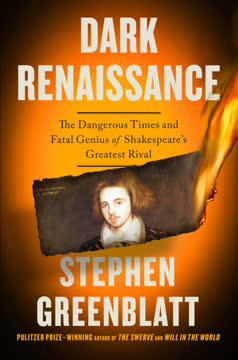
Dark Renaissance by Stephen Greenblatt receives mostly positive reviews (4.05/5 stars) for its exploration of Christopher Marlowe's brief life and literary genius. Reviewers praise Greenblatt's prose style and literary analysis of Marlowe's groundbreaking plays, which influenced Shakespeare. However, many note the book relies heavily on speculation due to sparse historical records about Marlowe, with frequent use of "perhaps" and "possibly." Some find this frustrating, while others appreciate Greenblatt's transparency. The book excels in contextualizing Elizabethan England's dangerous political and religious climate, making Marlowe's revolutionary impact on English theater compelling despite biographical gaps.