Key Takeaways
1. The Deliberate Provocation of Japan
The decision he made, in concert with his advisors, was to provoke Japan through a series of actions into an overt act: the Pearl Harbor attack.
A calculated strategy. President Franklin D. Roosevelt and his top military advisors, facing an isolationist American public unwilling to enter World War II, adopted a secret plan to incite Japan into attacking the United States. This strategy, outlined in a confidential October 1940 memorandum by Lieutenant Commander Arthur H. McCollum, aimed to create an "overt act" that would galvanize public support for war against the Axis powers. McCollum, head of the Far East desk of Navy Intelligence, understood Japanese culture and their propensity for surprise attacks, having lived in Japan during the 1904 Port Arthur raid.
McCollum's eight actions. The memo proposed eight specific provocations designed to push Japan toward war. These included:
- Arranging for US use of British and Dutch Pacific bases.
- Providing aid to China.
- Deploying US cruisers and submarines to the Orient.
- Keeping the main US Fleet in Hawaiian waters (Action F).
- Insisting the Dutch deny Japan economic concessions, especially oil.
- Completely embargoing trade with Japan (Action H).
FDR systematically implemented these actions, with his "fingerprints" found on each, despite objections from some military leaders.
Richardson's defiance. Admiral James O. Richardson, then Commander-in-Chief of the US Fleet, vehemently opposed FDR's plan to keep the fleet in Hawaii, recognizing the immense risk. He quoted the President as saying, "Sooner or later the Japanese would commit an overt act against the United States and the nation would be willing to enter the war." Richardson's refusal to place his men and ships in harm's way led to his immediate removal from command, replaced by Admiral Husband E. Kimmel, who was unaware of the underlying provocation policy.
2. An Extensive Intelligence Network Tracked Japan
It was America’s intelligence backbone. In 1941 it comprised twenty-five Pacific Rim radio intercept stations, including four cryptographic centers that decoded Japanese military and diplomatic messages.
The "splendid arrangement." The United States maintained a sophisticated, extensive network of twenty-five radio intercept stations and four cryptographic centers across the Pacific Rim, known as the "splendid arrangement." This network, including Station HYPO in Pearl Harbor, Station CAST in the Philippines, and Station US in Washington, D.C., continuously monitored and decoded Japanese military and diplomatic communications. This allowed American officials, including President Roosevelt, to be aware of Japan's intentions and activities.
Breaking the codes. American cryptographers achieved remarkable success in breaking Japan's most vital codes:
- Purple Code: The primary diplomatic code, solved by Colonel William Friedman's Army team in 1940, revealing strategic decisions and even Hitler's plans for Russia.
- Kaigun Ango: The Japanese naval code system, comprising twenty-nine separate codes, with four key systems (5-Num, call signs, ship movement, merchant marine) largely broken by Agnes Meyer Driscoll's Navy team by late 1940.
This intelligence provided an unparalleled window into Japan's war preparations, fleet movements, and strategic objectives.
Allied cooperation. The intelligence was not confined to the US alone. The "splendid arrangement" extended to British and Dutch forces, who also operated intercept stations and shared decoded information. This collaboration meant that a broad coalition of Allied leaders, including Winston Churchill and the Dutch government-in-exile, had access to Japan's secrets, creating a comprehensive picture of the impending conflict.
3. Hawaii's Commanders Were Deliberately Kept in the Dark
There is no evidence that Admiral Kimmel knew of the action plans advocated by McCollum, because Admiral Richardson never told him of them.
Exclusion from vital intelligence. Despite commanding the Pacific Fleet, Admiral Husband E. Kimmel and Lieutenant General Walter Short, the Army commander in Hawaii, were systematically denied access to crucial Japanese intelligence. While Washington and other Pacific commanders like General Douglas MacArthur and Admiral Thomas Hart received decoded Japanese diplomatic and military messages, Kimmel and Short were kept out of the loop. Kimmel repeatedly requested full intelligence access, but his pleas were ignored.
The "slow boat" to Hawaii. Solutions to the critical Japanese naval 5-Num code, vital for understanding fleet movements, were deliberately delayed in reaching Hawaii. While these solutions were rushed to Britain and the Philippines by armed couriers, the package for Station HYPO in Pearl Harbor was sent on a "slow boat," arriving only after the attack. This ensured that Kimmel's cryptographers could not independently decipher the Japanese naval messages that explicitly detailed the Pearl Harbor attack plans.
Mutilated reports. Even the daily intelligence summaries prepared by Station HYPO for Admiral Kimmel were tampered with. Crucial radio direction finder (RDF) reports, which pinpointed Japanese warship locations, were crudely cut from Kimmel's copies of the summaries. This deliberate censorship ensured that Kimmel remained unaware of the Japanese carrier force's approach, reinforcing the narrative of a "surprise" attack.
4. Japanese Spy Reports Detailed Pearl Harbor Targets
Morimura would provide the operational intelligence on Pearl Harbor using the Tsu radio code in the J series of Japanese Foreign Ministry codes.
The "outside man." Ensign Takeo Yoshikawa, operating under the alias Tadashi Morimura, was a Japanese naval spy assigned to the Honolulu consulate in March 1941. His mission was to gather detailed intelligence on the Pacific Fleet and Pearl Harbor, including maps and bombing plots, for Japan's air and torpedo pilots. American intelligence, including the FBI and Navy Intelligence, was aware of Morimura's true identity and activities from the moment he arrived.
Bomb plots intercepted. Morimura's espionage reports, encoded in the J-code (Tsu) and later the PA code, were regularly intercepted, decoded, and translated by US Army and Navy cryptographers in Washington. These messages provided precise grid coordinates for Pearl Harbor's anchorages, identifying targets like "Battleship Row" (designated "Ho Ho"). Despite this clear evidence of targeting, these bomb plot messages were withheld from Kimmel and Short.
"All clear for a surprise attack." On December 6, 1941, Morimura sent his final, most damning report: "There are no barrage balloons up and there is an opportunity left for a surprise attack against these places." This "all-clear" message, transmitted in the simple PA code, was intercepted by US stations and delivered to Station HYPO. However, it was either ignored, mistranslated, or deliberately withheld from Admiral Kimmel, ensuring the "surprise" element of the attack.
5. The Myth of Japanese Radio Silence Debunked
Admiral Yamamoto did send radio messages to the Pearl Harbor force during its eleven-day sortie to Hawaii. Overwhelming evidence proves that Yamamoto, as well as the commanders of the Task Force warships, broke radio silence and that their ships were located by American communication intelligence units.
Yamamoto's "radio silence" was a facade. Contrary to decades of official narratives from both American and Japanese sources, Admiral Isoroku Yamamoto's Pearl Harbor strike force did not maintain absolute radio silence. His November 25 order to cease communications included provisos allowing transmissions for emergencies or at commanders' discretion. This loophole was exploited, and numerous Japanese naval broadcasts were intercepted by US, British, and Dutch listening posts.
Intercepted communications. Between November 15 and December 6, 1941, US naval monitor stations recorded 129 Japanese naval intercepts directly contradicting claims of radio silence. These included:
- Nagumo's extensive communications: Vice Admiral Chuichi Nagumo, commander of the First Air Fleet, engaged in "extensive communications" with submarine and Central Pacific forces as he departed Hitokappu Bay on November 26.
- Carrier transmissions: Carriers like the Akagi, Kaga, Zuikaku, Hiryu, and Soryu, along with battleships Kirishima and Hiei, were heard transmitting.
- Weather warnings: Tokyo Naval Radio sent a 5-Num coded message on November 28, warning the First Air Fleet of a powerful winter storm in their path.
These intercepts, along with radio direction finder (RDF) bearings, provided clear evidence of the fleet's movements.
Solar storms and "blasts." A major solar storm from November 28-30 inadvertently aided US intelligence. The Akagi's low-power transmissions, used to regroup scattered warships after the storm, were bounced across the Pacific by the solar activity, reaching US intercept stations in Hawaii, Alaska, and the West Coast. The American liner SS Lurline also reported "Japs are blasting away on the frequencies," confirming the widespread nature of these transmissions.
6. The "First Overt Act" Directive Guided US Policy
If hostilities cannot repeat cannot be avoided the United States desires that Japan commit the first overt act.
A deliberate policy. The core of FDR's strategy was explicitly articulated in war warnings sent to US Pacific commanders on November 27 and 28, 1941. These directives, originating from President Roosevelt and dispatched by Secretary of War Henry Stimson and Admiral Harold Stark, instructed military forces to undertake reconnaissance but "not to complicate an already tense situation or precipitate Japanese action." The key phrase, repeated twice for emphasis, was: "The United States desires that Japan commit the first overt act."
Handcuffing the fleet. This directive effectively tied the hands of commanders like Admiral Kimmel, preventing them from taking any offensive or overtly defensive actions that might be construed as initiating hostilities. Kimmel's attempt to conduct a wide-ranging reconnaissance of the North Pacific (Exercise 191) was abruptly canceled by Washington, and his fleet was ordered back to Pearl Harbor, leaving the North Pacific a "Vacant Sea" for the approaching Japanese.
Strategic rationale. The policy was rooted in the belief that only a clear, unprovoked attack by Japan would unite the American people, who were deeply isolationist, behind a declaration of war. As Stimson noted in his diary, the "War Cabinet" discussed the "risk involved... in letting the Japanese fire the first shot," but concluded it was "desirable to make sure that the Japanese be the ones to do this, so that there should remain no doubt in anyone’s mind as to who were the aggressors."
7. Critical Warnings Ignored in the Final Hours
This means war.
FDR's realization. On the evening of Saturday, December 6, 1941, President Roosevelt received the first thirteen parts of Japan's diplomatic memorandum, which effectively severed relations with the United States. After reading it, he famously remarked to Harry Hopkins, "This means war." Later that night, the final fourteenth part and a crucial deadline message, instructing Ambassador Nomura to deliver the note at 1:00 P.M. EST on Sunday, December 7, were intercepted. This time corresponded to 7:30 A.M. in Hawaii, just minutes before the attack.
Delayed warnings. Despite the clear implications of the 1:00 P.M. deadline, direct warnings to Hawaii were inexplicably delayed. General George Marshall, Chief of Staff of the Army, received the deadline message around 9:00 A.M. EST on December 7 but, after a 75-minute delay, chose to send the warning to Hawaii via slower Western Union and RCA channels instead of immediate scrambler telephone. This message did not reach General Short until after the attack had begun.
Local failures and ignored alerts. Even in Hawaii, critical local warnings were disregarded:
- Opana Radar: Army Privates Joseph Lockard and George Elliott detected a large mass of aircraft approaching Oahu from the north at 6:50 A.M. on December 7. Their warnings were dismissed by Lieutenant Kermit Tyler, an inexperienced duty officer.
- Midget Submarine: The USS Ward sank a Japanese midget submarine attempting to enter Pearl Harbor at 6:45 A.M. The plain-language radio alert was received by the Fourteenth Naval District but was not immediately relayed to Admiral Kimmel or General Short.
These failures, combined with the overarching "first overt act" policy, ensured that Pearl Harbor remained unprepared for the impending assault.
8. The Cost of Unification: A "Cheap Price"
It was a pretty cheap price to pay for unifying the country.
The human toll. The attack on Pearl Harbor on December 7, 1941, resulted in 2,476 American military and civilian deaths, 1,119 wounded, and the crippling of the Pacific Fleet. Four battleships were sunk, and four others damaged. The Army Air Force and Navy/Marine air bases lost significant numbers of aircraft. Beyond Pearl Harbor, Japan seized 1,951 Americans as prisoners of war from Guam and Wake Island, many of whom died in captivity.
Strategic miscalculation by Japan. While devastating, Japan's attack was a strategic blunder. By focusing on battleships and not destroying Pearl Harbor's vital oil reserves (five million barrels) or its industrial capacity (dry docks, repair facilities), Japan failed to cripple America's long-term ability to wage war in the Pacific. The relatively undamaged infrastructure allowed the US to quickly repair ships and launch a counteroffensive, leading to decisive victories like Midway just six months later.
A controversial legacy. The revelation of deliberate provocation and withheld intelligence casts a shadow on President Roosevelt's legacy. While the attack undeniably unified a divided nation and propelled the US into World War II, ultimately leading to Allied victory, the human cost and the deception involved remain deeply controversial. The truth, suppressed for decades by government secrecy and gag orders on cryptographers, raises profound ethical questions about the sacrifices made for national interest.
Last updated:
Review Summary
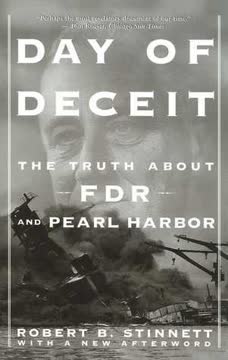
Day of Deceit by Robert B. Stinnett argues that FDR and his administration deliberately provoked Japan into attacking Pearl Harbor to unite isolationist Americans behind entering WWII. Based on seventeen years of research using declassified documents, Stinnett claims the U.S. had broken Japanese naval codes, tracked the attacking fleet, but withheld intelligence from commanders Kimmel and Short. Reviews are polarized: supporters praise the extensive documentation, while critics cite organizational problems, lack of "smoking guns," and questionable interpretation of evidence. Most agree Stinnett raises important questions, though few find his conspiracy theory completely convincing.
Similar Books