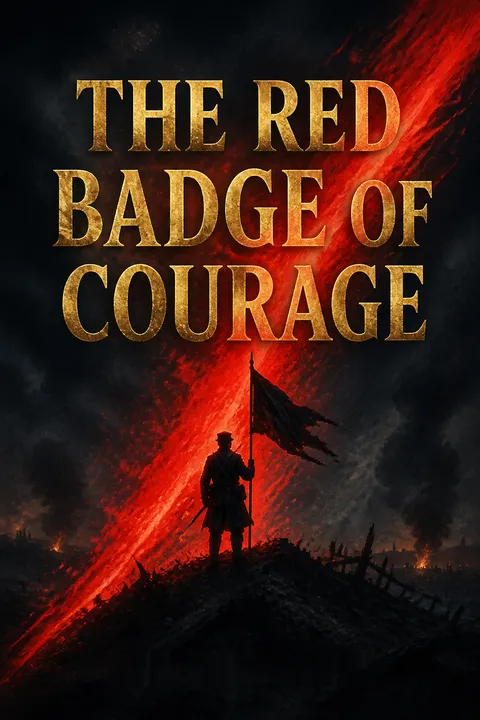


Plot Summary
Farm Boy Faces the Unknown
Henry Fleming leaves his mother's farm to enlist in the Union army, drawn by imagined glory despite her practical warnings to care for himself and behave honorably. Months of camp routine dull his excitement until a rumor of movement revives it.
The tall soldier Jim Conklin confirms that a battle may be near, while Wilson, another young private, scoffs at the reports. Henry's attention turns from the enemy to a more private danger: he cannot know whether he will stand or run when bullets come.
He studies his comrades for signs of the same uncertainty, but their confident talk leaves him feeling alone. Jim admits that his own conduct might depend on what the rest of the regiment does, giving Henry a little reassurance without answering the question.
Henry's enlistment begins as an act of self-invention. He has borrowed his picture of courage from stories, public ceremony, and the approval he imagines awaiting him, while his mother's advice points toward a less theatrical standard: do what is right, even when nobody applauds. The coming battle threatens to expose the gap between this ideal self and the frightened body he cannot predict. Jim's conditional confidence matters because it makes courage social rather than purely personal. Henry is not yet asking what he owes his comrades; he is asking what their behavior might permit him to become.
The First Line Holds
The regiment crosses the river and marches through woods toward distant firing. Henry studies the dead and the moving skirmishers, but waiting and uncertainty trouble him more than the battle he had pictured. Before the first attack, Jim entrusts Henry with a packet for his family, convinced he may not survive.
When enemy soldiers charge across the field, Henry barely has time to settle his thoughts before his rifle begins firing. The noise and labor absorb him; he stops measuring himself and acts as part of the line. The regiment repels the attack. For a moment, Henry feels pride in having endured, and the shared danger seems to create a bond stronger than the patriotic language he had carried into the war.
The first fight answers Henry's question only provisionally. He discovers that action can overtake self-consciousness: loading and firing leave little room for the imagined test he has rehearsed. The regiment's collective force lends him a courage he experiences as both his own and borrowed from those beside him. Jim's packet provides a counterpoint to Henry's uncertainty. Jim prepares for death as a responsibility to others, whereas Henry's attention remains fixed on how he will appear to himself. The temporary victory lets Henry mistake successful participation for a settled knowledge of his character.
Flight Through the Woods
After the first attack, the men have little time to recover before another enemy wave advances. Henry sees comrades break and run, and their panic loosens his own hold on the line. He drops his rifle and cap and flees, imagining death behind him as more terrifying than any danger he can see.
When he learns that the regiment has held, he recasts his escape as sound judgment and blames the men who stayed for failing to understand the danger. In the woods, he takes a squirrel's flight from a pine cone as proof that running is natural. Then he finds a dead Union soldier propped against a tree, and the sight makes his private argument with fear feel less secure.
Henry's flight is followed not by relief but by a scramble to control its meaning. He turns instinct into a moral defense, using the squirrel to make self-preservation seem like a law of nature rather than a choice with consequences for others. The dead soldier complicates that convenient lesson: the body offers no explanation of whether fear, duty, or chance shaped its fate. Henry cannot read courage from the corpse, but he cannot dismiss it either. His shame is therefore not simply fear of being judged. It arises from the discovery that his actions have separated him from the people whose shared risk had briefly made him feel whole.
Jim Conklin's Last Walk
A renewed roar of battle draws Henry back toward the fighting, where he joins a stream of wounded soldiers moving to the rear. A badly injured man beside him keeps praising the regiment's performance, then asks where Henry has been hit. Unable to answer, Henry slips away. In the procession he recognizes Jim, bleeding from a wound in his side.
Henry tries to support him, but Jim becomes terrified that passing artillery will run him down and then insists on walking alone. He staggers into a field and collapses as Henry and the wounded soldier follow at a distance. After Jim dies, the wounded man turns his concern toward Henry's unseen injury. Henry, exposed by the question, abandons him and walks away.
Jim's death strips away the clean, heroic image Henry has attached to battle. The dying man moves under his own force, at once frightened, stubborn, and beyond the reach of Henry's attempts to help. Henry's helplessness before this death stands beside his earlier refusal to answer the wounded soldier honestly. That contrast makes the abandonment especially painful: he can recognize another man's need, but shame narrows his attention back to himself. The wounded soldier's questions are not accusations; their ordinary concern becomes unbearable because it tests the story Henry is trying to hide. He escapes the conversation, not the knowledge that he has left someone vulnerable behind.
Blood Becomes an Alibi
Alone after leaving the wounded man, Henry watches troops stream away from the battle and briefly envies their apparent vindication. He considers returning to the front, but exhaustion, thirst, and fear defeat the plan. When he grabs a fleeing soldier to ask what is happening, the man strikes Henry's head with a rifle and runs on.
Blood from the blow gives Henry a wound he did not earn in combat. A cheerful, unnamed soldier finds him and guides him through the confused woods to his regiment. Wilson recognizes him, assumes he was lost in the fighting, and brings the corporal to inspect the injury. Wilson's care gives Henry shelter before he can explain himself; Henry lets the wound stand in for a more honorable account.
The wound changes Henry's social position without changing the history that produced it. It is accidental, inflicted during the retreat, yet it supplies visible evidence that others can mistake for battle courage. That mismatch turns the injury into an alibi: Henry can accept care and belonging while withholding the truth. The episode also complicates moral judgment. The rifle blow is not a punishment arranged by fate; it is the product of panic and confusion, just as Henry's own flight was. Wilson's practical kindness offers Henry a chance to be received without interrogation, but Henry interprets that mercy as permission to preserve his false self-image.
Wilson's Blanket and Letters
At the campfire, Wilson cools Henry's head, gives him coffee, and makes a bed from his blankets. The friend who once boasted of his bravery now shows quiet care and accepts the danger around them without swagger. By morning, Henry notices the change and hears that the regiment has been scattered and suffered losses. He tells Wilson that Jim Conklin is dead.
Later, while the company waits to move, Henry remembers Jim's packet and realizes Wilson survived the battle he had expected would kill him. Henry could use the letters to embarrass his friend, but instead returns them without a taunt. He calls this restraint generous, even as he continues to protect his own story of the previous day.
Wilson's transformation is less a conversion than a correction of scale. Experience has reduced his need to advertise himself, leaving room for care and a steadier sense of responsibility. Henry notices this maturity but measures it against his own concealed failure, turning the returned packet into a private contest he can win. His choice not to mock Wilson is genuinely considerate, yet Henry's self-congratulation reveals how easily one decent act can become a substitute for fuller accountability. The packet, first entrusted under a false expectation of death, now marks the gap between imagined sacrifice and the quieter obligations that survive a battle.
The Regiment Becomes a Tool
The next day's movement takes the regiment to rifle pits, then into a confused retreat as the enemy presses through the woods. Henry complains that poor command has wasted the men's effort, but a comrade's dry remark about whether Henry fought the whole battle silences him. When the regiment reforms, the enemy attacks again.
This time Henry stays and fires with such relentless fury that his lieutenant praises his ferocity. During a brief search for water, Henry and Wilson overhear officers discussing the threatened line and selecting the 304th as the force they can spare for a charge. The news gives the regiment a new task, but also reveals how casually command can spend the lives of men it has just praised for fighting.
Henry's conduct now contains a real change, but it is not yet a simple moral awakening. He fights hard partly from anger, partly from the force of the immediate danger, and partly because he can no longer bear the image of himself as a deserter. The sarcastic comrade punctures Henry's easy accusations against the generals by exposing the authority he has not earned. The officers' decision to use the 304th as a disposable reserve then widens the scale of the problem: individual courage operates inside institutions that treat soldiers as movable units. Henry's first sustained act of fighting grows from a mixture of motives, not a clean conversion.
Two Flags in the Smoke
The officers align the 304th and send it toward the enemy through smoke and rifle fire. The regiment advances, then falters among trees and open ground as casualties mount. Henry runs ahead, but the line stalls under the defenders' fire. The lieutenant curses the hesitation and urges the men forward; Henry resents being ordered across exposed ground, then joins the lieutenant and Wilson in calling the regiment on.
The renewed rush carries them into the enemy's fire. The color sergeant is struck and falls without releasing the Union flag. Henry and Wilson wrench the pole from his grip and keep it moving with the broken charge. The regiment is forced back, but the flag remains with the two soldiers who had helped drive it forward.
The flag gives Henry a concrete object onto which he can fasten courage, loyalty, and the hope of being seen. Its symbolic force is not simply patriotic: in the chaos, it supplies a visible direction when orders, terrain, and personal motives have become difficult to distinguish. Henry's resistance to the lieutenant shows that fear and anger persist even as he acts bravely. When he and Wilson take the flag from the fallen color sergeant, they assume a duty created by another man's death. Their action is meaningful, but it does not make the charge a victory; the regiment still retreats, preserving the difference between courage and success.
Retreat, Then a Volley
The diminished regiment withdraws under fire, with Henry and Wilson keeping the flag between them as they dispute who should carry it. When enemy soldiers close in, the lieutenant spots them and the Union line fires a sudden volley at close range.
The attackers vanish into smoke, leaving the ground clear and the regiment briefly restored by its own defense. As the men reach their former position, a general reproaches the colonel for stopping short of the objective.
The insult lands hard because the soldiers believe they have spent themselves fully. Soon they hear that the colonel and lieutenant praised Henry and Wilson for leading with the colors. The praise lifts their spirits, though it cannot erase the exhausted retreat or the commander's criticism.
The regiment's close-range defense gives its men evidence that they can still act effectively after a failed charge. But the general's rebuke reframes their sacrifice through an objective they did not know they had nearly reached, exposing the distance between a soldier's immediate experience and a commander's measure of performance. Recognition from their own officers then restores some dignity, especially to Henry and Wilson, yet it is also selective: the flag makes their actions legible in a way that the suffering of the whole line is not. The episode shows how military honor is negotiated through incomplete information, public judgment, and the symbols that survive combat.
Henry Takes the Enemy Colors
When the enemy attacks again, Henry watches the fighting from his place with the Union colors and no longer flinches at every shell. His regiment holds until its fire weakens and enemy soldiers shelter behind a rail fence. Officers call for a charge. The exhausted men surge forward, Henry keeping their flag in front as bullets cut through the line.
Near the fence, a volley breaks the defenders' resistance. Wilson crosses the rails and takes the enemy flag from its wounded bearer, while several opposing soldiers are captured. The charge turns the regiment's earlier defeat into a hard-won success, though the men reach it through losses, confusion, and a final burst of collective effort rather than a clean, triumphant advance.
The final charge resolves the regiment's immediate struggle for ground, but Crane keeps its victory materially narrow. The men seize a flag and prisoners; they do not gain mastery over war's disorder or undo the dead and wounded left behind. Henry's steadiness now differs from his first battle, when the line's movement carried him along before he could think. Yet courage remains collective: Wilson takes the enemy colors, and the regiment's momentum makes the capture possible. The image of one flag replaced by another turns military success into a visible trophy, while the cost beneath it resists any uncomplicated reading of triumph.
Out of the Red Noise
As the firing dwindles, Henry and Wilson receive orders to leave the field with the regiment. During the march, Henry revisits the day in memory, first taking pleasure in the comrades' praise and the deeds they witnessed. Then the memory of his flight returns, followed by the image of the wounded soldier he abandoned. The shame remains, but it no longer swallows every other fact about him.
Henry recognizes that his old worship of battlefield glory was childish, and that courage cannot be measured by the stories he once imagined telling at home. He walks beneath the rain with a quieter sense of himself, turning from the battle's fever toward ordinary peace without claiming that his failures have vanished.
The ending refuses both absolution and permanent condemnation. Henry's memories still arrange themselves to favor his public deeds, but the abandoned wounded man interrupts that self-serving parade and keeps moral responsibility alive. His growth lies less in proving himself brave than in learning to see his own motives without the grand stories that once protected him. The battlefield has exposed the instability of heroic reputation: a wound can be accidental, an act can be brave for mixed reasons, and praise can coexist with failure. The closing turn toward peace is therefore not a victory over guilt. It is a more mature capacity to carry contradiction without letting it dictate his entire identity.
Analysis
The Red Badge of Courage follows a young soldier whose chief conflict is not simply whether he will feel fear, but whether he can live without the flattering story he has built around himself. Henry enters the army imagining courage as a stable quality that will reveal him as exceptional. Combat instead makes action contingent: he fights when the regiment's motion absorbs him, runs when panic becomes contagious, and later returns with an injury that others misread as evidence of bravery. The book refuses to turn these episodes into a neat moral ledger. His retreat is a real failure of solidarity, but later acts of courage are not therefore counterfeit.
Crane also makes military identity a social construction. Henry watches his comrades for clues about his own character, while the regiment's flags, officers, rumors, and public praise shape what can be recognized as valor. Wilson's packet and Henry's wound show how easily private fear becomes a public narrative, especially when others lack the information to challenge it. The wounded soldier's ordinary questions carry more ethical force than a formal accusation because they expose Henry's self-absorption without intending to judge him.
The battlefield's apparent grandeur repeatedly collapses into material detail: exhausted bodies, confused orders, mud, thirst, and men treated as resources by command. Henry's eventual maturity comes not from discovering a pure heroic self, but from revising his scale of judgment. He can see his flight and his courage together, without letting either one define him completely. The final turn toward peace offers no clean absolution. It suggests a more durable kind of character: the willingness to face one's conduct without disguising it as destiny, and to recognize that courage is made in relationships as much as in solitary resolve.
Review Summary
The Red Badge of Courage receives mixed reviews. Many praise its vivid portrayal of war and innovative prose style, while others find it boring or difficult to understand. Readers appreciate Crane's psychological insights and the book's exploration of courage and fear. Some criticize the lack of historical context and overuse of dialect. The novel's ambiguity and potential for multiple interpretations are noted. Despite its short length, the book is considered an American classic that has influenced war literature and continues to provoke discussion.
People Also Read



Characters
Henry Fleming
The untested privateA young Union private raised on a farm, Henry enlists with a romantic picture of war and a strong hunger to prove himself. He is introspective, imaginative, and unusually alert to how other people might judge him, but his self-analysis often becomes a means of avoiding an uncomfortable fact. His mother's practical counsel and his comrades' conduct offer competing measures of honor. Henry's inner life moves between fantasy and observation: he imagines heroic scenes, then struggles to interpret what his body actually does under fire. His central tension is not simply fear versus bravery, but the desire to possess a settled identity before experience has tested it. He matters because the battle is filtered through his shifting, often self-protective understanding.
Wilson
Henry's changing comradeWilson is a young private in Henry's company, initially loud, confident, and quick to defend his own expectations. Before the first battle, he assumes he may die and entrusts Henry with letters for his family. His later behavior is more considerate and grounded: he nurses Henry after finding him injured and takes responsibility for practical needs in camp. Wilson's friendship gives Henry a close human measure of conduct, distinct from abstract ideas of patriotism or public glory. His movement from bravado toward steadier attention shows how combat can humble a person without making him passive.
Jim Conklin
The tall veteran friendJim Conklin, Henry's tall comrade from home, is calm, practical, and less certain of his own courage than he first appears. His willingness to admit that a soldier might follow the rest of the regiment gives Henry a rare glimpse of honest uncertainty. Jim's manner makes him a source of reassurance, but not because he claims to understand battle. He represents the familiar ties Henry carried into military life and the limits of those ties once combat begins.
Henry's mother
The farm's moral compassHenry's mother is a practical farmer whose advice resists the ceremonial language of war. She worries about his safety, sends warm clothing and food, and reminds him to act honorably even when doing so may cost him. Her restraint at his enlistment is emotionally complex: she is grieving, but she does not turn his departure into the grand farewell he expects. She anchors Henry's past in ordinary work and a plain, demanding idea of character.
The tattered soldier
The wounded witnessAn unnamed soldier with wounds to his head and arm, he praises the regiment and seeks ordinary fellowship while making his painful way from the battle. His questions about Henry's injury are gentle rather than prosecutorial, yet they expose the gulf between Henry's concealed flight and the man's visible suffering. He is a practical, vulnerable presence whose need for companionship persists even as his own strength fails.
Hasbrouck
The profane lieutenantHasbrouck commands Henry's company and expresses fear, anger, and urgency through relentless profanity and physical movement. Though young and often abrasive, he stays engaged with his soldiers in the thick of combat, urging them forward and reacting directly to danger. His authority is imperfect, but it becomes one of the forces that can break the regiment's hesitation. The contrast between his blustering manner and his willingness to remain exposed makes him more than a comic officer.
MacChesnay
The judged colonelThe colonel of the 304th must answer for how far his regiment advanced during a costly charge. His composure under a general's criticism contrasts with the anger and exhaustion of the men he commands. Through him, the novel shows how responsibility for battlefield outcomes is distributed unevenly between officers and soldiers.
The color sergeant
Keeper of the colorsThe color sergeant carries the regiment's flag into the charge, making him a visible center of movement and danger. His role is practical as well as symbolic: the flag helps the scattered soldiers orient themselves when smoke and terrain disrupt the line. He embodies the burden of holding a shared emblem in the middle of individual fear.
Plot Devices
The head wound
A borrowed badge of courageHenry receives a blow to the head from a fleeing soldier after he has already run from the battle. The resulting blood and bandage make his return to camp look like the return of a wounded fighter, allowing Wilson and the corporal to care for him without suspecting his flight. The injury is real, but its apparent meaning is false. It gives physical form to the novel's concern with how reputation is made from visible signs, incomplete knowledge, and the stories people tell about themselves. Henry's wound offers shelter from shame while leaving the underlying choice unresolved.
Wilson's packet
A test of private loyaltyBefore the first battle, Wilson gives Henry a packet of letters for his family because he expects not to survive. The packet introduces Wilson's fear beneath his bravado and gives Henry a private responsibility amid the public spectacle of war. Once Wilson returns alive, Henry has the opportunity to use the letters to embarrass him, but instead gives them back. The object measures how friendship can turn from imagined farewell into an everyday obligation, while also revealing Henry's tendency to treat another person's vulnerability as a possible defense against his own.
The regimental flag
A moving point of unityThe 304th's flag remains visible as smoke, casualties, and broken formations make the battle difficult to read. Henry and Wilson take it from the fallen color sergeant during a retreating charge, and Henry later carries it as the regiment faces another attack. Its presence gives the soldiers a shared point of direction and turns courage into something other people can witness. The flag is both an emblem and a practical object: it concentrates attention, exposes its bearer to danger, and provides a visible measure by which officers and comrades later remember the men's actions.
Nature and the squirrel
Henry's instinctive defenseAfter fleeing, Henry watches a squirrel escape from a pine cone and treats its movement as proof that running from danger is natural. The moment gives him a convenient argument against shame, because it turns a personal decision into a rule shared by living creatures. Yet the novel does not let that observation settle the question. Nature's calm surroundings offer Henry temporary comfort, while the dead soldier he later encounters and the wounded men returning from battle resist his attempt to make instinct a complete moral explanation.
FAQ
Synopsis & Basic Details
What is The Red Badge of Courage about?
- Young soldier's psychological journey: The novel follows Henry Fleming, a young Union soldier in the Civil War, as he grapples with his romanticized ideas of war and the harsh realities of combat. It's less about the battles themselves and more about his internal struggle with fear, courage, and self-discovery.
- Loss of innocence and disillusionment: Henry's initial eagerness for glory is quickly replaced by fear and doubt as he experiences the brutality of war. He confronts his own cowardice and grapples with the psychological toll of battle, leading to a profound disillusionment.
- Search for self and redemption: The story charts Henry's path from a naive recruit to a battle-hardened soldier. He seeks to understand his own nature, ultimately striving for redemption and a sense of self-worth through his actions on the battlefield.
Why should I read The Red Badge of Courage?
- Unique psychological realism: Stephen Crane masterfully portrays the inner turmoil of a young soldier, offering a raw and honest depiction of fear, courage, and the psychological impact of war. This focus on internal experience sets it apart from traditional war narratives.
- Timeless themes of human nature: The novel explores universal themes of identity, self-doubt, and the search for meaning in the face of adversity. These themes resonate with readers across time and cultures, making it a relevant and thought-provoking read.
- Groundbreaking literary style: Crane's innovative use of imagery, symbolism, and psychological realism revolutionized war literature. His vivid descriptions and introspective narrative create a powerful and immersive reading experience.
What is the background of The Red Badge of Courage?
- American Civil War setting: The novel is set during the American Civil War, though it doesn't focus on specific battles or historical figures. The war serves as a backdrop for exploring the psychological impact of conflict on an individual soldier.
- Focus on the common soldier: Unlike many war stories that focus on generals and grand strategies, Crane's novel centers on the experiences of a young, ordinary soldier. This perspective provides a more intimate and relatable view of the war.
- Rejection of romanticized war: Crane's work is a stark departure from the romanticized portrayals of war prevalent at the time. He presents a realistic and often brutal depiction of combat, highlighting the fear, confusion, and moral ambiguities faced by soldiers.
What are the most memorable quotes in The Red Badge of Courage?
- "He had been to touch the great death, and found that, after all, it was but the great death.": This quote encapsulates Henry's transformation, showing his realization that death is not the romanticized ideal he once imagined, but a simple, inevitable part of life. It highlights his newfound maturity and acceptance.
- "He had performed his mistakes in the dark, so he was still a man.": This quote reveals Henry's self-justification and his understanding that his past actions, though flawed, do not define his entire being. It speaks to the human capacity for self-deception and the desire for self-preservation.
- "So it came to pass that as he trudged from the place of blood and wrath his soul changed. He came from hot plowshares to prospects of clover tranquilly, and it was as if hot plowshares were not.": This quote illustrates Henry's final transformation, his ability to move beyond the trauma of war and find peace. It emphasizes the cyclical nature of life and the possibility of renewal after suffering.
What writing style, narrative choices, and literary techniques does Stephen Crane use?
- Psychological realism and stream of consciousness: Crane delves deep into Henry's thoughts and feelings, using a stream-of-consciousness style to convey his internal struggles, fears, and shifting perceptions of war. This technique creates a sense of immediacy and intimacy with the protagonist's experience.
- Vivid imagery and symbolism: Crane employs rich, sensory language and powerful symbolism to depict the horrors and chaos of battle. The recurring image of the "red badge of courage" and the use of color symbolism enhance the novel's thematic depth.
- Ironic and detached tone: Crane often uses irony and a detached narrative voice to highlight the absurdity and brutality of war. This approach allows him to critique romanticized notions of heroism and explore the complex moral landscape of conflict.
Hidden Details & Subtle Connections
What are some minor details that add significant meaning?
- The youth's mother's practical advice: Her focus on socks, shirts, and blackberry jam, rather than grand pronouncements about heroism, reveals her deep love and concern for Henry's well-being. This contrasts with Henry's romanticized expectations of a heroic send-off, highlighting the mundane realities of war.
- The description of the river: The river's changing appearance, from "amber-tinted" to "sorrowful blackness," mirrors the shifting moods and emotional states of the soldiers. It symbolizes the transition from anticipation to the grim reality of war.
- The fat soldier's attempt to steal a horse: This seemingly minor incident reveals the soldiers' boredom and their tendency to focus on trivial matters to distract from the looming threat of battle. It also highlights the breakdown of order and discipline in the face of prolonged stress.
What are some subtle foreshadowing and callbacks?
- The tall soldier's rumor: The tall soldier's initial rumor about the army's movements foreshadows the chaotic and unpredictable nature of war. It also sets up the theme of misinformation and the soldiers' reliance on unreliable sources.
- The youth's fear of running: Henry's early preoccupation with the possibility of fleeing foreshadows his actual flight from battle. This internal conflict is a recurring motif, highlighting his struggle with cowardice and the desire for self-preservation.
- The tattered man's questions: The tattered man's persistent questioning about Henry's wound foreshadows Henry's later desire for a "red badge of courage." It also serves as a callback to his earlier fears and insecurities, emphasizing his ongoing internal struggle.
What are some unexpected character connections?
- The youth and the tattered soldier: Despite their brief encounter, the tattered soldier's questions and suffering deeply impact Henry, forcing him to confront his own cowardice. This connection highlights the shared experiences of soldiers and the psychological toll of war.
- The youth and the lieutenant: Despite their initial antagonism, the youth and the lieutenant share a subtle fellowship in their shared experiences of battle. They both become figures of defiance and leadership, highlighting the transformative power of war.
- The youth and Jim Conklin: Jim's death, though tragic, serves as a catalyst for Henry's growth. Their connection, though brief, underscores the importance of camaraderie and the impact of loss on the individual soldier.
Who are the most significant supporting characters?
- The loud soldier (Wilson): Wilson's transformation from a boastful and arrogant soldier to a supportive and humble comrade mirrors Henry's own journey. His character arc highlights the impact of war on individual personalities and the importance of camaraderie.
- The tattered man: This character serves as a haunting reminder of the human cost of war and forces Henry to confront his own cowardice. His brief but impactful presence is crucial to Henry's psychological development.
- The lieutenant: The lieutenant embodies the complexities of leadership in war. His initial harshness and later camaraderie with Henry highlight the challenges of maintaining order and inspiring courage in the face of chaos.
Psychological, Emotional, & Relational Analysis
What are some unspoken motivations of the characters?
- Henry's desire for validation: Beneath his romanticized notions of war, Henry is driven by a deep-seated need for validation and recognition. His desire for a "red badge of courage" stems from his insecurity and his longing to prove his worth.
- Wilson's need for acceptance: Wilson's initial brashness and boasting mask his own insecurities and his desire to be accepted by his comrades. His transformation reveals his underlying need for connection and belonging.
- The lieutenant's struggle with responsibility: The lieutenant's harshness and profanity mask his own fear and his struggle to maintain control in the face of chaos. His actions reveal his deep sense of responsibility and his desire to protect his men.
What psychological complexities do the characters exhibit?
- Henry's internal conflict: Henry's constant struggle between his desire for glory and his fear of cowardice reveals the complex psychological impact of war. His internal debates and shifting perceptions highlight the fragility of the human psyche under extreme stress.
- Wilson's transformation: Wilson's journey from arrogance to humility demonstrates the transformative power of war. His character arc reveals the psychological toll of combat and the potential for growth and self-awareness.
- The lieutenant's emotional volatility: The lieutenant's sudden shifts between harshness and camaraderie reveal the emotional toll of leadership in war. His volatile behavior highlights the psychological strain of command and the difficulty of maintaining composure in the face of chaos.
What are the major emotional turning points?
- Henry's flight from battle: This moment marks a significant turning point, as Henry confronts his own cowardice and experiences the shame and guilt that will drive his subsequent actions. It shatters his romanticized view of war and forces him to grapple with his true nature.
- Jim Conklin's death: Jim's death serves as a catalyst for Henry's introspection and growth. The loss of his friend and the encounter with the tattered man deepen his shame and motivate him to seek redemption.
- Henry's return to the regiment: This decision marks a turning point in Henry's journey, as he chooses to confront his fears and seek acceptance among his comrades. It demonstrates his growing resolve and his desire to prove his courage.
How do relationship dynamics evolve?
- Henry and Wilson's friendship: Their relationship evolves from a casual acquaintance to a deep bond forged in the crucible of war. They learn to rely on each other for support and encouragement, highlighting the importance of camaraderie in the face of adversity.
- Henry and the lieutenant's dynamic: Their relationship shifts from antagonism to a subtle form of respect and understanding. They both become figures of defiance and leadership, highlighting the shared experiences of soldiers in battle.
- Henry's relationship with his regiment: Henry's initial isolation and self-doubt are gradually replaced by a sense of belonging and connection to his fellow soldiers. He learns to value their camaraderie and to find meaning in their shared experiences.
Interpretation & Debate
Which parts of the story remain ambiguous or open-ended?
- The true nature of Henry's courage: While Henry performs acts of bravery, the novel leaves open the question of whether his courage is genuine or merely a product of his desire for validation. This ambiguity challenges the reader to consider the complexities of heroism.
- The meaning of the "red badge of courage": The novel questions the traditional understanding of courage as a physical wound. It suggests that true courage may lie in the internal struggle and the ability to overcome fear, rather than in external displays of bravery.
- The overall message about war: The novel does not offer a clear-cut message about the morality or purpose of war. Instead, it presents a complex and often contradictory view of combat, leaving the reader to grapple with the ambiguities and moral dilemmas of conflict.
What are some debatable, controversial scenes or moments in The Red Badge of Courage?
- Henry's initial flight from battle: This scene is often debated, with some readers viewing it as an act of cowardice and others as a realistic portrayal of human fear. The ambiguity of Henry's actions challenges traditional notions of heroism and valor.
- Henry's self-justification: Henry's attempts to rationalize his flight and his subsequent actions are often seen as morally questionable. This raises questions about the nature of self-deception and the human capacity for rationalizing flawed behavior.
- The ending's ambiguity: The ending, while seemingly triumphant, leaves open the question of whether Henry has truly achieved redemption or merely found a way to reconcile his actions with his desire for self-respect. This ambiguity invites readers to consider the lasting impact of war and the complexities of human nature.
The Red Badge of Courage Ending Explained: How It Ends & What It Means
- Henry's transformation: The ending sees Henry having seemingly overcome his fear and self-doubt, having fought bravely and captured the enemy's flag. He has earned the respect of his comrades and found a sense of belonging.
- Ambiguity of true heroism: Despite his apparent triumph, the ending leaves open the question of whether Henry's courage is genuine or merely a product of his desire for validation. This ambiguity challenges the reader to consider the complexities of heroism and the psychological impact of war.
- Cycle of violence and redemption: The novel ends with a sense of peace and renewal, but it also acknowledges the cyclical nature of violence and the ongoing struggle for self-discovery. The final image of the sun breaking through the rain clouds suggests the possibility of hope and redemption, but it also hints at the enduring challenges of the human condition.
Download PDF
Download EPUB
.epub digital book format is ideal for reading ebooks on phones, tablets, and e-readers.








