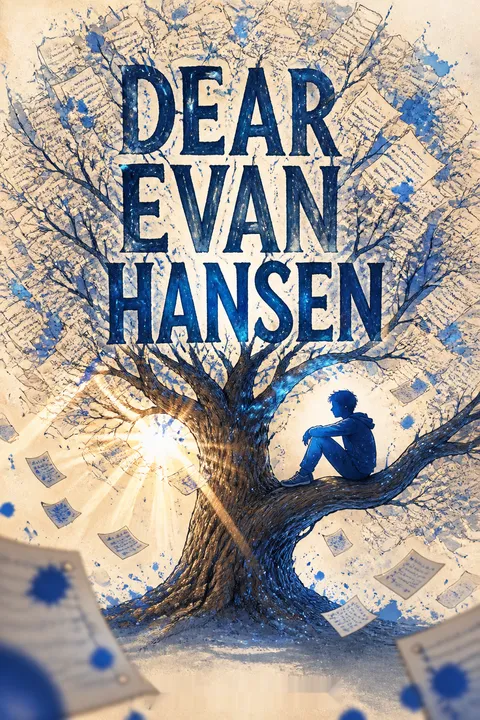


Plot Summary
Prologue
Connor Murphy speaks from beyond his own death, trying to understand how his life ended without leaving a proper goodbye. The last mark he made was his name on another boy’s cast.
He imagines himself among extinguished stars, already gone while those looking upward still believe he is there. His brief account makes absence feel immediate: Connor can look back, but no one living can hear him.
The opening gives the dead boy a voice before anyone else can define him, but that voice is already shaped by self-erasure. Connor measures his life by whether he made an impact, then finds significance in a small, accidental gesture: signing Evan’s cast. The stars image establishes the book’s central tension between visible presence and private suffering. What others remember may glow long after the person has vanished, but remembrance can also distort the life it claims to preserve.
The Cast Stays Blank
Evan Hansen returns to school for senior year already rehearsing how to survive it. He takes medication for anxiety, writes pep letters for his therapist, and accepts a Sharpie from his mother as a prompt to let classmates sign his cast.
His first attempts at conversation with Alana Beck and Jared Kleinman leave him embarrassed, but a cafeteria confrontation brings him unexpectedly close to Zoe Murphy, the guitarist he has admired from a distance. Her brother Connor shoves Evan after mistaking his nervous laughter for mockery.
Later, Connor quietly discusses Evan’s broken arm, signs the cast, and notices the letter Evan printed for therapy. When he sees that it mentions Zoe, he assumes Evan meant him to find it, then leaves with the letter.
Evan’s isolation is not simple shyness: he monitors every possible social misstep until even a greeting becomes a test he expects to fail. His mother’s cast-signing suggestion makes connection feel like a public plea, yet Connor’s signature briefly gives him what he wants: evidence that someone has noticed him. The letter changes that fragile success into danger. Its private honesty, intended for Evan alone, becomes vulnerable to interpretation by another person, setting the plot’s central problem in motion.
A Letter Becomes Evidence
Connor is absent from school, and Evan spends two days expecting the stolen letter to surface. Instead, Principal Howard summons him to meet Connor’s parents, Larry and Cynthia Murphy. They return the letter and explain that Connor has died by suicide, with Evan’s words folded in his pocket.
Because the cast bears Connor’s name, the parents conclude that the two boys were close and that the letter was Connor’s final message to his friend. Evan tries to correct them, but panic and grief leave him unable to make the truth understood. Cynthia clings to the mistaken friendship as one of the few things she has left. Evan leaves with an invitation to Connor’s wake and a lie already taking shape around him.
The misunderstanding is made credible by objects rather than evidence: a letter addressed to Evan and a cast signed by Connor. The parents read these fragments through bereavement, while Evan reads their need for connection as a demand he must satisfy. His failure to clarify is not yet a calculated scheme, but his silence has consequences. The scene shows how grief can turn ambiguity into certainty, and how a frightened witness may choose immediate escape over a truth that seems capable of causing fresh harm.
Connor's Last Day
After leaving school on the day he died, Connor recalls feeling trapped by classes, conflict at home, and the sense that nobody understood him. His parents argued over how to manage him, while his sister Zoe drove him to school and remained caught in the family’s orbit. Connor had already wrecked a car deliberately and concealed the reason.
At school, other students mocked and provoked him; he left before the day ended and reached out to Miguel, the friend he had pushed away. When that contact failed to bring relief, Connor sought drugs from someone he knew through rehab. He later became a ghost in the hospital and discovered Evan’s mother was the nurse whose cast he had signed.
Connor’s account resists a single explanation for his death. He describes impulsive harm, shame, family conflict, and a failed attempt to reconnect, but he cannot arrange them into a neat diagnosis or final lesson. His viewpoint also complicates the school’s simple label of dangerous outsider: he recognizes his own destructiveness while wanting someone to see past it. The hospital encounter links Connor’s unseen suffering to Evan’s already isolated household, creating an eerie intimacy between two boys whose lives had barely touched.
The Orchard Lie
Evan attends Connor’s wake, where fewer than twenty people gather and Zoe’s family treats him as Connor’s closest friend. When the Murphys invite him to dinner, Zoe challenges his story, remembering that she saw Connor shove him at school. Evan admits that Connor did not want people to know they were friends, then invents secret emails and a shared visit to a closed apple orchard.
The details come from the Murphys’ own memories, which they fill in with childhood picnics and family outings. Their relief rewards Evan’s invention, even as Zoe watches him skeptically. In the car ride home, Zoe asks whether Connor and Evan were involved with drugs. Evan denies it, but her suspicion survives the answer.
The orchard is powerful because Evan does not invent every detail from nothing. He borrows the Murphys’ memories and returns them as if they belonged to Connor and himself. Their participation makes the false story feel jointly authored, which deepens Evan’s sense that he is helping rather than exploiting them. But Zoe’s questions expose the cost of that comfort: she remembers actual events, including the shove, and cannot make them fit the sentimental portrait her parents want to believe.
Jared Manufactures a Past
Cynthia asks Evan for messages that might explain Connor’s drug use, and Evan realizes his spoken story will not withstand scrutiny. His family friend Jared Kleinman offers to help create emails, initially treating the job as a paid technical favor. Together they build a dozen backdated messages in which Connor confides in Evan and Evan encourages him to improve.
Evan delivers the printouts to the Murphys, who read them as proof of a lighter, more hopeful Connor they never knew. On a later visit, Evan is left in Connor’s bedroom and finds books and intricate sketches that suggest a more complicated boy. Zoe asks what Connor thought of her. Evan invents praise, then impulsively kisses her; she pulls away, and he still cannot confess.
The fabricated correspondence transforms a temporary misunderstanding into an engineered history. Jared’s technical skill makes the deceit feel manageable, while Evan’s emotional investment makes each false message sound like the friendship he wishes he had. Connor’s bedroom briefly offers evidence of a real inner life, but Evan uses that intimacy to deepen his own fiction instead. His kiss with Zoe crosses another boundary: he turns her grief and longing for her brother into an opening for a romance she has not chosen.
The Friend Behind Connor
Connor’s memories introduce Miguel, a boy he met at Hanover, the private school he attended before being expelled. Miguel recognized Connor’s humor and vulnerability, and the two became close. When Miguel faced punishment for possessing marijuana, Connor claimed the drugs were his and was sent to rehab instead. They later reconnected, and their friendship grew into a relationship Connor struggled to name or trust.
Miguel asked Connor to be more open; Connor fled rather than reveal his self-harm and fear of being rejected. In the weeks before Connor’s death, he tried to contact Miguel again, but their exchange stalled. This history shows that Connor had once been genuinely seen, even though shame and withdrawal helped sever the bond.
Miguel’s story makes the invented friendship ethically sharper. Evan has not merely fabricated closeness; he has taken the place of a real person whose relationship with Connor contained sacrifice, desire, and painful limits. Connor’s rescue of Miguel also reveals a pattern: he can act decisively for someone else but cannot offer himself the same vulnerability. His retreat from Miguel is not proof that he felt nothing. It shows how fear can make intimacy seem most dangerous precisely when it matters most.
A Speech Finds Its Crowd
Alana Beck helps Evan and Jared launch the Connor Project, a student group meant to keep Connor’s memory alive. At the memorial assembly, Evan freezes, drops his note cards, and nearly abandons the stage. Wearing Connor’s unused tie, he manages to finish a story about falling from a tree and imagining Connor arriving to help. The account is false, but his grief and loneliness are real enough to move the audience.
Someone uploads the speech, and online viewers share it widely, turning the project into a growing community for people who feel isolated. Zoe visits Evan afterward, moved by the speech, and kisses him. For Evan, public attention and personal affection arrive together, making the false story feel not only useful but rewarding.
The speech’s emotional force comes from a split between factual invention and genuine feeling. Evan does not tell the truth about Connor, yet he voices the loneliness both boys carried, and listeners recognize their own experience in it. The viral response turns that recognition into collective belonging, but it also attaches the community to a false account. Zoe’s kiss intensifies the reward: Evan receives intimacy for performing a friendship that never existed, so the lie begins to shape not just public memory but his private future.
The Orchard Has a Price
The Connor Project launches a campaign to restore the closed orchard, with Alana organizing its public work and Evan becoming its visible spokesman. Evan and Zoe begin dating, and he enjoys the attention of her family, especially Larry’s practical kindness.
He also avoids telling his own mother, Heidi, how close he has become to the Murphys. When she discovers the memorial video and learns Evan knew Connor, their argument exposes how little they have been sharing with each other.
Evan feels more understood at the Murphy home than in his own, while Heidi’s exhausting work and missed plans have fed his sense of abandonment. The campaign continues toward a fifty-thousand-dollar goal, but Alana notices gaps in the fabricated emails and insists the project needs more proof.
The orchard gives grief an achievable task: money can be raised, land restored, trees planted. That concrete work lets the Murphys and Evan imagine repair without resolving what happened between them. At the same time, Evan’s new attachment to the Murphys reveals the emotional deprivation beneath his deception. Heidi has not stopped loving him, but her absences have made care feel abstract to him. Alana’s scrutiny threatens the arrangement because she treats the project as an organization with obligations, not as a refuge from truth.
The Note Goes Public
As the orchard fundraiser approaches its deadline, Alana presses Evan to explain contradictions in the emails and plans to publish some of them. Evan fears the private messages will not hold together, so he sends her the original letter to prove that Connor had written to him.
Alana posts it as Connor’s suicide note and urges supporters to donate. The campaign rapidly passes its goal, but comments turn vicious: strangers blame the Murphys, circulate private details, and direct harassment toward Zoe and her family.
Evan goes to their house as the family tries to understand the online attack. Cynthia and Larry argue about how they failed Connor, and Zoe tries to stop them. Seeing his own letter on the table, Evan can no longer let the false account stand.
The internet converts Evan’s private mistake into a public instrument of blame. A letter meant to describe his own despair is recast as evidence against Connor’s parents, and the campaign’s moral language gives strangers permission to punish a family they do not know. Alana’s intentions are mixed with ambition and urgency, but the harm exceeds her control. The table, where Evan once found belonging, now holds the letter that made him a liar and the apples that recall the story he invented.
The Lie Finally Breaks
When Cynthia insists Connor was trying to get better, Evan finally admits that he wrote the letter himself for therapy and that Connor was not his friend. He explains that their only real encounter happened at school and that he broke his arm alone at Ellison Park, not at the orchard. The revelation strips away the comfort he had built for the Murphys.
Zoe is hurt by the invented praise about her brother, and Cynthia struggles to accept that the emails were fabricated. Larry asks Evan to leave. Outside, Evan collapses in the street, overwhelmed by shame and unable to move as a car approaches. Connor’s ghost urges him to face what he has done. Evan gets to the curb instead of remaining in the road.
The confession does not repair the harm; it ends Evan’s power to manage it through performance. His invented account had made him indispensable to the Murphys, so telling the truth also means surrendering the family and romance he had come to depend on. Connor’s posthumous presence functions as the recognition Evan cannot yet give himself: responsibility is not self-destruction. Getting out of the road is a small physical act, but it breaks the pattern of letting shame decide what happens next.
The Oak Tree Truth
After the confrontation, Evan walks to the hospital where Heidi works and asks her to come outside. He tells her that his fall from the oak tree was deliberate: after his father sent news of a new baby, Evan felt discarded and climbed high enough to consider ending his life. He let go, survived with a broken arm, and hid what he had tried to do.
Heidi admits she did not know how much pain he was carrying and remembers promising, after Evan’s father left, that she would remain with him. Evan returns home with her, then sits in the driver’s seat of her parked car, gripping the wheel without yet driving. For the first time, he has told someone the truth about his own loneliness.
Evan’s revelation connects the novel’s central image of falling to a crisis he had kept outside even his own story. His first account made the accident a comic failure; the final account names it as an attempt to escape pain. Heidi cannot undo her absences or promise that suffering will vanish, but she stays present while he speaks. The parked car matters because movement is possible without being demanded. Recovery begins not with confidence, but with Evan allowing another person to know what happened.
Epilogue
In the months after his confession, Evan withdraws from the Connor Project and struggles through senior year, while Alana completes the orchard campaign without revealing the truth. He eventually reconnects with Jared and learns that Connor had a real friend, Miguel, whose account complicates the public legend.
About twenty months later, Evan visits the restored orchard and meets Zoe there. He gives her an uncropped photo of Connor with Miguel and Miguel’s number, letting the Murphys know their son had known genuine closeness. Evan is writing again, studying Connor’s books, and learning to carry responsibility without turning it into self-punishment.
The ending refuses a clean absolution. Evan’s confession does not become public, the Connor Project’s supporters retain a false version of events, and Evan remains responsible for the damage he caused. Yet his later choice to give Zoe Miguel’s identity offers the Murphys a piece of truth that does not center Evan. The orchard makes grief visible as patient labor: saplings need years before they bear fruit. Evan’s own change follows the same scale. He is not cured or restored, but he is beginning to participate honestly in a life that continues.
Analysis
Dear Evan Hansen examines how the hunger to belong can make a person confuse usefulness with intimacy. Evan does not begin with a calculated plan to deceive the Murphys. He first fails to correct their mistaken reading of a letter, then discovers that his invented friendship gives them comfort and gives him a place in a family. Each reward narrows his choices: the more loved he feels, the more elaborate the lie must become. The story understands this as both morally serious and psychologically legible. Evan wants to help, but he also wants the attention, acceptance, and romance that arrive with the role.
The novel’s repeated images of writing, names, trees, and photographs ask who gets to shape a person’s memory. Connor’s name on Evan’s cast becomes evidence; Evan’s letter becomes a suicide note; an edited photograph removes Miguel from Connor’s life. These objects are not neutral records. People use them to build stories that answer emotional needs, sometimes at the expense of the person they claim to honor. The orchard likewise changes meaning, from invented refuge to public memorial and, finally, actual place where the Murphys can gather.
The book does not present honesty as a painless cure. Evan’s confession costs him the surrogate family and public identity he has gained, while Connor’s family must face grief without the comforting story he supplied. Yet the alternative, remaining inside a lie, requires Evan to keep replacing genuine relationships with performances. His eventual disclosure to Heidi matters because he also reveals the pain he had concealed from himself. The movement toward recovery is modest: he speaks, accepts another person’s presence, and begins again. The orchard’s young trees capture that scale. They do not undo loss or guarantee fruit, but they make continued care visible.
Review Summary
Dear Evan Hansen receives mixed reviews, with some praising its emotional depth and portrayal of mental health issues, while others criticize its problematic handling of suicide and questionable character choices. Many readers appreciate the book's exploration of loneliness, anxiety, and the need for connection. The musical adaptation is often preferred over the novel. Some find the protagonist's actions morally ambiguous, but others empathize with his struggles. Overall, the book elicits strong emotional responses and sparks discussions about important themes.
People Also Read






Characters
Evan Hansen
Anxious would-be witnessEvan is a high school senior who experiences ordinary social contact as a sequence of risks. Anxiety, self-criticism, and fear of disappointing others make him retreat into private writing, therapy, and imagined versions of a more confident self. He wants to be noticed, but he also fears what people might see if he becomes visible. His attraction to Zoe and hunger for the Murphys’ warmth make him especially vulnerable to the role they assign him. Evan’s intelligence is often turned inward as overanalysis; he can explain his fear more easily than he can act against it. His central struggle is learning that being known requires more than saying what others need to hear.
Connor Murphy
The angry absent boyConnor is a volatile, guarded student whose anger makes him easy for classmates to caricature. He reads widely, draws elaborate unsettling images, and carries a sensitivity he rarely allows others to approach. Family conflict, school alienation, and a history of treatment for substance use shape his distrust of adult solutions. Connor can be impulsive and hurtful, but he is not reducible to the frightening reputation that follows him. His relationship with his sister Zoe is strained, and his need for connection collides with his habit of retreating before someone can reject him. He embodies the gap between visible behavior and private need.
Zoe Murphy
A guarded guitaristZoe is Connor’s younger sister, a jazz guitarist and emerging songwriter who has spent much of her life trying not to be swallowed by her family’s crises. She is perceptive enough to notice when Evan’s stories do not fit what she witnessed, and she resists the sentimental version of Connor her mother longs for. Her skepticism is not a lack of love; it is a defense against being asked to ignore the difficult brother she actually knew. Zoe’s music gives her a way to express grief and desire without translating herself for her parents. She wants relationships in which she is seen as a person in her own right, not only as Connor’s sister.
Heidi Hansen
A striving single motherHeidi works long shifts as a nurse’s aide while studying toward a legal career and raising Evan after his father leaves. Her practical advice and efforts to encourage him come from love, but her exhausting schedule often leaves him feeling managed rather than accompanied. She uses written notes, plans, and school opportunities to show care when she struggles to be present consistently. Heidi is neither indifferent nor perfectly attuned; she wants to help Evan while carrying financial pressure and her own history of abandonment. Their relationship is shaped by affection that is real but too often interrupted by work, fatigue, and the words neither knows how to say.
Jared Kleinman
A blunt reluctant allyJared is Evan’s family friend, a technically skilled student whose sarcasm keeps vulnerability at a distance. He often says the cruel or practical thing Evan fears hearing, yet he is also the person Evan turns to when the situation becomes impossible to manage alone. Jared helps fabricate the emails because he treats the lie as a problem to solve, then grows uneasy when Evan’s story begins to consume both of them. His cynicism is partly armor and partly a belief that social life is a transaction he understands better than sincerity. Beneath the mockery, he has loyalties he rarely knows how to express.
Alana Beck
An ambitious organizerAlana is a highly driven classmate who fills her schedule with service, leadership, and carefully managed accomplishments. Her confidence can make her seem self-sufficient, though she recognizes the loneliness of being overlooked. She responds to Connor’s death by organizing the Connor Project and turns Evan’s idea into a substantial public campaign. Alana is capable of genuine compassion, but she also believes that action, visibility, and measurable results can solve problems that remain emotionally complex. Her determination to keep the project alive eventually collides with her limited understanding of Evan’s private motives and the truth behind its origin.
Cynthia Murphy
A searching grieving motherCynthia is Connor and Zoe’s mother, a well-off parent who searches constantly for ways to help her family. She moves from one interest or possible remedy to another, hoping to find an explanation that will make Connor reachable. After loss, she leans on Evan’s stories because they offer a version of her son that feels newly accessible. Her warmth toward Evan is sincere, but grief makes her especially susceptible to the account she wants to believe.
Larry Murphy
A guarded practical fatherLarry is Connor and Zoe’s father, a corporate lawyer who tends to express care through rules, provision, and practical instruction. He believes consequences matter and often takes the stricter position in conflicts about Connor. Beneath his reserve, he carries regret about missed time with his son and a wish to connect through ordinary rituals, such as throwing a baseball. His measured manner can look like indifference, even when he is trying to protect his family.
Miguel
Connor's lost confidantMiguel meets Connor at Hanover and becomes the first person with whom Connor experiences a deep, private closeness. He is curious, culturally engaged, and willing to treat Connor as more than the reputation attached to him. Their bond gives Connor a rare experience of being accepted, but Miguel also asks for openness Connor finds frightening. His presence complicates the public image of Connor and reveals how a meaningful relationship can still be damaged by silence and fear.
Dr. Sherman
A structured therapistDr. Sherman treats Evan for anxiety and assigns him daily letters intended to build confidence and self-compassion. He offers a formal, patient setting in which Evan can begin to examine his thoughts, though Evan often feels he cannot fully participate. His therapeutic prompts become plot-relevant because Evan’s private writing is mistaken for Connor’s last message.
Ranger Gus
A blunt park mentorRanger Gus supervises Evan during his summer apprenticeship at Ellison Park. He teaches him practical responsibilities and insists that safety rules exist to protect people, not merely to enforce authority. His directness gives Evan a kind of adult attention he sometimes misses elsewhere, even though their connection is bounded by work.
Mrs. Gorblinski
A patient strict teacherMrs. Gorblinski, called Mrs. G by her students, taught Connor in second grade. After he throws a classroom printer in anger over being skipped for line leader, she responds with structure and a way for him to ask for attention without disrupting class. The story behind the incident complicates the legend that reduces her to Connor’s victim.
Mark Hansen
An absent distant fatherMark is Evan’s father, who moved to Colorado after separating from Heidi and built a new family there. Evan still seeks his approval through small accomplishments and suggestions for shared activities, but their contact is sporadic and often disappointing. Mark’s distance shapes Evan’s fear of being replaced and his sensitivity to signs that he matters less than someone else.
Theresa
Evan's stepmotherTheresa is Mark’s second wife and the mother of his younger children. Evan views her through the unresolved hurt of his parents’ separation, while her presence represents the stable household and new family he feels excluded from.
Bee
Zoe's wary friendBee is part of Zoe’s lunch group and appears to be one of the people closest to her. Their friendship has its own uncertainties, showing that Zoe’s reserve is not directed only at Evan.
Plot Devices
Evan's daily letters
Private thoughts become public evidenceDr. Sherman asks Evan to write pep letters to himself as a way to practice optimism and self-compassion. On the first day of school, Evan instead writes honestly about loneliness and whether anyone would notice if he disappeared. Connor takes the printed page, and his parents later find it with him and mistake it for Connor’s message to Evan. The letters therefore operate in two opposing ways: they give Evan a private form for feelings he cannot speak, then become the accidental foundation for a false story about Connor.
Connor's signature
A mark mistaken for intimacyEvan’s broken-arm cast becomes a public surface where he hopes to collect signs of connection. Connor writes his name across it after noticing that nobody else has signed. To Evan, the signature is a startling scrap of recognition; to Connor’s parents, it appears to corroborate the friendship suggested by the letter. The cast keeps the misunderstanding visible even when Evan tries to cover it, turning a small gesture between two isolated boys into supposed proof of a relationship neither had time to build.
The forged emails
A counterfeit friendship gains historyJared uses his technical skills to create backdated messages between Evan and Connor. The emails make Connor appear to confide in Evan about drugs, family, and recovery, while Evan plays the supportive friend. They satisfy the Murphys’ desire to understand their son and provide material for the Connor Project, but every new use raises the cost of discovery. Their contradictions eventually help Alana suspect the story is false. The emails turn an initial failure to correct a misunderstanding into deliberate deception, shared by Evan and Jared and sustained by the family’s grief.
The Connor Project
Grief becomes a public campaignAlana, Evan, and Jared create a student group intended to preserve Connor’s memory and encourage people who feel isolated to seek community. Evan’s assembly speech attracts a vast online audience, and the project later raises money to restore the closed apple orchard as a memorial. The campaign gives grief a practical form through a website, videos, fundraising, and plans for the land. Its reach also amplifies the false story of Evan and Connor’s friendship, making the project both a source of genuine connection and a structure built on misinformation.
The apple orchard
A false memory becomes living groundThe orchard first enters Evan’s story as an invented place where he and Connor supposedly spent a meaningful day. The Murphys supply real memories of family visits, making Evan’s fabrication feel persuasive and comforting. Later, the Connor Project campaigns to restore the abandoned property as a memorial. The orchard consequently holds both the lie that brought Evan into the Murphy home and the real work that outlasts the lie. Its trees require years to mature, echoing the slow, unfinished process of grieving and rebuilding trust.
FAQ
Synopsis & Basic Details
What is Dear Evan Hansen about?
- Synopsis focuses on deception: The novel centers on Evan Hansen, a socially anxious teenager who inadvertently becomes entangled in a lie after the death of a classmate, Connor Murphy. The lie, stemming from a misinterpreted note, leads Connor's grieving family to believe Evan was Connor's close friend.
- Evan's lie snowballs: As Evan tries to comfort the Murphys, he fabricates details about his friendship with Connor, creating a false narrative that brings him popularity and acceptance but also deepens his guilt. The story explores the consequences of this deception and Evan's struggle to reveal the truth.
- Themes of grief and belonging: Beyond the central lie, the novel examines themes of grief, social anxiety, the search for belonging, and the impact of mental health struggles on individuals and families. It highlights the complexities of human connection and the importance of honesty.
Why should I read Dear Evan Hansen?
- Explores relevant social issues: The novel tackles important and timely issues such as social anxiety, depression, suicide, and the impact of social media on mental health, making it relatable to a wide audience, especially young adults.
- Offers complex character study: It presents a nuanced exploration of its characters, particularly Evan Hansen, whose motivations are complex and whose actions are morally ambiguous, prompting readers to consider the gray areas of human behavior.
- Emotional and thought-provoking: The story is emotionally resonant, prompting readers to empathize with the characters' struggles and reflect on their own experiences with loneliness, grief, and the search for identity.
What is the background of Dear Evan Hansen?
- Contemporary social context: The novel is set in a contemporary high school environment, reflecting the pervasive influence of social media, technology, and the pressures faced by modern teenagers. This setting amplifies Evan's social anxiety and the spread of misinformation.
- Mental health awareness: The story draws attention to the importance of mental health awareness and the challenges faced by individuals struggling with anxiety, depression, and other mental health conditions. It reflects a growing societal awareness of these issues.
- Based on a stage musical: The novel is an adaptation of the acclaimed stage musical of the same name, which premiered in 2015. The musical's success and popularity contributed to the novel's creation and its focus on themes relevant to a younger audience.
What are the most memorable quotes in Dear Evan Hansen?
- "Today is going to be an amazing day and here's why": This quote, repeated throughout the novel, encapsulates Evan's therapeutic exercise of positive affirmation, highlighting his struggle to believe in a better future despite his anxiety and loneliness. It becomes ironic as the story unfolds and his life spirals out of control.
- "No one deserves to be forgotten, no one deserves to disappear": This quote speaks to the core theme of the story, emphasizing the importance of human connection and the fear of being insignificant. It underscores the motivation behind Evan's actions, even as they become increasingly misguided.
- "When you're falling in a forest and there's nobody around, do you ever really crash, or even make a sound?": This quote poignantly captures the feeling of isolation and the question of whether one's existence matters if no one is there to witness it. It reflects Connor's internal struggles and the novel's exploration of loneliness and invisibility.
What writing style, narrative choices, and literary techniques does Val Emmich use?
- First-person perspective: The novel is primarily narrated from Evan Hansen's first-person perspective, allowing readers to intimately experience his thoughts, feelings, and anxieties. This creates a sense of empathy and allows for a deeper exploration of his internal struggles.
- Stream-of-consciousness: Emmich employs a stream-of-consciousness style, particularly in Evan's narration, reflecting his anxious and often rambling thought processes. This technique enhances the realism of his character and immerses the reader in his mental state.
- Use of dramatic irony: The narrative relies heavily on dramatic irony, as the reader is aware of Evan's lies while the other characters are not. This creates tension and suspense, as the reader anticipates the inevitable consequences of his deception.
Hidden Details & Subtle Connections
What are some minor details that add significant meaning?
- The significance of the tree: Evan's fall from the tree at Ellison State Park is initially presented as a simple accident. However, it later becomes a recurring motif, symbolizing his isolation, his desire for connection, and the precariousness of his situation. The tree itself becomes a symbol of Connor, something Evan reaches for but ultimately cannot grasp.
- The blue polo shirt: The blue polo shirt that Connor wears in the circulated photo is a stark contrast to his usual dark attire. This detail highlights the constructed image of Connor that people create after his death, one that is sanitized and idealized, obscuring his true struggles.
- The name "Ellison": The name of the park where Evan breaks his arm, Ellison State Park, is a subtle nod to Ralph Ellison, author of "Invisible Man." This connection reinforces the theme of invisibility and Evan's desire to be seen and recognized.
What are some subtle foreshadowing and callbacks?
- Early mentions of the orchard: The Murphys' fond memories of the Autumn Smile Apple Orchard, mentioned early in the story, foreshadow Evan's later fabrication of his visit there with Connor. This creates a sense of impending doom as the reader knows the truth will eventually be revealed.
- Alana's initial question: Alana's initial question to Evan, "How was your summer?" seems like a casual greeting. However, it foreshadows the central conflict of the story, as Evan's summer experiences (or lack thereof) contribute to his desire for connection and his subsequent deception.
- The recurring phrase "Any second now": Evan's repeated thought, "Any second now," after falling from the tree, foreshadows his later feelings of abandonment and his longing for someone to reach out to him. It also echoes his later hope that his lies will be exposed, and he will face the consequences.
What are some unexpected character connections?
- Mrs. G's presence at the wake: Mrs. Gorblinski's (Mrs. G) presence at Connor's wake is unexpected, given their history. This reveals a hidden layer of compassion and understanding in a character initially presented as strict and intimidating, suggesting that even those who seem to be adversaries can experience grief and empathy.
- Ranger Gus and Evan's dad: The contrast between Ranger Gus's genuine concern and Evan's dad's detached reaction to his broken arm highlights the different forms of support and connection available to Evan. It underscores the theme of absent fathers and the search for surrogate father figures.
- Jared's family history: The fact that Jared's mother helped Evan and his mom find a new place to live after Evan's dad left creates a subtle connection between their families, suggesting a shared experience of loss and resilience. This adds depth to Jared's character and his relationship with Evan.
Who are the most significant supporting characters?
- Alana Beck as a foil: Alana Beck, with her relentless ambition and overachieving nature, serves as a foil to Evan's social anxiety and lack of direction. Her actions, both well-intentioned and misguided, highlight the pressures faced by teenagers and the different ways they cope with grief and loss.
- Jared Kleinman as a cynical voice: Jared Kleinman provides a cynical and often humorous counterpoint to the story's more serious themes. His sarcasm and lack of empathy serve as a reminder of the moral complexities of the situation and the potential for insensitivity in the face of tragedy.
- Heidi Hansen as a struggling parent: Heidi Hansen, Evan's mother, is a significant supporting character whose struggles as a single parent working multiple jobs highlight the challenges faced by many families. Her absence and her attempts to connect with Evan underscore the theme of familial relationships and the difficulty of balancing work and family life.
Psychological, Emotional, & Relational Analysis
What are some unspoken motivations of the characters?
- Cynthia's need for connection: Cynthia's unspoken motivation is to find a connection to her deceased son, Connor. She desperately seeks solace and understanding, even if it means clinging to a fabricated version of his life. This need drives her acceptance of Evan's lies and her desire to keep him close.
- Larry's desire for redemption: Larry's unspoken motivation is to atone for his perceived failures as a father to Connor. He seeks to make amends by supporting Evan and the Connor Project, hoping to create a positive legacy for his son.
- Zoe's search for understanding: Zoe's unspoken motivation is to understand her brother, Connor, and to reconcile her own feelings about him. She is torn between her memories of his troubled behavior and the idealized image that emerges after his death.
What psychological complexities do the characters exhibit?
- Evan's anxiety and avoidance: Evan exhibits significant social anxiety, leading him to avoid social situations and struggle with self-expression. His anxiety fuels his desire for acceptance and his inability to correct the misunderstanding about his friendship with Connor.
- Connor's depression and alienation: Connor's character, though largely seen through the lens of others, is marked by depression, anger, and a sense of alienation. His struggles with mental health and his inability to connect with others contribute to his tragic fate.
- Alana's perfectionism and control: Alana's character is driven by a need for control and a desire to achieve perfection. Her relentless ambition and her tendency to take charge stem from her own insecurities and her fear of being overlooked.
What are the major emotional turning points?
- The Murphys' belief in the letter: The moment the Murphys believe Evan was Connor's friend is a major emotional turning point, solidifying Evan's role in their lives and setting the stage for the escalating deception. It marks the beginning of Evan's internal conflict and his struggle to reconcile his actions with his conscience.
- Evan's speech at the assembly: Evan's speech at the school assembly is a major emotional turning point, as it catapults him into the spotlight and amplifies the impact of his lies. It also marks a shift in his own perception of himself, as he begins to embrace the role of a hero and a leader.
- The revelation of the truth: The moment Evan confesses the truth to the Murphys is the ultimate emotional turning point, shattering their illusions and forcing him to confront the consequences of his actions. It marks the beginning of his journey toward redemption and his attempt to rebuild his life.
How do relationship dynamics evolve?
- Evan and the Murphys: The relationship between Evan and the Murphys evolves from one of grief-stricken dependence to one of disillusionment and betrayal. As Evan's lies unravel, the Murphys must confront the reality of their son's life and their own vulnerabilities.
- Evan and Zoe: The relationship between Evan and Zoe evolves from initial skepticism to tentative connection and then to a brief romance, ultimately ending in heartbreak and disappointment. Their relationship is complicated by the lies surrounding Connor and their shared grief.
- Evan and his mother: The relationship between Evan and his mother is characterized by distance and a lack of communication. As Evan becomes more involved with the Murphys, his relationship with his mother becomes even more strained, highlighting the challenges of single parenthood and the difficulty of connecting with a child struggling with mental health issues.
Interpretation & Debate
Which parts of the story remain ambiguous or open-ended?
- Connor's true feelings for Evan: The extent of Connor's feelings for Evan remains ambiguous. While Evan fabricates a close friendship, it's unclear whether Connor saw Evan as anything more than an acquaintance or a target for his anger. This ambiguity raises questions about the nature of human connection and the potential for misinterpretation.
- The long-term impact on the Murphys: The novel leaves the long-term impact of Evan's deception on the Murphys somewhat open-ended. While they eventually learn the truth and begin to heal, it's unclear whether they will ever fully recover from the betrayal or whether their relationship with Evan can ever be fully repaired.
- Evan's future: While the epilogue suggests that Evan is on a path toward healing and self-acceptance, his future remains uncertain. It's unclear whether he will ever fully overcome his anxiety and his tendency to lie, or whether he will be able to form genuine and lasting relationships.
What are some debatable, controversial scenes or moments in Dear Evan Hansen?
- Evan's initial decision to lie: Evan's initial decision to perpetuate the misunderstanding about his friendship with Connor is a highly debatable moment. Some may argue that he was simply trying to comfort a grieving family, while others may see it as a selfish act driven by his own desire for acceptance.
- The creation of fake emails: Evan and Jared's decision to create fake emails between Evan and Connor is a controversial moment that raises ethical questions about the use of deception, even with good intentions. Some may argue that it was a harmless attempt to provide closure, while others may see it as a violation of Connor's memory and a betrayal of the Murphys' trust.
- Evan's romantic relationship with Zoe: Evan's romantic relationship with Zoe, given the circumstances of Connor's death and Evan's lies, is a controversial element of the story. Some may see it as a genuine connection that helps both characters heal, while others may view it as exploitative and inappropriate.
Dear Evan Hansen Ending Explained: How It Ends & What It Means
- Evan confesses and faces consequences: The ending sees Evan confessing his lies to the Murphys, leading to a painful but necessary confrontation. He loses their trust and faces the consequences of his actions, experiencing the full weight of his deception.
- Redemption through truth and service: The ending emphasizes Evan's journey toward redemption through honesty and service. He dedicates himself to making amends for his actions, seeking to honor Connor's memory in a more authentic way.
- Ambiguous but hopeful future: The ending offers a glimpse of a more hopeful future for Evan, as he begins to rebuild his life and connect with others in a genuine way. However, it also acknowledges the lasting impact of his mistakes and the ongoing challenges he will face in his journey toward self-acceptance.
Download PDF
Download EPUB
.epub digital book format is ideal for reading ebooks on phones, tablets, and e-readers.








