

Plot Summary
Prologue
The narrator, Mello,5 writes these notes as a record of L,2 the detective he admired and never fully understood.2 He frames the Los Angeles murders as a case with consequences beyond its victims: it drew L2 into a private contest connected to Wammy’s House10 and introduced the alias Ryuzaki.
Mello5 means the account for readers who may include Near11 or Kira, but his deepest purpose is to preserve what he remembers of L.2 He sets aside the killer’s4 methods at first and turns instead toward the people caught in the investigation.
Mello’s frame makes the case both a crime story and an act of memorialization. His attention is not neutral: he wants to honor L, diminish Kira, and leave Near with knowledge that may unsettle him. That openly partial stance complicates the authority of the account without making its events unusable. Mello also signals that the case matters because it introduces L through an alias, suggesting that identity in this story is something performed, concealed, and contested. The prologue gives the reader a destination, L’s legacy, before the investigation begins its procedural climb toward the truth.
L Recruits Misora
Naomi Misora,1 an FBI agent on leave after a failed operation, wakes to find a message from L2 on her laptop. He asks her to investigate three Los Angeles killings, each staged in a locked room and marked with straw dolls. The victims, Believe Bridesmaid,7 Quarter Queen,8 and Backyard Bottomslash,9 seem to share no obvious connection.
Their deaths differ by method, while the number of dolls at each scene falls from four to two. L2 believes the killer4 will strike again and wants Misora1 to work independently, outside the FBI’s formal chain of command. Still burdened by her professional failure, she accepts, though L’s2 abrupt manner makes the request feel less like a partnership than an assignment she cannot refuse.
Misora enters the case at a moment when professional shame has already narrowed her sense of choice. L does not persuade her through warmth or reassurance; he treats her availability and skill as sufficient reasons to recruit her. That bluntness both irritates her and frees her from the institution that has judged her. The falling doll count gives the murders a legible pattern, but not yet a motive. Its apparent simplicity encourages the investigators to treat the killer’s theatrical details as clues rather than as part of a larger performance. From the beginning, the puzzle concerns not only who killed the victims, but who gets to direct the investigation.
A Detective Underneath
At Believe Bridesmaid’s7 house, Misora1 studies the bedroom and notices that the killer4 wiped fingerprints even from light sockets. She suspects the crime scene contains a deliberate message, not merely evidence of excessive caution.
While she searches, a gaunt stranger crawls out from under the bed and introduces himself as Rue Ryuzaki,3 a detective hired by the victims’ families.3 Ryuzaki3 recognizes the cut marks on Bridesmaid’s7 chest as Roman numerals. He and Misora1 match those numbers to page numbers in a thick book, then take the first letters of selected words.
The resulting code identifies Quarter Queen,8 the second victim. Ryuzaki’s3 access to the police crossword that led to Bridesmaid’s7 address makes him useful, but his appearance and unexplained knowledge leave Misora1 wary.
The first decoded clue establishes the case’s governing method: ordinary objects become a language only when read in combination. The cuts are not simply bodily mutilation, the book is not simply a possession, and the missing volumes matter because of what their absence lets the investigators infer. Ryuzaki’s arrival alters the emotional texture of the work. Misora gains an apparent collaborator, but she also loses control over who knows what. Her distrust is rational rather than merely instinctive: the stranger has information that should be difficult to obtain and keeps his sources hidden. Cooperation here begins as surveillance in both directions.
The Child in Reverse
On her way to Quarter Queen’s8 apartment, Misora1 dodges a masked attacker’s4 blackjack and drives him off with a Capoeira maneuver. He escapes without injuring her, but the assault suggests someone is measuring her abilities.
At the apartment, she and Ryuzaki3 find no clear link between the victims until their initials draw attention: Believe Bridesmaid7 and Backyard Bottomslash9 are B.B., while Quarter Queen8 is Q.Q. The child’s8 body was left face down, and Misora1 sees that lowercase b and q are the same shape reversed.
The pose turns the second victim into a visual variation on the other two. Ryuzaki3 helps focus her attention on the initials and the victim’s age, but Misora1 makes the final connection: the killer4 chose a child because the reversal depends on lowercase letters.
The clue turns a child’s age into a condition of legibility. The killer’s pattern does not merely classify victims by initials; it requires one victim to be young enough for the distinction between uppercase and lowercase to become meaningful. That formal cleverness is inseparable from cruelty, because the child’s body is made to carry the burden of the puzzle. Misora’s deduction also emerges through collaboration that she cannot fully evaluate. Ryuzaki’s hints sharpen her attention, yet she supplies the decisive interpretation herself. The alley attack adds physical danger to this intellectual dependence and quietly joins the investigator’s body to the case’s hidden design.
Glasses Mark the Station
At the third crime scene, Misora1 revisits photographs of Quarter Queen8 and notices that the child8 wore glasses only in the image of her corpse. Her mother confirms that Quarter Queen8 normally used contact lenses and that the glasses were not hers.
The planted eyewear points to Glass Station, near Backyard Bottomslash’s9 home. There, Misora1 finds a more elaborate tableau: the victim’s9 left arm and right leg are missing, a wristwatch has vanished, and stuffed animals line the walls.
Ryuzaki3 helps her treat the body as the hands of a clock and the room’s objects as its face. Counting the stuffed animals together with the remaining doll placements gives a time, 6:15 and 50 seconds. The message narrows the search to a Pasadena condominium complex.
The second and third clues expand the case from wordplay into staged perception. The glasses work because the police accept what they see without asking whether the object belongs to the victim. The clock clue demands a more active reconstruction: a body, a watch, stuffed toys, and the dolls must be read as one arrangement. Misora’s progress depends on noticing how familiar assumptions conceal the message. Yet each answer also brings her closer to the killer’s intended next move. Solving a clue is not the same as gaining control; the messages are invitations into a game whose rules remain partly hidden.
B Challenges L
The clock reading leads to a Pasadena complex with two possible B.B. targets, and L2 tells Misora1 that he has long known the killer4 as B.4 Mello’s5 account supplies what Misora1 cannot know: B,4 later identified as Beyond Birthday,4 was raised at Wammy’s House10 as a potential successor to L.2 Born with shinigami eyes, he can see people’s names and remaining lifespans.
He has used that knowledge to select victims and avoid resistance. His purpose is not simply to kill; he wants to present L2 with a case that cannot be solved, then make his own death look like an unsolved murder. The first three scenes are therefore both killings and instructions, designed to draw L’s chosen investigator1 toward a final, supposedly impossible puzzle.
The revelation reframes the murders as an attack on the conditions that make detective work meaningful. B treats a solved case as proof of L’s superiority and an unsolved one as a way to erase the distinction between original and copy. His supernatural sight gives him information without granting him judgment: he can read names and lifespans, but still underestimates the person investigating him. Mello’s retrospective account also exposes how little Misora is permitted to know. The reader sees the contest’s architecture while she is still working inside it, creating dramatic irony without making her discoveries irrelevant.
Two Rooms, One Trap
The clock clue yields two possible targets: Blackberry Brown12 in room 1313 and Blues-harp Babysplit13 in room 404. The date fits the killer’s4 number patterns, but the evidence cannot identify which resident is in danger.
Misora1 and Ryuzaki3 decide to substitute themselves, placing her in 1313 and him in 404 while L2 arranges discreet backup. As she waits, Misora1 confronts the reason for her suspension: she once failed to shoot a thirteen-year-old suspect, allowing a cartel operation to collapse.
She worries that the killer4 may be another child, then asks L2 whether justice leaves room for anything beyond punishment. His answer steadies her resolve. Meanwhile, she recognizes that the attacker in the alley4 knew her Capoeira, a fact she had disclosed only to L.2
The stakeout forces Misora to confront the gap between professional competence and moral certainty. Her earlier hesitation was not a failure of skill; it arose when the target’s age made lethal force feel newly visible. That memory complicates the coming arrest without making her a pacifist or a simple instrument of justice. L’s reassurance helps her act, but her renewed confidence is not borrowed entirely from him. The detail about Capoeira gives her an independent route to suspicion, linking bodily memory to deduction. The two-room plan, meanwhile, makes the investigators’ uncertainty concrete: they can predict the attack’s frame but not its target.
The Fire in Room 404
Alone in room 1313, Misora1 realizes the straw dolls were nailed opposite the thumb-turn locks, and their nails could guide thread around a door’s latch to create a locked room from outside. The trick requires multiple dolls, so it cannot explain a fourth scene with only one. She also understands that Ryuzaki3 knew about her Capoeira because he was the masked attacker.4
Misora1 races down nine floors to room 404, shoots through the lock, and sees Ryuzaki3 engulfed in flames. She extinguishes the fire, finds him alive, and handcuffs him beside the final doll. The man who called himself Rue Ryuzaki3 is the killer,4 Beyond Birthday,4 and his intended final murder was his own staged death.
The resolution depends on Misora refusing to treat the locked rooms as decorative eccentricities. Their mechanics expose a limit in the killer’s design, while her memory of the alley attack supplies the personal link that formal clues cannot. The final scene reverses the expected roles: the investigator arrives not to discover a corpse but to interrupt a planned suicide. Misora’s choice to rescue Ryuzaki before arresting him matters. She does not let the killer’s wish to control the ending dictate her response, and she preserves the possibility of legal accountability rather than granting him a self-authored exit.
The Copy Loses
After the arrest, the full design becomes clear. Beyond Birthday4 arranged the first murders as clues for L,2 then planned to burn himself as the fourth victim and leave no killer for L2 to identify. He meant the missing solution to become proof that L2 had failed.
The dwindling dolls and increasingly ambiguous messages concealed that the final scene contained no further puzzle. Misora’s1 discovery of the locked-room method came just in time to expose the plan and save him.
Beyond Birthday4 survives, is convicted, and serves a life sentence; he dies in prison in 2004. Misora’s1 investigation also restores her confidence enough to return to the FBI. The contest ends not with L2 solving the case alone, but with his chosen investigator1 seeing what B4 refused to see.
B’s defeat is not simply a matter of a better puzzle-solver finding the answer. His plan depends on Misora remaining a pawn, useful for carrying L’s attention but incapable of independent judgment. That assumption becomes the crack through which the entire design fails. The story thereby locates intelligence not only in abstract pattern recognition but in a person’s capacity to revise her view of the evidence and act on it under pressure. B’s survival is a final irony: he designed a death that would make him untouchable, yet the investigator’s intervention leaves him alive to face the ordinary consequences he tried to evade.
Epilogue
On September 1, Misora1 heads back to her FBI office, expecting her badge and weapon to be returned. At the subway entrance, a troubled young man suddenly tries to embrace her. She flips him down the stairs with a Capoeira move, then hurries to check that he is all right.
He takes her hand, studies her technique, and introduces himself as Ryuzaki.2 The resemblance to the strange investigator from the case3 unsettles her, but the encounter does not keep her from going to work. The book later notes that Beyond Birthday4 dies in prison in 2004, long after the case has ended.
The closing encounter turns a recovered name into a fresh uncertainty. Misora meets a man who resembles the figure she has just helped unmask, but this time she is not merely receiving a stranger’s performance. She reacts physically, corrects herself by offering help, and remains alert to the danger of confusing resemblance with identity. Her return to the FBI gives the case a practical consequence: she reclaims the work she had considered abandoning. The final prison note denies Beyond Birthday the ending he designed, while the renewed Ryuzaki encounter leaves L’s identity and presence intriguingly unfinished.
Analysis
The novel treats detection as a struggle over who controls the meaning of evidence. The killer4 does not hide every clue. He arranges clues so that they seem to belong to a contest whose rules he alone understands. Misora’s1 most important skill is not simply spotting patterns; it is noticing when an apparently solved pattern has left an inconsistency behind. The dolls, glasses, books, body positions, and missing limbs are all ordinary materials made strange by arrangement, and each demands that she revise her assumptions rather than merely collect more facts.
The story also questions what it means to inherit genius. B4 understands succession as a contest in which the copy must defeat the original,2 so he converts murder and even his own intended death into evidence of intellectual superiority. Yet his plan depends on reducing Misora1 to a tool. L’s2 trust in her, and her own capacity to make an independent inference, expose the limits of a model that equates intelligence with control. B4 can read names and lifespans, but he cannot accurately judge the person standing in front of him.
Misora’s1 moral conflict gives the procedural plot its human cost. Her earlier failure to shoot a child has left her unsure whether restraint was weakness, compassion, or both. The case does not erase that uncertainty. Instead, it lets her act decisively without making her imitate L2 or accept the killer’s4 preferred ending. Saving Ryuzaki3 before arresting him is a concrete refusal to treat a person as only a piece in a contest. In that sense, the novel’s most consequential revelation is not merely who the killer4 is, but how completely his design depends on overlooking the investigator he believes he has already understood.1
Review Summary
Death Note: Another Note receives mostly positive reviews, praised for its intriguing plot, unexpected twists, and connection to the original series. Fans appreciate the focus on L and Naomi Misora, along with the complex mystery. Some readers find the logic flawed and criticize inconsistencies with the main storyline. The book is recommended for Death Note enthusiasts but may confuse newcomers. Many enjoy the dark atmosphere and clever deductions, though some find it convoluted. Overall, it's considered a worthwhile addition to the Death Note universe.
People Also Read


Characters
Naomi Misora
Independent FBI investigatorMisora is a Japanese-born FBI agent whose strongest work comes when she can observe closely and act without a committee directing her. A recent professional failure has shaken her trust in her own judgment, particularly around the use of lethal force. She is disciplined, physically capable, and more humane than her reputation suggests, but she does not regard herself as a moral authority. Her relationship with L2 begins as reluctant cooperation, while her dealings with the detective called Ryuzaki3 force her to distinguish useful insight from trustworthy intent. The case tests whether she can make decisions without hiding behind either institutional rules or another person’s certainty.
L
Hidden master detectiveL is the world’s most formidable detective, but he conducts this investigation through a synthetic voice and a carefully protected network rather than appearing in person. He recruits Misora1 because she is skilled and available, not because he offers comfort or explanation. His bluntness can make him seem indifferent, yet he recognizes the value of individual investigators and provides support when the case demands it. L treats justice as an active responsibility, while remaining guarded about his own history and the reasons certain cases matter to him. His relationship with Misora1 is practical, but his confidence in her becomes an important counterweight to her self-doubt.
Rue Ryuzaki
Unlicensed case investigatorRue Ryuzaki presents himself as an eccentric, unlicensed detective hired by the victims’ families. He crouches and crawls through crime scenes, eats jam by the handful, and offers observations with unnerving confidence. His social habits make him difficult to read, but his attention to detail is formidable. He invites Misora1 to cooperate while withholding the source of his knowledge, turning their partnership into an uneasy exchange of observation and suspicion. As he interprets clues, he often guides Misora1 toward the next question rather than simply supplying an answer. His strange manner makes it hard to tell where performance ends and conviction begins.
The killer
Meticulous puzzle makerThe killer selects victims through a deliberate pattern and turns crime scenes into messages addressed to investigators. He varies the methods of death, removes or alters objects, and wipes away fingerprints with extraordinary care. His work suggests a mind fascinated by control, theatrical misdirection, and the possibility of turning an investigation into a contest. He wants his clues to be noticed, but only on terms he has arranged. The case gradually reveals a person whose technical ingenuity is matched by an obsessive need to be recognized by a particular detective2.
Mello
Witness preserving L’s storyMello narrates from a later point in his life, presenting the case as a record of L2 and the people shaped by his work. He is openly biased: he wants to honor L2, needle Near11, and reject Kira’s legacy. That candor gives his account personality while reminding the reader that recollection is an act of selection. Mello’s connection to Wammy’s House10 supplies context for the case’s private history, but his central role is that of a witness trying to preserve a story he fears may otherwise be lost.
Raye Penber
Misora’s partner and colleaguePenber is Misora’s1 boyfriend and fellow FBI agent. He cares about her safety and prefers that she leave dangerous assignments, even as he respects her abilities. When Misora1 asks him to check Ryuzaki’s3 background, he helps discreetly and discovers that the detective’s claimed identity has no supporting record. His concern connects her private life to the professional risks she is trying to manage alone.
Believe Bridesmaid
First coded victimBridesmaid is a freelance writer whose bedroom contains the books and physical clues that point investigators toward the next victim. His habits of keeping a carefully packed bookshelf become part of the puzzle, making his possessions as important to the investigation as the crime scene itself.
Quarter Queen
Child at the center of a clueQuarter Queen is a thirteen-year-old girl who lives with her mother in a small apartment. Her age and the position of her body make her a crucial part of the case’s visual pattern. The ordinary details of her life, including her use of contact lenses, later prove more revealing than the investigators first expect.
Backyard Bottomslash
Third coded victimBottomslash is a bank clerk whose carefully decorated bedroom becomes the setting for the investigation’s most elaborate scene. Stuffed animals, a missing watch, and the arrangement of her body provide material for a clue that can be read only when the entire room is treated as one design.
Watari
Founder of Wammy’s HouseWatari, also known as Quillish Wammy, founded the English home that gathers gifted children and prepares some of them to follow L2. His effort to create successors reflects both practical foresight and the difficulty of replacing a singular mind. Though he remains outside Misora’s1 investigation, his institution forms part of the case’s hidden history.
Near
Likely reader of Mello’s notesNear is one of the children associated with Wammy’s House10 and a likely reader of Mello’s5 account. Mello’s5 references to him suggest a rivalry shaped by comparison with L2, though Near does not participate directly in the Los Angeles investigation.
Blackberry Brown
Potential fourth targetBrown lives in condominium 1313, one of the two addresses that fit the investigators’ reading of the killer’s4 final clue. Her initials and room number make her a possible target, placing her life at the center of the investigators’ dangerous stakeout.
Blues-harp Babysplit
Second possible targetBabysplit lives alone in room 404, the other address that fits the code. His initials and apartment number create a genuine uncertainty for Misora1 and Ryuzaki3, forcing them to divide their watch rather than protect a single confirmed target.
Plot Devices
The Wara Ningyo
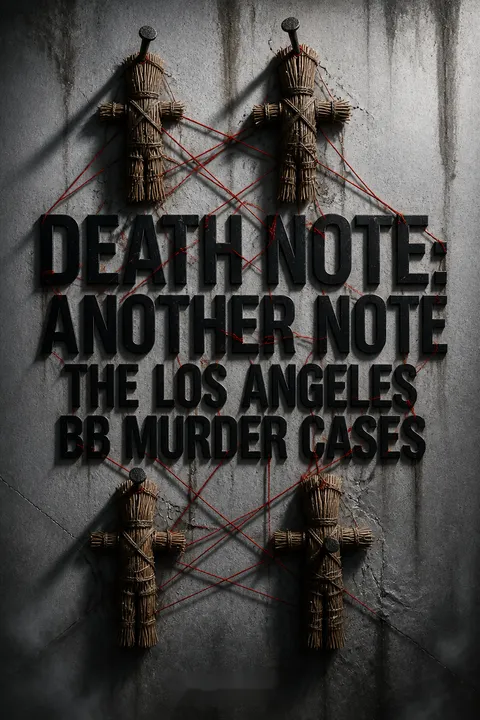
Count down and misdirectStraw dolls appear at each crime scene in decreasing numbers, creating the expectation that the killer4 has planned a fixed sequence. They also draw attention away from the nails that hold them to the walls. Those nails can serve as guides for thread in the locked-room mechanism, so the dolls function both as theatrical symbols and as practical components. Their shifting count supports the investigators’ predictions while concealing a weakness in the killer’s4 final design.
Encoded crime scenes
Turn objects into cluesEach early murder leaves a message assembled from the scene rather than written plainly. Roman numerals carved into a body point through book pages to Quarter Queen8. A pair of borrowed glasses leads toward Glass Station. At the third scene, a watch, the victim’s limbs, stuffed animals, and doll placements combine into a clock reading. The clues reward attention to absences and arrangements, while their increasing complexity lets the killer4 control the investigation’s pace.
Shinigami eyes
Reveal names and lifespansThe killer4 possesses an unnatural ability to see people’s names and remaining lifespans. This allows him to select victims and anticipate how they will respond to an attack. The ability gives him an informational advantage, but it does not supply emotional understanding or sound judgment. In the story, it explains the killer’s4 unusual confidence and his capacity to build a murder pattern around people he can identify at a glance.
The locked rooms
Hide a mechanical weaknessThe crime scenes appear sealed from within, encouraging speculation about keys and conventional locked-room tricks. In fact, thread and the nails holding the dolls can redirect force to turn a thumb latch from outside. The arrangement requires more than one doll, a constraint that becomes decisive when Misora1 realizes the fourth scene cannot use the same method. The locked rooms are both a repeated puzzle and the structural flaw in the killer’s4 plan.
Aliases and detective codes
Blur identity and allegianceL2 works through a concealed voice, while the supposed investigator Rue Ryuzaki3 adopts a name associated with detective identity. The aliases make the central contest harder to see, even as they turn names into a form of ambition and disguise. Mello’s5 account connects the case to Wammy’s House10, where children are raised in relation to L’s2 possible successors. Identity is therefore not merely hidden information; it is one of the stakes the characters are trying to claim.
Download PDF
Download EPUB
.epub digital book format is ideal for reading ebooks on phones, tablets, and e-readers.








