

Plot Summary
Roadside Mind
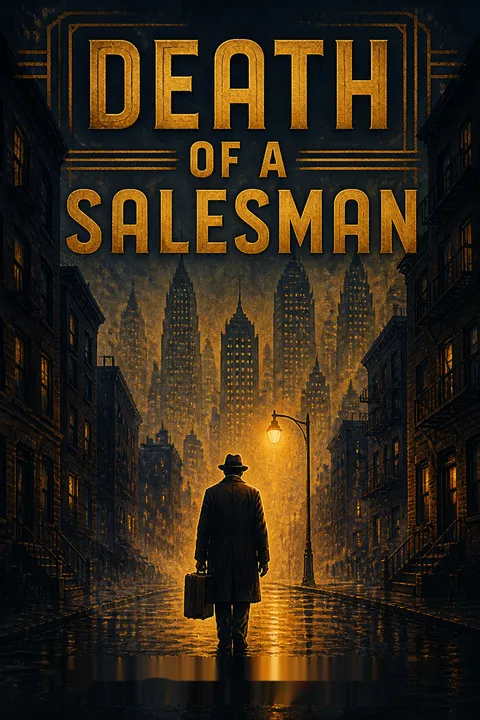
Willy Loman, an aging traveling salesman, returns to his Brooklyn home after losing focus at the wheel and nearly driving off the road. He admits to Linda, his worried wife, that stretches of the journey have vanished from his memory. He insists he is essential to his New England territory, though business has dwindled and the company pays him only on commission.
Their sons, Biff and Happy, are visiting, and Willy swings between scolding Biff for drifting through temporary jobs and boasting that the popular former athlete can still become a success. The crowded apartment buildings around the house have replaced the open yard Willy remembers. His exhausted body and collapsing confidence now intrude on the family future he keeps promising.
The opening makes a private crisis physically visible: Willy cannot reliably keep his car on the road, yet he still measures his worth by his ability to travel and sell. His insistence that he remains indispensable is not simple vanity. It protects him from a more frightening conclusion, that the work and identity supporting his family may have outlasted their usefulness. The boxed-in house externalizes this narrowing life, while his contradictory judgments of Biff reveal how urgently he needs his son to embody a success that will vindicate both of them.
Golden Boy Lessons
As Willy talks to himself, the present gives way to memories of Biff and Happy as admired schoolboys. Biff was a football captain, surrounded by friends, and Willy treated that popularity as better preparation for life than Bernard's careful studying.
When Bernard warned that Biff might fail mathematics, Willy brushed him aside and celebrated Biff's borrowed football and rough confidence. He also encouraged the boys to take risks and treated Biff's theft of the ball as harmless initiative.
In these memories, Willy's salesmanship becomes a family creed: being liked seems more powerful than discipline or honesty. The bright scenes are not neutral recollections. They are Willy's evidence that the boys once stood on the threshold of greatness and that he had known how to guide them.
Willy's remembered household is a training ground for the standards that later trap his sons. By praising attention, physical prowess, and social ease while dismissing Bernard's academic warning, he makes external approval look like reliable evidence of merit. His indulgence of Biff's theft further blurs the boundary between confidence and entitlement. The past therefore functions less as a record than as an argument Willy keeps making to himself. He selects the scenes that support his belief that his family was destined to rise, leaving the costs of his advice outside the frame.
Ben's Jungle Gospel
Willy's memories summon Ben, the brother who left home young and became rich after entering the African diamond trade. Ben's success embodies the abrupt fortune Willy imagines he missed when he chose salesmanship over joining him. The memory fades, but its promise of wealth without ordinary limits remains with Willy.
In the present, Linda tells Biff and Happy that Willy has been stripped of his salary and now borrows money from Charley while pretending it is his pay. She has also found a short length of rubber tubing attached to the gas heater, evidence that Willy has tried to end his life. She removes it each day, then secretly replaces it. Biff discovers the tube and takes it away, grasping that his father's danger is immediate.
Ben is less a fully available brother than a measuring instrument Willy uses against himself. His spectacular fortune gives Willy a simple story of missed opportunity, shielding him from less dramatic explanations for his distress. Linda's discovery breaks through that fantasy with material evidence: poverty, concealed borrowing, and a prepared means of self-destruction. Her daily removal and replacement of the tube captures the paralysis of loving someone whose despair she cannot openly name. Biff's decision to take it marks a shift from resentment toward responsibility, though responsibility alone cannot resolve the false ideals that produced their conflict.
The Recorder's Cold Welcome
The next morning, Willy leaves home believing Biff's visit to former employer Bill Oliver and his own appeal to Howard Wagner may finally stabilize the family. At the company office, Howard is absorbed in a new wire recorder, proudly playing recordings of his children.
Willy waits to ask for a local position because he can no longer manage the road, and reminds Howard that he served the firm for decades and knew Howard as a child. Howard refuses, saying there is no place for him, then dismisses him from the company altogether.
The recorder's mechanical voices interrupt Willy as he tries to appeal to the memory of Howard's father, who had once employed him. Sent away without a paycheck, Willy has lost both income and the status he thought loyalty had earned.
Howard's office stages a collision between two kinds of value. Willy understands employment as a relationship accumulated through years of service; Howard treats it as a present calculation of usefulness. The recorder intensifies the insult because Howard can preserve family voices mechanically while failing to hear the older man in front of him. Willy's appeal to personal history is sincere, but it also exposes his dependence on a promise the company never formally secured. His firing transforms the family's financial strain into a crisis of recognition: the institution that once gave his labor meaning now regards him as expendable.
Bernard's Missing Cause
After leaving Howard's office, Willy visits Charley's workplace and finds Bernard, Charley's once-studious son, now a successful lawyer preparing to argue a case before the Supreme Court.
Willy asks why Biff's life stalled after high school, and Bernard recalls that Biff initially intended to make up the mathematics credit he had failed. Instead, after visiting Willy in Boston, Biff returned home, burned his University of Virginia sneakers, and abandoned his plans.
Bernard cannot explain what happened during that visit, but his memory fixes the timing Willy has avoided confronting. Charley offers Willy a paid job and lends him money for the insurance bill. Willy accepts the cash but refuses the job, unable to bear working for the neighbor whose son has surpassed his own.
Bernard's success is not presented as proof that every life can be neatly mastered; it is a contrast that makes one missing cause impossible to ignore. His recollection links Biff's collapse not to the failed exam itself, but to the unexplained trip to Boston. Willy hears the question and recoils, revealing that his uncertainty is partly knowledge he will not examine. Charley's practical help offers a route to survival without requiring admiration. Willy refuses it because accepting ordinary assistance would puncture his preferred identity as a respected provider, even as he depends on Charley's money.
The Oliver Appointment
While Willy is at the office and Charley's, Biff waits for hours to see Bill Oliver, the sporting-goods businessman he once worked for. Oliver does not recognize him and leaves without offering money or a partnership.
In a panicked impulse, Biff takes Oliver's fountain pen, then runs from the office ashamed of having mistaken a vague old kindness for a real opportunity. At the restaurant, he tells Happy what happened and tries to explain that he was only a shipping clerk, not the rising salesman their father imagines.
Happy urges him to conceal the failure and invent a promising follow-up meeting. When Willy arrives, Biff cannot bring himself to tell him the truth; Happy's cover story feeds their father's hope just as Biff's honesty begins to surface.
Oliver's failure to recognize Biff destroys a story Biff had partly borrowed from his father: that old popularity can be converted into investment and status on demand. Taking the pen is a small, concrete repetition of the earlier thefts Willy excused, but now it leaves Biff ashamed rather than triumphant. Happy responds by preserving the lie, not because he believes it will solve the problem, but because he knows anticipation temporarily steadies Willy. The brothers diverge in their coping strategies: Biff wants the humiliating facts to end the fantasy, while Happy keeps the fantasy alive to avoid an immediate family reckoning.
Boston's Open Door
As Biff tries to tell Willy what happened with Oliver, the restaurant scene opens onto the memory Willy has spent years avoiding. After failing mathematics, teenage Biff traveled to Boston to ask his father to persuade the school to let him graduate.
He found Willy in a hotel room with a woman from the sales office. Willy tried to disguise her presence as a harmless business arrangement, but the woman emerged wearing stockings he had given her.
Biff saw the betrayal of Linda and the falseness beneath his father's authority; he rejected Willy's attempt to explain and left the hotel. Back in the restaurant, the memory overwhelms Willy while Biff, unable to reach him with the truth, walks out. Happy leaves with two women, abandoning his father there.
The Boston memory gives Biff's long estrangement a specific origin. His disillusionment is not merely a reaction to a disappointing father, but to the collapse of the moral authority Willy had built through confidence and praise. The stockings sharpen the betrayal by connecting an intimate act to Linda's frugality and loyalty. Willy's later distortions cannot erase what Biff saw, yet the memory has also trapped Biff in anger and shame. In the restaurant, the past interrupts the present precisely when Biff attempts honesty, while Happy's departure repeats the family's habit of avoiding painful reality rather than staying to face it.
The Hose On The Table
Biff returns home with the rubber tube he found in the cellar and confronts Willy while Willy is trying to plant seeds in the dark, determined to leave something growing behind him. Biff abandons the story of Oliver's investment and admits that he has failed at jobs, stolen, and never become the executive Willy expected.
He tells Willy he wants ordinary work and a life outdoors, not the business success his father keeps demanding. Biff breaks down as he insists that their shared failures do not erase his love. Willy mistakes the tears for proof that Biff is destined for greatness and imagines the insurance money will make him a hero in his son's eyes. He settles on suicide as a final provision for the family.
Biff's confession tries to replace performance with proportion. He does not claim a hidden talent or promise a future triumph; he names the limits of his abilities and his preference for work that fits him. His tears make the truth emotionally legible, but Willy translates them into the old language of recognition and future success. The mismatch is tragic because love is present, yet each man assigns it a different meaning. Willy's fixation on the insurance payment converts his life into a final transaction, an attempt to purchase the admiration that Biff is offering without conditions.
Twenty Thousand Dollars
After the household quiets, Willy meets the imagined Ben in his mind and weighs the insurance payment against Linda's suffering and Biff's future. Ben warns that the policy may not pay and frames the act as cowardice, but Willy keeps picturing the money as something tangible he can leave his son.
He imagines a crowded funeral that would prove he was known and valued, though he has no evidence that the buyers he remembers will come. Linda calls him toward bed. Willy leaves the house, gets into his car, and speeds away. The crash kills him. His family hears the car depart but cannot stop him; his last gamble has taken the life he meant to turn into a legacy.
Willy's final choice is built from the same confusion that has governed his career: he treats attention as proof of love and money as proof that his life mattered. The imagined funeral would stage a public audience large enough to silence his private doubts, while the policy seems to offer Biff a material inheritance in place of the relationship Biff has tried to repair. Ben's presence gives the decision the shape of a contest with the brother who became rich, but it cannot make the risk rational. Willy acts from desperation, not self-knowledge, and the result destroys the living bond he hoped to secure.
A House Without Willy
At the funeral, Linda, Biff, Happy, Charley, and Bernard gather at Willy's grave, but the crowds he imagined never arrive. Happy rejects Biff's judgment that Willy pursued the wrong dream and vows to prove his father was not defeated by staying in business. Biff chooses a different direction, recognizing that he and Willy were never suited to the same ambitions.
Charley defends the pressure carried by a salesman, whose livelihood depends on customers continuing to welcome him. Linda remains after the others leave, bewildered that Willy died just as the final mortgage payment made the house theirs. She can no longer make sense of freedom as a financial milestone when the person she built the home with is gone.
The sparse funeral gives Willy's imagined popularity a painful public test, but the play refuses to reduce his worth to attendance. Charley recognizes the occupational vulnerability Willy faced, while Biff sees the destructive cost of the ambition that shaped their family. Happy's decision to continue the contest shows how completely he has inherited Willy's measure of success. Linda's paid-off home makes the ending's irony concrete: the family has achieved the security it labored toward, yet the achievement arrives after its intended beneficiary is absent. Material completion cannot repair the relationships organized around deferred happiness.
Analysis
Death of a Salesman locates its tragedy in the gap between a person's human needs and the social measures he has learned to use in their place. Willy wants love, security, and a sense that his labor has mattered, but he pursues them through popularity, income, and the imagined applause of buyers. Because he treats those signs as proof of worth, economic decline becomes an assault on his identity rather than a change in circumstance. The play's shifting time makes the cost of this belief visible: the father who celebrated Biff's charisma and dismissed Bernard's warnings is shown beside the older man grieving Biff's failure, while the Boston betrayal explains why their bond broke. Willy's fantasies are not simply lies told for advantage. They are defensive constructions that let him endure humiliation, but they also keep him from receiving the affection already offered by Linda, Charley, and Biff. The family inherits different parts of his vision. Biff tries to reject the race for status and accept a life suited to him; Happy reproduces the competition in the hope of repairing his father's reputation. Linda's devotion and Charley's practical generosity offer alternatives based on care rather than performance, but neither can undo Willy's dependence on public recognition. The mortgage and funeral sharpen the play's central irony: material completion cannot compensate for a life organized around a future that never arrives. Miller's critique is not that ambition itself is false, but that a culture can make recognition conditional on market success, then persuade people to blame themselves when the promise fails. Willy's end is at once personal, familial, and social because the values that isolate him are shared by those who love him.
Review Summary
Death of a Salesman receives generally positive reviews, praised for its powerful critique of the American Dream and capitalism. Readers appreciate Miller's complex characters, especially Willy Loman, and the play's exploration of family dynamics and personal failure. Many find the dialogue and structure innovative, particularly the use of flashbacks. Some readers struggle with the depressing tone, but most consider it a classic of American theater. The play's themes of disillusionment, generational conflict, and the pursuit of success resonate strongly with many readers.
People Also Read










Characters
Willy Loman
The failing salesmanWilly is a traveling salesman who has built his identity around personal charm, business success, and the belief that his sons will surpass him. He wants to be remembered and valued, but he often confuses being admired with being loved. His stories about past prosperity and future triumph protect him from shame, while his changing judgments of Biff reveal how dependent he is on his son's success for a sense of his own worth. Willy can be generous, energetic, and deeply devoted to his family, yet his insistence on a narrow ideal of success makes it difficult for him to hear what they actually need.
Linda Loman
The family's steadfast witnessLinda is Willy's wife and the practical center of the Loman household. She tracks bills, repairs, and the fragile routines that keep the family functioning, while carefully managing Willy's pride and moods. Her loyalty is not passive: she challenges her sons to treat their father as a person in distress and insists that they recognize what he has given them. Yet her devotion also limits her ability to confront the stories Willy tells about himself. Linda's strength lies in sustained attention, an undervalued form of care in a family that keeps looking toward future achievement.
Biff Loman
The disillusioned eldest sonBiff is Willy and Linda's older son, once a celebrated high-school athlete whose adult life has moved through a series of jobs across the country. He is drawn to outdoor labor and physical work, but his father's expectations make him feel that an unambitious life is a disgrace. Biff carries both affection for Willy and anger at the standards Willy imposed on him. His bluntness can become cruel, especially when he sees the family retreating into fantasy, but beneath it is a serious attempt to name his own capacities and stop performing a future he does not want.
Happy Loman
The smiling younger sonHappy is Willy and Linda's younger son, a confident city worker who measures his progress through money, status, and sexual attention. His charm conceals loneliness and a fierce appetite for recognition. He wants Biff beside him, but he also competes for the approval their father lavishes on his brother. Happy frequently chooses evasion over honesty, smoothing over failures with new plans and flattering stories. His outward ease makes him seem more secure than Biff, yet he is deeply invested in the same success myth and struggles to imagine a life outside it.
Charley
The practical neighborCharley is the Lomans' next-door neighbor and Willy's dependable source of work, money, and unvarnished judgment. His laconic manner contrasts with Willy's need to impress, and he offers help without requiring the admiration Willy craves. Charley has raised Bernard with patience rather than constant direction, though he does not present himself as a perfect parent. His loyalty is expressed through practical acts, including lending money and offering Willy a job. He understands the hardship of sales work while resisting Willy's belief that personal worth depends on universal popularity.
Bernard
The overlooked schoolmateBernard is Charley's son and Biff's childhood neighbor. As a boy, he tries to warn Biff that neglecting school could keep him from graduating, but Willy dismisses him as insufficiently popular. As an adult, Bernard becomes a successful lawyer without boasting about his achievements. His careful memory helps Willy approach an episode he has avoided examining. Bernard's character is defined by steady effort and a willingness to care for Biff even when Biff treats him dismissively. He offers a quiet counterexample to Willy's belief that charm matters more than preparation.
Ben
The absent brother's legendBen is Willy's older brother, a successful adventurer whose brief visits and remembered exploits loom larger than his actual presence. He left home in search of their father and made a fortune in Africa's diamond trade. Willy regards him as proof that decisive risk can produce instant wealth, and repeatedly turns to his memory when his own life feels small. Ben's brisk certainty appeals to Willy because it offers uncomplicated answers. He is also a measure of what Willy believes he failed to become, rather than a model whose success Willy can realistically reproduce.
Howard Wagner
The modern company bossHoward is the younger head of the company where Willy has worked for decades. He is absorbed in new technology and treats business decisions as matters of present efficiency rather than personal obligation. Howard's history with Willy's family does not make him receptive to Willy's appeal for a less demanding position. He is not presented as a grand villain; his ordinary managerial self-interest is precisely what makes the rejection chilling. To Willy, Howard represents the company as a community that ought to remember loyalty. To Howard, the firm is a business that must keep moving.
The Woman
The Boston office clerkThe Woman is a clerk Willy meets while traveling for work in Boston. She enjoys his humor and gives him access to buyers, which reinforces his belief that charm can open professional doors. Her presence belongs to the private life Willy keeps separate from his image as a devoted husband and admired father. She is not developed beyond the relationship's effect on the Loman family, but her appearance exposes the distance between Willy's public lessons about honesty and his own conduct.
Jenny
Charley's office secretaryJenny works as Charley's secretary and tries to keep Willy's noisy visits from disrupting the office. Her reaction shows that Willy's private conversations have become visible to people outside his family.
Stanley
The accommodating waiterStanley serves the Lomans at the restaurant and treats Willy with small courtesies after the family gathering falls apart. His practical kindness contrasts with the sons' inability to remain present for their father.
Miss Forsythe
Happy's restaurant companionMiss Forsythe meets Happy and Biff at the restaurant. Happy uses his brother's old athletic reputation to impress her, making her part of the evening's performance of status.
Letta
The second restaurant guestLetta joins the restaurant gathering with Miss Forsythe and encounters Willy during the family's increasingly uncomfortable evening. Her brief presence helps expose how the sons prioritize flirtation over their planned time with their father.
Plot Devices
Fluid memory
Past invades the presentThe play shifts between the Lomans' present and Willy's memories without treating the past as a separate, orderly history. Younger Biff, Happy, Bernard, and Ben can appear beside the older characters, allowing a remembered school day or family scene to interrupt current events. This structure reflects Willy's mind, where recollection, wish, and fact blur together. It also makes cause and consequence visible at once: the confident father who dismissed Bernard's warning exists beside the adult son whose life remains unsettled. Memories are not reliable reports, but they gradually reveal what Willy cannot openly face.
The rubber tube
A concealed danger made tangibleThe short length of rubber tubing Linda finds near the gas heater gives physical form to the danger she has feared but cannot discuss openly with Willy. She removes it, then replaces it, caught between protecting him and avoiding a confrontation that might humiliate him. Biff later takes the tube and brings it into the family's argument, forcing Willy's hidden crisis into view. The object also reveals the limits of the family's care: everyone has sensed the danger, but knowledge and love do not automatically provide a way to stop it.
The seeds and garden
A last bid to leave somethingWilly's attempt to plant seeds in the small, light-starved yard is both a practical gesture and a symbol of his wish to produce something lasting. The house has been crowded by apartment buildings, and there is little room for the vegetables and trees he remembers. He reaches for gardening when his sales career has failed to provide a visible legacy. The seeds also connect the family's work on the house to Willy's final thoughts about what he can leave behind. His need to grow something becomes especially poignant beside his conviction that he has not built a secure future for his sons.
The wire recorder
Technology replaces human attentionHoward's wire recorder captures family voices and children's recitations, which he plays proudly in the office while Willy waits for a hearing. The device embodies a world that can preserve sound without offering genuine attention. Its recorded voices interrupt Willy's appeal to Howard and make his attempt to invoke the old employer's personal regard seem even more powerless. The recorder is not merely a modern gadget: it sharpens the generational divide between a salesman who believes work creates lasting human bonds and a manager who sees no obligation beyond current business needs.
The paid-off house
Security arrives too lateThe Loman house embodies Willy and Linda's long effort to achieve stability. Its mortgage, appliances, repairs, and installments shape repeated conversations about money, while the surrounding apartment buildings turn a once-open neighborhood into a constricted landscape. Linda's final mortgage payment appears to fulfill the family's practical goal, yet the house cannot provide the future Willy imagined: a home filled with sons and grandchildren. The house therefore records both real labor and deferred happiness. Its completion exposes the difference between owning a structure and securing the relationships that were supposed to make it a home.
FAQ
Synopsis & Basic Details
What is Death of a Salesman about?
- Faltering American Dream: The play centers on Willy Loman, an aging salesman, grappling with his perceived failures and the crumbling of his idealized vision of the American Dream.
- Family and Relationships: It explores the complex dynamics within the Loman family, particularly the strained relationships between Willy and his sons, Biff and Happy, and his devoted but often bewildered wife, Linda.
- Past vs. Present: The narrative weaves between Willy's present struggles and his memories of the past, revealing the roots of his disillusionment and the choices that led to his downfall.
Why should I read Death of a Salesman?
- Timeless Social Commentary: The play offers a poignant critique of societal pressures and the pursuit of success, themes that remain relevant and resonate with contemporary audiences.
- Complex Character Study: It delves into the psychological complexities of its characters, particularly Willy Loman, providing a deep exploration of human flaws, aspirations, and the search for meaning.
- Innovative Narrative Structure: Miller's use of flashbacks and hallucinations and stream-of-consciousness techniques creates a unique and engaging theatrical experience, blurring the lines between reality and illusion.
What is the background of Death of a Salesman?
- Post-War America: The play is set in post-World War II America, a time of economic boom and heightened consumerism, which fueled the pursuit of the American Dream.
- The Great Depression's Shadow: The lingering effects of the Great Depression, with its broken promises and economic anxieties, are subtly woven into the narrative, influencing Willy's perception of success and failure.
- Personal Inspiration: Miller drew inspiration from his own family experiences and observations of salesmen, imbuing the play with a sense of authenticity and emotional depth.
What are the most memorable quotes in Death of a Salesman?
- "Attention must be paid": Linda's plea highlights the need to recognize the worth and struggles of ordinary individuals, challenging the societal tendency to overlook those who don't achieve conventional success.
- "He had the wrong dreams. All, all, wrong": Biff's realization underscores the tragic consequences of pursuing a misguided vision of success, emphasizing the importance of self-awareness and authenticity.
- "A salesman is got to dream, boy. It comes with the territory": Charley's statement encapsulates the inherent vulnerability of salesmen, whose livelihoods depend on maintaining a facade of optimism and success.
What writing style, narrative choices, and literary techniques does Arthur Miller use?
- Non-Linear Time: Miller employs a non-linear narrative structure, seamlessly transitioning between past and present through flashbacks and hallucinations and Willy's fragmented memories, reflecting his mental state.
- Expressionistic Elements: The play incorporates expressionistic elements, such as the shifting set design and the use of music, to convey Willy's internal turmoil and the distorted nature of his perceptions.
- Lyrical Dialogue: Miller's dialogue often transcends naturalism, employing poetic language and heightened emotional expression to convey the characters' inner conflicts and the play's thematic concerns.
Hidden Details & Subtle Connections
What are some minor details that add significant meaning?
- The Rubber Hose: The rubber hose, initially a seemingly minor detail, becomes a potent symbol of Willy's suicidal intentions and Linda's desperate attempts to protect him, highlighting the family's unspoken anxieties.
- The Stockings: The stockings, a seemingly mundane item, represent Willy's infidelity and the betrayal of his marriage vows, revealing a hidden layer of guilt and moral compromise.
- The Seeds: Willy's late-night attempt to plant seeds symbolizes his desperate yearning for a tangible legacy and a sense of accomplishment, highlighting his failure to achieve lasting success in his career.
What are some subtle foreshadowing and callbacks?
- Car Accidents: Willy's repeated car accidents foreshadow his eventual suicide, revealing his subconscious desire for self-destruction and his inability to cope with his failures.
- Ben's Jungle: Ben's stories of success in the jungle foreshadow Willy's decision to take his own life, as he seeks a quick escape from his problems and a way to provide for his family.
- "Well Liked" vs. "Liked": The recurring distinction between being "well liked" and simply "liked" foreshadows Willy's tragic realization that his popularity is superficial and ultimately meaningless.
What are some unexpected character connections?
- Charley and Willy: Despite their contrasting personalities and values, Charley and Willy share a complex relationship, with Charley serving as a foil to Willy's self-delusions and offering him genuine friendship and support.
- Bernard and Biff: Bernard, initially portrayed as the "anemic" foil to Biff's athletic prowess, ultimately surpasses Biff in success, highlighting the limitations of Willy's emphasis on popularity and physical prowess.
- The Woman and Linda: The Woman, a figure from Willy's past, serves as a stark contrast to Linda's unwavering loyalty, revealing the depth of Willy's betrayal and the emotional toll it takes on his wife.
Who are the most significant supporting characters?
- Charley: Charley's pragmatic approach to life and his genuine concern for Willy provide a crucial counterpoint to Willy's self-destructive tendencies, highlighting the importance of honesty and hard work.
- Ben: Ben's presence as a symbol of success and adventure exacerbates Willy's internal conflict, tempting him with the allure of a quick escape and reinforcing his misguided belief in the American Dream.
- Linda: Linda's unwavering support and her silent suffering reveal the emotional toll of Willy's actions on his family, highlighting her strength and resilience in the face of adversity.
Psychological, Emotional, & Relational Analysis
What are some unspoken motivations of the characters?
- Willy's Need for Validation: Willy's desperate need to be "well liked" stems from a deep-seated insecurity and a desire to prove his worth, driving his relentless pursuit of the American Dream.
- Biff's Search for Identity: Biff's constant drifting and job changes reflect his struggle to define himself outside of his father's expectations and his yearning for a more authentic and fulfilling life.
- Happy's Desire for Approval: Happy's superficial achievements and his constant need for attention reveal his deep-seated insecurity and his desire to gain his father's approval, mirroring Willy's own misguided pursuit of success.
What psychological complexities do the characters exhibit?
- Willy's Delusions: Willy's inability to distinguish between reality and illusion, his constant flashbacks and hallucinations, and his distorted memories reveal a fragile mental state and a desperate attempt to escape his failures.
- Biff's Internal Conflict: Biff's struggle to reconcile his father's dreams with his own desires and his guilt over his past actions create a complex internal conflict that drives his search for self-discovery.
- Linda's Enabling Behavior: Linda's unwavering support for Willy, despite his self-destructive tendencies, reveals a complex mix of love, loyalty, and a fear of confronting the harsh realities of their situation.
What are the major emotional turning points?
- Biff's Confession: Biff's emotional confession to Willy about his failures and his inability to live up to his father's expectations marks a turning point, forcing Willy to confront the reality of his life.
- Willy's Firing: Willy's firing from his job shatters his remaining illusions of success and triggers a downward spiral, leading to his desperate attempt to secure his family's future through his life insurance.
- Linda's Revelation: Linda's revelation about Willy's suicide attempts and the rubber hose exposes the depth of his despair and the family's unspoken anxieties, highlighting the tragic consequences of his actions.
How do relationship dynamics evolve?
- Willy and Biff's Cycle: The relationship between Willy and Biff is characterized by a cycle of conflict and reconciliation, reflecting their shared struggle with the American Dream and their inability to communicate openly and honestly.
- Linda's Enabling Role: Linda's unwavering support for Willy, while seemingly selfless, inadvertently enables his self-destructive behavior, highlighting the complex dynamics of codependency.
- Happy's Superficiality: Happy's attempts to please his father and his superficial relationships with women reveal his own insecurities and his inability to form genuine connections, mirroring Willy's own flawed approach to life.
Interpretation & Debate
Which parts of the story remain ambiguous or open-ended?
- Willy's True Potential: The extent of Willy's potential as a salesman and the reasons for his failure remain ambiguous, leaving the audience to question whether his downfall was due to his own flaws or societal pressures.
- Biff's Future: Biff's decision to leave home and pursue a more authentic life leaves his future open-ended, raising questions about whether he will truly escape the cycle of disillusionment and find lasting happiness.
- The Nature of the American Dream: The play's critique of the American Dream is open to interpretation, prompting debate about whether the dream itself is inherently flawed or whether it is the pursuit of it that leads to tragedy.
What are some debatable, controversial scenes or moments in Death of a Salesman?
- Willy's Affair: Willy's affair and his gift of stockings to The Woman are controversial, raising questions about his moral character and the impact of his actions on his family.
- Linda's Enabling Behavior: Linda's unwavering support for Willy, despite his self-destructive tendencies, is debatable, with some arguing that she enables his behavior while others see her as a victim of his delusions.
- The Ending: The ending, with Willy's suicide and Linda's final words, is open to interpretation, prompting debate about whether it represents a tragic defeat or a form of twisted triumph.
Death of a Salesman Ending Explained: How It Ends & What It Means
- Willy's Suicide: Willy's decision to take his own life is driven by a combination of despair, guilt, and a misguided belief that his death will provide his family with financial security, highlighting the tragic consequences of his flawed values.
- The Funeral's Emptiness: The small, somber funeral underscores the emptiness of Willy's dreams and the superficiality of his relationships, revealing the hollowness of his pursuit of the American Dream.
- Linda's "Freedom": Linda's final words, "We're free," are deeply ironic, as they highlight the tragic cost of their financial freedom and the profound loss of Willy's life, leaving the audience to question the true meaning of success and happiness.
About the Author
Other books by Arthur Miller



Download PDF
Download EPUB
.epub digital book format is ideal for reading ebooks on phones, tablets, and e-readers.








