

Key Takeaways
Build a team, not a private monument to your own brilliance.
The lone genius is a myth. Software heroes such as Linus Torvalds and Steve Jobs are often credited as if they created world-changing products alone. The book argues that their larger achievement was coordinating people whose combined work made those products possible. Linux began as Torvalds’s small kernel project, then grew through the contributions of many programmers. The Chicago Bulls offer the same lesson: Michael Jordan was extraordinary, but championships depended on the whole team and its coaching.
Collaboration improves the work. A team can catch design mistakes, share expertise, and keep a project moving when someone leaves. Technical skill matters, but it cannot guarantee that a product is useful or that a team can deliver it. The goal is not to diminish individual talent. It is to make talent work together.
What's striking is how easily people mistake a visible leader for the whole production system. The same pattern appears in science, film, and business, where public credit clusters around a few names while coordination and maintenance disappear from view. That matters because credit shapes what newcomers try to imitate. Still, collaboration is not automatically better: a small, well-bounded task may benefit from solo concentration. The practical question is not whether work is individual or collective, but when another perspective would reduce risk or improve the result.
Share rough work early to catch wrong turns before they become expensive.
Feedback limits wasted effort. Programmers rarely write thousands of lines and compile only at the end. They work in small loops, checking and correcting as they go. The authors argue that projects need the same habit. A bicycle enthusiast who hides a new gear design for months may miss an obvious flaw that a friend could spot in a week. Early sharing also helps reveal whether the idea solves a real problem or duplicates existing work.
Spread project knowledge. The bus factor is the number of people who could disappear before a project becomes unable to continue. If only one person understands a system, a departure can put the work at risk. Shared reviews, documentation, and small, visible contributions make projects less dependent on any single person.
Short feedback loops are a form of risk management, not merely a preference for collaboration. They expose mistaken assumptions while the cost of changing direction is still low, much as prototypes do in product design. Shared knowledge also makes a project resilient to ordinary life events, not just dramatic emergencies. The qualification is important: early feedback should be targeted. Broadcasting every tentative thought can create noise or premature criticism. A useful team makes it safe to share unfinished work while choosing reviewers and timing deliberately.
Use humility, respect, and trust to make disagreement productive.
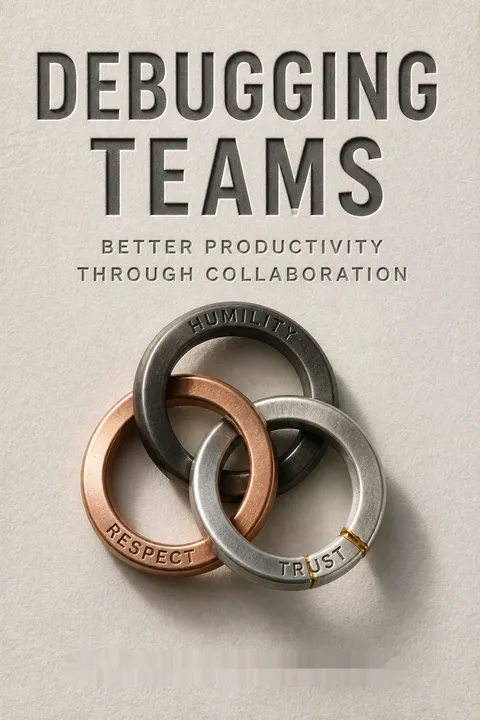
HRT names the foundation. The authors use HRT for humility, respect, and trust. Humility means recognizing fallibility and staying open to improvement. Respect means treating colleagues as people whose abilities and work matter. Trust means believing others can act competently and allowing them room to do so. Together, these principles help distinguish criticism of work from an attack on the person who made it.
Make feedback usable. Instead of declaring a colleague wrong, describe what is unclear and offer a possible improvement. That keeps attention on the work and lets the other person consider the suggestion without defending their worth. The same humility applies to failure: document what happened, what was learned, and what will change, rather than turning a postmortem into a list of excuses or culprits.
HRT is useful because it converts a vague demand to be nice into recognizable behaviors: invite correction, speak about the work rather than someone’s character, and grant reasonable autonomy. These behaviors resemble psychological safety, the shared sense that people can ask questions or admit mistakes without humiliation. Safety, however, is not the same as comfort or agreement. Teams still need standards, deadlines, and accountability. Respectful candor works best when the criteria for good work are explicit, so feedback is not mistaken for personal preference.
Write down the team's purpose, norms, and decisions before confusion compounds.
Culture is practiced daily. The book compares team culture to a sourdough starter: founding members establish habits that newcomers encounter and may continue. Culture includes how work is reviewed, how people resolve disagreement, and even recurring social rituals. If a team does not define its norms, stronger personalities can shape them by default.
Make direction explicit. When Google’s Web Toolkit team wrote a concise mission statement, the discussion exposed that its senior engineers disagreed about the product’s direction. The resulting statement clarified both the goal and what the team would not pursue. The authors also recommend choosing communication channels intentionally: use meetings for a small group that needs to decide together, and written channels for broader updates and an accessible record of decisions.
Written norms and decisions reduce reliance on memory, status, and hallway access. This is especially valuable for distributed teams, where an undocumented choice can quietly become a private decision. A mission statement also functions as a boundary: it helps a team say no to work that does not fit. But culture fit can become a polite label for exclusion if it means hiring people who resemble existing members. The stronger test is whether newcomers can understand the norms, question them, and improve them without having to mimic the founders.
Lead by clearing obstacles, then let capable people own the route.
Leadership is service. A servant leader provides direction and removes barriers without taking over every decision. The authors contrast this with supervision based on monitoring hours or controlling methods. One new employee had been conditioned by a previous manager to apologize for leaving work shortly before five. His new lead told him that results mattered more than sitting at his desk until a particular time. The employee was trusted to do his job, and did.
Motivation needs different inputs. Drawing on Daniel Pink, the book highlights autonomy, mastery, and purpose: room to make decisions, chances to develop skills, and a clear reason the work matters. Team members need different amounts of guidance and encouragement, much like plants with different needs. Leaders should also set clear goals, coach struggling performers, and make sure people know when their work is valued.
The shift from controlling activity to enabling outcomes fits creative work, where leaders rarely know every technical detail better than the people doing the work. Autonomy can increase ownership, while coaching and recognition help people grow. Yet autonomy is not a universal dose: a new hire, an unclear assignment, or a serious performance problem may call for more structure. The useful distinction is between support that builds capability and control that substitutes for it. Effective delegation changes with a person’s skill, the task’s risk, and the clarity of the goal.
Correct damaging behaviors without turning coworkers into permanent villains.
Protect attention and focus. The book uses poisonous person as shorthand for someone behaving in ways that drain a team, but recommends addressing behavior rather than labeling a whole person as bad. Disruptive patterns include repeatedly reopening settled decisions, demanding that others do basic research, or polishing a design so long that work never begins. In one project, a frequent poster consumed much of the core team’s time because contributors spent so many messages responding to him.
Respond proportionately. A perfectionist may be redirected toward another problem once a workable design is ready. A troll seeking a reaction may be best ignored. A colleague who does not realize that their remarks alienate others may benefit from a private, clear conversation. If repeated attempts do not change the behavior, a team may need to set firmer limits to protect its work.
Behavior-based language leaves room for correction and reduces the temptation to turn conflict into a battle between good people and bad people. It also makes the standard more observable: the issue is the repeated interruption or the stalled decision, not a guessed motive. This approach benefits from specificity and fairness. A single awkward remark or unpopular dissent should not be treated as a pattern. Teams should describe the impact, explain the expected alternative, and distinguish persistent harm from ordinary disagreement.
Spend political capital on changes that make valuable work possible.
Influence is part of the job. The authors call accumulated goodwill and favors a political bank account. Helping another team, making a useful connection, or taking on an extra responsibility can build relationships that later help a project move. Organizational influence need not mean deception. It can mean finding a practical route through bureaucracy, replacing a bad process with a better one, or explaining progress clearly to a manager.
Make effort legible. The book distinguishes visible product work, such as new features, from defensive work, such as refactoring and reliability improvements. It warns that teams can lose support if they do only maintenance that outsiders cannot see. The suggested balance is to avoid spending more than roughly one-third to one-half of effort on defensive work. For a busy executive, it recommends a short request with at most three concise points and one clear action.
Organizational influence is a form of coordination, and refusing to engage with it does not make its effects disappear. Visibility can protect good work and help teams obtain resources. The tension is that visible features can crowd out less glamorous reliability work, even when reliability is essential. The suggested fraction is a heuristic, not a law: a team stabilizing a failing service may rationally spend most of its effort defensively. The stronger principle is to connect maintenance to consequences users and decision-makers can understand.
Make the first minute useful, welcoming, and fast.
First use shapes perception. A product can be powerful and still lose users if getting started feels confusing. The authors describe Ben’s first encounter with vi, which required an unfamiliar mode before he could edit text, and his more comfortable first experience with Emacs. That initial ease influenced which editor he chose. They also point to products that reduce setup effort, such as TripIt, which turns forwarded travel confirmations into an itinerary.
Remove friction deliberately. Test the first few minutes with people who are not on the development team. Look for unnecessary forms, confusing defaults, and options that make a simple task feel difficult. Speed matters too: the book estimates that reducing a screen load from 750 milliseconds to 250 milliseconds across a million users making 20 requests daily would save a combined 116 years of waiting.
A first-use experience is a small experiment in whether a product earns continued attention. Familiar defaults, low setup costs, and responsive interfaces reduce the effort required to discover value. This connects usability to behavioral economics: people often abandon an option when its immediate cost is obvious and its benefit is still uncertain. Still, friction is not always waste. Security, informed consent, or a consequential setup choice can justify extra steps. The design task is to remove pointless effort without hiding decisions users need to make knowingly.
Treat launch as the start of listening, not the end of building.
Usage beats download counts. A product with many installations may still have few active users. The book recommends tracking measures such as seven-day and 30-day activity to see whether people return. It also urges teams to let users report problems and receive direct, human responses instead of disappearing into layers of bureaucracy.
Trust accumulates, then can break. Netflix had more than 23 million subscribers before a price change that raised costs by as much as 60 percent for some customers and a proposed split between its streaming and DVD services. The company lost 800,000 subscribers over three months. The authors use this episode to show how business decisions that ignore customers’ experience can damage a relationship built over years. Listening does not require accepting every feature request; it requires understanding what users are trying to do.
A launch is not a verdict because products continue to meet users in changing contexts. Active use reveals more than a download total, while direct feedback can explain why engagement rises or falls. The Netflix example also shows that customers interpret changes relationally, not only mathematically: a price may be defensible on paper and still feel like a breach of expectations. Metrics need interpretation, however. Usage can reflect habit or lack of alternatives, so qualitative feedback and the ability to leave are important checks on whether a product genuinely serves people.
Analysis
Debugging Teams reframes software development as a social system whose quality depends on how people coordinate, learn, and respond to one another. Its central contribution is not a technical workflow but a practical vocabulary for recurring human problems. HRT gives individuals a quick diagnostic for conflict. Team culture, communication practices, leadership, organizational influence, and user relationships then extend the same concern across increasingly broad circles of work.
The book is strongest when it translates values into observable actions. Critique the artifact without humiliating its maker. Write a mission statement to expose disagreement. Record failures so they change future practice. Give a colleague autonomy, but remove obstacles and provide clear goals. These examples make collaboration less sentimental and more operational. The stories also preserve an important distinction: a team is not productive simply because its members get along. It must direct its social effort toward building and improving something useful.
Its advice about organizational politics is unusually candid for a book aimed at engineers. Visibility, favors, and relationships affect whether good work survives, even when a company claims to reward merit alone. That realism is valuable, though the emphasis on visible product work carries a risk: maintenance, accessibility, and reliability may be undervalued precisely because their success looks uneventful. Leaders need to translate invisible work into consequences, not abandon it for showier output.
The book also offers principles more than universal rules. A meeting limit, a communication channel, or a preferred balance between maintenance and features depends on the task and team. HRT is a compass, not a substitute for expertise, boundaries, or accountability. Its enduring message is that people are neither distractions from the product nor a resource to be managed mechanically. Their trust, knowledge, and attention are part of the product-making system itself, and deliberate collaboration is how that system becomes more capable.
Review Summary
Debugging Teams receives mostly positive reviews, praised for its practical advice on team leadership and collaboration in software engineering. Readers appreciate the focus on humility, respect, and trust. Many find it valuable for both managers and individual contributors. Some critics note that experienced leaders may find the content basic. The book is commended for its readability and real-world examples. Several reviewers mention it would have been helpful earlier in their careers. A few note that it's an update of a previous book, "Team Geek."
People Also Read









Glossary
HRT
Three collaboration principlesHRT stands for humility, respect, and trust. Humility means accepting that one can be mistaken and remaining open to improvement. Respect means treating colleagues as people whose abilities and contributions matter. Trust means believing others can act competently and giving them room to do so. The authors use these principles to understand conflict and guide collaboration.
bus factor
Project knowledge resilienceThe bus factor is the number of people who would need to become unavailable before a project could no longer continue effectively. A low bus factor means essential knowledge or responsibility is concentrated in very few people. Shared documentation, review, and collaboration raise the number and make a project less vulnerable to departures or other unexpected absences.
servant leadership
Leadership through team serviceServant leadership is an approach in which a leader supports the team by clarifying direction, removing obstacles, and attending to both technical and social needs. Rather than micromanaging how capable people do their work, the leader creates conditions for them to make decisions and take responsibility. The role still includes coaching, accountability, and addressing problems.
poisonous person
Disruptive behavior patternThe book uses poisonous person as shorthand for someone whose behavior repeatedly drains a team’s attention, trust, or ability to make progress. The authors caution against treating the label as a verdict on someone’s character. They recommend identifying and addressing specific behaviors, such as derailing decisions or wasting others’ time, and setting limits if those behaviors persist.
political bank account
Accumulated organizational goodwillThe political bank account is a metaphor for goodwill and influence built through useful relationships and favors at work. Helping colleagues, sharing knowledge, or solving an unassigned problem can create goodwill that may make future requests easier. The account can also be spent when advocating for a change or challenging a decision, so the authors advise choosing important battles.
Three Bullets and a Call to Action
Concise request email formatThis is the authors’ format for asking a busy person for help by email. It limits the message to at most three short points explaining the issue and one clear request. The goal is to make the email quick to understand and easy to forward or answer. Extra background, if essential, belongs after the main request.
Imposter Phenomenon
Doubt despite evidence of competenceThe Imposter Phenomenon describes feeling like a fraud despite evidence of achievement or ability. The book notes that the feeling is common among people newly given leadership responsibilities. Rather than treating the doubt as proof of unfitness, a person can acknowledge uncertainty, act responsibly, and learn through the role while remaining open to feedback.
Offensive versus defensive work
Features versus product maintenanceOffensive work advances visible, user-facing product capabilities, such as a new feature. Defensive work protects long-term product health through tasks such as refactoring, migrations, and reliability improvements. The distinction helps teams explain why maintenance matters, while recognizing that outsiders may more readily notice new features. The authors suggest balancing both rather than allowing maintenance to consume all effort indefinitely.
FAQ
What's "Debugging Teams: Better Productivity through Collaboration" about?
- Focus on Collaboration: The book emphasizes the importance of collaboration in software development, highlighting that great products start and end with the people and organizations that build them.
- Human Factors: It explores the human side of creative product development, focusing on the social skills necessary for effective teamwork.
- Team Dynamics: The authors discuss how to build and maintain a productive team culture, emphasizing humility, respect, and trust (HRT) as foundational principles.
- Practical Advice: It provides practical strategies for dealing with common team challenges, such as handling difficult people and navigating organizational politics.
Why should I read "Debugging Teams: Better Productivity through Collaboration"?
- Improve Teamwork: The book offers insights into improving collaboration and productivity within teams, which is crucial for anyone involved in software development or any team-based creative work.
- Learn from Experts: Written by experienced software engineers, Brian W. Fitzpatrick and Ben Collins-Sussman, it draws on their extensive experience in leading successful teams.
- Practical Solutions: It provides actionable advice and real-world examples to help you address common team challenges and improve your team's effectiveness.
- Broader Application: While focused on software development, the principles and strategies discussed are applicable to any team-based environment.
What are the key takeaways of "Debugging Teams: Better Productivity through Collaboration"?
- HRT Principles: Emphasize humility, respect, and trust as the core principles for successful teamwork and collaboration.
- Team Culture: Building a strong, self-selecting team culture is crucial for long-term success and productivity.
- Leadership Role: Effective leaders serve their teams by removing obstacles and empowering team members, rather than micromanaging.
- User Engagement: Successful product development involves ongoing collaboration with users, focusing on their needs and feedback.
How does "Debugging Teams" define the "Genius Myth"?
- Misconception of Individual Genius: The book challenges the idea that individual brilliance is the key to success, emphasizing that software development is a team sport.
- Team Effort: It highlights that even renowned figures like Linus Torvalds and Steve Jobs succeeded through leading and collaborating with teams.
- Insecurity and Isolation: The myth often leads to insecurity and a tendency to work in isolation, which the authors argue is counterproductive.
- Collaboration Over Isolation: The book advocates for sharing ideas early and often to benefit from collective wisdom and avoid common pitfalls.
What is the "HRT" framework in "Debugging Teams"?
- Humility: Recognize that you are not the center of the universe, and be open to self-improvement and learning from others.
- Respect: Treat others as human beings, appreciating their abilities and accomplishments, and fostering a supportive team environment.
- Trust: Believe in the competence of your teammates and be willing to let them take the lead when appropriate.
- Conflict Resolution: The book suggests that most social conflicts can be traced back to a lack of humility, respect, or trust.
How does "Debugging Teams" suggest dealing with "Poisonous People"?
- Identify Behaviors: Focus on identifying and addressing negative behaviors rather than labeling individuals as "poisonous."
- Fortify Team Culture: Build a strong team culture that naturally repels negative behaviors and attracts positive contributors.
- Redirect Energy: For perfectionists or overly critical individuals, redirect their energy towards constructive tasks that benefit the team.
- Maintain Calm: Stay calm and factual when dealing with difficult individuals, and know when to disengage if the situation is unresolvable.
What strategies does "Debugging Teams" offer for organizational manipulation?
- Understand the System: Recognize the rules and dynamics of your organization, and learn which can be bent or broken to achieve your goals.
- Build Alliances: Cultivate relationships with influential people within the organization to help navigate bureaucratic obstacles.
- Manage Upward: Ensure that your achievements and contributions are visible to those in higher positions, and communicate effectively with management.
- Plan B: If all else fails, the book advises considering leaving the organization for a better environment where you can thrive.
How does "Debugging Teams" address the importance of user engagement?
- User-Centric Focus: Emphasize the importance of focusing on user needs and feedback to guide product development and improvements.
- First Impressions Matter: Ensure that the initial user experience is positive and intuitive to encourage continued use and engagement.
- Measure Usage: Focus on actual usage metrics rather than just download numbers to gauge the success and impact of your product.
- Build Trust and Delight: Foster a relationship of trust with users by being responsive, transparent, and occasionally delighting them with unexpected positive experiences.
What are the best quotes from "Debugging Teams" and what do they mean?
- "Engineering is easy. People are hard." This quote underscores the book's central theme that the technical aspects of software development are often less challenging than managing the human dynamics involved.
- "Software development is a team sport." It emphasizes the importance of collaboration and teamwork in achieving successful outcomes in software projects.
- "Failure is an option." This encourages teams to embrace failure as a learning opportunity and to take risks that can lead to innovation and growth.
- "Focus on the user, and all else will follow." This highlights the importance of prioritizing user needs and feedback in the development process to ensure long-term success.
How does "Debugging Teams" suggest building an awesome team culture?
- Define Culture: Establish a clear and strong team culture that aligns with the values and goals of the team, and is resistant to negative influences.
- Self-Selecting Teams: Encourage a culture that naturally attracts like-minded individuals who share the team's values and work ethic.
- Communication Patterns: Implement effective communication practices, such as regular meetings, design docs, and open channels for feedback and discussion.
- Mission Statement: Develop a concise mission statement to guide the team's direction and decision-making, ensuring alignment and focus.
What role does leadership play in "Debugging Teams"?
- Servant Leadership: Leaders should focus on serving their teams by removing obstacles, providing support, and empowering team members to succeed.
- Ego Management: Effective leaders manage their egos, prioritize team success over personal recognition, and foster a culture of collaboration.
- Catalyst for Change: Leaders act as catalysts for positive change, helping the team navigate challenges and seize opportunities for growth.
- Mentorship and Growth: Leaders should mentor team members, providing opportunities for learning and development to enhance team capabilities.
How does "Debugging Teams" address the challenge of managing public perception?
- Marketing's Role: Acknowledge the importance of marketing in shaping public perception and work collaboratively with marketing teams to ensure accurate representation.
- First Impressions: Pay attention to the initial user experience and presentation of the product to create a positive and lasting impression.
- Underpromise and Overdeliver: Set realistic expectations and exceed them to build trust and credibility with users and stakeholders.
- Engage with Analysts: Work respectfully with industry analysts and media to ensure fair and accurate coverage of your product and its capabilities.
Download PDF
Download EPUB
.epub digital book format is ideal for reading ebooks on phones, tablets, and e-readers.








