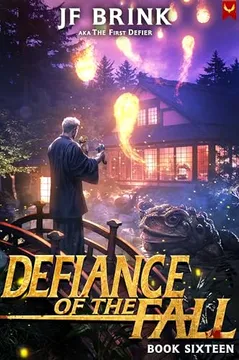


Plot Summary
A Lantern Finds Zac
As the trial begins, Esmeralda2 rides beside Zac1 through a river of memory lanterns and glimpses the ancient continent ahead as a vast altar, chained against the flow of Time. She spots one unusually bright lantern tied to a clue she cannot reach, so she guides Zac’s1 frozen body toward it.
The lantern pulls him into the life of Terea Wendimar,10 a young cultivator trapped inside a besieged imperial outpost. Her father, Kristvan,9 has stayed behind as the surrounding land sickens and an enormous tide of beasts and forest spirits closes in. Zac1 awakens inside her cultivation chamber while she tries to complete a breakthrough. The attack reaches the base before her training is finished.
The book opens by making history an active environment rather than a record. Esmeralda can perceive the design but cannot enter it alone; Zac can act, but only by accepting another person’s memories as part of himself. This asymmetry establishes their partnership and the trial’s central tension: every opportunity to alter the past may also bind the traveler to consequences he cannot see. Terea’s endangered breakthrough gives the cosmic machinery a human scale. The grand altar matters because a father is trying to buy his daughter a few more minutes.
Kristvan Buys Her Time
Zac1 and Terea10 share consciousness as Kristvan9 fights the invasion alone. When beasts breach the defenses, Zac1 emerges from the chamber and uses Terea’s10 fury to destroy the intruders, but the larger tide still surrounds the base. Kristvan9 gives his daughter10 the Wendimar Clan Seal and explains that her family has preserved a rare Imperial Merit for an Eonic Seed.
Then he uses his own life and Inner World to break the spatial blockade, sending her through a tear before the attackers can reach her. Zac1 later finds that his intervention let Terea10 say goodbye, strengthening the seal’s Imperial Destiny. He escapes the hostile forest and reunites with Esmeralda,2 carrying both Kristvan’s9 gifts and the grief of a borrowed daughter.10
Kristvan’s sacrifice turns inherited status into an obligation rather than a privilege. He gives Terea a future not by defeating the army, but by spending everything he has to make one narrow exit. Zac’s participation complicates that act: he does not merely observe a memory but lends Terea enough agency to resolve a regret her original life left unfinished. The resulting Imperial Destiny suggests that the trial rewards more than victory. It responds to changed relationships, particularly when power is used to preserve another person’s choices.
The Mayor’s Golden Bargain
Still recovering from his breakthrough, Zac1 travels toward the Lower Courts while Esmeralda2 searches for her own lost clue. In Black Zenith, a city built on the skull of an ancient beast, Mayor Truga Ur mistakes Zac’s1 borrowed Wendimar identity for a chance to inflate local property values.
Zac1 recognizes the scheme and forces the mayor to pay for using the clan name, trading unusually pure pills for six vats of Zenith Elixir. The exchange reveals how the Limitless Empire’s planned road is already changing energy flows and unsettling settlements.
Zac1 accepts the elixir because both bodies need repair after the Imperial Graveyard. He also sees that memory identities can open doors, though they do not erase his real nature or make the locals mindless puppets.
Black Zenith makes the Empire’s immense design legible through an ordinary local scam. A road meant to reshape a continent produces rumors, speculative buying, and a mayor trying to sell land before the public learns the route changed. Zac benefits from his borrowed family status, but he does not confuse access with moral authority. His bargain is pragmatic and faintly uncomfortable: he understands the town’s hope is being manipulated, yet chooses not to expose the lie because it is already ancient history to him.
The City Falls Backward
Zac1 and Esmeralda2 absorb the Zenith Elixir to restore their damaged foundations. The potent mixture drives Zac’s1 Void Emperor Bloodline awake, and his attempt to channel the resulting energy tears through the mayor’s mansion.
Truga protects him inside a containment formation while the memory city begins to fade from the strain. Zac1 leaves without revealing that the Imperial Road will bypass Black Zenith; he offers the townspeople reassurance instead. Once he and Esmeralda2 cross the chain bridge, the settlement is erased by time, leaving only small crags and a shower of lanterns.
The episode confirms that memory realms can collapse when their stored faith is drained. Zac1 also learns that his Void abilities remain weakened and that his damaged Cosmic Core needs a rarer repair than elixir can provide.
The collapse converts a lucky visit into a moral test. Zac has enough knowledge to puncture the town’s optimism, but no power to change its ancient outcome, so he chooses not to turn departure into needless despair. His destructive recovery also shows how easily a cultivation advantage can become collateral damage. The city is not merely scenery consumed by a stronger protagonist; its disappearance is a measurable cost of using a memory. The trial asks Zac to distinguish meaningful intervention from appetite.
Joanna Holds the Front
Following a signal from his Atwood tracking device, Zac1 enters a memory of a beast tide and finds Joanna5 fighting among Imperial soldiers. He joins her defense, kills attacking Beast Kings, and earns the chance to form a Warbringer Idol by holding to his own path amid the slaughter.
A suspicious general then accuses Zac1 of involvement in the theft of three Templar relics, because his presence triggers the general’s faith-detecting rosary. Joanna5 vouches for him, but the general plans to summon a Cardinal. Rather than submit to a search, Zac1 and Joanna5 enter a ruined city under the pretext of helping locate the relic. Zac1 finds it hidden with a dying thief, then escapes the memory with Joanna5 as Monarchs attack.
This turning point binds Zac’s inward cultivation to outward conflict. The Warbringer Idol forms not in a quiet chamber but while he fights beside Joanna, making battle a condition of self-recognition. The relic accusation then exposes the danger of being legible to institutions whose rules Zac does not understand. Joanna’s loyalty buys time, but not safety. Their escape depends on treating the investigation as both a real threat and an opportunity, a recurring pattern in a trial where moral action and tactical survival rarely separate cleanly.
Three Paths Diverge
Elsewhere in the trial, Ogras3 tracks down Iz Tayn and offers to accompany her toward the Farsee Court, believing Zac’s1 followers should complete the court cycle. Iz accepts his help and grows curious about the conviction that lets him trust Zac’s1 chaotic plans.
Rhubat, captured by the powerful insectoid Wrani,16 hears her argue that the Zhix should preserve their communal nature rather than imitate human cultivation. Wrani16 destroys Rhubat’s draft manual and offers a different future for the species, but her methods are brutal.
Meanwhile, Rhuger, a young shadow cultivator, spends days afraid to leave a safe city’s glow before finally taking a step into the dark. Their separate choices show the trial testing not only strength, but the kind of society and self each traveler is willing to defend.
These parallel stories widen the trial beyond Zac’s personal ascent. Iz confronts the limits of inherited planning, while Ogras offers a form of faith grounded in absurd experience rather than evidence. Rhubat faces the danger of cultural assimilation and the seduction of a powerful leader who claims to restore tradition. Rhuger’s hesitation is quieter: he fears the repeated violence will hollow him out. Together, the episodes ask whether adaptation is survival, betrayal, or both, and whether courage means acting despite fear or refusing another person’s definition of strength.
The Earth Remembers
A second memory brings Zac1 into Tam Brooks, an aging veteran who once served the Phoenix Legion. Tam is ordered to escort Roan,11 a strange child, after Templar priests die protecting him from Technocrat pursuers. Roan11 recognizes a replica of Zac’s1 hidden Void relic and claims the Earth remembers Zac1 taking it. Zac’s1 suspicion deepens when Roan11 leads him to the grave that marked the memory’s entrance.
There, Roan11 reveals the relic is a Fuxi Mountain Gate, a bridge that once connected the continent to the Void. Zac1 survives a renewed Technocrat attack, helps Roan11 transform, and receives the gate’s restored opening and a Fertile Earth seal. The memory ends with Tam’s original sacrifice, then Zac1 reappears beside Ogras3 and Ventus.4
Tam’s story makes memory more dangerous than a simulation: Zac’s actions alter a past that can recognize him and respond. Roan’s cryptic knowledge forces Zac to confront the possibility that the continent itself has a memory or consciousness. The gate offers immense power, but its significance lies in what it connects and in the danger of changing its history. Zac’s choice to protect Roan earns him access, yet the price is a new entanglement with the Fifth Pillar’s machinery.
A Crocodile Breaks Free
Reunited, Zac,1 Ogras,3 and the numerologist Ventus4 cross a shadow realm in which rain and terrain shift between layers. They discover a deadly hot spring and lure out an ancient crocodile whose shadow bloodline can strengthen Ogras.3
Their hunt destabilizes the realm, and a colossal ancestor rises from beneath the water before a buried weapon forces it back down. The ancestor’s roar nearly overwhelms Zac1 and knocks Ventus4 unconscious, but it gives Zac1 the insight needed to advance his Evolutionary Technique.
Ogras3 emerges from his cocoon with a more resilient shadow body and the ability to consume other shadows. Ventus’s4 calculations then guide them onward, while Zac1 begins rebuilding his damaged core and preparing to investigate a suspicious mining region.
The crocodile hunt is an alliance built on complementary risk. Zac supplies force, Ogras supplies shadow craft, and Ventus turns observation into a route through a shifting landscape. Their success is not clean: they awaken a greater threat and must flee amid a realm’s collapse. Ogras’s gain comes from enduring that danger rather than simply claiming a prize. Zac’s insight likewise arrives when a spectacular vision is cut short, suggesting that progress depends on returning from the brink with a usable truth.
The Hidden Earth Abode
Zac’s1 human body reaches Dipper Seven, where a mining town’s expansion is drawing outsiders and raising the yield of its newest veins. He senses Void energy beneath the mine and joins the Serpico Guild’s excavation with Kalir Whitecrest, who wants a heritage to strengthen his family’s standing at the Hollow Court.
The miners uncover the Hidden Earth Abode, a cultivator’s complex built around a gate that blends Void with the Inverse Peak. Zac1 recognizes the connection to his own damaged Fuxi Mountain Gate and secretly uses the surges to feed it.
Kalir’s formation experts install shunts to cut the abode’s power supply, while Zac1 keeps the miners alive through shifting traps. The intervention appears successful until the guildmaster, Ivar, reveals his own hidden Void inheritance.
The mine turns Zac’s private cultivation problem into a dangerous political expedition. Kalir wants influence, Ivar wants the inheritance, and Zac sees a chance to repair a bridge that may be central to the Fifth Pillar. Each motive is reasonable in isolation, but together they create a pressure system no one fully understands. The scene also distinguishes knowledge from control: Zac can recognize the Void’s pattern and use some of its energy, yet the architecture still exceeds his ability to predict what happens when its balance is disturbed.
Ivar Turns the Mine
Ivar reveals himself as a descendant of Hidden Earth and attacks when the shunts destabilize the abode. The battle kills Kalir’s guardian and most of the Serpico miners, while Zac1 and Ogras3 try to exhaust Ivar’s damaged Inner World.
Zac’s1 call brings an avatar of Pervata Wendimar, whose overwhelming presence further destabilizes the chamber. A buried Void weapon strikes Ivar and then threatens everyone nearby. Zac1 survives by channeling the unleashed energy into the Fuxi Mountain Gate, while Ogras3 detonates a goblin device to escape with Kalir and the copied inheritance.
Zac1 remains behind to absorb the Eclipse Twin, a C-grade Void flower, petal by petal. When the final energy surge tears apart the memory, he and Ogras3 flee through a corridor between realities.
The battle exposes the cost of trying to redirect a system whose safeguards are already failing. Ivar’s betrayal is dangerous not because he is a simple villain, but because his inheritance gives him power he cannot stabilize. Pervata’s intervention increases the danger even as it offers rescue. Zac’s decision to stay and absorb the flower is a deliberate gamble: he chooses a long-term cultivation breakthrough over immediate safety, while Ogras chooses loyalty by returning for him rather than escaping alone.
The Lord Between Hells
Inside the shattered passage, Ogras3 follows an instinctive pull through a succession of unstable worlds. They enter an earlier memory of the Threaded Hell, where its Realmlord stops time and examines Zac’s1 path.
The ruler’s controlled Death destroys the excess Void energy ravaging Zac’s1 body, heals his wounds, and grants him access to most of the Nine Gardens and Eight Hells. He also warns that their fates were connected before their meeting. Ogras3 wakes with no memory of the encounter, but both escape into the mist that had surrounded Dipper Seven.
Back in the trial, Zac’s1 gate has strengthened after consuming the Eclipse Twin, while Ogras’s3 struggle in the collapsing mine has advanced his shadow Dao. Their gains make the Hollow Court’s connection to the Lower Planes harder to ignore.
The Realmlord’s intervention is both reprieve and claim. He saves Zac by demonstrating a version of Death far beyond Zac’s own, then frames that rescue as repayment within a relationship Zac cannot remember. The scene turns the book’s temporal structure inward: Zac is not merely changing a past memory; a memory of his future has somehow reached an ancient ruler. Ogras’s amnesia adds uncertainty rather than closure. Survival is secured, but the cost is a deeper implication in the history of the Lower Planes.
Thea Returns to Vilari
Vilari,6 Zac’s1 Revenant daughter6 and a disciple of the Severance Cloister, searches a memory domain while collecting dangerous emotion-bound idols. She encounters a woman wearing Thea Marshall’s7 face, then confirms that Thea7 is alive and was taken from Earth decades earlier.
Thea7 explains that the Buddhist Sangha used her Karmic link to Zac1 to enter the trial and has manipulated memory domains, while Zecia has fallen after its allies abandoned the sector.
Vilari6 refuses to let the news overturn her own plans; she has already accepted that the Atwood Empire must seek a fresh start. Thea7 gives her evidence and a private message for Zac,1 then chooses not to travel with Vilari.6 Their restrained parting lets Thea7 reclaim her independence and sharpen her own Dao of Severance.
The reunion refuses the emotional shape both women might have expected. Vilari’s imagined grievance about Thea dissolves into a practical exchange of evidence, while Thea does not ask to be restored to the family she left behind. Each woman respects the other’s agency precisely by declining to demand closeness. The revelation about Zecia is devastating, but Vilari does not confuse the sector’s collapse with the Atwood Empire’s survival. The scene replaces sentimental reconciliation with a more difficult form of recognition.
A Flame Hides a Curse
At Terren’s Loom, thousands of residents vanish without warning, leaving only a residue that Esmeralda2 identifies as part of a growing Natural Curse. She discovers a rival trial taker, a spatially gifted Elemental, secretly repairing a nurturing array around a Spiritual Flame.
The Elemental intends to feed the curse until the flame becomes powerful enough to open a path to the curse’s core. Zac1 and Esmeralda2 infiltrate the hidden chamber, and Zac1 kills the Elemental while Esmeralda2 steals his escape tools and dismantles the altered array.
Bultras,13 a imprisoned master blacksmith, joins them after Zac1 promises to stop the disappearances. The now rootless flame becomes the catalyst for upgrading Alea,14 Zac’s1 spirit weapon, though the rushed plan leaves little room for error.
Terren’s Loom shifts Zac’s role from opportunistic visitor to someone whose choices directly affect a living community, even if that community exists in memory. The curse is not an external evil with a single clean target; it grows through a cultivation project that turns people into fuel. Bultras’s anger insists that intervention matters, while Zac’s concern for Alea makes his motives less pure than hers. Their temporary alliance works because they acknowledge conflicting priorities rather than pretending to share one.
Alea Becomes a Breastplate
With Esmeralda2 containing the curse’s spatial residue, Zac1 and Bultras13 spend days refining rare materials and the Spiritual Flame for Alea’s14 breakthrough. Bultras’s13 craft turns the scattered resources into a stable weapon embryo, while Zac’s1 Cosmic Forge removes impurities and supplies the materials with his Daos.
Alea14 takes control of the flame and begins reshaping herself into a broader protective regalia. The trio leaves Terren’s Loom before its fading memory can collapse around them, and Zac1 leaves Bultras13 information about the curse’s remaining danger.
Their success gives Zac1 a stronger weapon and the Joyful Gardens a chance to investigate further. It also gives his Dao of Life a new direction, one concerned with chosen bonds rather than survival alone.
The forging is a collaboration among skill sets that cannot substitute for one another. Bultras understands material transformation, Zac understands the weapon’s path, and Alea must choose and complete her own change. That division matters: the weapon is not simply upgraded equipment but a companion whose development depends on consent and trust. Zac’s cultivation remains costly, yet the act of helping Alea grow becomes a counterpoint to his habitual solitary burden.
Mei’Er’s Song Reveals Murder
At the Joyful Gardens, Zac1 discovers that the sect’s disciples cultivate through music, art, and bonds with small Garden Spirits. Mei’Er’s12 zither performance helps him complete the design for the fifth layer of his body-tempering method, and their shared experience lets him notice a hostile presence.
Soon after, four disciples are found dead, their contracted spirits consumed. Zac1 tracks the killer into a hidden seam beside the realmgate and captures Ching’Ru, an Inner Disciple fused with her corrupted spirit.
The creature’s memories reveal a sinister grimoire associated with Mox, an ancient predator of souls. The elders recognize the threat and promise Zac1 access to the Hollow Court. Mei’Er’s12 influence leaves him with hope, but Mox’s attention makes continued memory-hunting dangerous.
The Joyful Gardens offers a genuine alternative to power through extraction: its music and spiritual bonds cultivate reciprocity. Ching’Ru’s crime twists that same bond into a feeding mechanism, turning intimacy into predation. Zac’s ability to sense the concealed threat emerges from a new understanding of his own Dao, not simply from greater force. Mei’Er therefore changes more than his technique. She gives him a way to imagine life as something worth protecting, even while the evidence of Mox reveals how easily that value can be exploited.
A Dream Becomes a Statue
After exposing Ching’Ru, Zac1 receives Imperial Merit from the Joyful Gardens, enough to support a future audience at the Hollow Court. He declines to remain for the Grand Matron’s return, wanting distance from Mox and the memory’s growing instability.
Before leaving, he spends his final hours with Mei’Er12 and then carves a set of wooden figures representing the teachers who shaped his journey. The memory domain collapses into motes of Imperial Faith, sharply strengthening Zac’s1 court seal and those of Ogras3 and Ventus.4
They rest while the Nexus Vein absorbs the remains. Zac’s1 sculpture of Mei’Er12 gains a faint spiritual life, preserving a small part of their meeting. The trio then moves toward the Mercurial Court, avoiding further memories unless they can assess the danger first.
Zac’s departure is not a triumphal rush toward the next reward. He leaves because the threat has changed the terms of exploration, and because his connection with Mei’Er has made the past feel less disposable. The carving is his answer to inevitable loss: not an attempt to possess Mei’Er, but an effort to preserve what her music awakened in him. Imperial Merit rewards the practical intervention, while the statue records its intimate residue.
The Mercurial Court Awaits
Crossing a spatial boundary brings Zac1 and Esmeralda2 into a far more powerful region near the Mercurial Court, where even the local beasts hide from an unseen authority. They find Dawndeep Bastille, a city built along a stream of water and Imperial Faith, and enter its active memory.
Zac1 meets Xiphos Valtron,15 an unusually young Enkindling Sage of the Empyrean Chalice, who explains that the court is preparing a selection tied to the Imperial Road’s completion.
Entry requires a Mercurial Seal, Imperial Merit, or a rare decree; selected candidates will compete for the court’s rewards. Xiphos15 also reveals that Princess Astora Theomore will attend. Zac1 and Esmeralda2 decide to earn a seal rather than buy passage, while watching for a safe route through the trials.
The arrival changes the scale of the book’s immediate objective. Zac is no longer merely approaching a distant pillar; he has reached a political arena where access, lineage, and merit shape who may compete. Xiphos’s friendliness does not eliminate suspicion, especially when his guardian silently evaluates Zac. The revelation of a royal participant makes the contest feel both ceremonial and strategic. Zac’s choice to seek a seal preserves resources, but it also commits him to public trials where concealment will become harder.
Three Fires Change the Trial
Elsewhere, Emily8 infiltrates the Children of the True Sun and discovers that the Order of Dawn has used the cult’s ritual to reclaim its deity as an Imperial Sun. She ignites the altar’s flame, helping erase the cult and awaken the Radiant Court’s faith.
Joanna,5 investigating corruption in the Intrepid Battalion, executes the Burlai siblings after concluding their leak enabled the deaths of sixty thousand soldiers; her judgment summons Indra Eyler.20 In another memory, the observer Janos17 warns Kadel18 that an experiment with temporal omnipresence will destroy the Seat of Truth.
Kadel18 abandons his demonstration but keeps his research, while Janos17 uses the upheaval to advance toward the Mercurial Court. These separate interventions deepen the court awakenings, but reveal that powerful factions are also manipulating the same memories.
The closing parallel stories complicate the apparent purpose of Zac’s journey. Emily’s ritual shows that the Empire can use sacrifice to reclaim a religious power, while Joanna’s execution treats corruption as a breach of the army’s identity. Janos, by contrast, rescues a scholar’s future so that an incomplete theory can continue. Each intervention changes history through a different ethical instrument: infiltration, punishment, or selective preservation. The trial is therefore not a neutral contest for treasures. It is a struggle over which futures deserve to be made real.
Analysis
Book Sixteen turns the Ultom trial from a contest over ancient treasures into a struggle over historical causality. Zac1 enters the Left Imperial Expanse believing he can avoid the grand political stakes and simply gather resources. Each memory undermines that separation. His interventions strengthen or redirect Imperial Destiny, and the consequences range from a town erased by time to an inheritance rescued from collapse. The trial’s most important resource is therefore not any single relic, but the ability to make a different past count.
The book also argues that self-determination cannot mean isolation. Zac’s1 Void path is founded on resisting external control, yet his progress depends on Esmeralda’s2 theftcraft, Ogras’s3 loyalty, Ventus’s4 calculations, Bultras’s13 craft, and Mei’Er’s12 music. Their contributions do not weaken his agency. They make it possible. The Warbringer Idol and the evolving weapon Alea14 reinforce this point: strength becomes sustainable when it is connected to purpose and mutual recognition.
Memory complicates moral judgment. The people Zac1 meets are historically real enough to suffer, but they are also parts of a constructed trial that rewards interference. He cannot save every town or person, and refusing to act can itself preserve an old injustice. His choices become more deliberate as he learns to distinguish an intervention that changes a life from an intervention that merely feeds his appetite for power.
The parallel stories sharpen the political critique. Emily’s8 ritual reclaims a god for the Empire, Joanna5 confronts military corruption through uncompromising judgment, and Janos17 preserves a scholar’s18 failed inquiry because it may lead to a future no one else can see. These actions suggest the Fifth Pillar is being shaped by multiple factions, not merely restored by the Empire. By the ending, Zac1 has gained access to the Mercurial Court’s coming contest, but the deeper question remains unresolved: whether changing the Empire’s past can redeem its original act of remaking the Cosmos, or only make that act more powerful.
Characters
Zachary Atwood
Void-pathing empire builderZac is a cultivator whose unusual Void Emperor heritage leaves him with few trustworthy precedents to follow. He meets danger through preparation, force, and an instinct for turning whatever threatens him into a resource. Yet he is not simply driven by advancement. His concern for companions, his discomfort when memory people become collateral, and his growing interest in preserving meaningful encounters reveal a man trying to keep attachment alive inside a life built around emergencies. His powers make him exceptionally difficult to predict, including to himself. The book repeatedly tests whether his self-directed path can remain genuinely his when ancient factions, inherited identities, and cosmic plans keep trying to assign him a role.
Esmeralda
Ancient thief and guideEsmeralda is an irreverent, enormously experienced thief whose confidence is matched by a sharp eye for systems, hidden doors, and valuable opportunities. Her current limitations make her dependent on Zac’s1 ability to enter memory domains, but she rarely behaves like a passenger. She scouts, disguises, steals, and interprets dangers that would overwhelm less seasoned travelers. Her humor conceals a serious fear of her temporal curse and the possibility that her old power may return in destructive form. Esmeralda teaches by example rather than formal instruction, especially when showing Zac1 how to read a situation beyond its obvious strength. Their partnership is affectionate, argumentative, and founded on repeated acts of rescue.
Ogras
Shadow-blooded allyOgras is Zac’s1 sharp-tongued demon companion, a survivor who treats danger as both a threat and a likely source of profit. He is suspicious of institutions, alert to hidden motives, and often the first to identify a political risk Zac1 would rather ignore. Beneath the opportunism is a strong loyalty expressed through action: he returns to dangerous places, helps carry companions through collapsing realms, and accepts Zac’s1 storms as part of their shared life. His path as a shadow cultivator makes him a natural scout and infiltrator, while his dry humor prevents their friendship from becoming solemn. He is learning to turn self-preservation into a broader discipline without losing his irreverent edge.
Ventus
Fate-reading numerologistVentus is a numerologist of the Radiant Temple who reads terrain, energy, and providence through careful calculation. His measured manner contrasts with Zac’s1 instinctive action and Ogras’s3 opportunism, making him valuable when the group must navigate places where force alone would be disastrous. He is cautious because he understands the cost of reading too deeply into Heaven’s secrets, and his own divinations have left him weakened. Ventus is not a passive scholar: he accompanies the group into danger and adapts when his calculations fail. His loyalty remains bounded by obligations to unseen sponsors, so he is both an ally and a reminder that information can carry political strings.
Joanna
Spear of the Atwood EmpireJoanna is a battle-tested warrior whose instinct is to place herself between danger and the people she considers hers. She follows the example of her master20, Indra Eyler20, but her identity is not reducible to discipleship. Joanna is direct, protective, and impatient with hesitation when lives are at stake. Her battlefield conduct shows how naturally she understands violence, while her later judgment of military corruption reveals a strong commitment to institutional purpose. She expects an army to defend its people, not merely preserve the status or ambitions of its commanders. Her relationship with Zac1 combines trust, shared history, and a willingness to pursue separate trials when duty and personal growth point in different directions.
Vilari Blackwood
Revenant of severanceVilari is a talented Revenant and a disciple of the Severance Cloister, known for a calm exterior that does not mean emotional absence. Her early life tied her closely to Zac1 and the first generation of the Atwood family, but she is building an identity that can stand apart from that dependence. She is observant, disciplined, and willing to examine the motives behind her own feelings, including jealousy and grief. The memory trial challenges her to turn inherited attachments into chosen commitments. Vilari’s interest in severance is not simple rejection. She wants to cut false obligations and regrets so that the bonds she keeps can be freely affirmed.
Thea Marshall
Absent survivor and swordswomanThea is a determined cultivator whose years away from Earth have strengthened her independence and clarified her priorities. She values the Dao and personal freedom enough to resist being drawn back into a life chosen by others, even when the people involved matter to her. Her connection to Zac1 is shaped by affection, regret, and the knowledge that their paths diverged under circumstances neither fully controlled. Thea does not use her survival to demand reunion or absolution. Instead, she carries information about the Sangha and gives Vilari6 a message for Zac1, then continues on her own route. Her sword practice reflects her desire to sever regret without denying that the past mattered.
Emily
Inventive Templar infiltratorEmily is a technically gifted fighter who improvises under pressure and is rarely sentimental about danger. She arrives in the trial with a preference for practical solutions, an arsenal of tools, and a talent for turning a bad situation into a tactical opening. Her irreverence can make her seem careless, but it often masks fast analysis and a willingness to act when more disciplined people freeze. Emily is drawn to useful opportunities and sometimes learns their true cost only after she has committed. Her perspective adds comic relief to the book’s cosmic stakes, while her machinery and unorthodox tactics show how engineering can rival cultivation in a world dominated by Dao.
Kristvan Wendimar
Sacrificial clan patriarchKristvan is a Formations Master and a father whose authority rests less on combat strength than on responsibility. He is careful, restrained, and acutely aware that his clan’s former glory has diminished. When danger reaches his base, he turns his technical skill and accumulated resources into protection for his daughter10. His faith in the Empire is sincere but not effortless; he knows the undertaking around him has costs and that ordinary people may bear them. Kristvan represents a form of power that does not dominate a battlefield, yet can still shape who survives it. His relationship with Terea10 is defined by pride, sacrifice, and the hope that the next generation can restore what he could not.
Terea Wendimar
Memory-born clan heirTerea is a gifted young Wendimar whose ambition is matched by the difficult expectations attached to her family name. Her breakthrough occurs under extreme pressure, and the memories attached to her identity carry a forceful emotional imprint. She is not simply a vessel for Zac’s1 borrowed status; her grief, anger, and love for her father9 shape how he experiences the memory. Terea’s lineage carries both prestige and obligations, making her future inseparable from the clan’s past. Her story gives Zac1 an early lesson in the difference between inheriting a name and honoring the people who gave it meaning.
Roan
Child of Fertile EarthRoan first appears as a quiet child protected by Templar priests, but his words and attention suggest a perspective much older than his body. He speaks sparingly, notices what others cannot, and treats the Earth as a witness with its own memory. Roan is not impressed by status or displays of strength. His presence forces Zac1 to question the boundary between a person, a land, and the history carried by both. He is a mysterious figure whose calm can feel more unsettling than hostility, and whose connection to the Fertile Earth makes him central to the trial’s exploration of memory and place.
Mei’Er
Zither-playing cultivatorMei’Er is a talented cultivator of the Joyful Gardens whose music can meet another person’s Dao without overpowering it. She approaches Zac1 with curiosity and kindness, not as a target to seduce or a resource to consume. Her practice treats joy as a disciplined engagement with life, one that can soothe exhaustion and expose meanings hidden beneath violence. Mei’Er is perceptive enough to recognize Zac’s1 guardedness, but she does not demand that he abandon it. Their musical exchange brings genuine intimacy, and her influence helps him imagine a form of strength that includes rest, beauty, and chosen affection.
Bultras
Prisoner-forgemasterBultras is a renowned blacksmith whose bluntness and professional pride are inseparable from her loyalty to Terren’s Loom. She is suspicious of Zac’s1 promises and more interested in the truth of the cursed flame than in escaping her confinement. Her expertise is practical and exacting: she assesses materials, identifies flaws, and refuses to treat craft as a shortcut. Beneath her abrasive manner is a strong attachment to her home and its inhabitants. She will risk herself for a project only when she believes the work is real and the purpose worth the cost. Her partnership with Zac1 depends on skill and mutual need, not easy trust.
Alea
Spirit weapon seeking growthAlea is the sentient spirit bound to Zac’s1 weapon, but she insists on being treated as a companion with her own will. She is proud, candid, and unwilling to accept protection that limits her development. Her ambition is not merely to match Zac’s1 power; she wants to remain beside him without becoming a burden. Alea’s choices challenge the easy assumption that a weapon exists only to serve its wielder. Her evolving bond with Zac1 is built on frank disagreement, shared danger, and a mutual understanding that growth cannot be imposed from outside.
Xiphos Valtron
Young Empyrean SageXiphos is a high-ranking Templar whose youth contrasts with his exceptional authority and cultivation. He is curious, sociable, and eager to hear stories from people outside his immediate order, but he is not naïve. His ease in conversation can draw others into revealing more than they intended. Xiphos carries institutional Faith with genuine conviction, while the pressures of his assignment make him question how much he understands about the Empire’s larger plans. He serves as Zac’s1 first guide to the Mercurial Court’s selection and embodies the tension between personal curiosity and obedience to a powerful religious institution.
Wrani
Insectoid queen aspirantWrani is a powerful insectoid who believes her people should fulfill their communal nature rather than reshape themselves to resemble human cultivators. She speaks with the certainty of someone carrying a whole species’ future in her instincts. Her conviction has a protective core, but her methods are severe and frightening. Wrani forces Rhubat to confront the possibility that adaptation can erase the very traits that made the Zhix capable of surviving together.
Janos
Observer of changing futuresJanos appears as a mysterious observer able to enter a memory and briefly alter its course. He is patient, pragmatic, and focused on preserving possibilities rather than proving himself right. His intervention with Kadel18 is motivated by a long-term search for a way to escape the limits of the dreamlike reality surrounding the trial. Janos sees hope as a practical task: someone must keep a promising line of inquiry alive, even when its first attempt fails. His restrained manner hides a personal urgency tied to someone waiting beyond the memories.
Kadel
Scholar of time fracturesKadel is a brilliant but embattled scholar pursuing temporal omnipresence at the Seat of Truth. He is proud of his ideas and wounded by institutional resistance, yet not so arrogant that he cannot learn from a direct warning. His obsession makes him vulnerable to isolation and dangerous experiments. Kadel’s story turns intellectual ambition into a moral question: whether a theory that demands perfection can be pursued without sacrificing the imperfect people around it.
Yselio Tobrial
Imperial plotter and swordsmanYselio is a capable heir who treats history as something that can be manipulated for personal and dynastic advantage. He is clever, composed, and willing to test dangerous theories when he believes the potential reward justifies the risk. His irreverence toward authority does not make him careless; he understands the power of the institutions surrounding him and chooses his moments accordingly. Yselio’s actions suggest that the trial contains competing agendas even among those who appear to serve the same Empire.
Indra Eyler
Godking and masterIndra Eyler is a revered military leader whose reputation shapes Joanna’s5 understanding of duty and power. Her title and authority make her a major presence even when she is not physically beside her disciple5. Joanna’s5 admiration is tempered by the need to choose her own actions rather than merely imitate her master20. Indra represents the Empire’s martial ideal: disciplined force directed toward protecting the order that sustains its people.
Maseya
Joyful Gardens grand elderMaseya is a powerful elder of the Joyful Gardens, responsible for protecting its disciples and maintaining its role in the Hollow Court’s wider work. She is proud, politically alert, and deeply affected by the loss of a young relative. Her initial suspicion of Zac1 comes from grief as well as institutional caution. Once the danger is clear, she can acknowledge his contribution without pretending the cost has vanished. Maseya’s knowledge of ancient threats connects the local murders to the Empire’s wider conflict.
Litheweave
Elder of music and DaoLitheweave is an elder of the Joyful Gardens who uses music as both cultivation and guidance. He is patient, perceptive, and more willing than some of his peers to trust Zac’s1 intentions. His teaching offers Zac1 a framework for understanding how emotion and purpose can shape a Dao without diminishing its strength. Litheweave also represents the sect’s capacity for generosity, even when its members are frightened and uncertain.
Plot Devices
Memory Lanterns
Past lives as trial groundsLanterns carry the memories and faith of earlier people and draw trial takers into the worlds those people experienced. Within a memory, a participant can act under an inherited identity, and changing events can alter the domain’s Imperial Destiny. Memory realms may contain treasures, information, or turning points connected to the courts. They also collapse when their sustaining faith is depleted, and the memories can react unpredictably when a visitor changes the past. Zac’s1 encounters with Terea10, Tam, Black Zenith, and the Joyful Gardens show that the lanterns are simultaneously historical records, dangerous environments, and mechanisms for rewriting possibility.
Identity Seals
Credentials made from altered fateThe trial’s seals record the identities a participant has inherited from memory lanterns and connect those identities to the Lower Courts. A seal can grant access to a memory or provide a role that changes how its inhabitants respond. Successful interventions also strengthen Imperial Destiny, while killing another trial taker can yield a smaller share of their accumulated fate. Zac’s1 Wendimar and veteran identities provide different forms of access, but each carries risks, especially when observers recognize the history attached to the name. The seals turn personal choices into a measurable contribution to the Empire’s larger undertaking.
Fuxi Mountain Gate
A bridge into the VoidThe Fuxi Mountain Gate is an ancient relic built to connect the Left Imperial Expanse with the Void. It is badly damaged and sealed by Imperial Faith, so Zac1 can restore it only through a series of dangerous exchanges and discoveries. The gate can accept Void energy and eventually offers a route between realities, but it is not a simple storage device or escape tool. Its connection to the First People’s platform and to the Fifth Pillar makes it part of a much larger design. The relic gives Zac1 a possible way to cultivate and survive beyond the limits of ordinary Dao, while making him more visible to powerful forces.
The Nine Lower Courts
Pillars governing the trialNine Lower Courts support the Left Imperial Palace, each associated with distinct regions, inheritances, and powerful factions. Their distant pillars guide participants across the continent, while each court’s seal and defining treasure offer a route into its opportunities. The courts are not merely destinations: they are part of the mechanism that sustains the Fifth Pillar and the Imperial Road. Memories tied to their histories can replenish Imperial Destiny, and challenges such as the Mercurial selection determine who may enter. Zac’s1 shifting plans reflect the courts’ double nature as both cultivation grounds and political gateways.
Void Emperor Apotheosis
One method for three pathsZac’s1 cultivation framework links body, soul, and heart through the Void, allowing him to practice several disciplines together and draw more progress from scarce resources. Its components include the Warbringer Dharma, body-tempering methods, and soul cultivation, all adapted to his unusual heritage. The method improves when its three pillars reinforce one another, but it demands extensive customization and costly materials. Zac’s1 breakthroughs repeatedly show both its value and its danger: the Void can stabilize or empower him, but it can also magnify the consequences of a mistake. It is the practical expression of his attempt to build a path no existing lineage can fully provide.
Download PDF
Download EPUB
.epub digital book format is ideal for reading ebooks on phones, tablets, and e-readers.








