

Key Takeaways
Treat design as the work of connecting the whole business
Design solves connected problems. The book defines design not as decoration, but as intentionally linking elements so they work together to solve a problem. A package, for instance, must suit consumers, retailers, manufacturing equipment, distribution, and sustainability goals. A beautiful label cannot compensate for a package that fails in the supply chain. The Coca-Cola team found this when Japan’s Minaqua water brand lost ground: pricing, packaging, advertising, and customer relationships all seemed to be contributing, so no isolated fix was likely to work.
Start with the purpose. The Golden Circle framework organizes choices around why an organization acts, how it works, and what it makes. Applied to design, it asks whether the process and the product reinforce the company’s growth strategy. When those parts connect, the experience can feel simple even when the system behind it is complex.
The systems perspective is useful because business failures often occur at the handoffs between functions, not within any one function. A package may succeed with consumers yet fail in distribution, just as a digital service can have an elegant interface and broken back-end processes. This resembles systems engineering, where performance depends on interfaces as much as component quality. The approach also raises a practical question: who has authority to see across the whole system? Without shared ownership and incentives, holistic design can remain an aspiration while departments optimize their own scorecards.
Build for scale and agility, not one at the expense of the other
Different growth stages need different designs. Scale means increasing output without sacrificing quality or profitability. Coca-Cola built scale through repeatable elements such as a consistent formula, recognizable branding, and a franchise bottling network. These helped local bottlers sell the same product across many markets. But a single approach could not serve every later challenge. The company’s move from sparkling drinks to a broad beverage portfolio brought products with seasonal ingredients, varying recipes, and local tastes.
Agility means adapting quickly. Startups have room to change direction, but often lack customers, capital, and established operations. Large companies have resources and reach, but may become slow to respond. The book contrasts Kodak’s loss of relevance and BlackBerry’s delayed response to smartphones with the need to keep learning. The goal is not to choose between reliable execution and experimentation, but to design the organization to do both where each is needed.
This is a version of organizational ambidexterity: exploiting a proven business while exploring uncertain opportunities. The distinction matters because the skills that make a company excellent at repeatability can make experimentation feel wasteful or threatening. Yet the two modes cannot simply be blended everywhere. A mature production line should not behave like an untested startup, and a new offer should not be locked into mature processes before demand is understood. Leaders need to protect exploratory work while maintaining clear standards for the core business.
Keep the core recognizable, but make the surrounding system adaptable
Modularity creates options. A modular system uses components that connect through common rules but can be rearranged or replaced. Lego bricks illustrate the idea: the connection stays consistent while the creations vary. Coca-Cola used a similar logic for juice packaging, where fruit imagery and some branding cues could change by market while key information and identity elements remained stable. This mattered because shoppers in different countries expected different-looking fruit and flavors.
Fixed and flexible parts work together. The company’s Five Notes musical signature could be adapted by musicians into different genres and local versions while still signaling a Coca-Cola connection. Its Freestyle fountain machine used replaceable flavor cartridges to offer more than one hundred drink choices, rather than the handful available on traditional machines. These systems did not require a new design from scratch for every market or customer preference.
A stable interface paired with interchangeable components is a powerful design pattern, from software plug-ins to public infrastructure. It lets an organization preserve reliability while permitting variation at the edges. The hard part is deciding what belongs in each category. Fix too much, and local users cannot adapt the system; fix too little, and the brand or product becomes incoherent. Modularity also has costs, including more components to manage and potential compatibility problems. The best design makes variation easy without making integration fragile.
Test in the real world before expensive plans harden into commitments
Learning beats guessing. The book’s approach to agile design is to build a rough version, put it in front of real users, measure what happens, and revise. A minimum viable product is an early version that is sufficient to generate useful feedback, not a polished product intended to satisfy every customer. Coca-Cola applied iterative testing to its Freestyle fountain machine, exploring technologies beyond beverages before settling on small cartridges that could dispense concentrated flavors.
Observe what people do. The machine recorded use patterns and service problems, while customers shared custom drink combinations. Those signals helped the company understand preferences it could not have reliably inferred in a conference room. The book also recounts WD-40’s development through repeated attempts. Its lesson is not that failure is automatically valuable, but that each trial should reduce uncertainty about the problem or solution.
This method turns uncertainty into something manageable: a sequence of smaller decisions with evidence between them. It connects to experimental science, where a useful test is designed to distinguish between competing explanations, not merely to produce activity. There is a caution, however. Early feedback can overrepresent enthusiasts, and a prototype can change behavior simply because it is novel. Teams need to ask what evidence would disconfirm their assumptions, and whether early users resemble the broader market they hope to serve.
Solve the painful problem people actually have, not your favorite idea
Watch behavior before designing. Coca-Cola’s Latin American retail team had tried fourteen separate merchandising approaches before studying how small shopkeepers and customers actually used their limited space. Researchers followed local salespeople into shops and saw how different store owners worked. Some needed room for conversation, while others needed to serve several customers quickly. The resulting XMod system offered shelving and displays that could be rearranged, installed quickly, and removed if they did not help the shopkeeper.
Context changes the solution. In Japan, Coca-Cola’s ILOHAS water bottle weighed 12 grams, about 40 percent less than the company’s other plastic bottles. It could be twisted into a small piece for recycling, addressing limited apartment space as well as local recycling habits. Sales rose by double digits in under six months, and recycling increased. In both cases, the design began with lived constraints rather than a preferred object or campaign.
Direct observation helps correct the gap between stated preferences and actual practice. It is especially valuable in settings where workarounds reveal constraints that users may not mention in interviews. The XMod example also shows that a business intervention can succeed by improving a partner’s operation, not merely by increasing the visibility of the sponsor’s brand. Still, observation should not be treated as a substitute for listening. Watching reveals what happens, while conversation can uncover why. Strong inquiry uses both, then tests whether the proposed improvement benefits the people whose behavior it depends on.
Make good decisions repeatable with standards and tools
Standards preserve what matters. Coca-Cola grew through recognizable, repeatable features, including its formula, script logo, contour bottle, and consistent marketing. These shared elements helped consumers identify the brand across countries and helped bottlers execute consistently. Standards reduce unnecessary decisions, but only when they protect meaningful qualities rather than freeze every detail. The company’s visual identity work sought a simple set of brand cues that local teams could apply across different formats.
Make execution easier. The Design Machine, a web-based tool, gave employees access to approved brand assets and templates for creating local communications. It helped align work with common standards while reducing the time needed for development and review. The book reports more than 35,000 users in over 200 countries and over $100 million in cost savings. The point is broader than branding: systems should make the desired action easier than inventing an inconsistent workaround.
Good standards act like infrastructure: they reduce coordination costs and let people spend attention on choices that genuinely require judgment. This is why templates and shared tools can improve both speed and quality. But standards can also encode yesterday’s assumptions, especially when headquarters designs rules for people working in very different conditions. Effective governance therefore needs a way to revise the standard when field evidence changes. The strongest tool is not one that eliminates local judgment, but one that reserves judgment for the decisions where it creates value.
Map connected problems before pretending a single fix can solve them
Complexity is interdependence. A complicated task may be hard to understand; a complex problem has many connected parts that affect one another. The book calls problems with tangled causes and no single definitive solution wicked problems. Water scarcity, for example, involves climate, infrastructure, population, quality, pricing, and local policy. Treating only one part can shift the problem elsewhere.
Make the connections visible. A mind map is a group-built diagram that gathers relevant issues, clusters related ones, and shows how they connect. Coca-Cola used this kind of visualization to help teams see the dimensions of water stewardship and decide who else needed to be involved. The company set a goal to return to nature and communities an amount of water equivalent to what it used in its beverages and production. The map does not solve the problem; it helps a team avoid designing as if the other causes did not exist.
Mapping is valuable because people tend to reason in linear chains even when the problem behaves like a network. A shared visual model can expose neglected stakeholders, feedback loops, and unintended consequences before resources are committed. It is also a political tool: deciding which factors sit near the center of a map signals what the group considers important. The map should therefore be treated as a revisable hypothesis, not a neutral picture of reality. Teams need to ask whose knowledge is missing and what evidence would change the map.
Tie company growth to benefits that strengthen its surrounding community
Shared value links business and social outcomes. The book argues that businesses depend on healthy communities, capable suppliers, and customers with economic opportunity. Coca-Cola’s Manual Distribution Centers in Africa adapted delivery to narrow streets and small retailers through local entrepreneurs using bicycles, carts, boats, or other suitable methods. By the book’s account, the network grew to more than 2,500 centers and employed over 12,000 people.
Design partnerships for local needs. The 5by20 program aimed to support five million women entrepreneurs across one hundred countries by 2020, using training, financing, and locally adapted support. Project Unnati trained Indian mango farmers in high-density cultivation to increase yields while helping meet demand for fruit. These examples connect business resilience with local earning power. Their logic is practical: a company’s growth is more durable when partners can also grow.
The strongest version of shared value is not charity added to a business plan, but a change in how the business creates and distributes value. Local partners gain capabilities, while the company gains a more resilient supply or distribution network. This can create positive feedback between commercial and community outcomes. The tension is that corporate goals may not match community priorities, even when the language sounds aligned. Programs therefore need measures of benefit that communities themselves recognize, not only indicators tied to the company’s supply, sales, or reputation.
Open systems invite useful contributions without surrendering every rule
Openness expands the pool of ideas. An open system lets people outside a central design team contribute to its development. It still needs simple fixed rules, so participants can add useful material without breaking the system. Wikipedia is an example: its content can change constantly, while the basic structure remains recognizable. At Coca-Cola, the Design Machine allowed local teams to adapt brand communications within shared identity guidelines.
Share to accelerate the ecosystem. Coca-Cola initially hesitated to share its PlantBottle technology, but came to see that partners could increase the supply chain and speed development of plant-based packaging. The company collaborated with firms including Heinz, Ford, Nike, and Procter & Gamble. Openness can lower costs and spread learning, but it also brings coordination work and the possibility of errors. The design challenge is to set boundaries that enable participation rather than merely inviting it.
Open systems can turn users, suppliers, and employees into contributors rather than passive recipients. This resembles open-source software, where a shared base can support many improvements that no single team could produce alone. But participation does not happen just because a system is declared open. Contributors need clear entry points, incentives, and confidence that their work will be used. Nor should every asset be opened indiscriminately. The decision depends on whether broader adoption, faster learning, or shared infrastructure outweighs the risks of losing control or competitive advantage.
Track evidence of progress, then design the transition from startup to scale
Measure the question that matters now. The One Metric That Matters is a single indicator chosen to answer the most important current business question. For a workshop, for example, registrations may look impressive, but attendance on the second day better shows whether participants found it worthwhile. A useful measure should be actionable and tied to the project’s main risk, not selected because it is easy to celebrate.
Starting and scaling are different jobs. A startup searches for a repeatable business model through rapid testing and change. A scaling business uses proven assets and processes to increase reach without losing quality or profitability. The book calls attention to this gap: startups often struggle to scale, while established companies struggle to start. A scale-up must know when evidence justifies shifting from exploration to standardization, and when changing conditions require experimentation again.
A focused metric helps a team avoid confusing motion with progress. It also forces a useful discipline: state the uncertainty first, then choose the measure that can reduce it. Yet a single indicator can distort behavior if it becomes a target detached from the broader purpose. Metrics need interpretation alongside customer experience, financial durability, and effects on partners. The startup-to-scale transition is similarly not a one-way graduation. Mature organizations still encounter new uncertainties, while growing ventures need reliable operating systems. The real capability is moving deliberately between discovery and execution.
Analysis
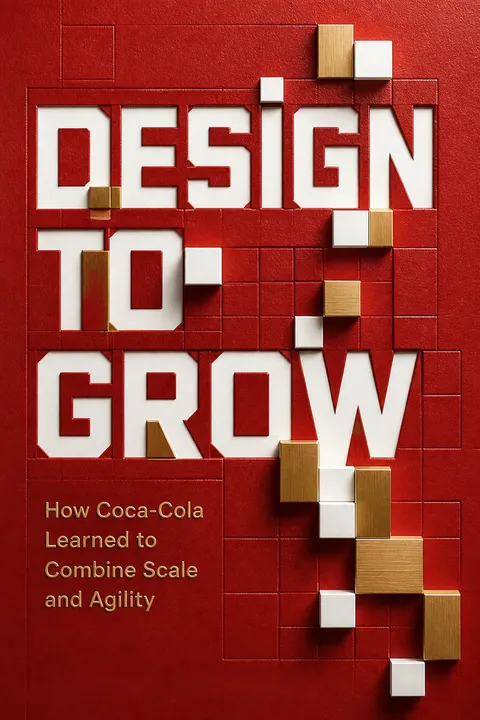
Design to Grow is a business book framed as a Coca-Cola transformation story. Its central claim is that design is not a specialist service applied to finished products, but a way of connecting strategy, operations, customer experience, and partnerships. The narrative progresses from Coca-Cola’s historic success in making a consistent product widely available to the difficulty of adapting that model once the company becomes a broad beverage portfolio operating amid rapid technological and social change.
The most useful distinction is between integrated systems for reliable scale and modular systems for adaptation. A familiar brand identity, common standards, and a franchise network make global execution possible. Modular components, prototypes, open participation, and feedback make local variation and learning possible. The metaphor of a Lamborghini for integration and Lego for modularity gives readers a memorable handle on a real management tension: consistency reduces friction, while flexibility preserves relevance. The book’s examples make that tension concrete, from the ILOHAS bottle to Freestyle machines and African distribution centers.
The argument is strongest when it explains the mechanics of coordination. It shows how everyday tools, clear standards, cross-functional teams, and field observation can turn abstract design principles into repeatable organizational behavior. It is less conclusive when it implies that design itself produced particular commercial or social outcomes. The case studies are presented from within Coca-Cola, and reported sales, savings, and impact figures do not by themselves establish what would have happened without the interventions. The reader should treat these examples as instructive cases, not controlled proof.
The deeper contribution is a practical model of organizational learning. Leaders need to protect what customers value, test what remains uncertain, and build systems that let knowledge travel beyond headquarters. That requires more than methods: incentives, authority, and accountability must support experimentation without making quality optional. The book’s version of agility is not permanent improvisation. It is the capacity to know when to standardize, when to adapt, and how to learn the difference.
People Also Read



Glossary
Designing on purpose
Strategic design for growthThe book’s term for using design with an explicit connection to business purpose and growth strategy. It includes coordinating the visible elements of products and communications with less visible processes, partnerships, and operations. The phrase also signals that design is a responsibility across functions and markets, not an activity reserved for a specialist department.
Golden Circle
Purpose, process, and outputA framework associated with Simon Sinek that organizes an organization’s work around why it exists, how it operates, and what it produces. The book applies this model to design: clarify the purpose design should serve, shape the process around that purpose, and ensure the resulting products or services support it.
Integrated systems
Connected parts for consistencySystems whose elements are designed to fit together in a specific, coordinated way. They are useful when an organization has a proven offering and needs to deliver it consistently at greater scale. Coca-Cola’s standardized brand identity and bottling arrangements illustrate how integration can reduce friction and preserve a recognizable experience across markets.
Modular systems
Interchangeable parts for adaptationSystems built from components that connect through shared rules but can be exchanged or recombined in different ways. They support experimentation and local adjustment without requiring the entire system to be redesigned. The book uses Lego bricks as its central analogy and applies the idea to products, visual identities, distribution, and business programs.
Wicked problems
Interconnected problems without one fixProblems with many interacting causes, uncertain conditions, and no single clearly optimal solution. The term comes from social planning and is used in the book for challenges such as water scarcity, which involves environmental, economic, infrastructural, and policy factors. Addressing one part may affect others, so teams need to understand the relationships before choosing interventions.
Mind map
Diagram of connected issuesA visual diagram used by a group to gather, cluster, and connect the factors related to a problem. Participants first surface relevant issues, then organize them into themes and show how they relate. In the book, mind maps help teams build a shared picture of complex challenges, identify overlooked factors, and decide what to investigate or prioritize.
Minimum viable product
Early version for useful feedbackAn initial version of a product that is sufficiently developed to be tested with real users and generate learning. It is not necessarily a finished or fully polished product. Its purpose is to test assumptions quickly, discover what users value, and guide the next iteration before the organization commits extensive time and resources.
Pivot
Strategic change based on learningA substantial change in a company’s strategy or business model, made while retaining its broader vision. A pivot may alter the product, customer, value proposition, revenue model, or route to market. In the book’s account of startup practice, the change follows evidence that the current approach is not working and is made quickly enough to preserve the venture’s options.
One Metric That Matters
Current priority measurementA focused metric selected to answer the most important business question at a particular stage. Rather than tracking every available number, a team identifies its riskiest assumption and measures the outcome that best tests it. The metric can change as the organization’s priorities and uncertainties change.
Emergence
New behavior from interactionA system-level outcome produced when individual elements interact, even though no single element creates that outcome alone. The book describes this through examples such as collaborative online projects, games shaped by user contributions, and economic activity. Emergence depends on arrangements that allow people or components to interact and self-organize.
Shared value
Business and community benefitAn approach to business growth that connects a company’s commercial success with economic or social progress in the communities and networks on which it depends. In the book, examples include supporting small distributors, training farmers, and helping women entrepreneurs. The idea goes beyond philanthropy by placing mutual benefit within business activity itself.
Scale-up
Business seeking repeatable growthA business moving beyond the search for a viable model and working to extend that model reliably. The book presents this as a distinct stage between startup exploration and mature enterprise operations. A scale-up must turn validated products, relationships, and processes into repeatable growth while retaining the ability to respond when assumptions change.
Download PDF
Download EPUB
.epub digital book format is ideal for reading ebooks on phones, tablets, and e-readers.








