

Key Takeaways
Make creativity systematic by starting with people, then testing what might work.
A disciplined search. Design thinking is a human-centered approach to solving problems, especially when the problem or solution is unclear. It balances what people value, what technology can deliver, and what an organization can sustain. The process begins by establishing a purpose, then explores people’s needs, defines a problem, generates ideas, tests prototypes, and scales what proves useful. It loops rather than marching in a straight line. Ritesh Agarwal’s early hotel venture illustrates the approach: he learned about budget travelers by staying in budget accommodation himself, changed direction as he learned, and kept refining his idea after setbacks. The point is not to add craft supplies to a meeting. It is to make discovery, learning, and correction part of problem-solving.
What's valuable here is the shift from creativity as a rare personality trait to creativity as a managed learning process. That makes the method accessible beyond design departments, from service operations to internal workplace problems. The framework also resists a common organizational reflex: treating a confident plan as proof that a problem is understood. Its usefulness depends on honest inquiry, however. A sequence of workshops cannot substitute for access to the people affected or the authority to change the system around them.
Watch people in context before trusting what surveys say they want.
Look beyond the answer. Empathy means learning how people actually behave, what they struggle with, and what matters in their circumstances. It is not simply feeling concern, nor is it accepting a customer’s explanation as a complete diagnosis. HUL’s Pureit water purifier emerged from learning that boiling water was inconvenient, costly, and altered its taste, while many alternatives required electricity or pressurized water. The product team had to address those realities, then build and test more than 200 prototypes. The book also widens the meaning of “customer”: employees, suppliers, sellers, and caregivers can shape the experience as much as a buyer does. Firsthand observation complements data by revealing details that averages and formal questions may miss.
This approach resembles ethnography, the study of people in their everyday settings, where actions and surroundings can reveal needs that people do not readily articulate. It also offers a useful correction to data-driven overconfidence: more measurements do not automatically explain why a pattern exists. Still, observation is not mind-reading. A team can misinterpret behavior through its own assumptions, so field insights are stronger when checked with participants and compared across different situations.
Reframe symptoms into a worthwhile problem before spending energy on answers.
Diagnose before prescribing. A visible complaint may only be a symptom of a deeper issue. The book’s “jobs to be done” idea asks what a person is trying to accomplish in a particular situation, including the emotional and social stakes, rather than focusing narrowly on a product feature. Tata Motors’ Ace mini-truck came from investigating what small transport operators needed: not merely a cheaper vehicle, but better stability, protection from weather, carrying capacity, and status. A strong problem statement should describe meaningful impact, leave room for different solutions, and include real constraints. It should not quietly dictate a favorite answer. The book urges teams to choose carefully: some problems matter little, some cannot be solved with available resources, and unclear problems need more investigation.
Problem framing is a form of resource allocation. A team that names the wrong problem can execute brilliantly and still create little value. Asking what task or outcome people are pursuing helps expose alternatives to improving the obvious product. Yet reframing can also become a way to avoid hard trade-offs: almost any complaint can be expanded into a sprawling system problem. Impact and feasibility criteria help keep the inquiry ambitious without making it limitless.
Create more options before judging which idea deserves attention.
Delay the verdict. The first ideas that appear are often familiar responses, not the most inventive ones. Design thinking therefore separates generating possibilities from evaluating them. One practical technique, hybrid brainstorming, lets people first write or sketch ideas alone, then discuss and build on them together. This can reduce the tendency for outspoken participants to dominate while others hold back or lose their own thoughts. Teams can also borrow useful patterns from other fields and combine existing ideas in new ways. Tanishq’s early bet on 18-carat jewellery did not fit the Indian market as expected. Rather than treating that setback as the end, the company developed other ways to build trust and encourage purchases, including purity testing and exchange offers.
Separating creation from evaluation protects ideas from premature social pressure and gives quieter participants a route into the conversation. The broader point is that novelty often comes from recombination, not a miraculous flash. This does not mean that every idea deserves equal investment. A useful process creates a generous pool, then applies evidence and constraints to narrow it. Without that second discipline, divergent thinking can become an entertaining meeting with no consequence.
Test your riskiest assumption with the cheapest prototype you can make.
Build to learn. A prototype is an early, limited representation of an idea, made to answer a question rather than to impress with polish. A minimum viable product is a basic version that can test whether an important assumption holds. Netflix’s founders tested whether a disc could survive the mail by sending one through the post before investing in a full service. That is more informative than debating the idea in a conference room. Teams can also test internally when outside users are unavailable, a practice called dogfooding. Flipkart’s overloaded Big Billion Day sale shows the risk of the opposite approach: it drew huge demand, but technical failures prevented most visitors from completing purchases. Early, inexpensive tests can expose weak assumptions before the stakes grow.
Prototyping turns disagreement into an observable question. Instead of arguing about whether an idea is promising, a team can ask what evidence would change its mind and design a small test to obtain it. This connects design practice to experimental science. But a test only helps if it measures the right uncertainty: a rough mock-up may reveal usability problems while saying little about long-term costs, adoption, or operational capacity. Cheap evidence is useful, not automatically decisive.
Scale proven ideas without losing focus or the economics that keep them alive.
Make impact repeatable. A prototype that delights a few people is not yet a durable innovation. Scaling requires a reliable way to deliver the solution, a clear priority, and sound economics. Reliance Jio tested its service with employees and partners before launching widely, then built a broader digital ecosystem around affordable connectivity. The example shows that scale involves more than copying a product: distribution, partners, technology, and customer habits all matter. The book recommends tracking progress from early learning through testing and results, using objectives and measurable key results. It also warns against confusing popularity with viability. Kingfisher Airlines and Jet Airways offered appealing customer experiences but failed as businesses. Customer value must be matched by an operating model that can endure.
The move from prototype to scale changes the central problem. Early experiments ask whether a solution can work; scaling asks whether people, processes, partners, and finances can keep it working consistently. That distinction is often blurred when a successful pilot is celebrated as proof of a complete business. Metrics help preserve focus, but they can distort behavior if teams optimize easy-to-count outputs instead of meaningful outcomes. A small set of measures needs judgment about whose benefit is being measured and over what time horizon.
Design the whole experience, not merely the object customers buy.
See the surrounding system. The solution may be a service, process, or experience, not a new product. The book’s “subject, not object” principle asks teams to begin with the person and their situation rather than the artifact they already know how to improve. The Embrace baby warmer, developed for settings where conventional incubators were expensive and difficult to maintain, was designed around the needs of newborns and caregivers. It used a different form and cost less than one percent of a traditional incubator. Maruti Suzuki similarly built customer value through servicing, financing, used-car sales, driving schools, and premium showrooms, not just through cars. These examples widen the design brief to include the full journey and the people who make it work.
A product is often only one encounter in a longer relationship. Looking at the entire journey can reveal that convenience, trust, repair, or access matters more than another feature. This systems view also helps explain why a technically elegant object may fail in everyday life. The challenge is boundary-setting: no organization can redesign every surrounding institution at once. Mapping the experience helps identify which connected parts it can influence and where partnerships are necessary.
Give teams a clear purpose, varied perspectives, and permission to learn from failure.
Make room for discovery. Leaders set the conditions for design thinking by explaining why a problem matters, creating a clear but open brief, and protecting time and resources for experimentation. A brief should give a team direction without embedding the solution in the question. Diversity matters because people with different experiences notice different needs and possibilities. But difference alone does not guarantee good collaboration; teams also need trust and room to question ideas without attacking colleagues. The book describes “air cover” as leaders’ protection for employees who test uncertain ideas. It also cautions against unrealistic pressure: research discussed in the book found that extreme time demands can fragment attention and undermine creative work. Stretch goals work best when people can focus on meaningful tasks.
Innovation is not just a matter of hiring imaginative people. It is shaped by authority, incentives, time, and whether dissent carries personal risk. A compelling brief can coordinate diverse expertise without prescribing every move, while psychological safety makes it possible to report bad news early. Leaders should not romanticize failure, though. Experiments need bounded costs, learning goals, and accountability. Protecting a team means enabling responsible risk, not excusing repeated tests that teach nothing.
Train curiosity, listening, observation, and resilience as everyday problem-solving habits.
Build the personal toolkit. The book’s design thinker is curious enough to notice opportunities, listens without preparing an immediate rebuttal, observes behavior rather than relying only on memory, and postpones judgment long enough for unexpected connections to form. One listening technique, RASA, means receive, appreciate, summarize, and ask. A “T-shaped person” combines deep skill in one area with enough breadth to work across other fields. That breadth can come from varied interests, collaborations, or experience in unfamiliar settings. The book describes the desired balance as clear analysis, deep empathy, and resilience under criticism. These qualities make the methods more than workshop activities: they help people keep learning when the problem is messy and the first attempt disappoints.
These habits complement one another. Observation supplies raw material, listening checks interpretation, curiosity widens the search, and resilience keeps a person engaged after rejection. Breadth can make expertise more adaptable, especially when a problem crosses professional boundaries. But constant curiosity can scatter attention, and broad interests do not replace technical depth. The practical aim is not to become an expert in everything; it is to stay capable of learning from people and disciplines beyond one’s specialty.
Analysis
The book’s central contribution is to treat creative problem-solving as a disciplined response to uncertainty. Conventional stage-gate development assumes that the problem is already clear, then invests heavily before learning whether the idea fits real users. Soni’s alternative keeps discovery and validation close to the work: investigate human contexts, frame a tractable challenge, generate alternatives, test assumptions early, and scale only what merits further investment. Its distinctive emphasis on inspiration and scale expands familiar design-thinking models from a workshop method into an organizational practice.
The Indian cases give the argument texture. Pureit, Embrace, Tata Ace, and Paytm show that insight often comes from constraints and overlooked users, while failures such as the Nano or Flipkart’s overloaded sale demonstrate that engineering effort and ambition do not establish desirability or readiness. These cases make the method concrete, though successful examples cannot by themselves prove that design thinking caused the outcomes. Market timing, leadership, capital, and execution also matter.
The strongest practical tension is between empathy and selection. Listening widely can reveal many needs, but attention and resources remain limited. The book addresses this by insisting on prioritization and by balancing human desirability with technical feasibility and business viability. That balance is important, but it does not resolve every conflict: current users may not imagine disruptive offerings, while a popular pilot may not support a sustainable operating model. Design thinking is therefore best treated as a learning discipline, not a universal recipe or a guarantee of innovation. Its promise depends on the quality of observation, the honesty of tests, and an organization’s willingness to act on what those tests reveal.
Review Summary
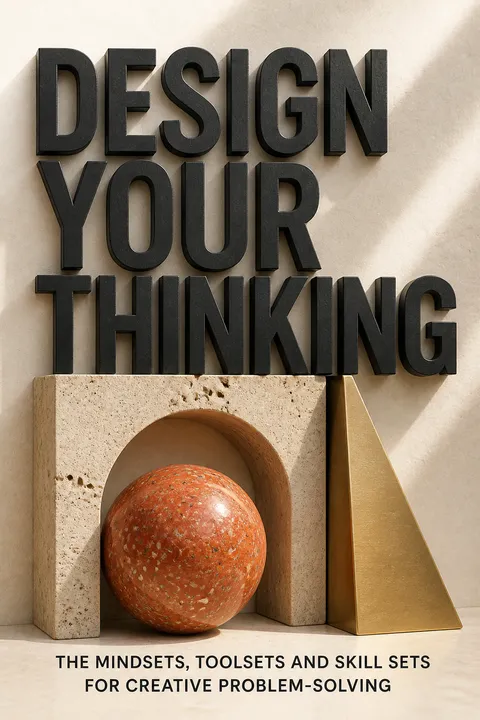
Design Your Thinking by Pavan Soni is highly praised for its comprehensive approach to creative problem-solving. Readers appreciate the book's systematic structure, real-world examples, and practical tools for applying design thinking. Many reviewers highlight the author's ability to explain complex concepts in an engaging, accessible manner. The book is lauded for its focus on Indian business scenarios, making it particularly relevant for local readers. Numerous reviewers mention the book's impact on their personal and professional decision-making skills, recommending it as a must-read for innovators and problem-solvers.
People Also Read









Glossary
Design thinking
Human-centered problem-solvingA systematic approach to solving problems by learning about people and their circumstances, defining a meaningful challenge, generating alternatives, testing ideas, and developing solutions that can be delivered sustainably. It is especially useful when the problem or solution is uncertain. The process is iterative rather than strictly linear.
desirability, technical feasibility and business viability
Three tests for ideasA set of complementary questions for judging a potential solution. Desirability asks whether it addresses something people genuinely value. Technical feasibility asks whether it can be built or delivered. Business viability asks whether the organization can sustain it economically. Considering all three helps prevent solutions that are appealing but impractical, or practical but unwanted.
jobs to be done
A goal in contextA way to understand what a person is trying to accomplish in a particular situation, and why they choose a product or service to help. The “job” includes more than a functional task: social and emotional aims may shape the choice. Designing around the job can reveal solutions beyond improving the existing product.
Hybrid brainstorming
Solo and group ideationAn ideation method that combines individual thinking with group discussion. Participants first write or sketch ideas on their own, then share and develop them collectively. This sequence aims to reduce idea blocking, fear of evaluation, groupthink, and free-riding that can limit conventional spoken brainstorming.
minimum viable product
A basic testable versionA deliberately limited version of a product or service used to test an important assumption and gather learning. It is not necessarily a polished launch product. Its purpose is to provide enough of an experience for a meaningful test while limiting the time and resources spent before the idea is better understood.
dogfooding
Testing with internal usersThe practice of using a developing product or service inside the organization before offering it broadly. Employees and internal teams act as early users, helping reveal problems and opportunities for improvement. This approach is useful when external customers are not yet available or public testing would carry substantial risk.
T-shaped person
Depth plus broad perspectiveA person with substantial expertise in one field and the ability to understand, collaborate with, and learn from other fields. The vertical stroke of the letter represents depth, while the horizontal stroke represents breadth and empathy. This combination can help people contribute specialist knowledge while making connections across disciplines.
RASA
A listening sequenceA listening technique whose letters stand for receive, appreciate, summarize, and ask. The listener first attends to what is being said, acknowledges the speaker, restates the message to check understanding, and asks clarifying questions. It is intended to slow the impulse to respond before the other person has been understood.
Unfocus Group
A varied user discussionA group assembled from people with different relationships to a product or service, such as active, new, former, dissatisfied, or non-users. Rather than seeking a single representative customer view, the group aims to surface contrasting experiences, inspire new directions, and help teams explore problems and assess early concepts.
FAQ
What's Design Your Thinking about?
- Focus on Design Thinking: The book delves into design thinking as a human-centric, systematic approach to problem-solving, emphasizing empathy, experimentation, and iteration.
- Framework for Innovation: It outlines a structured framework with stages like inspire, empathize, define, ideate, prototype, test, and scale, applicable beyond just technology.
- Real-World Applications: Pavan Soni uses case studies from Indian and global companies to show how design thinking fosters innovative solutions.
Why should I read Design Your Thinking?
- Practical Guidance: Offers tools and insights for adopting design thinking, valuable for managers, entrepreneurs, and students.
- Cultural Relevance: Highlights local contexts with examples from Indian companies, resonating with readers in similar environments.
- Empowerment through Creativity: Enhances creative problem-solving skills, turning challenges into opportunities.
What are the key takeaways of Design Your Thinking?
- Empathy is Essential: Empathy is the cornerstone, allowing problem-solvers to deeply understand user needs and motivations.
- Iterative Process: Advocates for prototyping and testing to refine ideas and ensure they meet user needs.
- Diverse Perspectives Matter: Emphasizes diversity in teams for innovative solutions and understanding complex problems.
What are the best quotes from Design Your Thinking and what do they mean?
- Reflection on Experience: “We do not learn from experience, we learn from reflecting on experience.” Highlights the importance of analyzing experiences for learning.
- Innovation and Quality: “Design thinking is to innovation what Six Sigma is to quality.” Compares design thinking's structured innovation approach to Six Sigma's quality management.
- Empathy's Importance: “Empathy is the cornerstone of design thinking.” Stresses understanding users' emotions for effective, human-centric solutions.
What is the design thinking process outlined in Design Your Thinking?
- Five Stages: Consists of inspire, empathize, define, ideate, prototype, and test, guiding structured problem-solving.
- Non-Linear Approach: Stages overlap, allowing flexibility and iteration as new insights are gained.
- Focus on User Needs: Keeps the user at the center, ensuring solutions are innovative, relevant, and desirable.
How does Design Your Thinking define empathy in the context of design thinking?
- Understanding User Perspectives: Empathy involves understanding and sharing others' feelings, crucial for identifying real user problems.
- Active Engagement: Encourages direct observation and interaction with users for deeper insights, beyond market research.
- Emotional Connection: Fostering emotional connections with users leads to solutions that resonate personally and are impactful.
How does Design Your Thinking suggest fostering an innovation culture?
- Encourage Experimentation: Create an environment where employees feel safe to experiment and take risks, learning from failures.
- Diverse Teams: Emphasizes collaboration among diverse teams for a wider range of ideas and perspectives.
- Leadership Support: Leaders should actively participate, providing support and resources for innovation initiatives.
What are some practical tools mentioned in Design Your Thinking?
- Empathy Maps: Visual tools to capture user insights, helping teams empathize and define problems effectively.
- Journey Maps: Outline user experiences over time, highlighting pain points and opportunities for innovation.
- Prototyping Techniques: Discusses low-fidelity prototypes like sketches and storyboards for quick testing and iteration.
How can I apply the concepts from Design Your Thinking in my work?
- Start with Empathy: Understand user needs and challenges using empathy maps and interviews to inform problem definition.
- Iterate and Prototype: Implement rapid prototyping to test ideas quickly and gather feedback for continuous improvement.
- Foster Collaboration: Encourage cross-disciplinary collaboration to leverage diverse perspectives for innovative solutions.
What challenges might I face when implementing design thinking from Design Your Thinking?
- Resistance to Change: Employees may resist new methods, requiring strong leadership and communication of benefits.
- Time Constraints: Iterative design thinking can be time-consuming; prioritizing initiatives is essential.
- Balancing Creativity and Structure: Maintaining flexibility while following the design thinking framework can be challenging.
How does Design Your Thinking define success in design thinking?
- User-Centric Solutions: Success is creating solutions that genuinely meet user needs and improve experiences.
- Iterative Improvement: Emphasizes learning and insights gained throughout the process, not just the final product.
- Impact on Business Goals: Aligns with broader business objectives, driving innovation and improving performance.
How can I become a better design thinker as suggested in Design Your Thinking?
- Practice Empathy: Engage with users to understand their needs and experiences, fundamental to a design thinking mindset.
- Embrace Iteration: View failure as a learning opportunity and iterate on ideas based on feedback.
- Cultivate Curiosity: Stay open-minded, seeking new perspectives and insights to inform problem-solving and innovation.
Download PDF
Download EPUB
.epub digital book format is ideal for reading ebooks on phones, tablets, and e-readers.








