

Key Takeaways
Read Santa Muerte through all seven candle colors, not only the black one
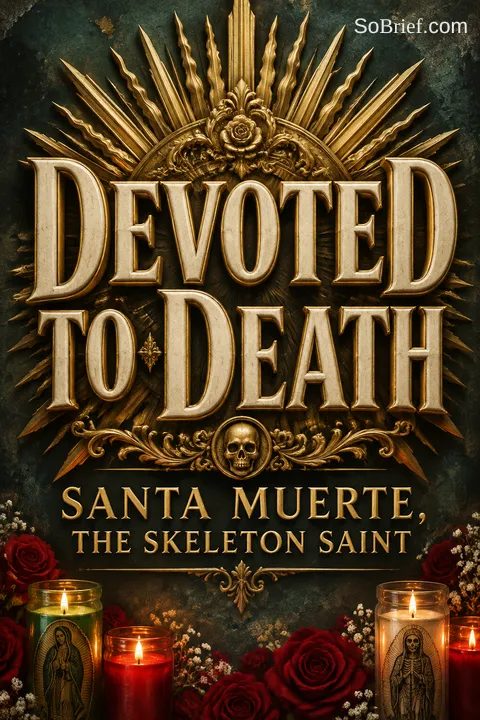
Start with the whole palette. Chesnut organizes the book around candles that signal different petitions: red for love, gold for prosperity, purple for healing, green for legal matters, and black for protection and harm. White candles commonly express purity, gratitude, and protection. The seven-color candle gathers these concerns into one object, for devotees asking for help on several fronts at once.
The book began after the Mexican army destroyed about forty Santa Muerte shrines along the border in 2009. That dramatic image suggested a cult defined by crime. Chesnut instead follows the other colors too, revealing a far broader devotional life.
The color scheme is more than a convenient outline. It acts as a corrective to a familiar media habit: letting the most alarming image stand in for an entire community. Color also makes abstract petitions legible, connecting a candle's appearance to a specific need. Still, the scheme should not be mistaken for a fixed creed. The book describes a loosely organized movement where practices vary, and some candle colors are newer or less common. The palette is a useful map, not a universal rulebook.
A roadside shrine turned a secret devotion into a public movement
One display changed everything. Devotion to Santa Muerte had largely remained private, partly because church authorities condemned it. In 2001, Mexico City resident Enriqueta Romero, known as Doña Queta, placed a life-size statue outside her home. Her son had given it to her after his release from prison, in thanks for the saint's help. Neighbors began asking to pray there, and the small household shrine grew into a major public site.
A few miles away, David Romo tried to build a formal church, with services and sacraments modeled on Catholic practice. The government first recognized the church as a religious association, then revoked its status in 2005. The contrast is revealing: public devotion spread through a neighborhood shrine, while institutional recognition remained contested.
The shrine's emergence shows how religious movements can grow through ordinary acts of visibility, not just through official leaders or doctrine. A home becomes a public place when neighbors recognize its usefulness and begin gathering there. The state, meanwhile, treats registration as a question of legal order, while worshippers experience it as recognition or exclusion. Neither a single shrine nor a church captures the whole movement, but both show how domestic practice can acquire public and political force.
See the familiar folk saint behind the sensational narco headlines
Death becomes a relative. A folk saint is a supernatural figure regarded as holy and able to work miracles, without formal canonization by the Catholic Church. Santa Muerte is unusual because many devotees understand her not as a dead person but as death itself, embodied as a female skeleton. Her nicknames cast her as a sister, godmother, or mother, while her shared tastes in foods, drinks, and tobacco make her feel close to everyday life.
That familiarity helps explain her appeal beyond criminal circles. Devotees include workers, students, parents, business owners, and people facing illness or legal trouble. Romo estimated millions of followers, but the book emphasizes that no reliable count exists. Her reputation rests less on formal doctrine than on stories of practical help.
This intimacy complicates the outsider's assumption that a skeleton must signify horror. In this devotional setting, death is not only an abstract ending. It is a powerful presence who can be approached, addressed, and asked for help. The comparison with family also makes the relationship emotionally intelligible without reducing it to metaphor. Yet familiarity does not erase fear: the same figure can comfort one devotee and unsettle another. The book's account is strongest when it treats both responses as part of the saint's meaning.
Treat Santa Muerte's origins as contested history, not settled Aztec inheritance
The past has competing versions. Some devotees identify Santa Muerte with Mictecacihuatl, an Aztec goddess of death. Others tell local origin stories, including one from Michoacán in which a Purépecha girl survives an Inquisition-era execution and is recognized as Holy Death. Chesnut finds firmer historical traces of Spanish Catholic imagery: colonial records from the 1790s describe Indigenous people venerating figures of death, and Spanish clergy had used skeletal images to teach about mortality.
After those records, the saint largely disappears from written accounts until the twentieth century. Researchers in the 1940s and 1950s encounter her chiefly as a figure in love magic. The evidence supports a layered history, but not one definitive origin story.
The competing accounts reveal as much about present identity as about the past. Indigenous origin stories can express a claim that the saint belongs to Mexico, while European imagery points to the religious encounter created by colonization. These explanations need not be treated as mutually exclusive cultural ingredients. Historical caution matters, though: a compelling community story is not the same as documentary proof. The book preserves that distinction while showing why believers may value a story for what it says about belonging.
Recognize love magic as leverage for women with little worldly power
The red candle follows heartbreak. The earliest modern accounts of Santa Muerte describe prayers for love, especially requests that an unfaithful husband or boyfriend return. Chesnut cites a 1947 account and Oscar Lewis's 1961 study, both describing women turning to the saint for help with straying men. In the film La Santa Muerte, two women compete for the same man through rituals, one hoping to keep her family together, the other seeking a more secure relationship.
This practice makes sense in settings where abandonment can threaten both emotional and financial stability. Love-binding rituals offer women a way to act when they have little control over partners or household resources. The saint's role is not limited to restoring romance; she may also be asked to punish the person who caused the hurt.
The love spells are not merely curiosities. They reveal how supernatural practice can become a form of agency when formal economic and social power is unevenly distributed. The rituals let a petitioner name a grievance, take action, and hope for a response. At the same time, binding another person's affection raises questions about consent that the devotional logic does not resolve. That tension is part of the practice's significance: a resource for the vulnerable can also imagine control over someone else.
Ask the saint for work, health, and justice, not only protection
Everyday needs drive devotion. The gold candle is offered for money, employment, and business success; the purple candle is associated with healing; and green is used for legal matters. A Morelia man named Rigo said he first sought Santa Muerte's help when he could not reliably feed his children. He credited her with helping him find construction work and with a small sum of money that let him get home and buy promised offerings.
Business owners also keep candles or statues at their shops, asking for steady customers. Meanwhile, devotees seek healing for illness and help with substance abuse. These petitions reflect economic insecurity and limited access to care, not merely a fascination with the supernatural.
The book's attention to practical requests keeps devotion grounded in the pressures people actually face. A prayer for work or health is also a response to material vulnerability, especially when institutions seem distant or inadequate. This does not mean religious practice replaces economic or medical solutions; the text does not establish that. It shows instead how people combine available resources, including ritual, when the stakes of illness or lost income are immediate and personal.
Use ritual to make a personal bargain visible and accountable
Devotion works through reciprocity. Many believers promise an offering, a candle, or a particular act of devotion in exchange for a favor. If the request is granted, they are expected to keep their promise. This pattern, called a vow or devotional contract in the book, also appears in other forms of popular religion. A person seeking release from prison might promise a candle at a shrine; a family seeking recovery might maintain an altar and pray over several days.
Altars make these relationships concrete. Statues, flowers, water, food, and candles express gratitude or petition, while prayers may adapt familiar Catholic forms such as the rosary or novena. Practices vary widely, from a small home arrangement to crowded public services.
A promise gives uncertainty a structure: the petitioner states what is wanted, marks what is offered, and later judges whether the exchange has been fulfilled. The altar makes that commitment visible, often to family or a devotional community as well as to the saint. This resembles the social function of ritual pledges more broadly, where repeated acts reinforce obligation. But the arrangement is not a simple transaction. The book shows that devotees interpret miracles, delays, and unanswered prayers in varied ways.
The same saint protects police and traffickers in one violent war
Danger crosses the divide. Santa Muerte has become associated with Mexican drug traffickers, who may ask her to protect them, their shipments, or their territory. This connection dominates many news stories. Yet the book also documents devotion among police officers, soldiers, prison guards, and other people exposed to violence. In the city of Valle de Chalco, the police chief said that about half of the 380 officers wore uniforms bearing the saint's image.
The conflict is especially sharp in the drug war. Chesnut reports that more than 34,000 people had died in the first four years of President Calderón's term. The government demolished roadside shrines, even as some law-enforcement personnel sought the saint's protection. Her appeal follows danger, not a single political or criminal allegiance.
This overlap exposes the limits of labeling a religious figure as the property of one side in a conflict. People facing danger can share a source of protection while remaining enemies in every practical sense. The symbol does not make their positions morally equivalent; it shows that fear and uncertainty can cross institutional boundaries. The account also cautions against treating a devotional image found at a crime scene as proof that the faith itself causes violence.
Do not mistake one priest's church for a loose, many-colored cult
There is no single center. Most devotion takes place through home altars, neighborhood shrines, shops, and informal prayer groups. Beliefs and rituals differ: some devotees see Santa Muerte as compatible with Catholicism, while others emphasize her power beyond church teachings. Romo's church tried to formalize worship, but its recognition was revoked, and his arrest in 2011 on kidnapping-related charges further drew public attention to him. The charges were allegations against a leader, not a measure of every devotee.
The movement also travels through commerce. Candles, statues, jewelry, clothing, magazines, and online services help spread the saint's image in Mexico and the United States. The book's central portrait is therefore not one unified institution, but a diverse set of people using a shared figure in different ways.
A decentralized movement is difficult to summarize because no single authority can settle what its central figure means. That looseness can enable adaptation and local ownership, while also making the faith easy to caricature through its most controversial leaders or adherents. Commercial visibility adds another layer: buying an image may signal devotion, curiosity, or both. The book's fieldwork helps distinguish these possibilities, though its estimates of scale remain uncertain in the absence of reliable membership data.
Analysis
Chesnut's most useful contribution is a change of scale. The public image of Santa Muerte is often produced from the most sensational evidence: a shrine at a crime scene, a trafficker's tattoo, or a state campaign against roadside altars. The book instead begins with the ordinary transactions of devotion: asking for employment, health, romantic security, legal help, or protection. The candle colors make that shift visible. They turn a contested religious movement into a set of specific relationships between petitioners and a figure they consider responsive.
That approach also makes the book's contradictions analytically valuable. Santa Muerte can be understood as mother, sister, death itself, supernatural lawyer, healer, and avenging force. These are not simply inconsistencies awaiting a single official doctrine. They reflect a movement with no central authority, shaped by devotees who bring different needs and moral expectations to the same image. Its flexibility is a source of appeal, but also a reason outsiders can define it narrowly.
The account is strongest where it combines field observation with historical restraint. The evidence for devotion in colonial records, twentieth-century studies, and contemporary shrines does not establish one clean line of descent. Competing origin stories reveal how historical memory serves identity as well as chronology. Likewise, the author's estimates of millions of devotees and merchants' reports of high sales suggest reach, but they are not a census. The distinction matters because visibility can be mistaken for prevalence.
Finally, the book shows religion operating where formal systems are experienced as unreliable. In a setting marked by economic insecurity, violence, and weak confidence in justice, ritual offers a way to make requests, obligations, and hopes tangible. It does not replace those systems or guarantee outcomes. Its significance lies in how people create a workable relationship with uncertainty, using an image that official religion and government both struggle to control.
Glossary
Santa Muertista
Santa Muerte devoteeA person who venerates Santa Muerte, the Mexican folk saint who personifies death. Santa Muertistas may pray at home altars, attend public rosaries, or make offerings in exchange for help with matters such as health, love, work, protection, or legal problems. The term describes devotion, not membership in one centralized church.
Folk saint
Unofficial miracle-working figureA spirit or figure considered holy because devotees believe it can work miracles, but which has not been canonized by the Catholic Church. Folk saints are often rooted in local histories and communities. Chesnut places Santa Muerte alongside other Latin American folk saints, while noting that she is commonly understood as death personified rather than a deceased human being.
Narcocultura
Drug-trade cultural worldThe distinctive styles, behaviors, beliefs, and products associated with drug traffickers and their admirers. In the book, examples include narcoballads, certain clothing and vehicles, and devotion to figures such as Santa Muerte or Jesús Malverde. The term describes a cultural formation, not every person who venerates Santa Muerte or every aspect of Mexican life.
Curanderismo
Folk healing practiceA form of folk healing practiced in Mexico and elsewhere in Latin America, drawing on Indigenous, Spanish, and other traditions. Curanderismo can offer a spiritual and practical response to illness, often using plants, cleansing rituals, and other remedies. Chesnut uses the term to describe a healing context that overlaps with, but is not identical to, devotion to Santa Muerte.
Novena
Nine-day prayer sequenceA devotional practice in which a prayer is recited over nine days, commonly to seek help with a difficult concern. Catholics use novenas, and devotees of Santa Muerte adapt the form to address the skeleton saint directly. The practice illustrates how the cult often retains familiar Catholic ritual structures while changing the figure receiving the petition.
Ex-votos
Offerings of thanksObjects or written messages offered to a saint in fulfillment of a vow or in gratitude for a favor received. At Santa Muerte shrines, examples include photographs, prayer notes, ribbons, personal belongings, and small devotional objects. Ex-votos make a petitioner's account of help visible and connect the practice to wider traditions of popular Catholic devotion.
Download PDF
Download EPUB
.epub digital book format is ideal for reading ebooks on phones, tablets, and e-readers.








