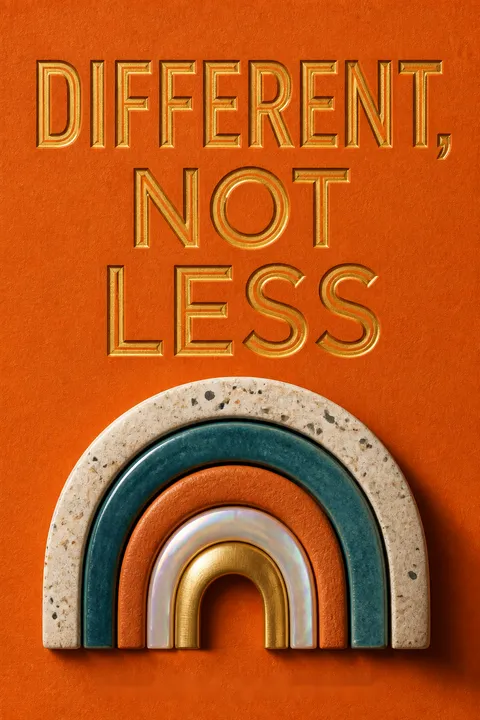


Key Takeaways
Stop treating neurological difference as a defect that must be erased
A different starting point. Chloé Hayden frames her life as a story with difficult beginnings, hard passages, and renewed possibilities. As a child, she felt stranded in a world whose social rules and sensory demands seemed designed for someone else. The metaphor changes the question from “How can she become normal?” to “What would help her belong?” Neurodiversity names the natural variation in human brains, including autism, ADHD, dyslexia, and dyspraxia. It does not mean that disability or distress is imaginary. Hayden’s point is that difference itself does not make a person lesser, and that many barriers arise because schools, workplaces, and social expectations accommodate only a narrow range of minds.
Belonging requires change. Her account calls for valuing disabled people’s own descriptions of their lives, while changing environments that treat conformity as the price of acceptance.
What's powerful here is the move from individual defect to the relationship between a person and their surroundings. That shift echoes the social model of disability: a staircase disables a wheelchair user when no ramp exists, just as an inflexible classroom can exclude a student whose learning needs differ. The model does not deny pain, impairment, or the need for treatment. It asks which difficulties can be reduced by removing barriers rather than demanding that a person adapt alone. The distinction matters because celebration without practical support can become another way of ignoring real needs.
When school punishes difference, change the environment, not the child
A hostile fit. Hayden recalls clinging to a metal post on her first school day, then spending years hiding, becoming physically ill with anxiety, and enduring bullying and punishment. One teacher, Wendy, made a striking difference by explaining lessons in ways Hayden could follow, allowing her to move or take breaks, and welcoming her interests. After years of trying more than ten schools, Hayden left mainstream education and learned at home, with family support and community activities. She later graduated with academic awards. The book cites Australian research reporting that 97 percent of autistic students face educational difficulties, while 44 percent change schools multiple times.
Access is the issue. Hayden argues for flexible assessment, teacher education, and sensory and learning supports. Her experience is not proof that every school fails, but it shows the cost when systems confuse compliance with learning.
Wendy’s example makes inclusion concrete: small changes in explanation, setting, and trust can alter whether a student can participate. This resembles Universal Design for Learning, an approach that plans multiple ways to engage, learn, and demonstrate understanding instead of waiting for a student to fail before offering an adjustment. It also exposes a common institutional blind spot: attendance and quiet behavior are easy to measure, while safety and genuine learning are harder. Homeschooling helped Hayden, but it depended on substantial family capacity. A just system cannot make escape the only effective accommodation.
Treat sensory distress as information, then reduce the load
Input can overwhelm. Sensory processing describes how the brain receives and interprets information such as sound, light, touch, taste, and smell. Hayden describes clothing tags as painful, supermarket detergent smells as overpowering, and loud events as so intense that she sometimes collapsed and required hospital care. Sensory needs vary: a texture soothing to one person may be unbearable to another. Overload can show up as agitation, loss of focus, nausea, increased stimming, or difficulty speaking.
Plan for relief. Hayden recommends learning personal warning signs, carrying ear protection or fidget tools, identifying quiet spaces and exits, and adjusting lighting, clothing, and schedules. Communication cards can help when speech becomes difficult. She also advises medical attention for recurring symptoms such as a racing heart, rather than assuming every physical problem is sensory.
The practical strength of this approach is that it treats distress as useful data, not defiance. In design, engineers reduce unnecessary demands on a system rather than blaming the system for failing under load; sensory accommodations apply a similar logic to daily life. Planning an exit or lowering background noise can preserve energy for the task that matters. The needed adjustment is individual, not universal. A quiet room may help one person and isolate another, so support works best when it is offered collaboratively rather than imposed as a standard package.
Suppressing harmless stims can turn coping into suffering
Movement can regulate. Stimming is repetitive movement, sound, or sensory activity that can help a person focus, express emotion, or manage stress. Hayden points out that many ordinary habits, such as tapping a pen or twisting a ring, serve a similar purpose. Her own stims included rocking, hand-flapping, and repeating sounds. As a teenager, pressure to hide them led her to suppress these forms of self-regulation. She describes the resulting distress and a shift toward painful, self-injuring behaviors. Her account challenges the assumption that visible difference is automatically a problem to eliminate.
Protect dignity and safety. A non-harmful stim should not need to be hidden for other people’s comfort. If a behavior risks injury, the priority is to understand its purpose and find a safer alternative, not shame the person for needing regulation.
Stimming reframes movement as information and agency. It also reveals how social judgments can mistake a behavior that looks unusual for a behavior that has no function. That distinction is useful in schools, clinics, and public spaces: ask what the action does for the person before trying to remove it. The argument should not be simplified into “every stim is safe.” Some behaviors can cause injury, and support may need to redirect them. The ethical difference is between reducing genuine harm and enforcing stillness merely because an observer feels uncomfortable.
Masking may win approval today and consume capacity tomorrow
The cost of camouflage. Masking means hiding or suppressing natural traits to meet social expectations. Hayden describes copying others, holding back stims, and performing an acceptable version of herself to avoid ridicule. That strategy sometimes helped her get through the day, but it also left her exhausted and less able to function. She distinguishes short episodes of sensory overload from autistic burnout, a longer-lasting state associated with chronic mismatch and inadequate support. In her account, burnout can bring fatigue, reduced tolerance for sensory input, memory problems, loss of speech, and difficulty with daily tasks.
Make recovery real. Her suggestions include reducing demands, scheduling breaks, resting, saying no, and spending time with trusted people where masking is unnecessary. She also stresses that openly unmasking is not equally safe for everyone; social identity and circumstances affect the risks.
Masking can be understood as a survival strategy with a hidden budget: the person may meet immediate expectations by spending energy needed for other tasks. That helps explain why outward competence does not reliably indicate how much effort or support someone needs. The comparison with workplace burnout can make the idea accessible, but autistic burnout, as Hayden describes it, can include changes in communication and everyday skills and should not be collapsed into ordinary tiredness. Neither rest nor self-acceptance can substitute for structural accommodation. The burden cannot fairly remain on the person to recover from an avoidable mismatch.
Build friendships around shared interests and explicit communication
Find people through common ground. Hayden’s early attempts at friendship repeatedly ended in exclusion and bullying. After leaving school, she began connecting through horses, theatre, photography, disability groups, and online communities. Shared interests gave people an immediate subject and purpose, without requiring her to decode every unspoken social cue. The book cites a study in which 43 percent of autistic teenagers had no contact with peers outside school; many also reported rarely receiving messages or invitations.
Make connection clearer. Hayden argues that friendship need not mean having one best friend or a large social circle. Supporters can invite autistic friends even when an event might be difficult, communicate directly, allow processing time, and ask what would help. An invitation preserves choice; assuming someone would refuse removes it. Friendship should be mutual, not charity or a project.
Shared interests can function as social scaffolding: they provide a predictable focus, reduce the pressure to invent conversation, and give people repeated chances to meet. That makes interest-based groups more than a hobby strategy; they can be accessible routes into belonging. Clear communication is equally important because indirect hints often reward people who already know the local social code. Online friendships can offer useful control over pace and sensory demands, but they are not automatically safe or equivalent for every person. The key is choice, with access to both digital and in-person connection.
Let diagnosis explain the pattern, not rank someone's worth
A name can open doors. Hayden was diagnosed with Asperger’s syndrome at thirteen, after years of feeling alien and struggling at school. Her trauma history had made it harder for adults to recognize overlapping signs, and she later received an ADHD diagnosis at twenty-two. She argues that autism criteria built around male stereotypes can miss girls and women, whose traits may be less visible because they mask or express interests differently. A diagnosis did not change who she was, but it helped her find information, community, and a more useful explanation of her needs.
Labels can mislead. Hayden rejects high- and low-functioning labels because someone’s visible abilities do not reliably reveal their support needs, which can vary with context. She also explains her choice to stop using Asperger’s terminology after research linked Hans Asperger to Nazi-era persecution and killing of disabled children. Personal identity language remains individual.
Diagnosis can convert years of private confusion into a shared vocabulary, and that vocabulary can support access to services and community. Yet categories are tools, not complete portraits. A label may open one door while inviting stereotypes through another, especially when clinicians use narrow expectations about gender, speech, or behavior. Hayden’s preference for individualized support is therefore more useful than a ranking scale: describe what a person can do, what is difficult, and what changes across settings. First-person accounts improve the picture, though no single account can represent every autistic person.
Protect special interests; they can become a route to confidence and work
Passion is more than pastime. Hayden calls the subjects that absorb and energize a person “eye sparkles.” In autism, these may be called special interests; in ADHD, they may be described as hyper-fixations. Her interests included animals, horses, the Titanic, and performing. A fascination with Titanic history led her, as a child, to challenge errors in a museum exhibit. Her love of performance grew into a character-entertainment business and, later, acting and public speaking. These interests also gave her ways to meet people, practice skills, and feel capable when school and ordinary social settings had not.
Follow the energy. Hayden urges parents and educators to encourage interests rather than use them only as rewards or distractions. The goal need not be a career. Enjoyment, calm, knowledge, and connection are valuable outcomes on their own.
This strengths-based account pushes beyond the idea that an interest matters only when it becomes economically productive. A deep interest can provide motivation, expertise, identity, and a bridge to other people, but its value does not depend on turning it into a job. That distinction matters in education: connecting new material to a student’s existing curiosity can make learning more meaningful without reducing the student to a productivity project. Adults should invite exploration while leaving room for interests to change, remain private, or simply be pleasurable.
Design adulthood around chosen support, not a narrow independence test
Autonomy has many shapes. Hayden once feared growing older because adulthood seemed to promise demands she could not meet. Later, she celebrated small steps on her own terms, including taking a short ride to a shop by herself. Her account of work makes the same point: a first café job overwhelmed her, while businesses built around photography, jewelry, and character performance let her use her strengths. She cites an Australian estimate that 31.6 percent of autistic people are unemployed, despite many wanting more or more challenging work.
Support is part of adulthood. In relationships, Hayden emphasizes consent, direct communication, respect for sensory needs, and equality. Her partner learns what helps rather than treating her as a burden. Independence is not the absence of help; it is having meaningful choice over one’s life and support.
Adulthood is often measured through a narrow checklist: paid work, self-sufficiency, conventional relationships, and steady performance. Hayden’s account challenges that checklist without dismissing the importance of opportunity or agency. A better measure is whether people can pursue chosen goals with the support they need, whether that means workplace adjustments, help with planning, or clear conversations about consent. The employment figure signals structural exclusion, not an individual deficit, although any single national estimate reflects its time and method. Inclusion becomes credible when accommodations are ordinary expectations rather than favors.
Analysis
Different, Not Less is a memoir and practical guide organized around Hayden’s journey from childhood alienation toward self-understanding, community, and public advocacy. Its emotional engine is the contrast between how others describe a child as merely quirky and how that child experiences school, sensory input, social rules, and change as exhausting or frightening. The recurring fairytale metaphor gives the narrative coherence while allowing for a realistic point: life does not resolve into one final, permanent happy ending. New transitions bring new challenges, and support matters throughout.
The book’s strongest contribution is epistemic as well as emotional. Hayden insists that autistic people must be heard as authorities on their own lives, especially when professional models and popular media have overlooked women, masked traits, or non-speaking communication. Her story makes abstract ideas such as sensory access, masking, and social exclusion tangible. It also links personal suffering to institutions: the school that prizes attendance over learning, the clinic that mistakes physical illness for anxiety, and the workplace that treats social polish as a proxy for competence.
The argument is most persuasive when it distinguishes a person’s needs from the barriers around them. It is less useful if reduced to the claim that every difficulty is caused by society, or that positive identity removes disability. Hayden’s own account includes trauma, chronic illness, eating disorders, and ongoing support needs. These realities call for both accessible environments and individual care. Similarly, her statistics and historical claims help establish urgency, but they come from studies with particular populations, dates, and methods; they should prompt attention, not be treated as universal predictions.
The central practical lesson is relational: listen to the person, ask what helps, make access routine, and allow difference without demanding that it become inspirational or profitable. The book offers hope not as a promise that hardship disappears, but as the possibility of building a life in which support, identity, and choice are not reserved for people who can pass as typical.
People Also Read




Glossary
Neurodiversity
natural neurological variationA term for the natural variation in how human brains function and process the world. In the book, it includes autism, ADHD, dyslexia, and dyspraxia. The concept challenges the idea that neurological differences are automatically defects to be cured, while recognizing that people may still need substantial support and face disabling barriers.
Sensory processing disorder
difficulty interpreting sensory inputA term the book uses for difficulty receiving and responding to information through the senses. Sensitivity may be unusually intense or reduced, and can involve sound, light, touch, taste, or smell. The resulting overload can affect communication, focus, movement, and emotional regulation. Sensory needs differ from person to person.
Stimming
repetitive self-regulationShort for self-stimulatory behavior, stimming refers to repeated movements, sounds, or sensory actions. Examples in the book include rocking, hand-flapping, repeating words, tapping, and handling fidget objects. It may help a person regulate, concentrate, express excitement, or manage stress. The author argues that harmless stims should not be suppressed simply to appear typical.
Meltdown
involuntary response to overwhelmAn intense, involuntary reaction that can occur when an autistic person is overwhelmed by sensory input, emotion, change, or accumulated stress. It may involve crying, screaming, agitation, or self-injury. The book distinguishes meltdowns from goal-directed tantrums and recommends safety, empathy, reduced demands, and time to recover rather than punishment or shame.
Shutdown
inward response to overwhelmA response to overload in which a person becomes still, withdrawn, silent, or unable to complete familiar tasks. Unlike a meltdown, which may be outwardly expressive, a shutdown is often less visible. The book recommends reducing demands, moving to a safe and quiet setting, and using simple communication or agreed signals.
Autistic burnout
prolonged loss of capacityA prolonged state the book associates with sustained pressure, masking, and inadequate support for an autistic person’s needs. It may involve chronic exhaustion, increased sensory sensitivity, reduced communication, memory difficulties, and loss of everyday skills. It differs from a brief episode of overload and may require extended rest, reduced demands, and reliable support.
Masking
concealing natural traitsThe effort to hide or suppress autistic or ADHD traits in order to meet social expectations or avoid rejection. Examples include copying other people’s behavior, forcing eye contact, scripting conversations, or suppressing stims. Masking can help someone navigate unsafe settings, but the book describes it as exhausting when it becomes a constant requirement.
Eye sparkles
energizing personal interestsHayden’s term for the interests, activities, or subjects that bring a person energy, joy, focus, and a sense of capability. They may overlap with autistic special interests or ADHD hyper-fixations. Eye sparkles can support learning, friendships, confidence, and work, but their importance does not depend on becoming a career.
Deficit framework
locates disability in the personA way of understanding disability that treats difficulty or lack of achievement mainly as an individual failure or impairment. The book argues that this view can make people seem defective when environments lack access or flexibility. It contrasts this approach with a social and diversity framework that examines barriers and accommodations.
Social/diversity framework
locates barriers in societyA perspective that treats disability as a natural human variation and examines how social arrangements create barriers. In the book, examples include inaccessible classrooms, rigid teaching methods, and buildings without ramps. Removing barriers and offering flexible support can enable participation without requiring people to become more like the majority.
Download PDF
Download EPUB
.epub digital book format is ideal for reading ebooks on phones, tablets, and e-readers.








