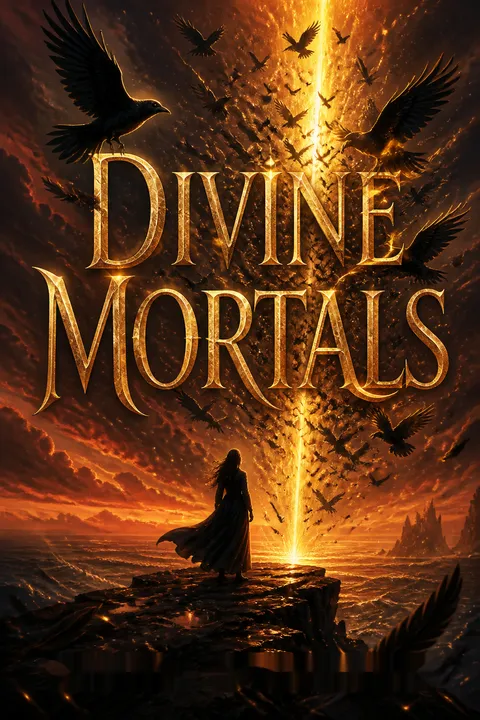


Plot Summary
Prologue
At eight, Mona Arnett runs from her older brother Patrick during their evening walk. When they struggle over her scarf near a cliff, she pulls free and Patrick falls to his death. Mona discovers a shimmering passage into the Flood, the gods’ otherworldly realm, and meets Irinorr, the crow god of love.
He tells her that he came because she loved her brother, not because she killed him. The encounter gives Mona a bond with Irinorr and a rare power: she can name soulmates. It also begins her retreat from the mortal world, where every doorway and open space will come to feel like a threat.
The opening makes guilt both the source of Mona’s magic and the prison that shapes her life. Irinorr’s reassurance does not erase the fact that Mona caused Patrick’s death; instead, it offers her a relationship in which she can be loved without first proving herself innocent. Her ability to name other people’s soulmates grows from this same wound: she can recognize attachment in others while refusing to believe she deserves it herself. The Flood first appears as refuge, but the comfort it offers is already entangled with avoidance.
The Seer Behind Curtains
Ten years after Patrick’s death, eighteen-year-old Mona lives in one wing of her parents’ house and earns money by naming customers’ soulmates. She hides behind wit and flirtation, but rarely leaves her rooms, burdened by the conviction that her family would be better off without her. Delmar Whitman, the young master of practitioners, arrives disguised as a guard and tests her with a borrowed sword.
Mona reads the names of his siblings, including a sister who died in infancy, convincing him her gift is real. He offers her a place in the Royal Practitioners Company. Mona refuses, unwilling to leave the only home she can bear, while Delmar warns that King Isaac’s failing health makes the recruitment urgent.
Mona’s performance gives her a kind of control she cannot claim over her own life. In a reading, she can temporarily hold another person’s future in her hands; outside it, she treats her own choices as dangerous. Delmar’s test matters because it validates her power without addressing her shame. His offer opens a route into public life, but the very possibility feels like exposure. The scene establishes the novel’s central tension: knowing what is true does not automatically make a person willing to act on it.
A Brother Crosses Back
After Delmar leaves, a dead, waterlogged version of Patrick appears in Mona’s rooms and attacks her, gripping her throat before she escapes through a spontaneous window into the Flood. There, Irinorr explains that Patrick’s spirit may be trapped in memories of the place where he died and could return to their home.
He also warns Mona that spirits crossing into the mortal realm may signal a larger disturbance. Since she cannot stay long in the Flood, Irinorr directs her to the castle, where royal magicians can protect her. Mona crosses back into her bedroom, runs through the house for the first time in ten years, and pounds on Delmar’s door. She agrees to go, choosing danger she can face over the ghost waiting at home.
The ghost turns Mona’s private guilt into an immediate physical threat. Patrick’s violence is frightening partly because it contradicts the brother she remembers, making her unable to resolve whether she is facing punishment or a distorted remnant of him. Irinorr’s order forces a distinction Mona has long avoided: the Flood can comfort her, but it cannot become a permanent hiding place. Her first run through the house is therefore more than escape. She acts without waiting for fear to disappear.
Jane Smith for a Queen
At Castle Selledore, Delmar explains the crisis: King Isaac is gravely ill, has no heir, and must find a queen before the royal line ends. The council doubts Mona’s unusual magic, while she recognizes fellow favored mortal Bernadette Byers among the young practitioners and learns that Bernadette is hiding her own powers. At the public bride-divining ceremony, other seers offer elaborate predictions.
Mona uses Isaac’s sword and receives a name she cannot admit: her own. She fears the court will see her as a fraud angling for the crown, so she announces an invented candidate, Jane Smith. Delmar believes the reading can be pursued, while Mona leaves the ceremony knowing she has created a lie that may shape the kingdom’s future.
Mona’s false name is not a bid for power but a defense against being forced into a role she cannot imagine surviving. Yet the lie has public consequences: it directs the court’s attention toward an invented candidate and makes Mona responsible for managing a truth no one is prepared to hear. The ceremony also places her beside Bernadette, a potential equal rather than merely another magician. Their shared secrecy suggests that exceptional ability can isolate its possessor even when it might otherwise create solidarity.
Knives Beneath the Castle
A serrated dagger pins a note to Mona’s door, demanding the truth and bearing a symbol associated with the Guild of the Rising Tide. The council offers little more than procedure. Soon a chandelier crashes onto Mona’s bed with another warning, proving someone can reach her despite the guards. Bernadette traces a possible lead to Tasha D’Milliar, a vanished royal magician whose old cases involved catching dangerous offenders.
She and Mona enter the Flood to find Tasha, but six demons capture them. To secure their release, Mona bargains away runes and then cuts off her own pinkie when their leader demands a human hand. The pair escape, but Mona returns injured, and Tasha refuses to explain how she survives in the Flood.
The threats make secrecy costly, while the council’s slow response leaves Mona and Bernadette to build their own investigation. Mona’s bargain with the demon is both resourceful and reckless: survival overrides her concern for what the runes might enable. Her severed finger makes that choice bodily, not merely theoretical. The encounter also introduces Tasha as a possible answer to Mona’s longing for permanent refuge, but her refusal keeps the promise of safety uncertain. Mona has begun to act, though her motives still center on escape.
Parsons Leaves a Body
While recovering, Mona meets Elsie Tanner, a commoner seeking help to escape a marriage contract. A reading from Elsie’s ribbon names another man, Thomas Worden, not Isaac; Mona conceals the result rather than deepen Elsie’s uncertainty.
Soon assistant master Ryan Parsons is found hanged in Mona’s apartments, with a note ordering her to confess. Certain her silence has helped cause his death, Mona tells Delmar that her original reading named her as Isaac’s soulmate. Bernadette confirms Mona is telling the truth.
During the ensuing turmoil, the seven gods arrive at the castle in mortal forms and claim seats on the royal council. Their return links the orchard blight, restless spirits, and demon activity to a danger threatening Opalvale’s magic.
Parsons’s murder breaks through Mona’s familiar calculation that she can contain a lie by keeping it private. She does not know whether revealing the truth will save anyone, but the cost of silence has become concrete and unbearable. Her choice is still shaped by guilt, which makes it difficult to distinguish accountability from self-punishment. Elsie’s reading quietly complicates the royal contest before the gods’ arrival broadens its stakes: the private question of who loves whom now sits inside a crisis affecting an entire realm.
Whitman’s Hidden List
After the gods arrive, Patrick’s ghost attacks Mona again at the castle, and Delmar shares reports of similar hauntings elsewhere. He accepts her account rather than dismissing her, but their fragile trust collapses when the gods’ cat, Wayvadd, gives Mona a key to Delmar’s office. She finds a report calling her a likely fraud and a list of seers with her name circled.
Delmar admits he recruited her hoping to discredit the bride contest, not because he believed her gift. He insists he wanted to protect Isaac from a rigged marriage, but Mona hears another judgment against her. Learning the council suspects her of Parsons’s murder, she flees through a window to Tasha’s isolated home in the Flood.
Delmar’s deception wounds Mona because it confirms the fear beneath her bravado: that people tolerate her only while she is useful. His motives are not wholly selfish, but his decision to manipulate her reproduces the very pattern he claims to oppose. Mona responds by choosing the refuge she has long idealized, yet this flight is also a refusal to let the council define her solely as a suspect. Trust has been damaged, not erased; her next choices will depend on whether she can build a basis for it elsewhere.
Lessons in the Flood
At Tasha’s home, Mona and Bernadette spend weeks reading, working, and trying to understand the lessons hidden in their assignments. Mona realizes Tasha is teaching her to test claims rather than accept them because an authority made them; Bernadette must learn that certainty from her truth-sensing gift is not the same as trust.
Tasha reveals that the Flood does not harm mortals as the gods have claimed. Its magic strengthens them, and the gods’ warnings were meant to keep their favored humans manageable. Mona and Bernadette return to the castle with new power.
Mona reads a threat and identifies the chapel as the killer’s nightly destination. Surveillance leads to Simon Hansen, a guard, while Mona’s deeper reading exposes her first soulmate result as fabricated: Elsie, not Mona, is Isaac’s true love.
Tasha’s education is a critique of obedience disguised as curriculum. Mona’s growth comes not from receiving more information but from learning to challenge the sources that once defined reality for her. Bernadette’s parallel lesson is more intimate: truth detection can protect her from deception, yet it cannot tell her whom to trust. The revealed lie about the Flood transforms Mona’s relationship with Irinorr from uncomplicated dependence into moral conflict. Her return to the castle marks the first time she carries power back toward a problem instead of using it to disappear.
Elsie Becomes the Bride
Mona and Bernadette discover that Simon Hansen has been visiting the chapel, and the guards arrest him after finding evidence linking him to Parsons’s murder. Mona also proves that someone falsified her original reading, then announces that Elsie is Isaac’s soulmate.
The court moves quickly to secure the marriage. At the wedding, Elsie and Isaac are joined before the assembled court, and Mona sees them begin a life that seems to fit them both. The following day, during the tournament, a crossbow bolt strikes Elsie in the chest while Isaac survives a second shot.
Mona watches from a castle window and cannot reach her in time. Her friend’s death turns the contest’s apparent resolution into a fresh crime and leaves Mona convinced the killer’s plan still involves her.
The wedding offers a brief image of a future organized around mutual care rather than political necessity. Mona helps make that future possible despite her own earlier lie, suggesting that repair can begin before guilt is resolved. Elsie’s assassination destroys any easy separation between the romance plot and the political one. Mona’s inability to intervene echoes her childhood helplessness, but now she understands that passivity has consequences beyond her private grief. The death demands a choice: withdraw again, or accept responsibility for confronting the forces behind it.
The Queen’s Borrowed Crown
Grieving Elsie, Mona tells the council that whoever orchestrated the attacks wants her on the throne. She proposes marrying Isaac to expose the plot, though the crown is the role she has spent the novel fearing.
Her parents visit before the ceremony, and Mona finally asks them to forgive her for Patrick’s death; her mother insists that Patrick would never have blamed her. Mona marries the ailing king and is presented to Opalvale as queen. Soon afterward, a reading of the bodies shows that Parsons and Elsie were killed by different hands, though both deaths served the same larger purpose.
Bernadette and Mona identify Simon as Calvin Meeker, a favored mortal with the ability to move through the Flood, and Mona discovers that councilors bribed seers to influence the contest.
Mona’s marriage is strategic, not a romantic resolution. She accepts visibility because remaining hidden has become morally intolerable, even though she still doubts her capacity to rule. Her conversation with her parents matters because it loosens the false certainty that Patrick’s death has made her permanently unforgivable. The corpse readings sharpen her new ability to distinguish related events without collapsing them into one story. By becoming queen, Mona gains authority, but the title does not settle the deeper question of whether the gods’ preferred solution is just.
The Nexus’s Price
As queen, Mona confronts Calvin and forces the gods to explain why they have withheld the truth. They reveal that the Flood is expanding against the static mortal realm, causing the orchard disease, ghostly breaches, and approaching catastrophe.
Their solution is to sever the nexus, which would end mortal magic and, as Bernadette’s reading reveals, destroy the world itself. Mona rejects the gods’ demand and learns from Wayvadd that another connection could buy time, though it would worsen the breaches.
She forms a second nexus in the practitioners’ conference room, then takes Bernadette and Tasha to the Flood’s fortress. In the garden of the dead, Patrick recognizes Mona and reassures her through his restored warmth. Tasha speaks the runes that connect the realms again.
The gods’ betrayal reframes the story’s central conflict as a question of who has the right to decide what suffering is acceptable. Their plan is presented as mercy, but it excludes mortals from choosing their own future. Mona’s answer is dangerous and imperfect; she does not discover a clean solution, only a way to preserve time for one. Patrick’s appearance offers emotional repair without erasing responsibility. He cannot reverse his death, but his affection breaks Mona’s conviction that love must be earned through punishment.
A Second Doorway
Irinorr finds Mona in the garden and warns that the new nexus will intensify the breaches. Mona refuses to undo it, returning with Bernadette to tell the council what she has done. The gods leave for the Flood, while the first demon incursion brings casualties to Opalvale.
Isaac removes Delmar from his post and sends him to assess the growing danger; Mona challenges the decision but cannot stop him from taking his part in the crisis.
When Wayvadd appears as an ordinary cat, he promises to relish Mona’s coming downfall, hinting that the joined realms may unleash dangers neither she nor the gods understand. Isaac then asks Mona to bring him to Elsie in the garden of the dead. The novel ends with Mona asking Bernadette how the dead might be brought back.
Mona’s action preserves possibility by accepting consequences she cannot yet measure. That is a different kind of courage from certainty: she chooses without pretending the choice is safe or wholly right. The first invasion makes the cost immediate, while Delmar’s reassignment shows how private intimacy and public duty continue to collide. Isaac’s grief then redirects the ending from cosmic scale to a single beloved person. Mona’s final question opens a new moral danger: the desire to repair loss may become another attempt to overrule the limits others have set.
Analysis
Divine Mortals treats guilt not as a single secret to confess but as a system Mona has built her life around. She interprets Patrick’s death as proof that she should withdraw, then uses her talent to manage other people’s intimate futures from a safe distance. Her movement toward the throne is compelling because it does not cure that guilt. Instead, each step makes avoidance harder to sustain: the ghost returns, Parsons is murdered, Elsie is targeted, and Mona has to decide whether responsibility means action even when she cannot control the outcome.
The novel’s political conflict echoes this intimate pattern. Delmar, the council, and the gods all claim to act for someone else’s good. Their intentions vary, but each uses secrecy to limit another person’s choices. The gods’ concealment of the Flood’s effects is the largest version of that paternalism, while Delmar’s attempt to discredit the contest is its more human counterpart. Mona’s growing power therefore matters less as a route to mastery than as a capacity to question the people who have defined reality for her.
The soulmate plot resists the idea that destiny automatically dictates marriage. The initial reading appears to make Mona a queen, but Elsie’s bond with Isaac and her genuine care for him expose the difference between prediction and possession. Love is not proven by a magical match alone; it becomes meaningful through attention, consent, and shared responsibility. Mona’s help in bringing Elsie and Isaac together is one of her clearest acts of care, making the later loss painful without turning Elsie into a mere obstacle.
The ending refuses a clean triumph. Mona rejects the gods’ supposedly merciful solution and creates a dangerous alternative that may prolong suffering, choosing uncertainty over a decision imposed from above. Her final question about reviving the dead shows that growth does not erase longing or risk. She has begun to act as a person among others, but she remains vulnerable to the same desire that shaped her earlier life: to undo what cannot be undone.
Review Summary
Divine Mortals received mixed reviews, with ratings ranging from 1 to 5 stars. Positive reviews praised the unique premise, world-building, and character development, particularly the protagonist Mona. Critics found the plot engaging and appreciated the blend of fantasy, romance, and political intrigue. However, some readers felt the pacing was slow, the world-building underdeveloped, and the characters lacking depth. Several reviewers noted that the book's content may be too mature for younger YA readers. Overall, opinions were divided, with some eagerly anticipating the sequel and others feeling underwhelmed.
Characters
Mona Arnett
The reluctant soulmate seerMona is an eighteen-year-old soothsayer who can name soulmates without runes or tools. She is clever, theatrical, flirtatious, and skilled at reading other people, yet she has spent ten years avoiding the world beyond her family’s home. Guilt over her brother Patrick’s death shapes her belief that she is unworthy of love and unsuited to responsibility. Her magic gives her authority in other people’s emotional lives, a sharp contrast with her distrust of her own desires. Mona’s defensive humor can be cruel, but it also protects a frightened young woman who longs for safety and connection.
Delmar Whitman
The young court strategistDelmar is the young master of practitioners, appointed by King Isaac despite the council’s doubts about his age and experience. He is disciplined, guarded, and deeply invested in the royal company, a world he cannot enter through magical talent of his own. His loyalty to Isaac is personal as well as political, and his instinct to manage risk can lead him to manipulate people he means to protect. Beneath his formal manner is a thoughtful, anxious man who struggles to balance friendship, duty, and the fear that one mistake will confirm his critics’ worst opinions.
Bernadette Byers
The truth-sensing seerBernadette is a gifted young soothsayer and a favored mortal of Korimarr, the goddess of knowledge. Her magic lets her detect lies when she deliberately looks for them, but she conceals that power while serving in the Royal Practitioners Company. Guarded and sharply intelligent, she prefers evidence to intuition, partly because her childhood was shaped by her parents’ involvement with a doomsday cult. Her exchanges with Mona begin in suspicion and prickly rivalry, then reveal a shared loneliness and an ability to trust each other without pretending they are alike.
King Isaac
The ailing last AnglineIsaac is the last surviving member of House Angline and an inexperienced king facing serious illness, political pressure, and uncertainty about succession. He is warm, curious, and emotionally open, traits that unsettle a council accustomed to royal composure. His friendship with Delmar gives him one relationship not defined by ceremony or strategy. Isaac wants to serve his people but often doubts whether he can meet the demands of the crown, especially when his health and the kingdom’s magical stability seem connected.
Elsie Tanner
The unwilling royal candidateElsie is a commoner from Ahn Dien whose family’s old financial contract threatens to dictate whom she must marry. She is a would-be midwife, compassionate and curious, with a shy humor that survives even when court politics put her future in other people’s hands. Her markings reflect her connection to Korimarr and her interest in healing. Unlike Mona, Elsie approaches the prospect of love with hope, though she is not naïve about the power of money and inherited obligations.
Tasha D’Milliar
The reclusive Flood sorceressTasha is a former royal magician who has built an isolated home in the Flood and developed powers beyond ordinary divination. Blunt, demanding, and fiercely self-directed, she has little patience for students who accept instructions without examining them. Her strained history with Korimarr informs her suspicion of divine authority and her insistence that power does not automatically confer moral right. Tasha’s teaching combines menial labor, difficult books, and puzzles that force Mona and Bernadette to question what they think they know.
Irinorr
Mona’s crow god patronIrinorr is the crow god of love, especially love’s protective and nurturing forms. He found Mona after Patrick’s death and became her mentor, giving her a rare gift and a lasting sense of belonging in the Flood. Tender and patient with her, he also believes that withholding dangerous knowledge can be an expression of care. That conviction creates a complicated bond: Mona depends on his affection while gradually questioning whether protection without consent is truly love.
Patrick Arnett
Mona’s beloved older brotherPatrick helped raise Mona when their parents were older and less able to keep pace with her. He was protective, devout, and familiar enough to tease her while caring for her. Their closeness is the emotional measure by which Mona judges every later relationship. Her memories of him are inseparable from the guilt that has narrowed her life, even as the bond itself offers her a model of love not based on achievement.
Wayvadd
The disruptive cat godWayvadd is the cat god of self, associated with ego, appetite, and chaos. He delights in provoking Mona and exposing the motives people would rather leave unexamined. His jokes often conceal useful knowledge, though he offers it in ways that serve his own amusement. Unlike Irinorr’s steady affection, Wayvadd’s attention feels like a game whose rules may change mid-play.
Semyanadd
The wolf god of earthSemyanadd is the wolf god associated with earth, harvest, and the sun. He speaks for the gods in formal political settings and approaches crises as problems requiring decisive action. His calm authority can sound compassionate, but he shares the gods’ belief that they may need to make painful decisions on mortals’ behalf. He embodies the tension between stewardship and control.
Verimall
The boar goddess of violenceVerimall is the boar goddess of violence, direct and unembarrassed by the force her domain represents. She sees aggression as a tool that can be used deliberately rather than a failing to be hidden. Her fierce attachment to her favored mortal makes her different from a distant divine abstraction, even as her judgments remain severe.
Celia Renfield
The council’s master of whispersRenfield is the council’s master of whispers and an experienced political operator. She is observant, controlled, and rarely gives away her intentions before she has measured the room. Her history with Delmar’s family makes her relationship with him more personal than her official reserve suggests. Renfield understands that appearances can determine political survival, a principle that shapes how she handles threats and court scandals.
Georg Oversea
The master of justiceOversea oversees justice at Castle Selledore and approaches Mona’s case through procedure and institutional risk. He is not easily persuaded by claims that cannot be publicly verified. His caution reflects the council’s concern with preserving the legitimacy of the crown, even when that concern competes with the safety of an individual.
Simon Hansen
A young castle guardHansen is a young guard stationed among the castle’s security detail. His position gives him access to the halls and routines that shape life in the practitioners’ wing. At first, he appears to be one more ordinary member of a large institution, easily overlooked by the people whose safety he is meant to help maintain.
Plot Devices
The Flood
A refuge with hidden costsThe Flood is the gods’ realm, a shifting landscape of kelp-like forests, strange skies, demon settlements, and a fortress containing the garden of the dead. Windows allow favored mortals to pass between it and the human world, but the gods warn that prolonged exposure is dangerous. That warning keeps Mona from settling there, even though she experiences it as her safest place. The Flood also carries physical and magical evidence that connects spirit crossings, demon activity, and the weakening boundary between realms. Its true effect on mortals becomes central to Mona’s decision to question divine authority.
Soulmate readings
A future made personalMona’s rare magic names a person’s soulmate through contact with a meaningful possession. Unlike conventional seers, she does not need runes, mirrors, or other tools. Her readings can identify a powerful bond without guaranteeing what the people involved will choose, leaving room for agency, timing, and painful uncertainty. The royal contest depends on her ability, while her own reading threatens to make her both witness and candidate. The distinction between a future queen and a king’s soulmate becomes crucial when the court treats those as the same question.
The Opalvale nexus
Magic’s fragile tetherThe nexus links the mortal realm to the Flood and sustains the runic magic on which Opalvale depends, including spellsap and enchanted infrastructure. Its stability is tied to public confidence in the monarch, making Isaac’s illness and lack of an heir political as well as magical concerns. The failing orchards and spirits crossing into the mortal world signal that the connection is under strain. The nexus turns the succession plot into a question about the structure of reality, not merely who will wear the crown.
Spellsap and its blight
A warning in the orchardsSpellsap trees draw power from the Flood and provide lighting, medicines, and essential alchemical materials. Their spreading disease threatens the kingdom’s food supply and daily life while prompting fears that the nexus itself is failing. The shortage makes political arguments about Isaac’s legitimacy tangible: people experience the crisis in medicine, harvests, and household resources. The orchards also connect the early reports of a practical disaster to the larger conflict between the two realms.
Readings and false readings
Truth masked by repetitionA genuine magical reading changes subtly when repeated, while a deliberately fabricated reading produces the same result each time. Tasha’s lessons teach Mona to notice that difference and to question claims that seem reliable simply because they carry authority. The principle first appears as theory, then lets Mona recognize that her original answer about Isaac has been manipulated. It becomes a model for the broader mystery: apparent certainty can be manufactured, but disciplined attention may expose the hand behind it.
Download PDF
Download EPUB
.epub digital book format is ideal for reading ebooks on phones, tablets, and e-readers.








