

Key Takeaways
Read the archive before trusting the legend built from one interview
Start with the record. Kobek begins with 26,654 of XXXTentacion’s tweets, collected from an account the rapper started at fourteen. He compares them with the story Onfroy told in a 2016 No Jumper interview, which became the source for many later profiles. One striking correction: Onfroy described spending a year in jail, but the records Kobek found show 21 days in juvenile detention, followed by a boot camp sentence that ended when he was expelled roughly three months later.
Evidence has limits. The tweets offer unusually detailed glimpses of an adolescent’s life, including admissions of violence, drugs, and despair. But they are not a complete or neutral record: some posts were deleted, and public confession is still a form of self-presentation.
The archive makes biography testable: a vivid interview can be checked against dates, records, and the subject’s own earlier accounts. That is a useful corrective to profiles built by repeating whatever makes the cleanest story. Yet a digital trace is not a transparent window into a person. Posts are shaped by audience, mood, and the desire to perform a self, while official records also reflect what institutions choose to record. The strongest reading treats these sources as competing evidence, not as a final verdict on who Onfroy was.
Trace personal damage to the policies that narrowed a family's choices
Follow the family story. Onfroy grew up in Broward County while his father was in federal prison for drug-related offenses. His father went in when Jahseh was ten and came out when he was seventeen. Kobek connects this separation to the punitive drug policies that shaped Black families, rather than treating an absent father as a private biographical detail. In one tweet, Onfroy described his father asking him to rap for other people in prison, then telling him he was proud.
A missed intervention matters. In 2013, Onfroy asked online for information about alternative high schools. Instead, he attended a large conventional school and was expelled the following year. Kobek presents these events as missed chances to support a troubled, artistically driven teenager, not as proof that his later choices were inevitable.
This social lens helps explain how policy becomes intimate: a sentence imposed on one parent can reshape a child’s home, schooling, and sense of possibility. It also shifts attention from individual pathology toward the institutions that decide which problems receive care and which receive punishment. Context, however, is not destiny. Many people face similar barriers without making the same choices, and explanation cannot erase the people harmed by those choices. The value of this account is that it holds structural causes and individual agency in view at the same time.
Judge the music by its sound, not rap's inherited rulebook
Listen for the voice. Kobek argues that Onfroy’s defining musical quality was timbre: the distinctive tone and texture of a voice, beyond melody, harmony, rhythm, and lyrics. That helps explain how he could move among rap, alternative R&B, punk-like guitar, and screamed vocals without losing an unmistakable sound. The book sets the melodic, sung “Revenge” beside the disorienting, sharply shifting “schizophrenia,” and hears the same artist in both.
Genre is a poor fence. Onfroy did not consistently follow conventional rap structures or build his appeal around intricate lyrical schemes. Kobek’s examples instead emphasize the force of performance: a voice that could sound wounded, abrasive, or tender, sometimes in a song barely over a minute long.
This argument usefully separates musical identity from genre compliance. A recognizable artistic signature can live in delivery, texture, and atmosphere, not only in composition or lyrical craft. That is especially helpful for music shaped by recording technology, where a performance can be the work’s central event. Still, timbre cannot be the only thing that matters. Lyrics, beats, structure, and the listener’s cultural context all contribute to meaning. Kobek’s claim works best as a corrective to narrow standards of rap excellence, not as a universal law of music.
The internet turned adolescent candor into a permanent, profitable identity
A teenager becomes a persona. Onfroy began tweeting as @fuckjahseh in 2012, before XXXTentacion existed as a public identity. His account became an unusually open diary of arguments, sex, violence, drug use, and suicidal thoughts. He later changed the account name, and the same stream of posts became attached to his rising music career. Kobek sees a trap in that continuity: the persona formed at fourteen remained the center of a famous adult’s public image, while his old classmates could simply leave their teenage selves behind.
The record outlives the moment. Onfroy’s fame and his online presence fed each other. His posts supplied material for journalists and fans, while attention made every new post more consequential. After legal trouble began, he deleted some tweets, but the archive still preserved much of what came before.
The book anticipates a familiar problem of networked life: platforms make youthful self-expression searchable, portable, and easy to monetize. A person can mature while an old profile continues to circulate as a fixed character reference. This is more than embarrassment; it changes the cost of experimentation and the ability to leave a past identity behind. But the platform did not create every trait it amplified. Onfroy’s choices, his audience’s appetite, and the incentives of publishers and social networks all helped turn a teenage account into a durable public persona.
A SoundCloud hit exposed how chart rules can open and close doors
The route was unconventional. “Look At Me!” appeared on SoundCloud in December 2015, before the platform began monetizing Onfroy’s music in April 2016. It reached the Billboard Hot 100 in February 2017, more than a year after its upload. Kobek reports roughly 1.78 million Spotify plays and more than 2.36 million SoundCloud plays in the relevant week, while noting that a complete count across services was unavailable. The song entered the chart at number 95 despite little radio support and few digital sales.
Measurement shapes success. Billboard had begun counting streaming, and major labels had made licensing and investment deals with services including SoundCloud. Chart rules translated online plays into conventional measures of popularity. The resulting system helped a largely independent artist reach the mainstream, even as the major companies benefited from the same streaming economy.
The episode shows that cultural success is partly designed by measurement. A chart does not merely describe what listeners like; its rules determine which kinds of listening become visible to the industry and the press. That visibility can create a feedback loop, turning a niche audience into a story that attracts still more attention. Kobek’s account also reveals a tension in platform economics: systems built to serve large rights-holders can produce openings for outsiders. The opportunity is real, but it remains dependent on rules controlled by institutions with their own commercial interests.
Hold people accountable without reducing them to their worst act
Do not blur harm. Onfroy’s former partner Geneva Sativa accused him of serious abuse, and he was arrested in October 2016 on charges related to her alleged kidnapping and battery. He died before the allegations went to trial. Kobek considers contemporaneous public posts about Sativa’s escape, alongside later reporting, and concludes that Onfroy probably abused her. He does not present that conclusion as a court’s finding, and the distinction matters.
Do not turn a victim into content. Sativa was pulled into online scrutiny as Onfroy’s fame grew. Kobek argues that coverage, fan attention, and internet searches exposed her to further exploitation. He also recognizes that writing about her adds to that attention, and apologizes for his own role. The account asks readers to take alleged violence seriously without making either person a one-dimensional symbol.
This is the book’s most difficult ethical balance: context should deepen understanding, not become an excuse, and public concern for victims should not become another way to consume them. The distinction between an allegation, a writer’s assessment of evidence, and a legal finding is essential, particularly when no trial can resolve the dispute. At the same time, an accused person’s complexity does not require a victim to carry the burden of preserving it. A humane account can recognize harm, uncertainty, and the risks of publicity without collapsing them into a single moral label.
Ask who profits when media turns moral judgment into spectacle
Shared judgment is constructed. Kobek uses “consensus reality” for the public version of events shaped by media coverage, platforms, and repeated moral claims. He argues that Onfroy’s success made him a target for commentary that treated commercial achievement as proof of virtue, then treated his alleged and documented misconduct as grounds to deny him a place in popular culture. Kobek sees this as a contradiction: millions of listeners supported an artist whom influential writers described as beyond redemption.
Bias has measurable consequences. He cites a 2004 study using photographs of 216 convicted people. The researchers reported that defendants judged to have more Afrocentric facial features received longer sentences, with the association cutting across race. Kobek uses the finding to question whether supposedly neutral moral judgments can operate independently of racialized assumptions.
The section asks readers to inspect not only a judgment but the machinery that makes it feel self-evident. Media attention rewards outrage, while legal and social institutions can attach consequences to appearance and reputation. The study adds an empirical anchor to an argument otherwise driven by polemic. Yet the critique becomes less convincing when it treats journalists or critics as a single bloc with one motive. Reporting on abuse is not automatically a bid for virtue or profit. Unequal judgment deserves scrutiny, but so does the harm that prompted coverage.
Break career rules without confusing rebellion with cruelty
Reject the approved route. The book’s title points toward refusing the rules that tell artists to wait their turn, behave respectably, and secure permission before making work. Onfroy uploaded music to SoundCloud and built a following outside the standard industry pathway. Kobek draws a parallel with his own self-published books, arguing that unconventional routes can reach audiences that gatekeepers overlook.
Draw a firm boundary. Breaking career conventions is not the same as hurting people. Kobek argues that Onfroy sometimes blurred artistic transgression with cruelty, especially in his treatment of Sativa. The distinction is central: defying a system that rewards conformity may be liberating, while interpersonal violence transfers the cost of rebellion onto someone else. The book’s advice is therefore less about behaving badly than refusing to mistake respectability for goodness.
The distinction is powerful because institutions often present their preferred career path as the only responsible one. Questioning who benefits from those rules can make room for new forms, new audiences, and independent work. But not every norm is merely a gatekeeping device. Rules against coercion and violence protect other people, rather than simply preserving an industry’s comfort. A useful test is to ask who bears the risk when a rule is broken. If the answer is an exploited or endangered person, the act is not artistic freedom in any meaningful ethical sense.
A posthumous number-one hit cannot settle who deserved to be heard
Popularity and judgment diverge. Onfroy was shot and killed in June 2018, aged twenty. A week later, “SAD!” reached number one on the Hot 100. The book places that afterlife alongside his rise from SoundCloud uploads to major-label distribution, and the sharp split between his mass audience and the writers who debated whether his success should be allowed. Listeners had made him culturally important before critical consensus agreed on what his music or conduct meant.
Recognition is not absolution. Kobek ends by defending the listeners who connected with Onfroy’s work, not by claiming that popularity proves innocence or that death erases harm. His portrait keeps the artist’s musical invention, the social conditions around his life, and the damage attributed to him in the same frame. The result resists both a clean redemption story and a verdict that reduces a person to a single offense.
The final chart position makes a useful distinction between reach and moral worth. A number-one song records an audience’s attention; it cannot establish that an artist is innocent, admirable, or beyond criticism. Nor can a hostile critical consensus cancel the fact that listeners found something meaningful in the work. This is a more durable way to discuss controversial art: separate the value of the experience from the character of its maker, while refusing to pretend that either exists in a vacuum. Popularity can explain impact, but it cannot finish the ethical argument.
Analysis
Kobek’s book is at once a data-driven biography, a music criticism essay, and an argument about the institutions that shape public judgment. Its method is unusually revealing: it sets a large archive of tweets beside juvenile records, interviews, reporting, chart data, and recordings. The resulting portrait is not a clean chronology so much as a collision between selves. Jahseh Onfroy is a teenager seeking attention, a musician developing a singular voice, a person shaped by punitive systems, and a man accused of serious harm. The book’s strongest insight is that these descriptions need not cancel one another.
Its account of music is especially effective because it refuses to treat lyrical virtuosity as the only credible measure of rap. By focusing on voice, texture, and performance, Kobek explains how Onfroy could move between abrasive rap, melodic songs, and scream-driven experiments while remaining recognizably himself. That analysis makes the book more than a celebrity biography. It identifies a musical sensibility that conventional genre labels struggle to capture.
The argument about the internet is similarly persuasive when it shows how a teenager’s posts became both a public identity and an archive that others could monetize. Its limitation is that digital traces can look more complete than they are. The collected tweets do not reveal every private motive, and a public record cannot fully represent a life. Kobek’s own account recognizes this, yet his confident voice sometimes presses evidence into a broader theory before uncertainty has been resolved.
That tension also shapes the book’s politics. Its attention to incarceration, racialized judgment, and unequal media power complicates simplistic condemnation. But structural explanation cannot excuse violence, and exposing media hypocrisy does not make every criticism of Onfroy illegitimate. The book is most valuable when it resists either-or thinking: an artist can be innovative and dangerous, a victim can be harmed and exploited by coverage, and an audience can value work without endorsing its maker’s conduct. The reader is left with a harder task than choosing a side: separate evidence, consequence, context, and artistic experience without pretending they are unrelated.
Review Summary
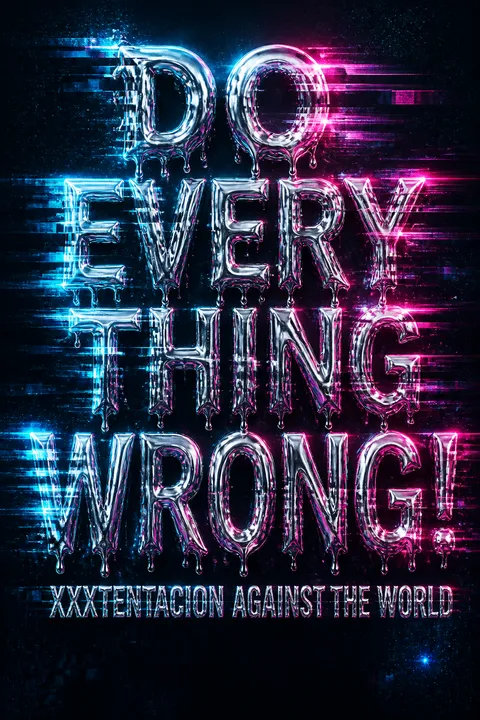
Do Every Thing Wrong! is a controversial book about rapper XXXTentacion that has received mostly positive reviews. Readers praise Kobek's analysis of race, class, and celebrity culture through the lens of XXXTentacion's life. Many find it thought-provoking and well-researched, appreciating Kobek's unique writing style and cultural critique. Some readers note it's more about society than the rapper himself. Critical reviews mention disjointed structure and perceived apologism. Overall, reviewers see it as a complex, satirical examination of modern America and internet culture.
People Also Read



Glossary
timbre
distinctive tone colorThe characteristic sound quality of a voice or instrument, beyond melody, harmony, rhythm, and lyrics. Kobek uses the term to explain why XXXTentacion remained recognizable while moving across sharply different styles. In this account, vocal texture and delivery carry much of the artist’s identity, even when conventional song structure or lyrical technique changes.
consensus reality
media-shaped shared judgmentThe public understanding of an event or person formed through repeated coverage, commentary, and platform circulation. Kobek uses the term for a version of reality that can appear broadly agreed upon while being shaped by commercial incentives and the interests of media institutions. It contrasts with the less tidy experiences of the people being discussed.
manufactured morality
commercially shaped moral judgmentKobek’s term for moral narratives produced and circulated through media in ways that can generate attention, status, or revenue. In the book, coverage of XXXTentacion often casts success and goodness as linked, then uses his alleged and documented misconduct to question whether he should be popular. The term describes the author’s critique, not a neutral category.
Righteous Whites
author's label for moralizing commentatorsA polemical label Kobek applies to white cultural commentators whom he sees as claiming moral authority over Black artists, especially when those artists become successful despite serious misconduct. The phrase captures the book’s attack on racialized media gatekeeping, but it is the author’s broad characterization, not an objective description of every critic or journalist.
SoundCloud rappers
artists grouped by platformA media label for a diverse set of musicians who released music through SoundCloud. Kobek argues that the category can imply a coherent genre where there may be little in common beyond the platform itself. In his account, the term reflects how journalists and industry observers turn a shared route of distribution into a musical trend.
The Influence of Afrocentric Facial Features in Criminal Sentencing
facial-feature sentencing studyA 2004 study by Irene V. Blair, Charles M. Judd, and Kristine M. Chapleau, cited by Kobek. It examined photographs of 216 convicted people and reported an association between judgments of Afrocentric facial features and longer sentences. The book uses the finding to argue that appearance can influence punishment in ways that are not captured by race or prior criminal history alone.
Download PDF
Download EPUB
.epub digital book format is ideal for reading ebooks on phones, tablets, and e-readers.








