

Key Takeaways
Do less of the noise to give more attention to what matters.
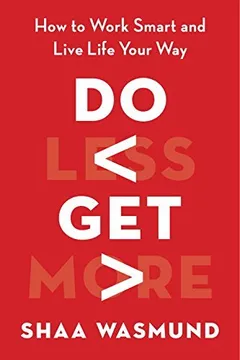
A wake-up call. After her partner died, Shaa Wasmund filled her days with work to avoid the grief. Staying busy helped her cope, but gradually became a way of life. Her young son’s observation that she was always busy made her see the cost: she was giving less attention to the people and projects she cared about most.
Attention beats activity. The book’s central claim is not that ambition or responsibility should disappear. It is that finite attention should be invested selectively. Doing fewer, more valuable things can improve both the work and the life around it. Wasmund recommends pausing, identifying one meaningful priority, and removing activities that crowd it out. The aim is to improve the life already in progress, not abandon it for an imaginary perfect one.
What's useful is the distinction between visible effort and directed attention. In workplaces that reward constant responsiveness, busyness can be rational signaling, not simply personal avoidance. That makes the prescription empowering but incomplete: individuals can prune commitments, while managers, finances, and care responsibilities also shape the load. A practical reading is to identify what can be changed personally and what requires negotiation or collective support. The child’s comment matters because it makes the cost concrete: a packed schedule is not neutral if it takes attention away from someone present.
Name what matters before fear fills your calendar with safer tasks.
Fear in disguise. Wasmund describes the “when...then” trap: postponing a valued goal until some condition is met, such as finishing a project, gaining another qualification, or waiting for life to calm down. The condition may be reasonable, but endless delay can protect a person from the risk of trying and failing. Being busy with less meaningful tasks can make that avoidance look responsible.
Start before certainty. The alternative is not a dramatic leap. Choose one practical step that does not require perfect timing, then take it. Wasmund’s own hidden assumption was that creative work could not provide a stable living, despite knowing people who had made it work. Naming the belief helped her see that a supposed fact about the world had been steering her choices.
The useful move is to treat delay as a question worth investigating, rather than proof of laziness. A person can ask whether a postponement solves a real constraint or merely lowers emotional exposure. That distinction is especially important when money, health, or caregiving genuinely limits options. Small experiments help because they produce information without requiring a total commitment. The book’s emphasis on personal beliefs is strongest when paired with this reality check: not every barrier is imaginary, but even real barriers may allow a first, low-risk step.
Use the 80:20 lens to protect your highest-return work and relationships.
Find the vital few. The Pareto Principle describes an uneven pattern in which a minority of inputs can produce a majority of results. Wasmund applies this as a prioritizing tool, not a precise formula: look for the small share of activities, people, and strengths that produce much of the value in work and life. She suggests asking which task today would make the greatest difference, rather than treating every item as equally important.
Question the destination. A story about a banker advising a Mexican fisherman to build a large business ends with the fisherman being promised the very retirement life he already enjoys: time with family, fishing, and music with friends. The point is to check whether striving serves a personal definition of a good life, or simply postpones it.
The 80:20 lens is powerful as a search question: where is effort producing disproportionate value? It becomes misleading if treated as a universal law or a demand to abandon everything outside a narrow top tier. Relationships, health, and maintenance work may matter precisely because their value is preventive or long-term. The fisherman story usefully tests ambition against its intended payoff. It does not prove that growth is foolish; it asks whether the reward is worth the time and trade-offs required to reach it.
Build your work around strengths that create energy and deep focus.
Work with your strengths. Wasmund recommends identifying what a person does well and enjoys, then finding ways to use those abilities more often. She uses “flow” for a state of absorbed concentration in which someone is engaged, challenged, and working effectively. The book cites Gallup research saying people who use their strengths daily are six times more likely to be engaged at work.
Trade rather than struggle alone. If detailed bookkeeping drains someone whose strength is communication, they might ask for help or exchange skills with a person who enjoys the task. This is not a reason to ignore every weakness. It is a reminder that trying to become equally good at everything can consume time better spent on distinctive strengths, while collaboration fills the gaps.
This approach connects motivation to job design: performance improves when tasks fit a person’s abilities and offer a meaningful challenge. It also reframes asking for help as resource allocation rather than personal inadequacy. Still, strengths should guide development, not become a permanent job description. People can grow new skills, and organizations should not use “play to your strengths” as an excuse to withhold training or assign all unwanted work to others. The most useful question is how to increase fit while sharing necessary work fairly.
Say no to attractive options that dilute your one real priority.
More choice can stall action. Wasmund describes filtering as deciding which requests deserve a yes, rather than accepting everything to avoid disappointing people. The book’s “Jam Test” refers to a study in which shoppers facing a smaller display of jams were more likely to buy than shoppers facing a much larger selection. It also recounts an animal shelter where showing 40 percent fewer cats reportedly doubled adoptions. Fewer options can make choosing easier.
Protect the yes. Before accepting a request, ask whether it matters, whether someone else could do it, and whether the reason for saying yes is fear of disapproval. If uncertain, pause instead of committing immediately. A polite no, a later date, or a referral to someone better suited can preserve time for work and people that matter more.
The insight fits a broader principle of choice architecture: abundance is not always experienced as freedom, especially when every option demands comparison. A deliberate no reduces future decision load and communicates a real boundary. But saying no is not cost-free; requests can involve power differences, shared obligations, or opportunities that are hard to predict. The best filter is not a rigid rule to reject most things. It is a pause that makes the trade-off visible before a reflexive yes turns into resentment.
Turn a meaningful goal into one small action scheduled today.
Make the next step visible. Wasmund suggests choosing one area of life, rating it from 1 to 10, and naming what would improve it. Then define a specific action, map the steps, and put them on a calendar. A mind map can move a tangled idea out of the head and show the actions needed to make it real. Working backward from the goal helps identify a reachable first step rather than demanding a complete plan.
Start with a short sprint. The Pomodoro Technique, as presented here, uses a timer for a focused 20-minute work period. It can lower the barrier to starting a project that feels too large. Wasmund also recommends sharing goals with a trusted person and setting a check-in, so intention becomes a commitment with a date attached.
This sequence turns aspiration into a feedback loop: define a target, try an action, observe what happens, and adjust. Scheduling reduces reliance on remembering or feeling motivated at exactly the right moment. The 20-minute interval is useful partly because it bounds the commitment, not because that duration suits everyone. Some work needs longer stretches, while interruptions may make even a short session impossible. The core tool is the combination of a concrete next action and a realistic appointment to do it.
Batch attention, silence alerts, and stop letting inboxes set the agenda.
Protect concentration. Batching means grouping similar tasks into a planned block instead of switching continually among email, calls, creative work, and administration. Wasmund notes that interruptions can take roughly 11 minutes to recover from, making frequent task changes costly. She recommends checking messages at set times, turning off nonessential alerts, and separating email used for communication from a task list used to track future work.
Make disconnection workable. The book describes a workplace study in which employees stopped checking email for five workdays. They experienced less stress, switched between tasks about half as often, and managers reported better work. The point is not that every job can abandon email. It is that teams can agree on response expectations and reserve uninterrupted periods for work requiring focus.
The attention lesson is stronger than a simple anti-technology message. Digital tools can coordinate work, but alerts make other people’s priorities constantly visible and easy to mistake for urgency. Batching creates a boundary around attention without requiring total disconnection. Its success depends on the surrounding system: a team that expects instant replies can punish an individual for silencing notifications. Clear shared norms make focused work a design choice rather than a private act of resistance.
Match demanding work to your energy, then schedule recovery deliberately.
Personalize the workday. Wasmund argues that productivity depends on individual rhythms. A morning-focused person should reserve fresh hours for demanding work rather than spend them clearing routine messages; someone with a different pattern can organize the day differently. She also cites research suggesting only about 2 percent of people multitask effectively, and argues that most people perform better by focusing on one task at a time.
Recovery supports output. The Healthy Mind Platter is Dan Siegel’s framework for tending to sleep, physical activity, focus, reflection, relaxation, play, and connection. Wasmund emphasizes that breaks, exercise, and time with others are not simply rewards after work. They help replenish attention and energy. She relays an estimate that only about four and a half hours of a workday may be highly productive, cautioning against assuming that longer hours automatically mean better results.
Personalization is a valuable corrective to productivity systems that assume everyone has the same energy curve. Rest also belongs in the model as a condition for sustained effort, not evidence of weak commitment. The harder issue is access: shift work, disability, caregiving, and precarious employment can restrict control over schedules and recovery. Advice to follow one’s rhythm is most practical when translated into small negotiable changes, such as protecting a short focus block or taking a real lunch break.
Do, delegate, or ditch each task instead of carrying it indefinitely.
Sort the load honestly. Wasmund proposes three choices for each task: do it, delegate it, or remove it. Before committing more effort, ask whether the task is useful, whether it is moving forward, whether someone else could do it, and what would happen if it stopped. This guards against maintaining obligations simply because they already exist. Delegation may require training or upfront coordination, but can free time for work that makes better use of a person’s abilities.
Persist or change course. The book uses Seth Godin’s “The Dip” for a difficult stretch that may be worth enduring, contrasted with a dead end that is not improving despite continued effort. Avoid quitting in a moment of panic; assess the pattern. If a goal still matters but the approach fails, change the method rather than treating one failed strategy as proof the goal is impossible.
The three-way sort challenges the hidden assumption that every item on a list deserves completion by the person who wrote it. Its most important safeguard is the distinction between temporary difficulty and persistent futility. That decision is rarely certain, so review criteria matter: evidence of progress, continuing motivation, cost, and available alternatives. Delegation also has a human cost if it merely transfers overload to someone with less power. A sound decision improves the whole system, not just one person’s calendar.
Analysis
Wasmund’s book is a practical argument about allocation: attention, time, and energy are limited, so the quality of a life depends partly on what those resources are spent on. Its narrative opening makes that claim more than a productivity slogan. Busyness first appears as a response to grief, then as a habit that obscures relationships and personal ambition. The shift from coping mechanism to costly default gives the advice emotional stakes.
The book’s most coherent sequence is: identify what matters, notice fear and inherited expectations, narrow the field, then make a plan that can survive ordinary distraction. This makes its productivity tools more useful than a bare list of hacks. Batching or scheduling becomes meaningful only after a person knows which work deserves protection. Likewise, saying no is not an end in itself; it serves a chosen yes.
The framework is strongest where it asks readers to inspect their own lives rather than imitate a supposedly ideal routine. The 80:20 lens, strengths inventory, and personal energy rhythms all encourage observation before prescription. Its weakness is that it sometimes treats structural constraints as if they were mainly matters of courage or prioritization. A person can be overwhelmed by low wages, understaffing, illness, or care duties, not merely by poor boundaries. Individual tools can still help, but they cannot substitute for changes in workload or support.
The book also occasionally turns research findings into confident rules of thumb. Claims about multitasking, productivity hours, and choice overload are best treated as prompts for experimentation, not universal measurements. That qualification strengthens rather than diminishes the central idea: test which tasks, conditions, and relationships actually produce value in a particular life. The durable lesson is not to do as little as possible. It is to stop confusing more activity with a better use of a finite day.
Glossary
Pareto Principle
Uneven distribution of resultsA statistical observation associated with Vilfredo Pareto, who noted that wealth in Italy was concentrated among a minority of people. Wasmund applies the principle as a practical search tool: identify the relatively small set of activities, customers, relationships, or strengths that produce a large share of value. The 80:20 ratio is a heuristic, not a guarantee.
flow
Absorbed, effective concentrationA state of deep involvement in an activity, associated in the book with psychologist Mihaly Csikszentmihalyi. A person in flow is absorbed in work that uses their abilities and provides a suitable challenge. Wasmund links this state to energy, learning, and strong performance, and argues that interruptions and mismatched tasks can make it harder to enter.
action habit
Starting before motivation arrivesWasmund’s term for building a pattern of acting on an important goal instead of waiting to feel fully motivated or certain. Taking an initial step brings attention into the present and can make continued effort easier. The approach relies on practical preparation, such as setting out exercise clothes in advance or beginning with a short work session.
Pomodoro Technique
Timed focus intervalA method for starting or advancing a task by working with focused attention for a set period, using a timer. In Wasmund’s account, the interval is 20 minutes, spent on one task without distractions. It is presented as a way to make an intimidating project feel manageable and to replace prolonged planning with a concrete start.
batching
Grouping similar tasks togetherA way of organizing work by placing similar activities into dedicated blocks rather than switching repeatedly among different kinds of tasks. Examples include reserving a defined period for writing, administration, or email. The purpose is to reduce the mental cost of changing focus and make it easier to sustain concentration on a particular type of work.
Healthy Mind Platter
Seven areas of mental wellbeingA framework attributed to Dan Siegel that identifies seven areas for supporting mental wellbeing: sleep, physical activity, focus, reflection, relaxation, play, and connection. Wasmund uses it to argue that productivity depends on more than work time. Neglecting rest, movement, or relationships can deplete the energy and attention needed for effective effort.
The Dip
A difficult stretch worth crossingA concept associated with Seth Godin, used to distinguish a temporary period of difficulty from a dead end. The Dip is a challenging phase that may lead toward a worthwhile outcome if a person persists. Wasmund recommends assessing progress, motivation, and value rather than quitting in a moment of panic or persisting automatically.
Jam Test
Choice and decision studyThe book’s name for a study by Sheena Iyengar and Mark Lepper comparing shoppers’ responses to displays of jam. Shoppers presented with six choices were more likely to make a purchase than those facing a much larger selection, and reported greater satisfaction with their choice. Wasmund uses the study to illustrate how excessive choice can obstruct action.

Download PDF
Download EPUB
.epub digital book format is ideal for reading ebooks on phones, tablets, and e-readers.








