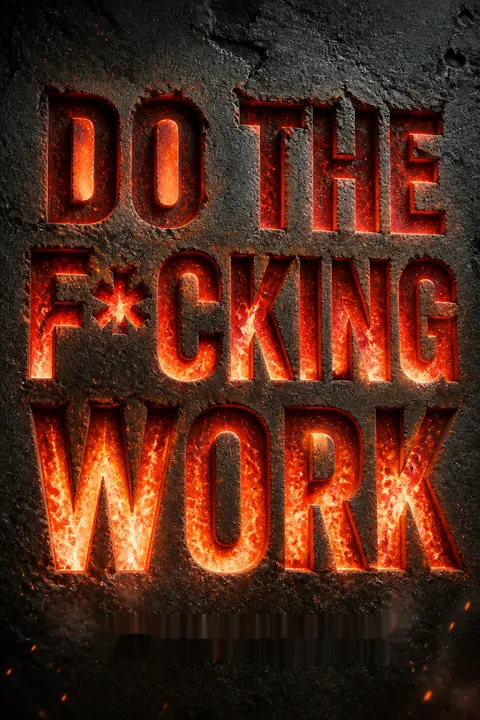


Key Takeaways
Start while the idea is still small enough to test.
Make a cheap first move. In graduate school, Jason Bacher and Brian Buirge built a design-advice website in about a day. The coffee and domain registration cost $14.45. It drew roughly 500 visitors on its first day, then 6,000, then 70,000. The lesson is not that every experiment goes viral. It is that a small attempt can reveal whether an idea deserves more effort.
Let reality expose the gaps. When they rushed into selling products, about 500 orders brought in roughly $10,000, but their printer could not deliver. The founders and a friend hand-printed 400 posters in a frantic weekend. Starting created an opportunity, and it revealed how much they still had to learn about delivering on it.
The first experiment is a useful antidote to the fantasy that good ideas arrive fully formed. In entrepreneurship, a prototype is not proof of success; it is a way to replace guesses with information before the cost of commitment grows. The authors’ sudden traffic spike is an unusually dramatic reward, though, and should not be mistaken for a typical result. Most small tests produce quieter evidence: a handful of users, a failed sale, or a clearer sense of what needs building. The durable principle is to make the next step small enough to attempt and concrete enough to teach.
Prepare to adapt, rather than worship a perfect plan.
Aim, then get ready. The book distinguishes planning from preparation. A plan sketches a route; preparation builds the skills, supplies, and judgment needed when the route breaks. The founders’ first poster launch showed the difference. They expected their printer to finish the job, discovered late that production had not begun, and had to recruit help, find equipment, and learn screen printing under a shipping deadline.
Make room for surprises. Goals still matter: without a direction or a way to judge progress, creative effort can scatter. But a detailed plan cannot anticipate every failure or opportunity. The practical balance is to set a destination, prepare for likely demands, and stay willing to change tactics when new facts arrive. Progress is more useful than endless rehearsal of an ideal process.
This distinction resembles the difference between a map and a capability. A map helps people coordinate, but expertise is what lets them respond when the terrain changes. That is why emergency services, expedition teams, and product developers rehearse contingencies rather than relying on a single forecast. There is a risk, however, in turning improvisation into an excuse for avoidable chaos. The poster crisis was survivable partly because friends had relevant skills and time to help. Preparation does not eliminate uncertainty, but it can make adaptation less costly and less dependent on luck.
Use obstacles to build skills, not to declare the goal impossible.
Turn a bad setting into a workshop. During graduate school, the founders and friends rented a neglected Ohio house they called the Windchimer. It had mold, damaged walls, missing trim, and little usable furniture. With four weeks to make it livable, they patched, painted, repaired, and rebuilt. The work was cold, exhausting, and often improvised.
Notice what the struggle produces. The house became a home, and its basement grew into a design studio and order-fulfillment operation for their company. The renovation also taught the group practical skills and strengthened trust through shared effort. An obstacle does not automatically contain a hidden gift. The useful shift is to ask what can be learned, repaired, or created within the conditions at hand, rather than assuming those conditions decide the outcome.
The house story makes resilience tangible: adversity becomes useful when people can act on it together. This fits research and practice in team learning, where shared problem-solving can build trust and reveal abilities that routine work leaves hidden. The caution is important. Hardship is not inherently ennobling, and a dangerous or exploitative situation is not improved by calling it an opportunity. The authors’ transformation depended on agency, cooperation, and practical resources, including access to discounted supplies. The lesson is not to romanticize bad conditions, but to distinguish constraints that can be changed from those that require an exit.
Make each failure specific enough to teach the next attempt.
Find the cause, not a scapegoat. When the founders began shipping coffee mugs, many arrived broken. They first suspected the postal service or supplier, then learned from a postal worker that fragile items needed double-boxing. The core mistake was their own failure to investigate a basic shipping requirement.
Treat rejection as information. Their mobile app was rejected by Apple three times. They concluded that the app had little chance because its profanity conflicted with Apple’s brand and, more fundamentally, it offered no useful feature beyond their existing website. Both stories sharpen the meaning of failure: disappointment alone teaches nothing. A useful postmortem asks what assumption failed, what evidence was missed, and what should change before the next attempt.
The authors’ strongest account of failure is diagnostic rather than motivational. In engineering, a postmortem is most valuable when it reconstructs the chain of decisions that produced an incident, without reducing the explanation to blame. The mug problem is a compact example: an overlooked process detail, not bad luck, damaged the product and the business case. Still, perseverance needs a stopping rule. Repeating an experiment after the evidence has changed little can waste scarce time. Learning from failure means both improving the method and recognizing when the underlying idea does not merit another attempt.
Practice creativity as labor, not as an aesthetic identity.
Make things, not just signals. The book pokes at the idea that creativity can be recognized by a uniform, a stylish workspace, a collection of inspirational references, or a carefully curated online persona. Those signals may surround creative work, but they cannot substitute for making it. The founders warn that endlessly saving other people’s ideas can become a stand-in for developing one’s own.
Give the work attention. They urge readers to choose goals, limit distractions, start projects, and change routines when familiar habits stop helping. Creative ability, in this account, grows through repeated attempts and decisions, not through waiting for a special mood. The test is not whether a person looks creative, but whether the work gains substance through practice, judgment, and revision.
This critique usefully separates creative identity from creative output, a distinction that matters in an economy where self-presentation can be mistaken for production. Practice also connects to deliberate learning: people improve by attempting difficult tasks, noticing errors, and adjusting their approach. Yet the book’s tough-love language can make effort sound like a virtue in itself. Hours spent on an unexamined process do not guarantee better work, and rest is not evidence of unseriousness. The sharper standard is purposeful effort: sustained attention directed toward a question, craft, or audience that matters.
Invite capable people in before control becomes a bottleneck.
Let other people change the result. As the company grew, the founders hired interns and employees whose contributions reached beyond the tasks initially assigned. One intern rescued a discarded black-on-black poster concept. Another helped lead a major transition between shipping platforms. A later assistant contributed across many parts of the brand and business.
Ask for useful scrutiny. The authors recommend seeking mentors, asking questions, requesting feedback, and learning to hear criticism without treating it as a verdict on personal worth. Collaboration introduces uncertainty because other people bring their own judgment and methods. That is precisely why it can produce something an individual would not have conceived alone. Help is not merely extra labor; it can expand what the project is capable of becoming.
The stories illustrate a central insight from organizational psychology: teams gain value not simply by adding more people, but by combining different knowledge and allowing that knowledge to affect decisions. Feedback is most productive when it is specific, informed, and connected to a shared goal. There is also an ethical tension in the book’s account of interns, long hours, and an informal workplace with weak safety practices. Collaboration should not be confused with extracting unpaid effort or making poor conditions feel like family. Good creative culture pairs openness with clear responsibility and fair treatment.
Keep the oddness that makes your work recognizable.
Do not dilute the point of view. At a stationery trade show, the founders designed a restrained booth to fit in with the other exhibitors. Their merchandise attracted some attention, but the setting did not naturally suit the irreverent character of their brand. On the final day, they improvised a joking, self-guided tour through the booth, using the kind of humor that felt more like them.
Fit matters more than imitation. The performance won praise and made their space memorable, although the show generated only about $800 in sales and little expected repeat business. The episode does not prove that standing out guarantees commercial success. It shows that copying a market’s conventions can erase the qualities that make a product distinctive, and that work feels more coherent when its presentation matches its character.
Distinctiveness is not decoration. In crowded markets, recognizable choices help an audience understand what a product is and whom it serves. The booth story also shows why authenticity cannot be measured solely by applause: the tour made the experience more enjoyable and memorable, but it did not erase the mismatch between the company and the trade show’s buyers. A sound strategy asks both whether a point of view is genuinely yours and whether the intended audience can value it. Nonconformity is useful when it clarifies the offer, not when it becomes a performance for its own sake.
Let experiences outside work enlarge what your work can become.
Make room for life beyond production. In 2012, the founders attended the What If conference, where creative professionals treated ambition, friendship, and enjoyment as parts of a whole life rather than competing distractions. The experience changed their sense of what was possible. Within a month, they bought a van and began organizing a speaking tour across the country.
Let new surroundings unsettle old assumptions. The tour lasted about two months and crossed 38 cities. Its exhausting drives, lectures, conversations, and unfamiliar places interrupted their normal routine and exposed them to new people and perspectives. The authors argue that work becomes more meaningful when life is fully experienced, not when every available hour is converted into business activity. Curiosity can feed creative judgment as directly as discipline does.
This account challenges the narrow idea that passion means loving one’s job more intensely. Novel settings can interrupt habitual attention and reveal possibilities that familiar routines conceal. In that sense, travel and community function as inputs to creative thinking, not merely rewards after productivity. The qualification is that a dramatic tour is not accessible or necessary for everyone. Renewal can also come from local relationships, reading, or a different kind of project. The broader principle is to protect experiences that change the questions a person asks, rather than treating all non-work time as lost output.
Finish the promise, then redesign the operation that keeps you stuck.
Completion can require structural change. As GFDA expanded, the founders found that processing every order themselves tied the business to one house and exhausted the people running it. They searched for a fulfillment company, faced repeated rejections because of the brand’s profanity, and eventually found a partner willing to handle packaging and shipping.
Separate persistence from recklessness. The founders also tested a year of working from different cities, with one partner in New York and another keeping operations in Ohio. These changes let the business continue while its founders explored new opportunities and reduced dependence on the original setup. Their point is not to cling to every commitment forever. It is to meet promises already made, then alter the system when the old way of working blocks further progress.
The shift from hand-packing orders to outsourcing fulfillment captures a common transition in small businesses: what once enabled growth can become the constraint that prevents it. Organizational design therefore has to change as volume and roles change. The authors’ distinction between calculated risk and recklessness is useful, especially because their own beginnings included avoidable operational failures. A practical test is whether a risk has a purpose, a fallback, and a plausible way to learn from the result. Persistence is valuable when it serves the mission; it is not a reason to preserve a failing process.
Make success useful by teaching what the struggle taught you.
Turn experience into shared knowledge. GFDA grew from a website and a poster into a studio, products, lectures, and workshops. The founders used their own mistakes and experiments to help other creative professionals take risks, work together, and complete ambitious projects. They present meaning not as a secret someone eventually uncovers, but as something made through choices and contributions.
Remember the people behind the work. The book closes by thanking a long list of friends, colleagues, employees, mentors, and family members. That gesture fits the story: the company depended on printers, collaborators, staff, audiences, and people who helped in ways the founders could not have planned. Success is not only a finished product or a larger business. It can also be knowledge passed on and credit given to the people who made the work possible.
The book’s account of contribution adds a social dimension to creative ambition. Knowledge gains value when it can travel beyond the person who acquired it, and gratitude makes visible the often-hidden labor behind an achievement. This view also counters the lone-genius story that dominates many accounts of entrepreneurship. At the same time, sharing advice is not a substitute for expertise or evidence; a vivid personal lesson may not generalize to every field or circumstance. Its strongest use is as an invitation to test, adapt, and pass along what has proved useful, while naming the people who helped.
Analysis
Do the F cking Work is a memoir-inflected guide to creative practice, built from advice fragments and the history of Good Fucking Design Advice. Its organizing force is less a formal system than a recurring cycle: begin before certainty, meet resistance, learn from concrete mistakes, draw in other people, and keep changing the operation as ambitions grow. The company’s story gives the advice credibility because the founders show both the energy that moved the work forward and the preventable errors that nearly undermined it.
The book’s most valuable distinction is between creativity as image and creativity as behavior. A curated identity, attractive references, or a clever idea cannot stand in for making something and confronting its consequences. Its strongest examples are operational rather than abstract: a failed printer forces the founders to produce posters themselves; broken mugs expose a packing mistake; a rejected app exposes the absence of useful functionality. These episodes turn failure from a romantic badge into information about a process.
The book also treats creative work as social. Friends provide skills, employees notice opportunities, mentors and critics expose blind spots, and a wider community changes what the founders imagine possible. That emphasis complicates the familiar story of the solitary entrepreneur. However, the book’s deliberately abrasive voice and celebratory accounts of exhausting work can make persistence seem universally virtuous. The stories themselves offer a needed correction: some problems are solved by changing course, seeking help, or redesigning the business, not simply by enduring more.
Its advice is most reliable when read as a push toward agency rather than a universal formula. Starting small does not guarantee rapid attention, and boldness does not remove economic or personal constraints. The durable contribution is a practical orientation: make the work visible, seek evidence, accept critique without surrendering judgment, protect the experiences that widen perspective, and give other people room to improve the result. Meaning, in this account, is not discovered fully formed. It emerges through sustained choices and work that reaches beyond private intention.
Review Summary
Do the F*cking Work receives mixed reviews, with an average rating of 3.94/5. Readers appreciate its motivational content and design aesthetic, praising its blunt advice and inspiring message. However, many criticize the silver font on white background as difficult to read. Some find the book's tone overly masculine and lacking depth. Opinions vary on the book's usefulness, with some finding it refreshing and others considering it superficial. The unconventional language and creative approach resonate with some readers while alienating others.
People Also Read







Glossary
GFDA
Good Fucking Design AdviceGFDA is the abbreviation for Good Fucking Design Advice, the design-advice website and creative business founded by Jason Bacher and Brian Buirge in 2010, with Jason Richburg later joining as a coauthor. The brand grew from online advice into posters, merchandise, client work, lectures, and workshops focused on creative risk, practical effort, and unconventional design.
FAQ
1. What’s "Do the F*cking Work: Lowbrow Advice for High-Level Creativity" by Brian Buirge about?
- Profane, Unfiltered Creative Advice: The book delivers 100 pieces of tough-love, profanity-laced advice aimed at helping readers unlock creativity and achieve ambitious goals.
- Real-World Lessons: It draws from the authors’ journey building Good Fucking Design Advice (GFDA) from a grad school project into an international brand.
- Emphasis on Action: The core message is to stop overthinking and start doing, embracing the messy, unpredictable process of creative work.
- Humor and Honesty: The book uses humor, personal stories, and visual experiments to challenge conventional thinking and motivate readers to see their work and life differently.
2. Why should I read "Do the F*cking Work" by Brian Buirge?
- No-Nonsense Motivation: If you’re tired of sugarcoated self-help, this book’s direct, irreverent style is a refreshing wake-up call.
- Practical, Actionable Advice: The book is packed with real-world strategies for overcoming creative blocks, handling failure, and pushing through obstacles.
- Universal Relevance: While rooted in design, the advice applies to anyone seeking to pursue creative or ambitious goals in any field.
- Entertaining and Relatable: The authors’ stories of failure, persistence, and success are both funny and deeply relatable, making the book enjoyable as well as useful.
3. What are the key takeaways from "Do the F*cking Work"?
- Start Before You’re Ready: Don’t wait for perfect conditions—take action and figure things out as you go.
- Embrace Failure: Failure is inevitable and essential; learn from it, don’t fear it.
- Ask for Help: Collaboration and seeking feedback are crucial for growth and better results.
- Show Passion and Finish: Bring energy to your work, see things through, and don’t settle for mediocrity.
- Make Your Own Meaning: The meaning of life and work isn’t found, it’s created through effort, risk, and persistence.
4. Who are the authors of "Do the F*cking Work" and what is GFDA?
- Founders and Creatives: The book is written by Jason Bacher, Brian Buirge, and Jason Richburg, who met in graduate school studying Visual Communication Design.
- GFDA Origins: Good Fucking Design Advice (GFDA) started as a humorous website offering blunt design advice, which quickly went viral.
- Brand Evolution: GFDA grew into a business selling merchandise, running workshops, and giving talks worldwide, all centered on their signature style of unfiltered advice.
- Real Experience: The authors share their own stories of building GFDA, including their many failures, successes, and lessons learned.
5. What is the main philosophy or method behind "Do the F*cking Work"?
- Action Over Perfection: The book’s philosophy is to prioritize doing the work over endless planning or waiting for inspiration.
- Profanity as a Tool: The use of strong language is intentional, meant to jolt readers out of complacency and make the advice memorable.
- Embrace Messiness: Creativity is inherently chaotic and unpredictable; the book encourages readers to accept and work with that chaos.
- Self-Belief and Endurance: Believing in yourself, persisting through setbacks, and never giving up are central to the method.
6. How does "Do the F*cking Work" by Brian Buirge address failure and obstacles?
- Failure Is Inevitable: The authors stress that everyone fails, often repeatedly, and that failure is a necessary part of growth.
- Learn and Adapt: Each failure is an opportunity to learn, adapt, and come back stronger.
- Obstacles as Opportunities: Challenges are reframed as chances to develop new skills, build resilience, and discover unexpected paths.
- Celebrate Mistakes: The book encourages readers to celebrate their failures, use them as feedback, and not let ego or fear hold them back.
7. What are some of the most important pieces of advice or concepts in "Do the F*cking Work"?
- Get Fucking Started: Don’t wait for permission or perfect timing—begin now.
- Don’t Censor Yourself: Be authentic and honest in your work, even if it’s uncomfortable.
- Ask for Fucking Help: Collaboration, mentorship, and feedback are essential.
- Finish the Fucking Job: See projects through to completion and honor your commitments.
- Show Some Fucking Passion: Bring energy, curiosity, and risk-taking to your creative process.
8. How does "Do the F*cking Work" suggest readers handle creative blocks and procrastination?
- Stop Fucking Around: Eliminate distractions and focus on the work that matters.
- Change Your Fucking Routine: Break out of ruts by altering habits and trying new approaches.
- Preparation Over Planning: Prepare for action rather than getting stuck in endless planning.
- Get Out of Your Own Way: Let go of perfectionism and self-doubt to make progress.
9. What role does collaboration and asking for help play in "Do the F*cking Work"?
- Collaboration Is Key: The book highlights how partnerships and teamwork lead to better, more unpredictable results.
- Lower Your Guard: Being open to others’ ideas and chaos can lead to unexpected breakthroughs.
- Seek Mentors and Feedback: Good mentors and honest feedback are invaluable for growth.
- Build a Supportive Community: Surround yourself with high achievers, misfits, and people who challenge you.
10. How does "Do the F*cking Work" by Brian Buirge define and encourage passion in creative work?
- Passion Fuels Persistence: Genuine enthusiasm helps you push through challenges and setbacks.
- Live in the Moment: The book urges readers to be present, enjoy the process, and find meaning in the work itself.
- Take Risks and Experiment: Passionate work involves risk-taking, experimentation, and a willingness to fail.
- Make Work Enjoyable: The authors emphasize that loving life makes work more enjoyable, and vice versa.
11. What are the best quotes from "Do the F*cking Work" and what do they mean?
- “Do the fucking work.” – The core message: action is everything.
- “Fail, fail, and fucking fail again.” – Embrace failure as a path to growth.
- “Don’t wait to be fucking discovered.” – Take initiative; don’t expect opportunities to find you.
- “Creativity is a fucking work ethic.” – Creativity is about consistent effort, not just inspiration.
- “Never fucking settle.” – Hold yourself to high standards and don’t accept mediocrity.
12. How can readers apply the advice from "Do the F*cking Work" to their own lives and careers?
- Start Small, Start Now: Take immediate action on your ideas, even if you feel unprepared.
- Embrace Messy Progress: Accept that the process will be chaotic and imperfect, but keep moving forward.
- Seek Out Feedback: Regularly ask for input from others and be open to criticism.
- Finish What You Start: Commit to seeing projects through, learning from each step, and building momentum.
- Make Your Work Meaningful: Strive to create work that matters to you and contributes something valuable to others.
Download PDF
Download EPUB
.epub digital book format is ideal for reading ebooks on phones, tablets, and e-readers.








