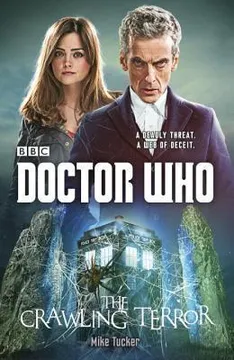


Plot Summary
Prologue
In Ringstone, new arrival Gabby Nichols12 finds an enormous insect in her daughter13 Emily’s13 bedroom and screams at what she sees. Nearby, farmer14 Alan Travers14 becomes trapped in a tunnel web and glimpses the creature that has caught him.
That night, schoolboy3 Kevin Alperton3 watches a swarm of black insects overwhelm a fox in his garden. By morning the quiet village has three separate warnings: something has grown far beyond its natural size, something is hunting, and the familiar countryside has become dangerous.
The opening makes ordinary domestic and rural spaces unsafe before the Doctor arrives. Gabby’s bedroom, Alan’s familiar walk home, and Kevin’s garden are not remote wildernesses but places where people expect to feel protected. Their separate encounters also establish different kinds of vulnerability: a mother trying to guard children, a man caught alone, and a boy who sees danger but lacks authority. The insects remain unnamed and unexplained, so the prologue makes fear precede understanding. Its quiet, local scale gives the later military response a human cost rather than the feel of an abstract invasion.
The Stone Circle Stirs
The Doctor1 arrives in Wiltshire with Clara2 after the TARDIS detects an unusual energy reading. At the King’s Guards, a Bronze Age stone circle, he finds a gap where one stone is missing and concludes that the site is dormant.
Meanwhile Kevin3 discovers the fox’s remains in his garden, then kills a hand-sized mosquito that attacks him on his way to school. Clara2 finds Alan Travers’s14 body caught in webbing beneath a railway underpass. At the veterinary surgery, Angela Drabble4 shows them the giant crane fly Gabby12 brought in.
The Doctor1 scans it and identifies engineered changes rather than natural growth. Constable5 Charlie Bevan5 confirms the dead man’s14 identity, and the Doctor1 realizes that the insects, the stone circle, and the TARDIS’s energy reading may be connected.
The Doctor’s arrival converts scattered sights into a problem of evidence. Kevin’s frightened but effective response, Clara’s discovery of the body, and Angela’s examination each provide a different kind of knowledge, while none of them can explain the whole event. The gap in the stone circle offers a physical clue, but the Doctor’s reading that the site is dormant complicates any easy supernatural explanation. The insects are not simply monsters from nature: their engineered bodies point toward human intention. That shift matters because it transfers the story’s central question from what is happening to who has chosen to make it happen.
The Roads Become Traps
Charlie5 and Angela4 help the Doctor1 warn the villagers, but many dismiss the danger until the Doctor1 describes Alan’s14 body. Gabby,12 already frightened for her children, takes Emily13 and baby Wayne from the meeting and tries to drive out of Ringstone. A wall of web catches her car across the road. As she frees the children, a huge spider climbs over the vehicle and a swarm of mosquitoes attacks; Gabby12 is stung and collapses.
Elsewhere, Bert Mitchell’s15 radio call breaks off amid crashing metal and a scream. The Doctor,1 Clara,2 Angela,4 and Charlie5 find Bert’s15 van wrecked beside another web barrier, with blood on the glass and a shotgun twisted by acid. Before they can investigate further, a car-sized beetle charges from the field.
The village meeting exposes a familiar crisis of credibility: the warning sounds absurd until people can see the danger, but by then the danger has already shaped their choices. Gabby’s flight is an attempt to reclaim parental control, and the web defeats that plan by turning the road itself into an enclosure. Her insecticide cans remain locked in the car, an ordinary precaution rendered useless by the speed of events. The attack on Bert and the discovery of the acid-damaged shotgun broaden the threat beyond a single predator. Ringstone is not merely being invaded; its routes of escape and communication are being deliberately closed.
The Village Turns Against Itself
A military helicopter attacks the beetle, but the insect sprays acid across the aircraft and brings it down in flames. The Doctor1 escapes to Ringstone church with Charlie,5 where they discover a giant spider hanging in the rafters above them.
Outside, mosquitoes sting villagers and inject a drug that leaves them obedient and blank-faced. Clara2 and Angela4 slip away toward the science park, while the Doctor1 and Charlie5 shelter until Kevin3 appears through a hidden passage beneath the church.
Kevin3 has kept a dead mosquito and suspects its sting is changing people. The Doctor1 identifies scopolamine in its venom, confirming that the insects are being used as tools. Kevin3 then leads the Doctor1 and Charlie5 through the passage, while Clara2 and Angela4 approach the research buildings.
The attack on the helicopter establishes that conventional force can hurt the insects without controlling the consequences. The greater danger is the mosquitoes’ ability to make Ringstone’s own residents instruments of the invasion. That transformation erases the usual boundary between attacker and neighbor: Clara and Angela must evade people they know, while the Doctor must treat the church as a temporary refuge rather than a sanctuary. Kevin’s preserved specimen gives his fear practical value. He is still a child, but his observation connects the biological attack to intentional control, making him an investigator in his own right rather than a bystander waiting for adults to act.
Clearfield Opens the Door
At the science park, Clara2 and Angela4 find cages of grotesque hybrid insects beside thirteen black machines patterned after the village stones. Jason Clearfield,6 the masked owner of the site, confronts them with a revolver.
He explains that he has recovered a wartime German Bell device and built a technological substitute for the damaged stone circle. His insect experiments are meant to provide bodies for the Wyrresters, aliens whose minds can cross the portal even when their bodies cannot.
Before Clara2 can escape, the Wyrresters demand that Clearfield6 use her as a host because her mind has been altered by alien technology. Clearfield6 obeys. Clara2 is forced into the circle, and the transfer sends her consciousness into an alien body while a Wyrrester takes hers.
Clearfield’s laboratory makes the story’s hidden machinery visible, but visibility does not mean consent. Clara recognizes that the machines reproduce the stone patterns, yet she cannot control what the system does to her. Clearfield presents himself as a mediator between species, but his willingness to sacrifice Clara reveals how readily his language of rescue becomes coercion. The transfer also sharpens the novel’s concern with personhood: the body can remain familiar while its occupant changes, and the mind can survive a displacement that the body cannot explain. Clara’s agency is threatened physically, but her awareness remains the source of resistance.
Robin’s War Story
Kevin3 guides the Doctor1 and Charlie5 through the church tunnel and out near the post office. They coat themselves in insect secretions to evade detection, then reach Robin Sanford’s7 isolated farm. Robin7 mistakes them for infected intruders and fires through the door before the Doctor1 disarms him.
Once he recognizes the danger, Robin7 explains that he served in the Home Guard during a secret wartime experiment at Ringstone. The British had built a Bell to investigate a signal from space, and the test had ended in a massacre.
A spider attacks the farmhouse before Robin7 can explain everything. Army gunfire draws it away long enough for the Doctor1 and Charlie5 to escape on Robin’s7 military motorcycle. They ride for the TARDIS, which can take them to the night Robin7 remembers.
Robin’s suspicion is not irrational paranoia; it is the residue of an earlier catastrophe that the village has turned into a joke. The Doctor’s willingness to listen converts that dismissed memory into usable history. Kevin’s tunnel and the insect-scent disguise show how local knowledge can outperform force in a landscape the creatures control. Yet the spider’s attack makes clear that recovering the past is not an academic detour. The Doctor needs the original event to understand the present, and the present gives him little time to investigate it safely. Robin’s account therefore becomes both testimony and a route into danger.
The Bell Calls a Scorpion
The TARDIS takes the Doctor1 and Charlie5 to Ringstone on 21 March 1944. They watch Professor Clearfield6 oversee the British Bell experiment, positioned by the stones and timed for the equinox. When the machine opens a gateway, a huge Wyrrester scorpion emerges and kills soldiers and scientists.
The Doctor1 recognizes the creature but refuses to alter events that have already shaped the present. Private7 Robin Sanford,7 whose weak heart keeps him from ordinary service, uses the village searchlight to expose the scorpion to German bombers.
The raid destroys the Bell and the stone circle, while the Doctor1 and Charlie5 escape to the TARDIS. Clearfield6 survives the attack, but the Doctor1 leaves him behind, unaware that the alien venom and the Bell’s energy have changed him.
The historical journey replaces village legend with an event whose violence is immediate and specific. Robin’s later reputation as an unreliable storyteller is overturned by the sight of the massacre, yet the Doctor cannot intervene simply because he knows what follows. His restraint is not indifference; it is recognition that changing the past could erase the very evidence that brought them there. Robin’s heart condition also recasts apparent weakness as a different kind of capacity: he cannot fight the creature directly, but he can direct the bombing that ends the experiment. Clearfield’s survival leaves the past unresolved in precisely the way that drives the present crisis.
Seventy Years Later
Back in the present, the Doctor1 detects a fresh activation at the science park and returns with Charlie.5 Clearfield6 explains that the venom made him extraordinarily resilient, but a bomb’s fire left his face permanently scarred. He has spent decades rebuilding the Bell and serving the Wyrresters, who have influenced his judgment.
Clara2 is no longer in control of her own body; her mind has crossed to the Wyrrester world. The Doctor1 interrupts the machine and escapes with her friends, taking a vial of the Bell’s essential fluid. He later returns to bargain with Clearfield,6 altering the fluid so the device will work only with his correction. His leverage is temporary, because the Wyrresters still need a functioning Bell before the equinox.
Clearfield’s history gives his villainy a human shape without excusing it. He measures his life by the moment the Doctor refused to save him, then converts that grievance into decades of collaboration with the beings who transformed him. His physical survival has become a story he tells himself about destiny, while the Doctor sees the same event as a danger that must still be contained. Clara’s displacement makes the conflict intimate: the machine is not a remote invasion device but the only route to restoring a companion. The modified fluid link turns technical knowledge into bargaining power, though it cannot make the bargain morally clean or safe.
Clara Sees the Wyrrester World
Clara2 awakens in the body of Gebbron,9 a Wyrrester scientist, on his devastated homeworld. Chief Researcher10 Maagla10 shows her a city reduced to ruins and a population collapsing under the species’ dwindling resources. He first frames the planned move to Earth as a desperate search for survival.
Clara2 then learns that Gebbron9 and his allies intend to save only an elite, abandoning the rest of their people after advocating mass killing at home.
On Earth, the Wyrrester occupying Clara’s body9 manipulates villagers and soldiers while searching for the missing stone from the original circle. Kevin3 reveals the stone in Robin’s7 garden. Its recovery gives the Wyrresters a way to restore the physical gateway they had been unable to open through Clearfield’s6 replica alone.
The alien world complicates the easy division between invader and refugee. The Wyrresters face real ecological collapse, but their leaders define survival as the privilege of a chosen few. Clara’s response to their ruined city is therefore not simple sympathy or simple rejection; she can recognize suffering without accepting the politics built around it. The contrast between Maagla’s appeal and Gebbron’s coercion exposes how humanitarian language can conceal hierarchy. The missing stone gives that ideology material force: an ancient object, kept in a village garden, may decide who gets access to a new world and who is left behind.
A Stone Returns
Gebbron9 forces the villagers to carry Robin’s7 recovered stone toward the King’s Guards and takes Kevin3 hostage to control the others. Captain Wilson’s8 soldiers break into the area with flash-bangs and smoke, freeing Angela,4 Charlie,5 Robin,7 Kevin,3 and Private Hawkins before the crowd can complete the work undisturbed.
Charlie5 then remembers the crucial detail from the 1944 bombing: one German bomb failed to explode and remains beneath the circle. Wilson’s8 team has only one anti-tank missile left, while Colonel Dickinson17 is preparing an airstrike if the Bell’s energy rises again.
At the science park, the Doctor1 repairs the Bell and connects it to the TARDIS, persuading Wilson8 to allow a brief activation so Clara2 can return before the military destroys the machine.
This turn gathers the story’s scattered resources into one unstable plan. Kevin’s discovery supplies the Wyrresters with the missing stone, but his capture also gives the village a reason to resist rather than merely flee. Wilson’s soldiers can free individuals, yet they cannot solve the larger threat with firepower alone. Charlie’s memory of the unexploded bomb provides a means to destroy the circle, at the cost of putting everyone nearby at risk. The Doctor’s appeal to Wilson is similarly conditional: he asks a soldier to delay a justified attack for the sake of one person. The rescue and the counterattack now depend on timing rather than certainty.
The Equinox Breaks
As the equinox approaches, Clearfield6 powers the Bell while the Doctor1 adjusts the fluid link through his TARDIS connection. The gateway opens over the stone circle, and a Wyrrester body appears in Ringstone as Clara’s2 consciousness returns to her human form.
The Doctor1 and Clearfield6 struggle over the controls, while Private Hawkins fires the team’s last anti-tank missile at the remembered bomb beneath the stones. The explosion destroys the circle and tears apart the newly arrived creature.
The blast jolts the Bell at the science park; the Doctor1 reverses its operation, shutting the portal down. Clearfield6 is caught inside the circle as the transfer collapses, leaving his ultimate fate uncertain. With the energy readings falling, Colonel Dickinson17 orders the approaching helicopter to abort its strike.
The climax succeeds because no single character controls the outcome. The Doctor restores Clara through technical improvisation, Hawkins acts on Charlie’s recovered memory, Wilson accepts risk, and Clearfield’s struggle helps destabilize the machine he devoted his life to rebuilding. The bomb that once destroyed the wartime circle returns as both weapon and historical consequence, making the past an active part of the present rather than a solved mystery. Clara’s return is immediate but not triumphant in a simple sense: she has been displaced, used, and forced to witness the Wyrresters’ world. Stopping the invasion requires destroying the very route that might have offered those desperate aliens another home.
The Last Clean-Up
Army medics treat Ringstone’s residents for scopolamine and minor injuries, and officials prepare to remove the insects, machinery, and wreckage under strict secrecy. Wilson8 learns that the surviving villagers should recover, while Dickinson17 leaves to report to the government.
The Doctor1 tells Robin7 that he damaged the Bell enough to delay any attempt to restart it for decades. Charlie5 asks what became of Clearfield,6 but the Doctor1 cannot tell whether the failed transfer killed him or carried him to Typholchaktas.
Clara,2 shaken but alive, leaves with the Doctor1 in the TARDIS. Angela4 returns toward the village with Robin7 and Charlie5 as soldiers continue clearing the fields. The villagers have survived the immediate attack, but the official response is to bury the story along with its evidence.
The resolution restores ordinary life only partially. Medical care addresses the drugged villagers’ bodies, while secrecy prevents them from publicly understanding what happened to their community. Wilson and Dickinson represent different faces of authority: one has taken personal risks to save lives, while the other must fold the event into national security procedures. The Doctor’s damage to the Bell offers a practical delay, not a permanent guarantee. Clara’s departure preserves her relationship with the Doctor but does not erase the cost of her displacement. The ending leaves Ringstone physically recovering and institutionally silenced, suggesting that survival and truth are separate outcomes.
Epilogue
After Ringstone’s roads reopen, Polish driver18 Józef Razowski18 joins the traffic and drives away without learning what caused the day’s blockade. A huge insect strikes his van’s windscreen, splattering yellow fluid and fragments of wings across the glass.
His wipers clear the remains as the radio comes back to life, and he continues his journey. The final encounter suggests that at least one altered insect escaped the village’s destruction, leaving the official clean-up incomplete.
The epilogue refuses the comfort of a perfectly sealed ending. The authorities can remove wreckage, medicate residents, and control what is reported, but they cannot guarantee that every consequence has been contained. Józef is an outsider whose only concern is getting through traffic; his ordinary irritation makes the insect’s impact feel accidental and therefore more disturbing. The surviving danger is no longer a coordinated invasion or a visible battle. It is a fragment of the crisis travelling unnoticed beyond Ringstone. The closing image also exposes the limits of institutional secrecy: a cover story may suppress knowledge, but it cannot make the material evidence disappear.
Analysis
The novel builds its invasion out of collisions between systems that do not share the same idea of responsibility. The Doctor1 treats knowledge as a duty, but his rule against altering established history limits what he can do in 1944. The army treats containment as a duty, yet its willingness to erase Ringstone with an airstrike threatens the people it is meant to protect. Clearfield6 treats scientific achievement as a personal vindication, allowing his old injury and resentment to become excuses for complicity. Against these large systems, local knowledge repeatedly matters: Kevin3 keeps the mosquito, Robin7 preserves the stone, and Charlie5 remembers the unexploded bomb. Their information is humble, imperfect, and decisive because it is grounded in attention to place.
The Wyrresters’ threatened extinction prevents the story from reducing invasion to a simple contest between good humans and evil aliens. Their world is genuinely devastated, and migration might appear to offer a humane answer. But Gebbron’s9 plan exposes the political limit of that appeal: he wants safety for an elite, not refuge for a population. The novel distinguishes the fact of suffering from the justice of the response. A desperate cause does not make other people’s bodies available for use, whether the proposed vessel is an insect, a controlled villager, or Clara2 herself.
The repeated transfers between minds and bodies make that question personal. Clara’s2 consciousness survives a radical displacement, but survival does not make the violation harmless. Clearfield’s6 altered life likewise shows how trauma can become a story of entitlement when no one challenges the meaning a person assigns to it. The ending offers no perfect restoration of history. The Bell is damaged, the village is treated, and Clara2 returns, but the authorities suppress the evidence and the epilogue hints that an insect escaped. The book’s final unease comes from the gap between stopping a catastrophe and proving that it is over.
Review Summary
The Crawling Terror receives mixed reviews, with ratings ranging from 2 to 5 stars. Many readers appreciate the fast-paced action and creepy atmosphere, comparing it to classic Doctor Who episodes. The story's blend of giant insects, World War II elements, and alien invasion is praised for its entertainment value. However, some criticize the characterization of the Twelfth Doctor and Clara as underdeveloped. The book is generally seen as a solid tie-in novel that captures the essence of the show, though not without flaws in pacing and plot complexity.
Characters
The Doctor
Restless alien investigatorThe Doctor is a time-travelling alien whose curiosity becomes practical responsibility when the TARDIS detects an unusual signal near Ringstone. He reads people and machines quickly, but his impatience with military force and his refusal to alter established history can put him at odds with those trying to protect others. He relies on improvisation, scientific knowledge, and the willingness to ask questions that local authorities dismiss. His bond with Clara2 gives the investigation personal stakes, while his encounters with Clearfield6 test the difference between understanding a person’s grievance and accepting the harm they do in response to it.
Clara Oswald
Brave, observant companionClara travels with the Doctor1 and combines quick judgment with an instinctive concern for people in immediate danger. She notices patterns others overlook, takes risks when waiting would leave someone exposed, and can steady frightened companions without pretending the situation is safe. Her curiosity about the science park leads her toward the center of the mystery, while her connection to the Doctor1 remains emotionally important even as she acts independently. Clara is neither a passive passenger nor a detached investigator; she responds to danger through empathy, wit, and a willingness to keep thinking under pressure.
Kevin Alperton
Resourceful village boyKevin is a schoolboy who notices the first signs of the insect attack and is willing to act despite being frightened. He kills a giant mosquito, preserves its body, and connects its sting with the villagers’ altered behavior. His knowledge of Ringstone’s hidden passageways helps the Doctor1 and Charlie5 move safely, while his curiosity about horror films encourages him to test ideas rather than simply believe what adults tell him. Kevin’s practical intelligence grows from close observation of his surroundings.
Angela Drabble
Practical village vetAngela is Ringstone’s veterinarian, accustomed to solving immediate problems with limited equipment and steady nerves. Gabby12 brings her the first giant insect, and Angela’s careful examination helps establish that the threat is biological as well as violent. She is direct with the Doctor1 and others, refusing to let their arguments distract from protecting the village. Her courage is grounded in care for people she knows, not in a taste for danger; when the crisis escalates, she keeps moving even when she feels powerless.
Charlie Bevan
Conscientious local constableCharlie is Ringstone’s local policeman, responsible for a community in which everyone knows one another and outside help is difficult to reach. He treats the threat as a matter of public safety and calls in the army, even when the Doctor1 objects to military involvement. His local knowledge and willingness to work with unfamiliar people make him a useful partner, though he is not immune to fear or uncertainty. Charlie’s memory of the wartime raid eventually helps others understand what remains buried at the center of the village’s danger.
Jason Clearfield
Masked, ambitious scientistClearfield is a wealthy scientist whose facial mask hints at a past injury and whose research combines advanced machinery with ancient stone-circle patterns. He is brilliant, disciplined, and deeply invested in the Bell project, but his confidence in his own purpose narrows his willingness to question its costs. Clearfield seeks a way to make his work matter and to secure a future he believes history denied him. His intelligence is real, yet it does not protect him from manipulation or from turning other people into instruments of his ambitions.
Robin Sanford
Wartime witness and keeperRobin is an elderly former Home Guard private who lives apart from much of the village. For years, his account of a wartime encounter with alien creatures has made him a figure of ridicule, but he has not forgotten what happened. His hereditary heart condition shapes his sense of physical limitation, while his stubborn watchfulness reflects a long effort to keep the past from repeating. Robin’s knowledge of the wartime experiment gives the Doctor1 a crucial lead, and his guarded habits preserve important evidence.
Captain Wilson
Pragmatic army captainWilson commands the small military team sent to Ringstone and must weigh civilian safety against orders to contain the threat. He is disciplined and tactical, but not blindly obedient: when the Doctor1 asks for time to restore Clara2, Wilson considers the human cost rather than treating the village as expendable territory. His decisions carry practical consequences for his soldiers as well as the residents. Wilson’s niece, who is ill, gives him a private understanding of what it means to want one more chance for someone he loves.
Gebbron
Wyrrester alien scientistGebbron is a Wyrrester scientist whose ideas about survival are shaped by the collapse of his homeworld and an intense belief in hierarchy. He is intelligent and forceful, but his reasoning turns other lives into costs that can be assigned to someone else. His methods reveal how a genuine crisis can be used to justify domination when compassion is restricted to a favored few. Gebbron’s presence also makes the story’s concern with identity concrete: a mind’s convictions can remain intact even when it occupies a body that belongs to another person.
Maagla
Wyrrester chief researcherMaagla is a Wyrrester researcher who explains the condition of his world to Clara2 and presents migration as a response to dwindling resources. He is more measured than the military figures around him, but his calm manner does not mean he is free of the political assumptions shaping the plan. Through Maagla, Clara2 sees both the reality of the Wyrresters’ suffering and the limits of the explanation offered to justify their actions.
General Legriss
Wyrrester military generalLegriss is a Wyrrester military leader who distrusts human beings and favors direct control. His suspicion of Clara2 reflects a soldier’s habit of judging unfamiliar people as possible threats. He represents the force behind the Wyrrester project, contrasting with Maagla’s10 scientific explanations and Clearfield’s6 human ambitions.
Gabby Nichols
Protective new motherGabby has recently moved to Ringstone with her husband Roy and their children, Emily13 and baby Wayne. She is managing a new home and frequent stretches alone while Roy works shifts. Her first instinct when the insects appear is to protect her children, even when fear and isolation make sound decisions difficult. Gabby gives the opening threat a domestic perspective.
Emily Nichols
Fearful, perceptive childEmily is Gabby’s12 young daughter, quick to call for her mother12 when she sees something frightening and later caught in the larger danger facing Ringstone. Her fear is direct and unfiltered, a reminder that the invasion reaches children before they can understand its causes.
Alan Travers
Local farmer and early victimAlan is a dairy farmer who walks home from the village pub by a familiar path past the ancient stones. His attachment to the circle reflects his suspicion of modern science and its promises. His ordinary journey makes the first human cost of the insect threat unmistakably local.
Bert Mitchell
Village pub landlordBert runs the Wheatsheaf and knows the village’s routines, people, and recurring jokes about the science park. His familiarity with local life helps the Doctor1 understand the rumors surrounding Clearfield’s6 research. Bert’s attempt to help transport Alan’s14 body places him among the first residents to confront the danger directly.
Simon George
Skeptical village postmasterSimon is Ringstone’s postmaster, initially inclined to treat warnings about giant insects as a hoax. His skepticism reflects the village’s understandable difficulty believing a threat that sounds impossible, but it also shows how ridicule can delay protective action.
Colonel Paddy Dickinson
Army command decision-makerDickinson oversees the military response from outside Ringstone. He must balance incomplete information, political pressure, and the danger of letting the Bell operate. His readiness to authorize an airstrike shows the brutal arithmetic imposed on commanders when a threat may spread beyond the people already at risk.
Józef Razowski
Passing Polish truck driverJózef is a driver caught in traffic around Ringstone who receives no useful explanation from the authorities. His brief appearance gives the epilogue an ordinary outsider’s perspective on a crisis that official secrecy cannot entirely contain.
Plot Devices
The TARDIS
Time-travelling investigationThe Doctor’s time machine brings him and Clara2 to Ringstone after detecting an unusual energy reading. It allows the Doctor1 and Charlie5 to witness the wartime Bell experiment directly, turning Robin’s7 discredited story into observable history. In the present, the TARDIS also provides a way to connect its systems to Clearfield’s6 machine and help return Clara’s2 mind to her own body. Its power is not a simple escape hatch: the Doctor1 must still understand the danger, respect the fixed events of the past, and use the machine with precise timing.
The Bell and stone circle
Gateway between worldsThe Bell is a wartime device intended to open a portal, and its operation depends on precise timing and the energy associated with ley lines. The King’s Guards circle once helped stabilize the process, but the 1944 experiment ended in disaster and damaged the site. Clearfield6 later builds a technological imitation of the circle, though its initial use permits only mental transfer. The missing ancient stone becomes essential to restoring the physical gateway. At the equinox, the Bell can return Clara2 and bring Wyrrester bodies through, but its activation threatens both Ringstone and the wider world.
Engineered insects
Biological invasion forceClearfield’s6 experiments combine modified insects with alien consciousness. The early creatures include giant crane flies, mosquitoes, spiders, beetles, and ants, each dangerous in a different way. Some hunt or trap prey; the mosquitoes inject scopolamine, leaving human victims suggestible and under the influence of the Wyrresters. The experimental hybrids are intended as bodies for alien minds. Their imperfect control creates a threat that is both biological and strategic: the insects can attack people, obstruct roads, and turn Ringstone’s residents into unwilling agents.
The missing circle stone
Hidden key to physical transferOne stone from the King’s Guards is absent when the Doctor1 first examines the circle, leaving a concrete bollard in its place. Robin7 has kept the original stone hidden in his garden because he fears someone will use it to reopen the gateway. Its patterned surface is not merely archaeological decoration: it restores a necessary part of the circle’s operation. When Gebbron9 finds it, the village’s old act of concealment becomes a defense that has delayed the invasion for decades, but the stone’s return forces the Doctor1 and soldiers to act before the equinox.
The buried German bomb
A wartime weapon’s last useDuring the 1944 raid, a German bomb fails to explode beneath the stone circle. The danger it represents is forgotten as Ringstone’s history passes into rumor, but Charlie5 recalls it when the Wyrresters restore the circle. Captain Wilson’s8 team uses its last anti-tank missile to detonate the buried bomb during the portal’s activation. That blast destroys the circle and the Wyrrester body emerging there, while the resulting shock helps disrupt the Bell’s operation. The bomb’s delayed purpose ties the present crisis to the exact moment that created it.
Download PDF
Download EPUB
.epub digital book format is ideal for reading ebooks on phones, tablets, and e-readers.








