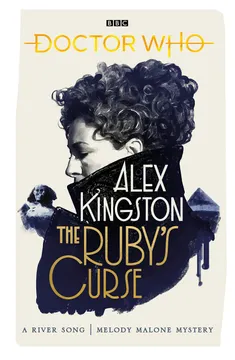


Plot Summary
A Cell Becomes a Study
Writing is the only work River Song cannot get done at home. Her parents, Amy and Rory, are building a legitimate life in 1939 New York, and interruptions keep her from completing another Melody Malone mystery. So River breaks into her own cell at Stormcage, a prison whose shifting corridors, lethal nanobots, and laser maze she knows how to cross.
She brings a typewriter and begins the novel there, turning Melody, her hardboiled private-eye persona, into a practical disguise for stories drawn from River’s own experience. The prison gives her the solitude she wants, but its ventilation system carries a stranger’s voice into her cell. River’s retreat is about to become an unexpected partnership.
River’s choice makes solitude a tool rather than a punishment. She is so practiced at treating Stormcage as a place she can enter and leave that she overlooks what the cell means to other prisoners. Her fiction is also doing double duty: Melody offers a way to tell dangerous personal history at a distance, while royalties help Amy and Rory settle without accepting the impossible riches River could obtain by theft. The opening establishes a tension between control and connection. River thinks she can manage both by choosing the setting, but the vent brings another person’s need into the one space she intended to keep entirely hers.
A Ruby Arrives Bloody
In the story River is writing, Melody Malone is a resourceful private detective struggling to find clients in Manhattan. Millionaire collector Horace P. Wallace hires her to intercept a valuable parcel from a transatlantic ship.
The plan collapses when Melody reaches the courier’s cabin and finds Marvin Motson stabbed, with no ruby in sight. Her quick reasoning and a witness who saw her arrive keep the ship’s crew from treating her as the killer. At the dock, Wallace reveals what Motson was carrying: a large ruby called the Eye of Horus, said to have belonged to Cleopatra.
The newspaper story accompanying the jewel traces a grim chain of deaths among the archaeologists and the Badger family, leaving Melody to decide whether the curse is merely a useful story for thieves.
Melody’s professional authority is tested before she has time to establish it. She earns credibility by reading the scene accurately, but her employer’s urgency makes clear that competence alone will not protect her from being treated as a woman out of place. The ruby’s reputation then puts two explanations into competition: human greed and supernatural punishment. The newspaper’s history is not neutral background. It invites every character to interpret later deaths through a ready-made pattern, which can hide the deliberate choices responsible for them. Melody’s skepticism is a strength, though her need for Wallace’s money will keep her investigating even as the evidence grows more frightening.
The Heir Takes the Ruby
Melody traces the auction and discovers that Wallace was not the only bidder who wanted the gem. Her search leads back to the ship’s red-haired steward, George Badger Junior, whose father had found Cleopatra’s tomb and died before he could return home.
In a shabby hotel room, Melody finds the stolen ruby beside bloodied gloves and a handkerchief. George admits that he killed Motson after the courier dismissed his plea to recognize his father’s discovery. He insists that history, not money, was his motive, but the ruby has become part of his delusion about the family curse.
George shoots himself while holding it. Melody takes the jewel to Wallace, who is delighted to have it back, and meets his handsome agent Harry Durkin, who soon brings her a second mystery: a map found in Egypt.
George’s motive complicates the easy equation of criminality with greed. He wants his father’s work remembered, but the attempt to reclaim that legacy turns him into the very kind of violence that made the family history tragic. Melody gives him room to explain himself, then refuses to take responsibility for his choice. Her response is both practical and emotionally guarded: she retrieves the stone, gets paid, and moves on. Harry’s arrival widens the story from a stolen object to a buried historical secret. The map promises discovery, but the first case has already shown how easily the desire to be remembered can become destructive.
Wallace Dies in His Club
Harry tells Melody that his Egyptian contact obtained a map from Masuda, a worker connected to George Badger’s doomed expedition. The symbols resemble those on the letter that accompanied the ruby, and Melody realizes George Junior’s hotel room may still hold that letter.
When she and Harry return, they find Wallace murdered in his office and the ruby and map missing. A note points toward Susan Peterson-Lee, a wealthy woman who claims to be Cleopatra reborn.
Melody and Harry find Susan’s room, recover the ruby hidden in face cream and the map behind a mirror, then leave her to the police. The code remains unreadable. Harry proposes asking rival collector Calvin Cuttling to finance an expedition, and Melody agrees to pursue the tomb by flying boat.
The case moves from recovery to interpretation: getting the ruby back does not explain why anyone is killing for it. Melody and Harry conceal some evidence from the police, a compromise they justify as necessary to protect the map, but the choice blurs the line between investigation and self-interest. Susan’s theatrical belief in reincarnation makes her a plausible suspect and an unreliable witness, while the physical clues remain stubbornly ambiguous. Harry’s proposal turns the unsolved cipher into a business opportunity. Melody accepts because the expedition could pay and because she is curious, yet the new arrangement places her trust in a partner she barely knows.
Ventrian Confesses Through the Wall
River’s new neighbour is Ventrian, an archaeologist who believes he deserves his Stormcage sentence. Their daily conversations begin with River reading chapters of Melody’s case, then grow into companionship. Eventually Ventrian explains that he unearthed a powerful Device on a planet marked by plague warnings.
It could influence technology and distort reality, while healing its user by replacing the user’s life force with its own. Ventrian used it, lost control, killed his wife, and destroyed a planet.
He buried the Device on a world without technology, then allowed himself to be arrested so no one would follow him there. River hears the guilt beneath his account and recognizes that the Device may still threaten the universe. She considers helping him, but waits while she finishes her book.
Ventrian’s story gives the novel’s curse motif a material, psychological source. The Device does not simply tempt with power; it makes dependence feel like agency, then gradually alters the user’s judgment. Ventrian’s deepest wound is not only that he killed his wife, but that he let her die to prevent a catastrophe and destroyed a planet in grief anyway. River understands that guilt because she too was raised to kill and has had to live with the consequences of her past. Their bond begins as literary companionship, yet the book becomes a safer language for confession than direct disclosure.
Stormcage Is Breached
The pause River intended to take ends when armed men break into Stormcage, kill guards Tomas and Ezra, and search the prison systems for Ventrian. River learns that another prisoner, Sukri, overheard her conversations and passed the archaeologist’s name to Deff, a powerful space gangster.
She reaches Ventrian’s cell through the prison’s timed doors and gives him her Vortex Manipulator, instructing him to hide the Device in another time. River then flees the intruders and tears open the damaged outer seal, expecting to die in space. Captain Jack Harkness catches her inside a temporary air bubble. He confirms the attackers belong to Deff’s gang, then takes River to 1939 New York, where she intends to meet Ventrian.
River’s escape changes her familiar game with Stormcage into a rescue operation. She had treated prison security as a puzzle she could solve at leisure; now its maze is filled with dead colleagues and people who will kill for information. Giving Ventrian her only time-travel device is an act of trust, but also a tactical gamble made under pressure. Jack’s arrival saves her without making the danger disappear. Deff now knows her name and the language she used for the Device. River reaches safety with a sharper understanding that her private choices have exposed other people to consequences.
Deff Finds River’s Parents
River reaches her Manhattan office expecting Ventrian, but finds her parents’ photograph missing and a heavily modified gunman waiting instead. Deff has taken a time traveller’s Vortex Manipulator and is using it to threaten Amy and Rory unless River gives him the Device.
A delivery boy brings a package from Amy: River’s own manuscript, her stolen Vortex Manipulator, and a note requiring her to be at that precise moment. The note also tells River to give it to the person about to arrive.
Ventrian materializes, wounded and disoriented, and reaches for the Device. Deff fires; River triggers the return function on Ventrian’s wrist, sending him away, then activates her own device. She arrives in ancient Alexandria, while Deff remains behind with her parents’ lives still at risk.
The package turns River’s family into participants in a paradox she cannot fully explain. Amy follows instructions because she senses the stakes, but the burden of protecting the family still falls on River. Deff’s threat exploits a vulnerability River rarely admits: she cannot be everywhere her parents need her. Her choice to send Ventrian away is not a clean victory. He is wounded, the Device remains uncontained, and River has lost control of where she herself will land. The manuscript and its return mechanism become evidence that a story can carry information through time, but not without placing its characters in danger.
Ventrian’s Last Pages
In a room near Alexandria’s ancient lighthouse, River finds Ventrian dead from an infected wound he refused to heal with the Device. His clothes and surroundings show that he has been there much longer than River has, and no Device is visible.
Among papyrus drafts, River finds Amy’s old note and the completed manuscript of The Ruby’s Curse. Ventrian has written the novel out by hand, apparently using River’s saved work, but has altered details.
River realizes the pages may carry a hidden instruction and begins searching for a way to find Cleopatra’s tomb. The first local reports confirm that Cleopatra died only weeks earlier and Egypt has fallen under Roman rule. River leaves Ventrian behind and begins following the trail he could not finish.
Ventrian’s death is an act of restraint with a terrible cost. He refuses to use the Device to save himself because each use strengthens its hold, and he leaves River the responsibility he could not safely discharge alone. His manuscript is simultaneously a record, a message, and a piece of imperfect evidence: illness and exhaustion have made his clues difficult to read. River is left with grief but also a task precise enough to keep her moving. Her choice to investigate rather than retreat shows the shift from solitary curiosity to responsibility for what another person entrusted to her.
The Guides Never Returned
River repeatedly searches the Nile region for Cleopatra’s tomb, hiring local boatmen to guide her. Five days pass before she notices scratches on her face and symbols from her childhood training on her skin.
Her memory has been erased: she has entered the tomb before, and four guides, Nebi, Oba, Djal, and Seti, died there. She turns back with Shenti, sparing him, and later discovers that an added reference to Silent Joe points to the Silence guarding the site.
A cat begins speaking with Melody’s detective instincts, helping River interpret Ventrian’s riddle. River follows its historical clues to Caesar’s crossing of the Rubicon, then to Rome, where she warns Cleopatra of Caesar’s murder and helps the queen and young Caesarion escape to Egypt.
The guide deaths puncture River’s confidence in her ability to control risk. Her memory gaps are not a convenient puzzle but an assault on the very instrument she trusts most, her own mind. The marks she makes on her body are a desperate form of self-communication, turning pain into evidence. Cat Malone offers a second kind of memory, external and collaborative, that can challenge River when her perceptions fail. The historical detour also places River beside people whose futures she knows but cannot fully command. Her intervention for Cleopatra and Caesarion shows her choosing limited, concrete protection over the fantasy of mastering history.
The Tomb’s False Eye
Back in Alexandria, River and Cat Malone decode Ventrian’s opening riddle by combining the Roman date with the book’s page and word positions. The hidden word points toward the ruby, and the real clue sends River back to the tomb. She and the cat pass a Silent’s memory trap, a floor of deadly scorpions, spears, falling blades, and a maze that borrows the logic of Stormcage’s defenses.
Inside the burial chamber, River touches a ruby set in a carved Eye of Horus, but Cat recognizes the trick too late. The stone throws River fourteen years backward, to the day Cleopatra plans to die rather than be paraded by Octavian. River has lost her Vortex Manipulator, but the tomb’s defenses have not yet been built.
The tomb turns River’s prison expertise into a survival method, but it also reveals the limits of expertise. She gets through by adapting rather than assuming that ancient architecture is harmless or that she can trust what she sees. The false ruby is a particularly pointed trap because it looks like the answer she has been pursuing. Its power is not merely to deceive her; it relocates her into a moment where the human stakes are immediate and intimate. River must now improvise without her usual technology, relying on historical knowledge and trust rather than escape equipment.
Buried Beside Cleopatra
River persuades Cleopatra that she can escape a public execution by appearing to die. With the queen’s handmaidens, Charmian and Iras, she stages a convincing death scene and lets guards carry River, disguised as Cleopatra, into the unfinished tomb. The real Cleopatra escapes beneath a couch while River wakes sealed inside the queen’s coffin.
River survives on burial food, waits until the date of her earlier arrival, and emerges as her past self enters the chamber. She retrieves her Vortex Manipulator and avoids touching the false ruby again. Cat Malone sees that the image of Horus conceals another route: the eye of Cleopatra’s son. River touches that carving and is pulled into the flying-boat world of her own novel.
River’s plan depends on Cleopatra’s consent and on the queen’s willingness to exchange royal visibility for an uncertain freedom. The coffin is both a practical route into the tomb and a literal confinement, forcing River to endure the consequences of her own strategy. Her reunion with her earlier self makes time travel feel less like mastery than patience and careful coordination. The final clue shifts the search from an iconic object to a relationship: Horus is not simply a symbol on the wall, but a son connected to Isis. River’s passage into fiction is earned through attention to family and identity.
The Killer Boards the Flight
Inside the novel, River appears as Melody’s archaeologist sister aboard the flying boat bound for Egypt. After a poisoned breakfast kills a steward, the sisters examine the case and discover that Harry replaced the bloodstained letter with a clean copy, keeping the real cipher hidden.
Melody retrieves the original from his cabin. She and River infer that Harry and Cuttling’s secretary, Dolores Jones, are working together. Melody lures Harry into the cabin while River hides nearby; Dolores arrives with a gun, shoots Harry, and is stabbed by Phil.
The woman is revealed as Ruby Badger, who had assumed Dolores’s identity after murdering her and had killed Wallace with Harry’s help. River recognizes that the seemingly misplaced assistant Phil is the real Caesarion.
The mystery’s solution depends less on a sudden confession than on material details the characters nearly dismissed: blood on one letter, its later cleanliness, and a secretary’s unexplained presence in New York. Melody’s pride suffers because her attraction to Harry clouded her judgment, but she recovers by trusting evidence over wounded vanity. River’s role is not to replace Melody’s detective work; their different kinds of attention let the case become legible. Phil’s oddness, first played as comic mismatch, acquires historical meaning. The story’s concealed identity is prepared through behavior that never quite fits the world around him.
Two Selves Break the Eye
Caesarion reveals that Ventrian hid the real Eye of Horus with him, and the ruby-like Device overwhelms River with visions of absolute power. The Doctor reaches River through their mental bond, steadying her long enough to resist. Melody, now fully real within the altered story, joins River in fighting the Device’s influence. Together they destroy it, though Melody is lost in the struggle.
River returns to her office with the power gone and Deff still threatening her parents. She uses the Device’s last force to send Deff into Cleopatra’s sealed tomb, alive but trapped, and reunites Caesarion with the history from which he was hidden. River survives, grieving Melody, but no longer alone in the sense she once believed herself to be.
The climax refuses the fantasy that one exceptional person can resist power through will alone. Ventrian failed while isolated, and River survives only when the Doctor’s love and Melody’s independent will interrupt the Device’s claim on her. Melody’s sacrifice gives moral weight to her new reality: she is not a disposable character merely because River created her. River’s final use of the Device against Deff is deliberately cruel, showing that victory does not erase her capacity for vengeance. The decisive change is relational: River’s identity becomes less a fortress and more a bond she must choose to honor.
Epilogue
River visits Amy and Rory for tea and tells them only part of what happened. Amy understands the grief River has not explained and suggests taking over the Melody Malone books, since River can no longer write about Melody as a character. The proof copy reveals that the Eye has left River’s own experiences woven into the manuscript.
Amy proposes keeping it unpublished until it can no longer expose her and Rory as time travellers. The final page contains a message from Melody, who has left her detective agency behind and signs herself as River’s sister. River accepts that the story belongs to them both.
The ending converts survival into a question of what can be shared. River cannot tell her parents everything, yet Amy recognizes the feelings beneath the omitted facts, offering care without demanding a complete account. Her decision to take over the books respects River’s grief while protecting the version of Melody who has become real to her. The manuscript is no longer only a source of clues or a record of adventure; it is a boundary that must be negotiated between private family history and public storytelling. Melody’s final note offers no resurrection, but it gives River a continuing relationship with the self she created and lost.
Analysis
The novel sets a detective story inside a time-travel narrative, then makes the boundary between them increasingly unstable. Melody begins as River’s invented hardboiled persona, useful for exploring gender, money, and criminal power in 1939 Manhattan. Yet the case gradually insists that fiction can carry more than metaphor: Ventrian uses its details to guide River, and Melody eventually acquires a life beyond her role as a character. The shift raises a moral question the book refuses to answer abstractly: does being created make a person less real, or does care and experience make that distinction untenable?
The Eye of Horus gives this question a material form. Its power promises repair and control, but its healing works by replacing the user’s agency. Ventrian’s tragedy shows that a person can understand the danger and still be changed by the machinery of desire, grief, and self-justification. River is vulnerable for similar reasons. Her confidence in her own competence resembles Ventrian’s confidence in his archaeological judgment. Both are tempted to believe that exceptional skill can make them exceptions to ordinary limits.
The ruby’s curse and the family’s failures also challenge the convenient idea that history is made by famous people alone. George Junior wants his father recognized; Cleopatra must protect her children from political history; Caesarion’s survival depends on the possibility that the record is incomplete. River’s interventions do not erase the brutality of history, but they expose how much is lost when people become artifacts, legends, or plot functions. The ending makes that insight personal. River cannot save Melody by claiming authorship over her. She can only recognize Melody’s separate will and trust her as a partner. The universe is saved not through mastery, but through a relationship River did not design and cannot own.
Review Summary
The Ruby's Curse received overwhelmingly positive reviews, with readers praising Alex Kingston's portrayal of River Song. Fans appreciated the intricate plot, time-travel elements, and references to the Doctor Who universe. Many found the audiobook narrated by Kingston particularly engaging. The book was lauded for capturing River's essence and providing deeper character insights. Some readers noted minor inconsistencies and occasional wordiness but generally found the story enjoyable. The novel was seen as a love letter to River Song, delighting longtime fans of the character.
Characters
River Song
Time-travelling archaeologistA brilliant archaeologist, adventurer, and former assassin, River treats danger with wit and often trusts her instincts more readily than anyone else’s judgment. Her unusual connection to time gives her extraordinary abilities, but it can also tempt her to believe that experience makes her immune to consequences. She writes the Melody Malone mysteries partly to earn money for her parents and partly to give difficult memories a manageable shape. Her bond with the Doctor is a source of deep love, though River is fiercely independent and accustomed to operating alone. The story tests whether she can accept help, share responsibility, and recognize when protecting others matters more than proving she can manage everything herself.
Melody Malone
Hardboiled detectiveMelody is River’s fictional private-eye persona: sharp, stylish, physically capable, and determined to earn respect in a profession that doubts women. She uses performance as a practical skill, adopting costumes and manners to gain access while refusing to let powerful men define her worth. Beneath the bravado is a detective who notices small inconsistencies and cares more than she admits about people harmed by the case. Her partnership with Harry Durkin draws out her romantic hopes, while her work with Phil gives her a steadier form of loyalty. Melody’s defining strength is not fearlessness but her capacity to act when pride, desire, and evidence pull in different directions.
Ventrian
Guilty archaeologistVentrian is an archaeologist whose hunger to make a historic discovery leads him to ignore warnings and trust an alien Device that manipulates his ambitions. He is neither a simple villain nor an innocent victim: he makes choices under influence, recognizes the harm he has caused, and accepts a harsh form of accountability. In Stormcage, his shame makes him reluctant to speak, while River’s companionship gives him a way to tell the truth gradually. His story contrasts the archaeologist’s desire to uncover the past with the responsibility to leave some dangerous things untouched. Even as his judgment deteriorates, he works to keep others from repeating his mistake.
Cleopatra
Queen under siegeCleopatra is an intelligent and politically skilled ruler navigating Roman power, family danger, and the vulnerability of a kingdom recently defeated. Her authority depends on performance, calculation, and the ability to read people who may be allies only temporarily. River recognizes in her a kindred survivor, though their lives and historical circumstances are radically different. Cleopatra’s love for her children sits beside the strategic decisions required to protect them. She is neither the romanticized beauty of legend nor merely a historical prize: she is a person trying to preserve choice when conquest has narrowed the options available to her.
The Doctor
River’s distant belovedThe Doctor is River’s long-distance spouse and the person River associates most closely with home. Though absent from most of the action, their bond remains emotionally present. When River is overwhelmed, the Doctor’s familiar mind helps her regain enough clarity to resist the Device. The relationship is not a rescue mechanism that removes River’s responsibility; it offers connection at the moment she might otherwise mistake isolation for strength.
Amy Pond
River’s perceptive motherAmy is River’s mother, a former traveller who is trying to build an ordinary, legitimate life with Rory in 1939. She supports River’s writing ambitions and follows instructions that arrive through impossible circumstances, trusting her daughter’s need even when she cannot know the full story. Her emotional intelligence lets her recognize what River withholds. Amy’s presence connects River’s dangerous adventures to a family life that River wants to protect but cannot completely control.
Rory Pond
River’s steady fatherRory is River’s father and Amy’s partner, making a home with her in a time and place far removed from their adventures. His quiet steadiness represents the ordinary life River wants her parents to be able to claim for themselves. River’s protectiveness toward him and Amy exposes a vulnerability she usually masks with confidence. Rory’s domestic efforts, including his enthusiasm for cooking, also provide a grounded contrast to the cosmic scale of River’s problems.
Harry Durkin
Wallace’s charming agentHarry is Horace P. Wallace’s handsome, capable agent, accustomed to traveling widely and turning opportunity into advantage. He treats Melody as a professional partner and a romantic prospect, drawing her into the search for Cleopatra’s tomb. His charm makes him easy to trust, while his fluency in the collector’s world gives him access to information and people Melody needs. Harry’s confidence is a carefully maintained asset in a world where money, loyalty, and ambition often overlap.
Phil
Melody’s loyal assistantPhil is Melody’s young assistant, a shaved-headed, resourceful presence who handles practical errands and stands by her when danger escalates. His formal manners and unusual reactions make him seem out of step with the 1939 detective story around him. He is loyal without being passive, and his willingness to act under pressure gives Melody a dependable ally. Phil’s background remains a question the story gradually invites readers to consider.
Deff
Time-travelling gangsterDeff is a violent criminal leader whose heavily modified body reflects a life built around power, intimidation, and survival. He pursues the Eye of Horus because he sees a universe-altering weapon as an instrument to possess rather than a danger to contain. Deff has access to stolen time-travel technology and uses River’s family as leverage. His blunt force and limited patience make him dangerous, but also leave him vulnerable to opponents who can think beyond the immediate threat.
Captain Jack Harkness
Immortal rescuerJack is a time-travelling ally who arrives when River is stranded in space after the Stormcage breach. His humor and boldness soften a moment of genuine danger, and he recognizes the gangsters pursuing her. Jack can provide a lift and a warning, but he does not take over River’s decisions. His brief appearance reminds River that help can come from unexpected companions.
Horace P. Wallace
Wealthy artifact collectorWallace is a millionaire collector with a criminal past and an appetite for rare objects. He hires Melody because she can move through places his entourage cannot, but his interest in the ruby and map is driven by possession as much as historical curiosity. He understands that information has value, yet his wealth encourages him to treat people and history as acquisitions. His nightclub, the Pink Tiger, is both his business and the center of Melody’s first major investigation.
Calvin Cuttling
Rival antiquities collectorCuttling is a wealthy collector who competed for the Eye of Horus and is eager to finance a search for Cleopatra’s tomb. He approaches history as a contest in which discovery means ownership, status, and a place in the record books. His money can make the expedition possible, but it also gives him leverage over Melody and Harry. Cuttling’s certainty about his own importance is matched by little patience for anyone who obstructs his ambitions.
Susan Peterson-Lee
Reincarnationist suspectSusan is a wealthy Englishwoman who sincerely presents herself as Cleopatra reborn. Her fascination with the ruby and ancient Egypt makes her both a vivid presence and a natural focus of suspicion. She brings theatrical conviction to her beliefs, yet her interest in the past is not merely eccentric display. Susan’s perspective shows how historical identity can become a personal refuge, especially when a person feels that ordinary life has little room for her.
Dolores Jones
Cuttling’s New York agentDolores works for Cuttling and is considered a knowledgeable, reliable agent in the jewelry trade. She accompanies him into the expedition’s orbit, where her reserved manner contrasts with the more flamboyant personalities around her. Her professional competence grants her access to collectors, travel plans, and the ruby’s history. She is easy for others to underestimate because she presents herself as an efficient secretary rather than an adventurer.
Caesarion
Cleopatra’s young heirCaesarion is the young son of Cleopatra and Julius Caesar, whose royal lineage places him in danger during Rome’s struggle for control of Egypt. He is a child caught inside adult political calculations, yet his identity carries consequences far beyond his years. His place in the story links the Eye of Horus to family, inheritance, and the uncertain boundary between history as recorded and lives history may have missed.
George Badger Junior
A son seeking recognitionGeorge Junior is the son of the archaeologist whose Egyptian discovery became a family burden. He wants his father’s work acknowledged and resents the auction that turns the ruby into a commodity. His grief and frustration leave him vulnerable to obsession.
Sukri
Prison informantSukri is a Stormcage prisoner who overhears River and Ventrian through the ventilation system. He passes their conversation to Deff, setting the prison attack in motion. His brief role shows how private confidences can travel through institutions built to isolate people.
Egyptian boatmen
River’s local guidesNebi, Oba, Djal, Seti, and Shenti ferry River along the Nile as she searches for Cleopatra’s tomb. Their lives and families are distinct from her archaeological quest, a truth River recognizes only after the tomb’s defenses exploit her forgotten visits.
Plot Devices
The Eye of Horus Device
Power that rewrites realityAn alien Device with the ability to influence technology and distort reality. It can heal its user, but every use replaces more of the user’s life force with its own, gradually bending thought and judgment. Ventrian’s attempts to use it for good end in personal and planetary catastrophe. Its apparent form as Cleopatra’s ruby lets the story connect an ancient curse, a 1939 murder investigation, and a threat to the wider universe. The search for the object is also a test of whether River can resist the fantasy that absolute power would make her a better protector.
Melody Malone’s manuscript
A story carrying instructionsRiver’s hardboiled novel begins as a creative refuge and a source of royalties for Amy and Rory. Ventrian later copies and alters it, embedding directions in names, historical references, and coded page positions. The fictional investigation then becomes a route through which River can receive information without the Device understanding the message too soon. When River enters the novel, the manuscript ceases to be a detached account and becomes a world with consequences for its characters. It connects authorship, memory, and the problem of whether a created person can become independent of the person who made her.
The Vortex Manipulator
A wrist-sized escape routeThis compact device moves its wearer through time and space, though its journeys can be uncomfortable, imprecise, and subject to interference. River has modified hers with voice controls, a fast return function, and a system for backing up her writing. She gives it to Ventrian so he can hide the Eye beyond Deff’s reach, then relies on it to follow him through history. Its ability to carry only a limited number of passengers shapes River’s decisions, while its loss strands her in ancient Egypt and forces her to improvise.
Stormcage’s defenses
A prison built as an obstacle courseStormcage protects its prisoners with disorienting corridors, swarming nanobots, laser barriers, and doors that align only at precise intervals. River knows the defenses well enough to break in and later uses that knowledge to reach Ventrian during Deff’s raid. The same logic appears again in Cleopatra’s tomb, where psychological confusion, swarming scorpions, blades, and a maze make River apply prison-survival skills in a different setting. The repeated structure links River’s past as a prisoner with the practical intelligence that helps her survive the ancient traps.
The Badger letter and map
A cipher concealing the tombThe letter George Badger left with the ruby contains unusual marks that resemble the symbols on a map recovered in Egypt. Melody and Harry struggle to interpret them, while the bloodstained original and its clean replacement become essential evidence in the New York murder case. Beyond the detective plot, Ventrian repurposes the book’s clues to guide River through dates, pages, and historical events. The paired documents make the search for a physical tomb depend on reading carefully and remembering which versions of a story have been altered.
Download PDF
Download EPUB
.epub digital book format is ideal for reading ebooks on phones, tablets, and e-readers.








