

Key Takeaways
Stop trying to control the clock; take responsibility for your choices.
The clock stays indifferent. Everyone gets the same twenty-four hours, and no one can store unused minutes for tomorrow or buy extra time. Maxwell compares the day to a suitcase: some people fit more into it because they know what belongs there. His point is that the clock cannot be managed, but personal choices can. Effective leaders examine where their time goes and whether those activities produce a worthwhile return.
That distinction shifts the question from how to squeeze more into a day to what deserves a place in it. A leader who spends hours on low-value demands may be busy while wasting both personal potential and the potential of the people they lead.
The distinction between controlling time and directing attention is useful because it places agency where it actually exists. A calendar cannot slow an hour, but it can expose whether recurring commitments match stated priorities. The caution is that personal choice has limits: caregiving, financial pressure, and organizational demands can sharply constrain someone’s options. The idea works best as a tool for identifying available choices, not as a claim that every schedule is freely chosen. That nuance preserves the practical message without turning limited control into personal blame.
Price ambitions in years, not just dollars.
Money hides the exchange. Maxwell draws on Charles Spezzano’s suggestion to translate purchases into the time required to pay for them. A person might save for five years to buy a vacation home, then expect life to slow down. But the purchase has also claimed five years of working life, a cost that a price tag can make easy to ignore.
This calculation does not declare the house a bad choice. It makes the trade visible. Before committing to a major expense or career goal, ask what portion of limited life it consumes, and whether the return feels worth that portion. Time is not simply the resource used to earn money; it is also what money is exchanged for.
This is a practical use of opportunity cost: the value of a choice includes the best alternative it displaces. Converting money into years makes that trade easier to feel, especially when a purchase promises future freedom while requiring years of present work. Still, the conversion is not a complete account. Work may provide identity, security, or enjoyment, and some expenses serve family needs rather than status. The strongest use of the exercise is not to condemn spending, but to make hidden trade-offs discussable before they become irreversible.
Protect the work only your strengths and purpose can do.
Other people can spend your hours. Early in his career, Maxwell says he was busy meeting others’ expectations while neglecting the work suited to his abilities. His effectiveness improved when he focused on his own vision and contribution. That meant guarding his calendar and declining requests, not out of contrariness, but because time spent imitating someone else’s priorities could not be spent doing his distinctive work.
For a leader, the cost spreads beyond personal frustration. Followers may lose direction or opportunity when their leader’s attention is consumed by low-value obligations. Review recurring commitments: which depend on particular strengths, and which exist mainly because someone asked? Protecting the first category makes room for more consequential contribution.
The argument resembles role design in organizations: people tend to contribute more when responsibilities fit their capabilities. It also recognizes that saying no is not merely a productivity trick; it is a way of preserving scarce expertise. Yet a personal mission can become an excuse to avoid unglamorous duties or ignore colleagues’ needs. A sound test is whether protected time advances an explicit purpose and benefits the wider work, rather than simply shielding a leader from inconvenience. Boundaries are most credible when priorities are clear to others.
Score tasks by importance and deadline before they claim your calendar.
Use a deliberate filter. Maxwell ranks each task for importance, from marginal to critical, and for timing, from the end of the year to this month. Multiplying the two scores produces a priority band:
1. Scores of 16 to 25: finish by the end of the month.
2. Scores of 9 to 15: finish by the end of the quarter.
3. Scores of 1 to 8: schedule by year-end or remove.
The formula is designed to make people assess value and timing before reacting to whatever is loudest. It also assumes planning can happen well ahead: Maxwell says his system does not classify work as due today or this week because he tries to plan at least a month in advance.
The formula is valuable less as arithmetic than as a forcing device. It makes a person state why a task matters and when it truly matters, which can reveal that an urgent request has little lasting value. But multiplication creates an appearance of precision that the ratings cannot guarantee. A sudden safety issue, for example, may deserve immediate attention despite a low prior score. Used well, the bands support judgment; they should not replace it or punish teams whose work is inherently unpredictable.
Lead from a longer horizon, not from the latest emergency.
The leader must look ahead. Maxwell argues that leaders should plan farther into the future than others in an organization. If they spend all their attention responding to immediate crises, the people and the organization pay the price. His preferred approach is to review upcoming work over the next month and year, rather than letting each day’s demands determine the whole agenda.
This does not mean that emergencies can be ignored. It means that constant reaction should not become the operating system. A leader can reserve time for planning, identify important work before deadlines become urgent, and make sure the team knows what matters beyond the current interruption. Foresight gives people a chance to act before pressure narrows their choices.
Longer-horizon leadership is a form of risk management: noticing a problem early often leaves more options than confronting it at the deadline. It also protects organizational attention, a resource easily fragmented by escalation and interruption. The limitation is that planning horizons differ by context. A team handling volatile demands cannot eliminate short-term response, and overplanning can create false confidence. The practical balance is to make future priorities visible while keeping capacity for surprises. Planning ahead is not prediction; it is preparation that reduces avoidable urgency.
Training can return more productivity than buying more equipment.
Invest in capability. Maxwell cites a study of 3,200 U.S. companies by Robert Zemsky and Susan Shaman. As reported in the book, a 10 percent increase in capital spending corresponded to a 3.8 percent productivity increase, while a 10 percent increase in training spending corresponded to an 8.5 percent increase. The comparison supports a simple leadership practice: seek coaching, mentoring, or training for important work instead of expecting people to improve through effort alone.
Maxwell also urges leaders to develop others, not just themselves. Target a specific skill for each person being mentored, plan focused instruction, and schedule recurring sessions. The goal is to make that person capable of taking responsibility for the work, rather than keeping expertise locked inside the leader.
The comparison highlights a frequently overlooked asset: equipment matters, but people determine how well it is used. Training can also multiply its effects when a skilled employee teaches others, which makes capability-building relevant to both productivity and succession. The reported figures should be read as one study’s result, not a universal return guaranteed for every training budget. Results depend on whether instruction addresses a real skill gap and whether employees have the time and authority to apply what they learn. Training is an investment, not a magic input.
Audit your calendar against purpose, values, strengths, and service.
Measure the return broadly. Maxwell describes effective life management as spending time on activities that advance personal purpose, express values, use strengths, increase happiness, equip others, and add value to them. These are not six separate tasks to cram into a day. They are lenses for judging whether the day’s work contributes to a worthwhile life and to other people’s effectiveness.
This matters especially for leaders. A poor use of time can waste not only the leader’s abilities but also the potential of followers. Review regular commitments against these criteria. If a role or profession makes meaningful change impossible, Maxwell’s application exercise raises the possibility of changing roles or professions, rather than endlessly optimizing a calendar that serves the wrong work.
The criteria widen productivity beyond output counts. Purpose and values address direction, strengths address fit, and coaching others recognizes that leadership can create results through other people. Happiness also matters because a sustainable life cannot be judged only by how much work it produces. These measures can conflict: a demanding role may serve a public purpose while leaving little room for family or rest. The audit is therefore a prompt for honest trade-offs, not a scoring system that can declare every important dimension satisfied at once.
Make mortality visible before busyness spends your Saturdays.
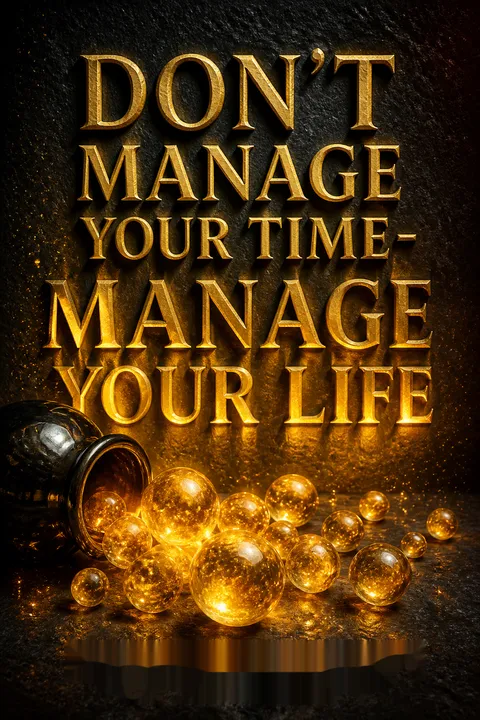
A small ritual makes time concrete. In the parable Maxwell shares, an older radio hobbyist estimates that a seventy-five-year life contains about 3,900 Saturdays. At fifty-five, he has already used more than 2,800, so he buys roughly 1,000 marbles and removes one each week. Hearing this, the story’s narrator abandons planned projects and takes his wife and children to breakfast instead.
The image turns an abstract lifespan into a visible, dwindling supply. Maxwell adds that at sixty he would have about 780 Saturdays left if he reached seventy-five. The number is an estimate, not a forecast. Its purpose is to help people notice whether routine busyness is crowding out the relationships and experiences they most want to protect.
The marble ritual works because it gives an invisible limit a physical form, making the passage of time easier to notice. Research on mortality awareness is often discussed in terms of changed priorities, though the response can vary: some people focus on close relationships, while others become anxious or defensive. A countdown is most useful when it clarifies choices rather than demands constant urgency. The parable’s breakfast is powerful not because every Saturday must be spent with family, but because an ordinary plan can suddenly reveal what it has been displacing.
Analysis
Maxwell’s central move is from time allocation to life stewardship. The clock is fixed; the leader’s choices, commitments, and preparation are not. That reframing supports a practical chain: identify work that fits purpose and strengths, rank it before urgency dominates, and build capability so important work is done better and by more people. The chapter’s most distinctive leadership claim is that wasted time has a social cost. A leader’s distraction can consume followers’ opportunities as well as personal potential.
The task-rating formula gives the argument operational shape, but it should be treated as a conversation starter rather than a neutral measurement. Importance and urgency are judgments, and multiplying them can make uncertain estimates look exact. The larger principle is stronger than the scoring mechanics: planning ahead helps distinguish genuine priority from the pressure of the moment. Similarly, the training figures make a compelling case for investing in people, but the reported comparison cannot establish that every training program produces the same return.
The chapter also contains a productive tension. Protecting one’s distinctive contribution may require saying no, while leadership requires coaching others and adding value beyond oneself. The tension is resolved not by choosing self-interest or service, but by asking whether a boundary protects work that benefits a meaningful purpose. The marbles parable supplies emotional force to that question, though its lifespan arithmetic is a prompt, not a prediction. Its lasting value is to make trade-offs visible. The chapter is most useful when its tools are applied together: clarify what matters, make time costs explicit, plan before crisis, and invest in people who can carry the work forward.
Review Summary
Readers highly praise "Don't Manage Your Time-Manage Your Life" by John C. Maxwell, giving it an average rating of 4.43/5. Many describe it as life-changing, offering valuable insights on time management and life prioritization. Reviewers appreciate Maxwell's expertise in leadership and success, recommending his other works as well. The book is praised for its practical advice, thought-provoking content, and potential for multiple re-reads. Some note it's a quick read but impactful, with concepts like the "1000 marbles" resonating strongly. Overall, readers find it an excellent resource for personal and professional growth.
People Also Read

Glossary
life management
directing personal choicesMaxwell’s alternative to the phrase time management. Time itself cannot be controlled, saved, or expanded, but people can manage their decisions about how to use it. The idea emphasizes choosing activities that serve purpose and values, use strengths, support well-being, develop others, and contribute value.
a thousand marbles
a lifespan reminderA parable’s physical reminder of finite time. An older radio hobbyist estimates the number of Saturdays in a seventy-five-year life, then uses a container of marbles to represent the Saturdays he believes remain. Removing one each week makes the passing years tangible and prompts a reconsideration of priorities.
About the Author
Other books by John C. Maxwell








Download PDF
Download EPUB
.epub digital book format is ideal for reading ebooks on phones, tablets, and e-readers.








