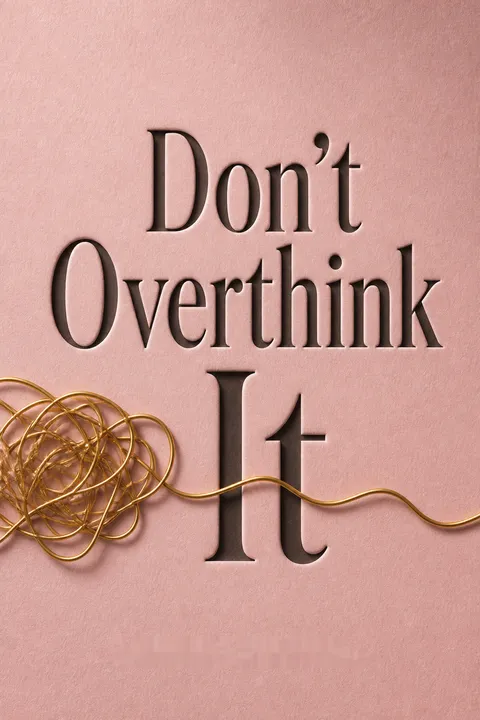


Key Takeaways
Treat repetitive, useless thinking as a drain on your life, not diligence.
Thinking versus looping. Overthinking is not careful thought about a serious choice. It is repetitive, unhealthy thinking that consumes attention without helping solve the problem. Bogel opens with a familiar trap: before a trip to Nashville, she keeps refreshing the weather forecast, although she cannot change the storm. Each check increases her anxiety and steals time from work that needs doing. A friend helps her name the real issue: she dislikes both available options, but one still has to be chosen.
Attention has a cost. The book draws on psychologist Susan Nolen-Hoeksema’s two decades of research linking rumination with strained relationships and risks to emotional health. The practical distinction is whether thinking produces useful information or a next step. When it produces neither, more thought may not be more wisdom.
The book’s most useful distinction is between reflection that changes a decision and repetition that merely intensifies distress. Decision science recognizes that additional information has diminishing value once it stops changing the available options. A simple test follows: after another round of thinking, is there a new fact, a clearer priority, or an action? If not, the loop is likely consuming attention rather than improving judgment. This framing also avoids shaming all worry. Some problems deserve sustained deliberation, and persistent or severe distress may require professional support rather than a productivity trick.
Practice a new response instead of making overthinking your identity.
A pattern can change. Bogel challenges the idea that a person is simply born an overthinker. She describes her own anxiety after the September 11 attacks, when a physician told her that thoughts could either work against her or become an ally. That observation sent her toward learning about attention and mental habits. The point is not instant control, but the possibility of learning a different response.
Start with a small move. Repeated habits of thought become familiar, so new habits need practice too. A friend facing a difficult school choice had researched herself into panic. Rather than requiring a complete philosophy of education, Bogel suggested one manageable next step: arrange a school tour. The action did not solve every question, but it interrupted the cycle and created information.
Identity language can either open or close a path to change. Calling a behavior a permanent trait makes each recurrence feel like proof that improvement is impossible. Describing it as a pattern leaves room to practice alternatives without pretending personality changes overnight. This resembles a growth-oriented account of learning: ability develops through effort, feedback, and repetition. The useful caution is that self-description is not a treatment plan by itself. It becomes meaningful when paired with a concrete action, support, and realistic expectations about setbacks.
When choices are good enough, experiment instead of waiting for certainty.
Perfect answers are scarce. Analysis paralysis is becoming so absorbed in comparing options that a person cannot choose or act. Perfectionism fuels it when a good decision is mistaken for a flawless one. Bogel and her husband debated for years whether to break an eleven-hour family drive into two days. They finally checked hotel availability and tried the overnight stop as an experiment. The family preferred it, but even disliking the new plan would have answered the question.
Learn by doing. The book borrows the logic of software development: create an early, imperfect version, observe what happens, and adjust. For a choice between two recommended business coaches, the author’s group used a coin flip to force movement. This approach suits reversible, lower-stakes decisions. It is not a reason to rush choices with serious or irreversible consequences.
Experiments turn uncertainty into evidence, which is especially useful when preferences are hard to predict in advance. Instead of asking which option is best in theory, a person can ask what a small trial would reveal. This is a strong fit for reversible decisions, where the cost of learning is limited. The boundary matters: medical, financial, and safety-critical choices may require deeper investigation and expert advice. The underlying principle is not speed for its own sake, but matching the amount of deliberation to the actual stakes.
Let named values decide recurring questions before they become exhausting debates.
Values provide a filter. Bogel’s friend Ally makes difficult travel and fundraising choices easier by connecting them to a commitment to support women affected by abuse and exploitation. That commitment, shaped by her own experience of leaving an abusive marriage, helps her decide whether to give money, attend events, or travel to help. The decision is no longer an isolated calculation about inconvenience.
Check actions against ideals. Values can guide ordinary choices too. A retired teacher friend favors options near home because neighborhood connection matters to her. Bogel’s family recognized the same priority and chose a nearby school. The book also recommends checking calendars, spending, and use of time: stated values should leave traces in daily behavior. If the evidence does not match the claim, the value or the habits may need reconsideration.
A value works like a decision rule: it compresses many individual choices into a stable priority. This is one reason principles can reduce decision load without eliminating judgment. Behavioral evidence also makes values less abstract. A calendar may reveal which commitments actually receive time, although it cannot capture every constraint or private sacrifice. The method is strongest when values are chosen freely rather than inherited as obligations. A useful check is whether a commitment makes life more coherent, not merely whether it makes a person appear virtuous.
Finish small tasks promptly, because loose ends become mental noise.
Daily systems matter. Bogel’s missing school vaccination forms seemed like a late-night emergency because she had postponed filing and sending them. After searching the house in a growing panic, she found them on the floor of her car. The problem had begun weeks earlier, when an unfinished task was left for memory to manage. She calls promptly finishing a task, rather than leaving it half-done, completing the cycle.
Reduce avoidable friction. A designated place for keys, a packing checklist, clear enough counters, and promptly filed papers all reduce searching and second-guessing. The body matters too. The book emphasizes sleep, food, water, movement, and restorative breaks, since fatigue makes it harder to focus and regulate reactions. The forms crisis happened at bedtime, when Bogel was already tired and less able to think clearly.
This insight treats mental life as partly shaped by physical surroundings and unfinished work. Cognitive-load research describes how open tasks can occupy attention even when they are not being performed. A dependable place for essentials or a checklist functions as external memory, leaving more capacity for current decisions. Yet organization should serve the person, not become another perfectionist standard. A workable system is not a spotless home. It is a setup that prevents recurring tasks from repeatedly demanding attention.
Redirect attention when rumination repeats without producing a next step.
Rumination is repetitive focus. The term describes returning to the same negative concern again and again without moving toward a solution. Bogel suggests first noticing what the mind is doing, then choosing a way to interrupt the loop. Options include imagining what a kind, objective friend would say, finding a neutral explanation for an upsetting event, writing down facts, or setting a short period specifically for worry.
Change the channel. The book also recommends brushing aside irrelevant intrusive thoughts, shifting attention to a task, or moving the body. Nolen-Hoeksema’s research, as summarized here, found that eight minutes of positive distraction could help lift mood and break repetitive thought. These tools do not require proving every negative thought false. Their immediate purpose is to stop giving an unhelpful thought the whole stage.
Several strategies here resemble cognitive defusion, the practice of noticing a thought as a mental event rather than treating it as a command or fact. The distinction is valuable because forcefully suppressing a thought can make it more salient. Shifting attention, recording a concern, or setting a later time to address it can create distance without demanding instant optimism. A neutral interpretation is often more credible than a cheerful one. Persistent, frightening, or impairing thoughts deserve appropriate clinical care, not just distraction.
Automate routine choices and outsource work that drains your scarce attention.
Save decisions for what matters. Decision fatigue describes the reduced capacity to choose after facing many decisions. Bogel reduces recurring choices through meal templates, familiar outfits, set times, and device-free boundaries. Former President Barack Obama is cited as limiting his suit choices to gray or blue so clothing would consume less attention. The aim is not to make every day identical, but to stop spending fresh deliberation on choices that matter little.
Get help strategically. Bogel outsourced podcast editing so she could focus on research and interviews. She suggests asking whether a task is possible, enjoyable, meaningful, and affordable, including whether there is enough mental space to do it. Help may come from a friend, a paid professional, or a useful checklist. Delegation works only when the person trusted with the task can deliver an acceptable result.
Defaults and delegation are forms of choice architecture: they change the number of decisions that reach conscious attention. Their value depends on targeting low-priority repetition rather than flattening activities that bring genuine pleasure. A personal uniform may free one person and frustrate another. Delegation also depends on access to money, time, and trustworthy support, so it cannot be treated as universally available. The more inclusive version is broader than hiring help: use tools, shared labor, and existing expertise wherever they genuinely reduce the load.
Protect calendar margin so surprise can become opportunity, not emergency.
Leave room to pivot. When Bogel’s college campus lost power, classes were canceled on a beautiful spring day. With no time to make elaborate plans, students took their meals and activities outdoors, and the disruption became a treasured memory. By contrast, on a rainy New York afternoon, Bogel and her husband got stuck debating where to find shelter and coffee, then remained in the rain rather than choosing a merely adequate place.
Pick, then adapt. An unexpected flight cancellation later left the couple with an extra night in the city. They accepted the changed plan and enjoyed the time. The book recommends building slack into schedules so a surprise does not collide with a calendar already at full capacity. When the stakes are low, choosing something imperfect can be better than letting the moment disappear.
Margin is a form of resilience: it gives a person room to absorb disruption without treating every change as a crisis. In organizations, slack can look inefficient until the unexpected arrives; personal schedules work similarly. Still, spare time is not equally available to everyone, especially caregivers and people in inflexible jobs. The principle should not become another demand to optimize every calendar. Even a modest buffer, when possible, can create a little more choice in how a disruption is met.
Turn repeated routines into rituals that restore attention and connection.
Meaning changes the experience. A routine is a repeated action; a ritual adds intention and significance. Making morning coffee can become a pause for focused attention, reading, or gratitude. Bogel’s own afternoon reset combines a brief pleasure, a look at the day’s priorities, and time to refresh. Rituals can change with the season, so their value does not depend on preserving every detail.
Rituals gather people. A shared dinner, a regular call with a sibling, or a weekly meal with friends can create dependable time for conversation. The book cites research associating family dinners with children’s emotional stability, identity, confidence, and connection. A ritual can be simple: the meaning comes from the attention and commitment it signals, not from an elaborate performance.
Rituals combine repetition with attention, making them useful both as personal resets and as social signals. Behavioral science suggests that predictable cues can support habits, while shared practices help groups mark what matters. The same structure can also reinforce an unhelpful focus: starting each morning with distressing headlines may reliably produce agitation. A ritual deserves evaluation by its effect, not its appearance. The best one is repeatable, meaningful to its participants, and flexible enough to survive changes in ordinary life.
Spend deliberately on experiences and small pleasures worth remembering.
Use a fitting measure. Bogel’s family hesitated over an expensive restaurant meal with their children, until she reconsidered what the cost might buy: a shared experience and a lasting memory, not merely hours at a table. She also recalls taking the family to Biltmore Estate, where the high admission price initially seemed hard to justify, but the visit became a cherished family outing.
Pleasure need not be grand. Simple abundance means making room for modest comforts that bring disproportionate joy, rather than saving every good thing for a perfect occasion. For Bogel, that can mean flowers from the grocery store; for her children, it meant choosing unusual drinks on a trip. Research by Thomas Gilovich and Amit Kumar, cited in the book, finds that experiences often provide more lasting happiness than material purchases, partly through shared memories and stories.
This is a useful corrective to evaluating every expense by immediate utility. Experiences can strengthen relationships and become part of personal memory, while small comforts can improve an ordinary day at low cost. Still, financial restraint is not automatically a scarcity mindset. A splurge is wise only when it fits available resources and reflects a genuine priority. The sharper question is not whether pleasure is necessary, but whether this particular pleasure matters enough to justify the money, time, or energy it uses.
Pre-decide small acts of generosity so compassion becomes action.
Let a principle guide the moment. After giving money to a person asking for help near a store, Bogel’s husband noticed the family had hundreds of granola bars in their car and wished they had offered some. They made a simple rule: when someone hungry or unhoused asks for help, give money and a snack when possible. On a later drive, they offered both to a man, who also asked for a peach from their crowded car.
Small actions add up. The rule did not settle every question about how much to give, and the family remained imperfect in its generosity. It did make the first helpful action easier. Bogel’s closing argument is that repeated choices shape both personal character and the environment shared with others. A small, consistent practice can carry care beyond the person making the decision.
A precommitment can help a value survive the pressure of a brief, emotionally complicated encounter. The rule reduces hesitation while leaving room for judgment, which is different from pretending that one formula fits every need. This example also shows how habits can connect private intention to public action. Generosity can be expressed in many forms, and practical boundaries matter. The value of a rule lies in making a person more responsive, not in guaranteeing a perfect answer to every difficult situation.
Analysis
Don't Overthink It is a practical guide to attention as much as a guide to decision-making. Its central argument is that excessive thought is not confined to private mental loops: it is encouraged by unfinished chores, depleted bodies, too many options, unclear priorities, and calendars with no room to maneuver. That broad lens gives the book its distinctive shape. Rather than offering a single cognitive technique, Bogel moves among identity, domestic systems, values, attention, social support, rituals, pleasure, and generosity. The recurring stories make the central claim concrete: the weather refresh, the lost school forms, the undecided road stop, and the family choosing a costly dinner all show how minor choices can occupy far more life than they deserve.
The strongest contribution is calibration. Careful thinking remains necessary for consequential choices, but endless analysis is not the same as responsibility. Values can settle repeat decisions, experiments can answer questions that speculation cannot, and routines can preserve attention for work that matters. The book also resists the notion that efficiency is the only goal. Its case for rituals, splurges, and spontaneous pleasure expands the definition of good decision-making from avoiding mistakes to making room for connection and enjoyment.
Its optimistic account of agency needs one qualification. Attention and habits are partly influenceable, but anxiety, depression, trauma, poverty, caregiving burdens, and inflexible work can constrain what a person can change through personal discipline. The book’s strategies are best treated as tools for avoidable loops, not as evidence that every distressing thought is voluntary or that every overloaded life can be fixed with tidier systems. Within that scope, its advice is practical and humane: notice the loop, identify what matters, take a proportionate next step, and stop demanding certainty where experience can provide the answer.
Review Summary
Don't Overthink It receives mostly positive reviews for its practical advice on reducing overthinking and making decisions. Readers appreciate the relatable anecdotes and actionable strategies, finding the book helpful for managing anxiety and indecision. Many describe it as life-changing and easy to read. Some criticize it as too simplistic or geared towards privileged readers. Overall, reviewers value the book's insights on clarifying values, establishing rituals, and bringing more joy to daily life, though a few found it repetitive or lacking depth.
People Also Read







Glossary
Overthinking
Unproductive repetitive thoughtBogel uses overthinking to mean repetitive, unhealthy, and unhelpful thought that consumes disproportionate attention without resolving a problem. It can appear as worry, second-guessing, fixation on small choices, or repeatedly reviewing past events. This is distinct from giving an important decision the careful consideration it genuinely requires.
Analysis paralysis
Thinking that blocks a choiceAnalysis paralysis is a state in which a person becomes so absorbed in weighing a decision that they cannot choose or act. It may involve repeatedly gathering information, postponing a decision, fearing the wrong answer, or reconsidering a choice after making it. The obstacle is often the decision-making process, not a lack of available options.
Rumination
Repeated negative mental reviewRumination is repetitive focus on a concern, past event, or negative interpretation without productive movement toward a solution. The mind returns to the same material, often intensifying distress while making clear thinking harder. Bogel distinguishes this from useful problem-solving, which identifies possible actions or produces relevant information.
Decision fatigue
Worn-down capacity to chooseDecision fatigue is the diminished ability to make decisions after facing many choices. Bogel describes it as a form of mental depletion that can feel like overwhelm rather than obvious tiredness. Streamlining recurring decisions through routines and defaults can preserve attention for choices that deserve more thought.
Complete the cycle
Finish a task promptlyComplete the cycle is Bogel’s term for finishing the next steps of a task rather than leaving it partly done. Filing a document, returning an item to its place, or sending completed paperwork closes the task and reduces the need to remember, search for, or revisit it. The goal is functional order, not perfection.
Simple abundance
Make room for modest pleasuresSimple abundance is Bogel’s frame of mind for welcoming small, meaningful pleasures without treating every nonessential choice as wasteful. It can involve modest purchases, time for rest, or noticing beauty. The idea is not extravagant or careless spending; it is allowing affordable, personally valuable joys to be part of ordinary life.
Signature experiences
Distinctive, memorable experiencesBogel uses signature experiences for notable activities that may cost more than everyday choices but offer unusual memories or shared meaning. Examples include visiting a major historic estate or taking children to a distinctive restaurant. Their value is better judged by the experience and its lasting significance than by cost per minute alone.
FAQ
What's "Don't Overthink It" about?
- Focus on Overthinking: "Don't Overthink It" by Anne Bogel addresses the common issue of overthinking, which involves repetitive, unhealthy, and unhelpful thoughts that can waste time and energy.
- Practical Solutions: The book provides practical strategies to help readers make easier decisions, stop second-guessing themselves, and bring more joy into their lives.
- Personal and Relatable: Through personal anecdotes and relatable examples, Bogel illustrates how overthinking affects daily life and offers ways to overcome it.
- Structured Approach: The book is divided into three parts, focusing on setting oneself up for success, taking charge, and letting positivity in, each with actionable advice.
Why should I read "Don't Overthink It"?
- Identify Overthinking Patterns: The book helps readers recognize their own overthinking patterns and understand how these habits impact their lives.
- Actionable Advice: Bogel provides clear, actionable steps to reduce overthinking, making it easier for readers to implement changes in their daily routines.
- Improved Decision-Making: By following the book's guidance, readers can learn to make decisions more confidently and efficiently, reducing stress and anxiety.
- Enhanced Quality of Life: The strategies in the book aim to free up mental space, allowing readers to focus on what truly matters and enjoy life more fully.
What are the key takeaways of "Don't Overthink It"?
- Set Yourself Up for Success: Establish routines and habits that prevent overthinking before it starts, such as completing tasks promptly and maintaining an organized environment.
- Take Charge of Your Thoughts: Learn to recognize and interrupt negative thought patterns, replacing them with positive and productive ones.
- Embrace Simplicity and Abundance: Adopt a mindset of abundance, allowing yourself to enjoy small pleasures without guilt or overanalysis.
- Create Meaningful Rituals: Transform routines into rituals that bring purpose and mindfulness to everyday activities, enhancing overall well-being.
What are the best quotes from "Don't Overthink It" and what do they mean?
- "How we spend our days is, of course, how we spend our lives." This quote emphasizes the importance of daily habits and routines, suggesting that small actions accumulate to shape our overall life experience.
- "You get to choose what you think about!" This highlights the power of intentional thinking and the ability to direct one's focus toward positive and constructive thoughts.
- "It doesn’t have to be perfect to be good." This quote encourages readers to let go of perfectionism, which often fuels overthinking, and to appreciate the value of good enough.
- "The worst that can happen isn’t that bad." This mindset helps reduce fear and anxiety around decision-making, promoting a more relaxed and open approach to life's uncertainties.
How does Anne Bogel define overthinking in "Don't Overthink It"?
- Repetitive and Unproductive: Overthinking is described as engaging in repetitive thoughts that do not lead to productive outcomes or solutions.
- Focus on the Negative: It often involves dwelling on past events or worrying about future possibilities, leading to increased anxiety and stress.
- Decision Paralysis: Overthinking can result in analysis paralysis, where individuals are unable to make decisions due to excessive deliberation.
- Mental Energy Drain: It consumes mental energy that could be better spent on meaningful activities and positive experiences.
What strategies does "Don't Overthink It" suggest for reducing overthinking?
- Complete the Cycle: Finish tasks promptly to prevent them from occupying mental space and causing unnecessary stress.
- Limit Options: Reduce decision fatigue by creating routines and limiting choices in areas like meals and clothing.
- Embrace Imperfection: Accept that not every decision needs to be perfect, and allow yourself to make mistakes and learn from them.
- Practice Mindfulness: Use rituals and mindfulness practices to focus on the present moment and reduce the tendency to overthink.
How does "Don't Overthink It" suggest handling decision fatigue?
- Streamline Decisions: Implement routines and habits that minimize the number of decisions you need to make daily, conserving mental energy.
- Adopt a Uniform Approach: Simplify choices in areas like clothing and meals to reduce the cognitive load of decision-making.
- Set Boundaries with Technology: Limit the constant decision-making prompted by digital devices by establishing device-free zones or times.
- Prioritize Rest and Breaks: Ensure you take regular breaks to recharge mentally, preventing decision fatigue from setting in.
What role do rituals play in "Don't Overthink It"?
- Mindfulness and Focus: Rituals help bring mindfulness and focus to daily activities, reducing the likelihood of overthinking.
- Emotional Reset: They provide a way to reset emotionally and mentally, especially during stressful or overwhelming times.
- Connection and Meaning: Rituals can strengthen connections with others and add meaning to everyday life, enhancing overall well-being.
- Consistency and Stability: Regular rituals offer a sense of stability and predictability, which can be comforting and grounding.
How does "Don't Overthink It" address the concept of abundance?
- Shift in Mindset: The book encourages readers to adopt a mindset of abundance, allowing themselves to enjoy small pleasures without guilt.
- Embrace Small Treats: Recognize the value of small indulgences that bring joy and enhance daily life, rather than constantly denying oneself.
- Focus on Joy: Prioritize activities and experiences that bring happiness and fulfillment, rather than focusing solely on necessities.
- Reduce Scarcity Mentality: Move away from a scarcity mentality that limits enjoyment and fosters overthinking about resources and decisions.
What does "Don't Overthink It" say about the impact of overthinking on relationships?
- Strain and Miscommunication: Overthinking can lead to misunderstandings and strain in relationships due to misinterpretation of actions or words.
- Reduced Presence: It can prevent individuals from being fully present with loved ones, as their minds are preoccupied with worries or doubts.
- Increased Conflict: Overthinking may cause unnecessary conflict by creating issues that aren't there or magnifying small problems.
- Improved Relationships: By reducing overthinking, individuals can improve communication, increase empathy, and strengthen their connections with others.
How can "Don't Overthink It" help with personal growth?
- Self-Awareness: The book encourages readers to become more aware of their thought patterns and how they impact their lives.
- Empowerment: By learning to control their thoughts, readers can feel more empowered and confident in their decision-making abilities.
- Focus on Values: It helps individuals align their actions with their core values, leading to a more fulfilling and purpose-driven life.
- Continuous Improvement: The strategies provided promote ongoing personal development and the cultivation of a healthier mindset.
What is the "ripple effect" mentioned in "Don't Overthink It"?
- Impact Beyond Self: The ripple effect refers to how individual thoughts and actions can influence not only one's own life but also the lives of others.
- Positive Change: By reducing overthinking and focusing on positive actions, individuals can create a ripple effect of positive change in their communities.
- Collective Impact: Small, positive actions can accumulate to create significant improvements in the world, emphasizing the importance of individual contributions.
- Encouragement to Act: The concept encourages readers to take action, knowing that their efforts can have a broader impact than they might initially realize.
About the Author


Download PDF
Download EPUB
.epub digital book format is ideal for reading ebooks on phones, tablets, and e-readers.








