

Key Takeaways
Define reinforcement by what it changes, not what you meant as a reward
Measure the result. A reinforcer is something that follows a behavior and makes that behavior more likely to happen again. The test is what the learner does next, not whether the trainer intended a treat, compliment, or warning as a reward. Rain may please a duck and bother a cat; praise may encourage one person and embarrass another. A consequence counts as reinforcing only if it actually strengthens the behavior.
Separate two processes. Positive reinforcement adds something the learner wants. Negative reinforcement removes something unpleasant when the learner changes behavior. Pryor describes a shy llama learning to stand still as a person approached: the person clicked, then backed away. The llama’s stillness increased because it made the frightening approach stop.
This functional definition is more useful than guessing what another person ought to enjoy. It resembles feedback control: a system changes course in response to consequences, and the observed result tests whether the feedback worked. The same principle invites humility. A manager may think public praise is motivating, while an employee experiences it as exposure. One important distinction is that negative reinforcement is not punishment: removing an aversive can strengthen a new action, while punishment is defined by its effect on behavior. The categories depend on outcomes, not good intentions.
Mark the exact behavior now, before the learner guesses what earned success
Timing carries information. If a dog sits and receives praise only after standing, the praise may strengthen standing instead. Pryor argues that the instant a behavior occurs is the clearest moment to identify what earned a consequence. This matters in sports, animal training, and everyday conversation, where delayed feedback can be confusing or even seem sarcastic.
Bridge the delay. When a dolphin leaps, a trainer cannot deliver a fish midair. A conditioned reinforcer, such as a whistle or click, solves the timing problem: first the signal marks the desired action, then the food arrives. The signal begins as meaningless but gains force through repeated pairing with something the learner values. Used carefully, it tells the learner which moment worked.
A precise marker functions like a timestamp in a complex process. It reduces ambiguity between action and outcome, making feedback more useful than a general verdict delivered afterward. The same logic supports timely coaching and performance reviews: specific, immediate information is easier to act on than a vague annual rating. Yet precision is not the same as fairness. A well-timed signal can efficiently reinforce the wrong target if the trainer has chosen poorly. Good feedback therefore requires two checks: Was the signal clear, and was the behavior worth strengthening?
Build difficult skills through small, measurable approximations, not pressure
Shape the next step. Shaping means developing a complex action by reinforcing successive, manageable improvements toward it. To teach a chicken to turn in a circle, a trainer might first reinforce movement in one direction, then larger turns, and gradually complete rotations. The learner need not produce the finished skill by accident; the trainer builds a bridge from behavior already happening.
Raise one bar. Pryor’s practical advice is to make each new criterion achievable, work on one feature at a time, and ease old demands while a new feature is being learned. A father took away his son’s motorcycle until his grades improved. When the boy moved from failing marks to modestly better ones, the father demanded a much larger jump and withheld the bike. The boy stopped trying. Small progress, acknowledged, is more productive than a leap the learner cannot yet make.
Shaping connects naturally to curriculum design and physical rehabilitation: complex competence is decomposed into attainable actions, then recombined. Its advantage is not merely kindness. Each step gives the learner usable evidence about how to succeed. But small steps require active judgment. Criteria that never rise can reward stagnation, while jumps that are too large can erase momentum. A skilled trainer keeps measuring performance, adjusts the next step, and distinguishes a temporary wobble during learning from evidence that the task itself needs redesign.
Punishment can stop an act without teaching a better one
Stopping is not teaching. Pryor distinguishes punishment, which suppresses or interrupts behavior, from reinforcement, which makes future behavior more predictable. A parent who grabs a baby reaching toward an electric outlet may stop that attempt immediately, but the intervention does not guarantee the baby will understand the danger or choose safely next time. Preventing access, supervising, and teaching a safer action address different parts of the problem.
Watch the escalation. When scolding fails, people often increase the penalty, then increase it again. The learner may instead become fearful, evasive, resentful, or simply better at avoiding detection. Punishment can halt behavior in some circumstances, especially when immediate safety is at stake, but it does not reliably supply a replacement. The trainer should ask whether the goal is to stop an emergency now or to teach a durable alternative.
The distinction between interruption and learning is crucial in parenting, management, and public policy. A consequence can suppress an action without revealing what the person should do instead, much as blocking a faulty process does not design a working one. The section also helps explain why punishment can feel effective to the person administering it: a behavior stops in the moment, reinforcing the punisher’s choice. That does not make punishment useless. Immediate protection may require it. The mistake is treating a necessary interruption as a complete teaching strategy.
For unwanted behavior, change its payoff or give it a better replacement
Find the function. Pryor lays out eight ways to reduce an unwanted behavior: remove the subject or opportunity, punish, use negative reinforcement, let the behavior extinguish, teach an incompatible action, put the behavior on cue and withhold that cue, reinforce other behavior, or change the motivation behind the act. The methods differ in cost and kindness, and some teach little beyond what to avoid.
Replace, then reinforce. A dog begging at dinner can learn to lie in a doorway instead, earning food after the meal. This incompatible behavior prevents begging and gives the dog a clear alternative. A barking dog may be lonely or bored; exercise, company, or bringing it indoors may remove the reason for barking. Before correcting a nuisance, identify what it accomplishes for the learner and whether a replacement can meet the same need.
This is a functional approach to problems often treated as character flaws. A messy roommate, a whining child, or a barking dog may be responding to attention, relief, access, or unmet needs. Changing the consequence or the environment can be more effective than condemning the behavior. The framework is strongest when it encourages diagnosis before intervention, but its options are not morally interchangeable. Removing someone, punishing them, and teaching a replacement carry very different ethical costs. Choosing a method requires considering both the result and the learner’s welfare.
A cue works only when behavior is reliable on cue and absent off cue
Teach the signal clearly. Stimulus control means a learned cue reliably sets the occasion for a particular behavior. Pryor recommends teaching the behavior first, then connecting it to a signal, rather than demanding an action the learner does not yet understand. A cue is not fully established just because a dog sometimes sits when told. The dog must respond promptly to that cue, avoid sitting during the training situation without it, and not confuse it with other signals or actions.
Make requests count. Repeating a command, raising one’s voice, or adding threats can teach the listener to wait for a louder version. Pryor’s example of asking a visitor to move wet clothes from a couch shows a different pattern: repeat the request calmly, follow through, and thank the person when the task is done. Clear expectations and consistent follow-through make requests more meaningful.
A cue is a small contract: it should predict an opportunity the learner recognizes, and the response should have a consistent consequence. This idea illuminates why repeated instructions lose force in classrooms and workplaces. The signal is not the same as volume or authority; it is a learned relationship between context and action. Still, responsiveness is not automatically cooperation. In human settings, a request may be clear yet unreasonable. Reliable communication depends not only on training the listener but also on making requests that are feasible, fair, and worth honoring.
Intermittent payoffs keep behavior alive, including habits you meant to extinguish
Rewards need not be constant. A variable schedule of reinforcement means a behavior is reinforced occasionally rather than every time. Once a skill is learned, unpredictable reinforcement can help maintain it. A dolphin that receives a fish after some jumps may keep jumping with vigor, while one rewarded after every jump may stop when the predictable reward disappears.
Notice accidental patterns. The same persistence can maintain behavior people want to stop. If a parent eventually gives in after a long bout of whining, that occasional success may make whining more durable. Gambling offers a vivid example: unpredictable wins keep a player trying. Pryor also describes superstitious behavior, where an action is repeated because it happened to coincide with a good outcome, such as chewing a pencil during an exam when a useful idea appeared.
Intermittent reinforcement explains why inconsistent responses can be more powerful than steady ones. It offers a useful diagnostic question: what occasional outcome is keeping this behavior going? The idea can illuminate habits and relationships without serving as a complete explanation for either. Unpredictable affection, for example, may reinforce continued efforts to regain good moments, but that pattern alone cannot diagnose a relationship or explain why someone stays. Social context, dependence, safety, and personal history matter. The framework identifies a possible mechanism, not a verdict about a person.
Build long routines backward so every step leads into something already mastered
Turn steps into a chain. A behavior chain is a sequence in which each action or cue helps prompt the next, with the main reward arriving at the end. A dog’s Frisbee game includes chasing, catching, and returning the disc. If the dog never brings it back, practicing longer throws will not fix the broken link.
Start at the finish. Pryor recommends teaching chains backward. In the Frisbee example, first teach the dog to bring an object back and release it; then teach catching; then gradually increase the distance of the chase. The same approach can help with memorizing a speech or poem: learn the final section first, then connect earlier sections to material already secure. Each new step leads into a familiar one, rather than ending at the hardest, least-reliable point.
Backward chaining is useful whenever a task has multiple dependencies, from learning a musical passage to onboarding a new employee. It makes early practice more rewarding because each attempt reaches a known endpoint. The method also encourages troubleshooting at the level of the sequence: a failure may reflect one unlearned transition rather than laziness or lack of ability. Its limits are practical. Some complex tasks require understanding the whole structure, not just its final link, so backward practice works best alongside an overview of how the parts fit together.
Clicker training makes learning faster by making feedback precise, safe, and engaging
Let the learner experiment. Clicker training uses a brief marker signal, commonly a click, to identify the behavior that earned reinforcement. The click is paired with something the learner values, often food. Pryor reports that dogs and other animals trained this way often learn quickly, retain behavior, and show more initiative. A Percheron horse that had already learned many tasks without a clicker struggled to keep its foot in a soaking bucket. One click clarified the request, and the horse held still without needing a treat.
The tool is not magic. Pryor describes clickers as useful during teaching, not as a device that must accompany every learned behavior forever. She also notes that many reports of rapid learning and retention are observations from trainers, not conclusive scientific proof. The broader technique is clear, timely marking paired with reinforcement, not a special property of plastic clickers.
The clicker’s appeal lies in how little it adds: a compact, repeatable signal that makes feedback easier to time than spoken praise. It also gives the learner room to test actions without fear of a correction, which can support exploration and initiative. Those benefits should not be confused with proof that every clicker-trained behavior is retained permanently or learned faster in every setting. The book’s anecdotes make a strong case for the method’s promise, while controlled comparisons would be needed to establish its effects across different learners and tasks.
Treat training as communication, while checking whose goals the system serves
Both sides change. Pryor presents training as a feedback loop, not simply something done to a subject. The trainer observes the learner’s response, changes the approach, and learns from the result. In a zoo demonstration, an elephant fetching a Frisbee began steering the trainer toward preferred foods through deliberate gestures and eye contact. The trainer’s choices shaped the elephant’s behavior, but the elephant was also shaping the trainer’s.
Apply the method carefully. Pryor describes reinforcement at home, in schools, in business, and in animal care, while noting that it cannot solve every problem or replace medical and professional help. The central practical question is not just whether a technique gets compliance. It is whether the behavior matters, whether the learner’s needs are understood, and whether the method is appropriate for the relationship.
The feedback-loop model challenges the fantasy of a trainer who can manipulate others without being affected in return. It also sharpens an ethical question: who defines the desired behavior, and who receives the benefit? In education, care, and employment, reinforcement can make learning clearer while also concentrating power in the person setting the criteria. Transparency and opportunities for choice matter especially when the learner cannot easily refuse. A humane method is not merely efficient or pleasant. It should respect the learner’s interests as well as the trainer’s aims.
Analysis
The book’s most durable contribution is its insistence on defining learning by observable consequences rather than by the trainer’s intentions. That shift replaces moral labels such as stubborn, lazy, or disobedient with questions that can be tested: What happens before the behavior? What follows it? Does the behavior increase? This is a practical form of systems thinking. It directs attention away from blame and toward the interaction between learner, setting, signal, and consequence.
Pryor makes this logic memorable by moving between dolphins, family life, sports, and workplaces. The examples are not merely colorful; they expose how often people reinforce the opposite of what they want. A delayed compliment can reward the wrong action. Giving in after prolonged whining can sustain the whining. Repeating a request until it becomes a threat can teach others to ignore the first request. These are vivid demonstrations of how small contingencies accumulate into routines.
The framework is most persuasive when it treats behavior change as communication. Shaping supplies understandable steps, and a marker signal can make feedback precise. The learner’s response becomes information about the trainer’s method, not just a score for the learner. That reciprocal view counters the caricature of behaviorism as mechanical control.
But effectiveness is not the same as ethical legitimacy. A technically skilled person can shape another person toward goals that serve the powerful party, especially when the learner has limited ability to refuse or understand the intervention. Human relationships also involve reasons, values, and institutional constraints that cannot be reduced to immediate consequences. Pryor acknowledges that reinforcement has limits, and her own examples show motivation can be misunderstood. The strongest use of the book is therefore disciplined and modest: observe consequences, redesign conditions, reinforce useful alternatives, and ask whether the desired outcome is genuinely good for the learner. The method improves the quality of influence, but it cannot decide what influence is for.
Review Summary
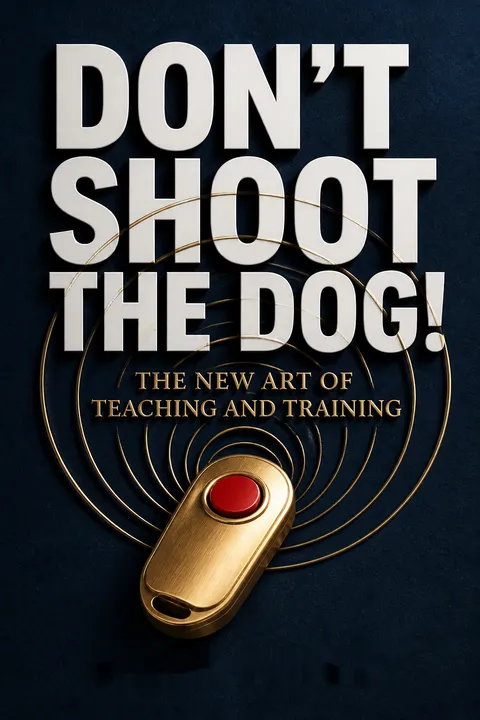
Don't Shoot the Dog is widely praised for its insights on positive reinforcement and behavior modification. Readers find it applicable to training animals and improving human relationships. Many appreciate Pryor's clear writing and practical examples. Some criticize dated references and questionable anecdotes. The book is seen as groundbreaking in promoting clicker training and operant conditioning. While primarily about animal training, readers find value in applying concepts to various aspects of life. Overall, it's considered an influential and thought-provoking read on shaping behavior.
People Also Read




Glossary
Reinforcer
Consequence that strengthens behaviorA reinforcer is an event that occurs with or after a behavior and increases the likelihood of that behavior occurring again. It is defined by its effect, not by the trainer’s intention. Food, praise, escape from an unpleasant situation, or another consequence counts only if it strengthens the relevant behavior for that learner.
Shaping
Building behavior in small stepsShaping develops a new or complex behavior by reinforcing successive approximations, meaning actions that move progressively closer to a target. A trainer begins with something the learner already does, then gradually changes the criterion for reinforcement. Effective shaping uses steps the learner can achieve and avoids demanding several improvements at once.
Conditioned reinforcer
Learned signal for successA conditioned reinforcer is a signal that gains reinforcing value through association with another reinforcer, such as food or attention. A click or whistle can mark the precise behavior that earned reinforcement, especially when the primary reinforcer cannot arrive immediately. The signal must be paired reliably with outcomes the learner values.
Stimulus control
Behavior reliably guided by cuesStimulus control exists when a learned signal reliably evokes a particular behavior in the training context. In Pryor’s account, the behavior should occur promptly when the cue is given, should not occur without that cue during training, and should not be confused with responses to other signals. Establishing a behavior and establishing its cue are separate tasks.
Variable schedule of reinforcement
Occasional, unpredictable reinforcementA variable schedule reinforces a behavior intermittently rather than after every occurrence, with the timing or number of responses varying. Once a behavior is learned, this pattern can help maintain it even when rewards are not constant. The same mechanism can unintentionally sustain unwanted behavior when occasional outcomes reward persistence.
Extinction
Behavior fades without reinforcementExtinction is the decline of a behavior when the consequence that previously reinforced it is no longer provided. The behavior may temporarily intensify or vary before it decreases. Ignoring works only when attention or another consequence was maintaining the behavior; it does not reliably eliminate actions that are self-reinforcing or meet an ongoing need.
Behavior chains
Cued sequences of actionsA behavior chain is a sequence of learned actions linked by cues, where each action or signal helps occasion the next and a larger reinforcer often comes at the end. A dog retrieving a thrown object must complete several connected steps. Pryor recommends teaching chains backward so each newly learned step leads into a more secure one.
DRO (Differential Reinforcement of Other behavior)
Reinforce behavior other than the targetDRO is a method for reducing an unwanted behavior by reinforcing other behavior instead. The trainer rewards periods or actions in which the target behavior does not occur, without necessarily requiring one particular replacement action. Pryor calls this shaping the absence of a behavior and illustrates it with reinforcing calmer, more pleasant parts of a conversation.
Limited hold
Time window for a responseA limited hold is a defined interval during which a response to a cue must occur in order to receive reinforcement. The trainer begins with an interval that includes most current responses, then gradually shortens it. The method can make responses more prompt, but the interval must remain achievable while the behavior is being shaped.
Prelearning dip
Temporary decline before cue learningA prelearning dip is a temporary collapse in correct responding that Pryor observes while a learner is beginning to connect a behavior with a cue. She interprets the dip as a possible shift from responding without recognizing the signal to attending to it before understanding what action it predicts. Continued clear training may restore and improve performance.
FAQ
What's "Don't Shoot the Dog!" about?
- Behavior Modification Focus: The book by Karen Pryor is about understanding and changing behavior in animals and humans using positive reinforcement techniques.
- Training and Teaching: It introduces methods for training animals and teaching people without using punishment, emphasizing the effectiveness of positive reinforcement.
- Practical Applications: The book provides practical advice for dealing with everyday behavioral issues, from barking dogs to personal habits.
- Scientific Foundation: It is grounded in behavioral science, particularly the principles of operant conditioning developed by B.F. Skinner.
Why should I read "Don't Shoot the Dog!"?
- Improve Training Skills: It offers valuable insights into training animals and managing human behavior effectively.
- Positive Reinforcement Techniques: The book provides a comprehensive guide to using positive reinforcement instead of punishment.
- Real-Life Applications: Readers can apply the techniques to various situations, including parenting, teaching, and personal development.
- Engaging and Accessible: Written in an engaging style, it makes complex behavioral concepts accessible to a broad audience.
What are the key takeaways of "Don't Shoot the Dog!"?
- Positive Reinforcement Works: Positive reinforcement is more effective than punishment in changing behavior.
- Shaping Behavior: Behavior can be shaped through successive approximations, reinforcing small steps toward a desired behavior.
- Stimulus Control: Bringing behavior under stimulus control ensures it occurs only in response to specific cues.
- Eight Methods for Behavior Change: The book outlines eight methods for eliminating unwanted behavior, emphasizing positive approaches.
What are the best quotes from "Don't Shoot the Dog!" and what do they mean?
- "Reinforcement is information": This quote highlights that reinforcement provides feedback about what behavior is effective, guiding future actions.
- "You can train anyone...to do anything that can and should be done": It emphasizes the universality of reinforcement principles in training both animals and humans.
- "The laws of reinforcement are simple": This underscores the straightforward nature of reinforcement principles, though their application can be complex.
- "Training is a loop, a two-way communication": This quote illustrates the interactive nature of training, where both trainer and trainee influence each other.
How does Karen Pryor define positive reinforcement in "Don't Shoot the Dog!"?
- Definition: Positive reinforcement is anything that, when presented after a behavior, increases the likelihood of that behavior occurring again.
- Examples: It can include food, praise, or any other desirable outcome that follows a behavior.
- Contrast with Punishment: Unlike punishment, which aims to stop behavior, positive reinforcement encourages the repetition of desired actions.
- Application: It is used to shape new behaviors and maintain existing ones by providing rewards.
What is the "clicker training" method discussed in "Don't Shoot the Dog!"?
- Marker Signal: Clicker training uses a clicker as a conditioned reinforcer to mark desired behavior precisely.
- Immediate Feedback: The click provides immediate feedback, bridging the gap between the behavior and the reward.
- Versatile Application: It is used widely in training animals, particularly dogs, but can also be applied to humans.
- Benefits: Clicker training accelerates learning, enhances retention, and fosters a positive learning environment.
What are the "Ten Laws of Shaping" in "Don't Shoot the Dog!"?
- Incremental Criteria: Raise criteria in small enough increments that the subject always has a realistic chance for reinforcement.
- One Aspect at a Time: Train one aspect of any particular behavior at a time; don't try to shape for two criteria simultaneously.
- Variable Reinforcement: Put the current level of response on a variable schedule of reinforcement before adding or raising the criteria.
- Plan Ahead: Stay ahead of your subject by planning your shaping program completely.
How does "Don't Shoot the Dog!" address the use of punishment?
- Ineffectiveness of Punishment: The book argues that punishment is often ineffective and can have negative side effects.
- Escalation Risk: Punishment tends to escalate, leading to harsher measures without solving the underlying behavior.
- Alternative Methods: Pryor advocates for positive reinforcement and other non-punitive methods to change behavior.
- Emotional Impact: Punishment can create fear, anger, and resentment, which are counterproductive to learning.
What is "stimulus control" as explained in "Don't Shoot the Dog!"?
- Definition: Stimulus control is when a behavior is performed only in response to a specific cue or signal.
- Training Process: It involves teaching the subject to associate a particular behavior with a specific stimulus.
- Four Conditions: Complete stimulus control is achieved when the behavior occurs only on cue, never without it, and no other behavior occurs in response to the cue.
- Applications: It is crucial in training animals and managing human behavior in structured environments.
How can "Don't Shoot the Dog!" be applied to human relationships?
- Improving Communication: The principles of positive reinforcement can enhance communication and cooperation in relationships.
- Reducing Conflict: By focusing on reinforcing desired behaviors, conflicts can be minimized.
- Building Trust: Consistent reinforcement builds trust and strengthens bonds between individuals.
- Practical Examples: The book provides examples of applying these techniques in parenting, teaching, and workplace settings.
What are the eight methods for getting rid of unwanted behavior in "Don't Shoot the Dog!"?
- Method 1: "Shoot the Animal": Eliminating the behavior by removing the subject, though not recommended for most situations.
- Method 2: Punishment: Using aversive consequences, which is often ineffective and discouraged.
- Method 3: Negative Reinforcement: Removing something unpleasant when the desired behavior occurs.
- Method 4: Extinction: Letting the behavior go away by itself by not reinforcing it.
- Method 5: Train an Incompatible Behavior: Teaching a behavior that cannot occur simultaneously with the unwanted behavior.
- Method 6: Put the Behavior on Cue: Bringing the behavior under stimulus control and then not giving the cue.
- Method 7: Shape the Absence: Reinforcing anything and everything that is not the undesired behavior.
- Method 8: Change the Motivation: Addressing the underlying motivation for the behavior to eliminate it.
How does "Don't Shoot the Dog!" suggest using reinforcement in sports and business?
- Sports Training: The book highlights the shift from punitive methods to positive reinforcement in individual sports training.
- Business Management: It discusses using reinforcement to improve employee performance and satisfaction.
- Practical Techniques: Examples include rewarding creativity, offering flexible work hours, and recognizing achievements.
- Benefits: Reinforcement leads to better results, higher morale, and a more positive organizational culture.
About the Author
Other books by Karen Pryor

Download PDF
Download EPUB
.epub digital book format is ideal for reading ebooks on phones, tablets, and e-readers.








