

Key Takeaways
Treat adulthood as messy practice, not a certificate you finally earn.
Growing up looks ridiculous. Nugent opens with the gap between the polished adult she imagines and the person who is still figuring out work, money, relationships, and basic household chores. At a party meant to prove that she and her friends have matured, cheap tequila turns the evening into an awkward game of strip poker. The point is not that irresponsibility is charming. It is that one humiliating night does not disqualify anyone from becoming an adult.
No grand arrival follows. Across these essays, progress comes in fits: a job application, an uncomfortable talk with a parent, a move, or simply recognizing a pattern. The book replaces the fantasy of a clean transition with a more credible picture of adulthood as repeated, imperfect attempts to manage life.
What's striking is how the party turns a familiar developmental script into comedy: the guests perform maturity, then expose how little they know about it. Developmental psychology likewise treats adult identity as something shaped through changing roles and choices, not a switch flipped at graduation. The comic voice makes embarrassment easier to face without pretending it has no consequences. Still, humor can make serious instability seem harmless. The more useful distinction is between a mistake that becomes a story and a repeated behavior that keeps damaging health, finances, or relationships.
Keep the dream, but expect its first paycheck to be tiny.
Ambition meets the rent. As a child, Nugent imagined a future built around writing jokes and stories. Her parents encouraged her, sometimes laughing at work that was plainly not ready for an audience. After graduation, the dream collided with joblessness, student loans, and a résumé with little relevant experience. The book does not present the childhood ambition as foolish; it shows how the adult version has to survive contact with ordinary constraints.
Start where the work is. Nugent eventually begins writing paid pop-culture pieces for websites, despite low pay, hostile readers, and paperwork she handles badly. The work is not the imagined destination, but it gives her a direction. Her route into writing also involves luck, so the story is not a promise that persistence guarantees success. It is evidence that a modest first step can make a vague ambition more concrete.
The essay makes a useful distinction between preserving an aspiration and insisting that its path should look glamorous. Career research often describes early work as a period of exploration, where people test skills and preferences before settling into a direction. Nugent's freelance assignments do that, even when the conditions are precarious. The caution is important: celebrating low-paid entry work can normalize exploitative labor. A useful test is whether an imperfect job builds a transferable skill, a portfolio, or a clearer next move, rather than merely consuming time and energy.
Moving back home can be a bridge, not proof you failed.
Home offers a pause. Unable to afford the move she had planned, Nugent returns to her parents' house in suburban New York. She tells herself the stay will be brief, but months pass without a job. Familiar comforts, including meals and a stocked refrigerator, make life easier, while old photographs and childhood belongings sharpen her sense that she is stalled.
Accept the new terms. A joking remark from her father about unpacking makes clear that this is not just a short visit. Nugent finally puts away the boxes and begins to treat the situation as real. Her parents do not solve her life for her; they provide a place to regroup while she applies for work. She eventually saves enough through freelance and part-time jobs to move out. Returning home is presented as a fortunate resource, not a universal option.
The story challenges the idea that independence must be linear. Family support can function as a temporary buffer during economic instability, giving a person room to recover without erasing their agency. Nugent's turning point is not leaving immediately, but acknowledging the present instead of treating it as an embarrassing detour. That framing also needs a material caveat: many adults lack a safe or available home to return to, and family dependence can carry real costs. Support is most useful when it enables choices rather than dictating them.
Let survival jobs build stamina without letting them choose your whole future.
Work can be both burden and training. Nugent spends years in coffee shops, then takes retail work when freelance income cannot cover rent, taxes, and new glasses. Service work demands punctuality, patience, and composure even when customers are difficult or the worker has personal problems. She learns to perform the job well because she needs the money, not because it is her ideal career.
Notice the comfort trap. She describes how a tolerable job can gradually become a permanent one: annoyance fades into numbness, then into acceptance. Freelance work brings a different set of problems, including late payments, missed invoices, and an unexpected tax bill. Her point is not to scorn service work, but to keep a sense of direction while doing necessary work. Resilience helps a person endure a job; it should not require pretending that the job meets every need.
This account captures a real feature of precarious work: the same job can provide income and competence while narrowing the time available to pursue another path. Labor scholars often distinguish between a job's immediate security and its longer-term mobility. Nugent's emphasis on stamina is valuable because it dignifies unglamorous work, but stamina alone is not a career plan. Employers and economic conditions shape how freely someone can leave. The practical question is not whether a job is worthy, but what it sustains and what it makes harder.
Make money visible before small comforts quietly become a monthly crisis.
Avoidance hides the total. Nugent attempts a budget and lists rent, utilities, toiletries, laundry, food, loan payments, clothes, drinking, and unpredictable purchases. The list is funny because each expense seems defensible on its own: a necessary household item becomes makeup, snacks, and cleaning products; groceries do not prevent an expensive meal out. She admits that the final total feels too depressing to calculate.
Name the leak before judging it. Her financial stress is not simply about extravagant purchases. It also involves irregular freelance pay, debt, rent, and procrastination over bills. The comic savings tips mostly fail, but the honest inventory reveals how spending and avoidance reinforce each other. The implied first move is modest: learn where the money goes before promising to eliminate every pleasure. A budget that hides reality is reassurance, not a tool.
The essay's strength is its attention to friction and self-deception: small purchases remain invisible until they join a larger pattern. Behavioral economics calls this mental accounting, the tendency to treat separate expenses as unrelated even when they draw from the same limited pool. Making categories visible can improve decisions without demanding joyless austerity. Yet personal budgeting cannot fix low wages, debt burdens, or unstable income by itself. The book is strongest as a portrait of financial avoidance, not as a comprehensive solution to structural insecurity.
Choose kindness and compatibility over cinematic chaos in dating.
A bad-boy script feels familiar. Nugent names her attraction to brooding, unreliable men the Shawn Hunter phenomenon, after a rebellious television character she admired as a girl. Her brother sees the pattern more clearly: she treats anger, emotional distance, and inconsistency as signs of excitement. She can predict how these relationships unfold, yet keeps mistaking that predictability for chemistry.
Reliability is not dullness. Nugent recognizes that a dependable partner does not have to be humorless or passive. Part of her resistance to a genuinely good relationship is fear: trusting someone makes the possibility of being hurt feel more serious. Her brother cannot choose better partners on her behalf. She has to notice when she is accepting behavior that makes her feel small, and decide that being worthy of care is not a prize earned after enduring enough bad dates.
What's valuable here is the link between romantic preference and emotional risk management. Familiar disappointment can feel safer than uncertain intimacy because the outcome is easier to anticipate, even when it hurts. Attachment theory offers one lens for this pattern, though the memoir does not diagnose Nugent or establish a universal rule. The distinction between kind and compatible also matters: reliability is foundational, but attraction, shared humor, and mutual interest remain important. The goal is not to replace dramatic men with merely polite ones, but to stop treating disrespect as proof of passion.
Let food be pleasure, not another test your body must pass.
A sandwich interrupts the rules. During a disappointing night out, Nugent and a friend order a rich grilled cheese. Eating it brings uncomplicated pleasure, a striking contrast with years of monitoring her weight and fearing ordinary changes in her body. In high school, she describes severe restriction, exercise that injured her knee, and reaching a clothing size that made her feel temporarily accepted.
A good moment is not a cure. Nugent does not claim that one meal makes her love her body forever. She still has days of dissatisfaction, but begins to see that food can be enjoyable without becoming a moral failure. The essay also challenges a culture that treats thinness as a condition for confidence. Its advice is not to ignore health, but to stop harming oneself in pursuit of a narrow appearance standard.
The scene is powerful because it makes bodily acceptance sensory rather than abstract: pleasure arrives through eating, not through winning approval. Research on body image and disordered eating broadly supports concern about restrictive behavior and appearance-based self-worth, though this memoir is personal testimony, not clinical guidance. Its nuance lies in allowing ambivalence; body acceptance need not mean constant admiration. The challenge is that individual self-acceptance cannot neutralize industries and social norms that reward thinness. Personal compassion matters, but so does changing the environment that keeps bodies under scrutiny.
When fear becomes the ocean, cross it one ordinary day at a time.
The fear changes shape. As a child, Nugent is terrified of sharks, then faces a staged shark encounter at a theme park and declares the fear conquered. As an adult, she wakes in panic, convinced something is terribly wrong. The source is harder to isolate: money, work, and the distant demands of building a life all seem to gather into one overwhelming future.
Quick relief is not resolution. Friends suggest alcohol, yoga, or medication; drinking worsens her night, yoga does not suit her, and a borrowed anti-anxiety pill briefly quiets her thoughts without answering what she fears. Nugent recognizes that muting panic is different from understanding or treating it. She begins narrowing the task to getting through the present day, rather than solving every imagined year at once. The episode is a memoir of distress, not a substitute for medical care.
The shift from a visible shark to an overwhelming future captures how anxiety can attach to uncertainty rather than one discrete threat. Breaking an impossible horizon into near-term tasks resembles approaches in cognitive behavioral therapy, where attention returns to manageable actions and interpretations. The essay also wisely refuses to present alcohol or borrowed medication as cures. Still, day-by-day coping has limits when symptoms recur or impair functioning. Professional assessment can distinguish panic, medical causes, and other conditions, a form of support absent from the comic experiments described here.
Treat friends' milestones as evidence of change, not a deadline.
A wedding makes time visible. Nugent receives an invitation to a friend's wedding and initially reacts as if it has arrived too soon. The bride is someone she remembers from college trips, drinking, and casual conversations, so seeing her marry feels like a sudden jump in the story. On the road to the ceremony, Nugent and friends revisit old music and memories, then talk about their current jobs and uncertain plans.
The milestone belongs to the friend. The wedding does not prove that everyone else should marry, settle down, or share the same timeline. It reveals that people who once seemed fixed in a familiar stage have changed. Nugent's response is both sadness and affection, followed by joining her friends on the dance floor. The event becomes a prompt to notice time passing, not a scorecard for measuring whose life is ahead.
Milestones compress time: a single ceremony places a person's remembered past beside their changed present. That makes weddings emotionally potent even for guests who do not want marriage themselves. Social comparison can turn another person's joy into evidence of personal failure, but Nugent's story allows a less competitive reading: the event is a shared marker of change. A useful nuance is that nostalgia can romanticize earlier years and obscure their difficulties. Remembering the past is richest when it honors what mattered without demanding a return to it.
A city becomes yours through repeated errands, small rituals, and human attention.
Belonging begins locally. Nugent arrives in New York hearing sirens and feeling out of place. She imagines that being a real New Yorker requires confidence and effortless knowledge, but belonging grows through smaller acts: learning which subway stop works, finding a favorite bagel shop, recognizing a useful ATM, and discovering bars and food places that suit her.
Attention creates connection. The city remains expensive, crowded, and sometimes alienating. Nugent still gets lost and sometimes feels plain among strangers, yet she notices people around her and imagines their lives with care. Friendships formed after the move also show that her social world is not limited to old classmates. By the end, she feels present in the city without claiming complete mastery. Home is less a flawless place than a set of familiar routes and human ties.
This account treats belonging as accumulated knowledge rather than a personality trait. Environmental psychology describes place attachment as a relationship built through routine, memory, and social connection, all visible in Nugent's neighborhood map of shops, transit, and companions. Her attention to strangers also resists the idea that urban anonymity must mean indifference. There is a productive tension, though: familiarity can make a city feel one's own while high rents and exclusion remain powerful forces. Emotional belonging is real, but it is not the same as economic security.
Analysis
This memoir is not a step-by-step guide to becoming an adult. It is a sequence of comic essays that makes uncertainty legible by locating it in ordinary scenes: a party that collapses into tequila-fueled embarrassment, a return to a childhood bedroom, a frightening loan bill, and a grilled cheese eaten after a failed night out. The recurring method is self-mockery, but the deeper movement is from performance toward recognition. Nugent begins by trying to look adult, independent, desirable, or unbothered. Her strongest moments arrive when she admits what she needs, whether that is family help, a more dependable partner, pleasure without punishment, or simply a manageable next day.
The book's value lies in its refusal to turn every stumble into a triumph. Moving home is not framed as a clever life hack, freelance work is neither stable nor glamorous, and a single meal does not erase years of body anxiety. That resistance to tidy transformation gives the humor credibility. At the same time, the memoir's personal lens has limits. Its economic pressures are real, but the solutions available to Nugent depend on family housing, friendships, and access to paid work. Readers facing more severe insecurity may recognize the pressures without sharing those buffers.
The essays also reflect a specific cultural moment: young adults navigating student debt, online self-presentation, precarious creative work, and social expectations around dating and marriage. Rather than claim that every twentysomething shares the same experience, the book uses detail to make one person's confusion recognizable. Its central reassurance is not that adulthood becomes easy, but that awkwardness does not mean a person is uniquely broken. The comic voice helps readers hold both truths at once: the mess can be funny, and the problems still deserve attention.
Review Summary
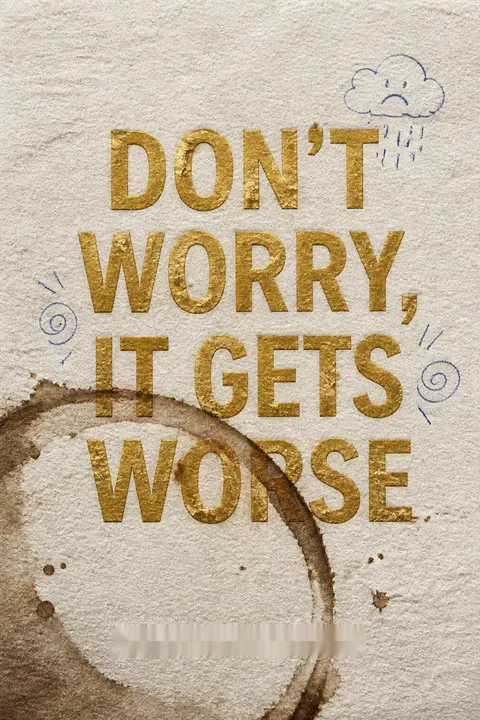
Don't Worry, It Gets Worse received mixed reviews from readers. Many found it relatable and humorous, appreciating Nugent's candid portrayal of post-college struggles. However, some felt the book was overly pessimistic and lacked depth. Readers connected with themes of job hunting, financial woes, and navigating adulthood. The author's writing style and pop culture references resonated with the target audience of twentysomethings. While some praised the book's honesty, others found it self-indulgent and unoriginal. Overall, it was seen as a quick, entertaining read that captured the challenges of early adulthood.
People Also Read




Glossary
Shawn Hunter phenomenon
Attraction to unavailable bad boysNugent's name for a recurring romantic preference shaped by her teenage admiration for Shawn Hunter, a rebellious character from Boy Meets World. The pattern involves mistaking emotional distance, anger, or unreliability for excitement, then tolerating behavior that causes hurt. Recognizing the pattern helps her separate genuine compatibility from the familiar drama of pursuing someone unlikely to offer care.
Download PDF
Download EPUB
.epub digital book format is ideal for reading ebooks on phones, tablets, and e-readers.








