

Plot Summary
A Drop Before Christmas
Brasenose’s Acting Head, Gilchrist, rushes a first-ever manned medieval drop while the History Faculty’s regular head is away. Kivrin Engle, a young historian who has spent years preparing to study ordinary life in the fourteenth century, is sent in a disguise as a robbed noblewoman. Her tutor, James Dunworthy, objects that the risk rating is too low and the safety checks are missing, but he has no authority to stop the college’s project.
Technician Badri Chaudhuri rechecks the equipment, while Kivrin says goodbye through the observation glass. Gilchrist has even arranged for her to begin the journey with a staged head wound, hoping a traveler will believe her story. As the net opens, Dunworthy watches her vanish and can do nothing more.
The launch turns institutional ambition into personal danger. Gilchrist treats preparation as a matter of convincing statistical language, while Dunworthy understands that an individual life cannot be protected by averages. Kivrin’s confidence complicates his paternal worry: her desire to witness the past is neither naïve nor casual, but the result of disciplined study. Yet her competence cannot compensate for an organization that has compressed testing to meet its own timetable. The scene establishes the novel’s central tension between historical knowledge and lived experience. The University can calculate a drop, but it cannot reduce the human consequences of error to a probability.
The Forest Landing
Kivrin wakes beneath an oak in a wood, not on the Oxford-Bath road where the drop was meant to place her. The wagon and equipment have arrived with her, but the road is distant and the daylight is fading. She marks the site with a small brass casket, climbs a hill, and uses the evening bells to locate nearby villages. Before she can reach Skendgate, fever, dizziness, and chest pain overwhelm her.
A red-haired household retainer named Gawyn finds her and carries her toward a manor, with the village priest, Father Roche, helping along the way. Kivrin experiences their rescue through delirium, mistaking Roche for a cutthroat and fearing she is being taken to be burned. Her illness leaves her unable to return to the drop or explain herself.
The error becomes consequential before anyone can diagnose it: Kivrin is physically displaced, medically incapacitated, and separated from the technology that could return her. Her training helps her orient herself through bells and landscape, but the body defeats the plan. The delusion that Roche is a murderer shows how fear reshapes perception when language and memory fail. Crucially, the people who appear threatening are the ones who care for her. That reversal challenges Dunworthy’s imagined catalogue of medieval dangers without making the past safe. Kivrin’s vulnerability is real, but so is the ordinary mercy she could not have predicted.
Badri Falls Ill
Back in 2054, Dunworthy waits for the fix that will establish where Kivrin arrived. Badri appears in a pub, soaked, confused, and feverish, then collapses at the laboratory console. Dr. Mary Ahrens identifies a dangerous influenza-like infection, and Oxford is placed under temporary quarantine.
Dunworthy learns that Badri had contact with crowds on the High Street and at a dance, so officials begin tracing everyone he may have exposed. The quarantine traps students, visitors, and residents, while the University struggles to find records, medicines, and enough staff.
Colin Templer, Mary’s twelve-year-old great-nephew, is turned back toward London, then secretly makes his way into Oxford to find her. Dunworthy takes him in as the disease spreads and the fix remains unread.
Badri’s collapse creates a second crisis whose urgency competes with Kivrin’s absence. Dunworthy initially interprets the technician’s confusion as a possible warning about the fix, while the medical staff must treat it as illness; the uncertainty makes every delay dangerous. The quarantine also reveals the social machinery of emergency: paperwork and contact lists struggle to contain a virus moving through ordinary crowds. Colin’s defiance echoes Kivrin’s determination, but his return brings Dunworthy a responsibility he cannot simply delegate. The novel begins to braid its timelines through shared helplessness. Both Oxford and the medieval village become places where people wait for information they cannot yet obtain.
A House Without Words
Kivrin wakes in a manor bedroom with her forehead bandaged and her hair cut short, but she cannot understand the women caring for her. The interpreter implanted for the drop struggles with their unfamiliar dialect, leaving Kivrin dependent on gestures and fragments of speech.
The household belongs to Lord Guillaume, who is away in Bath, and includes his wife, Eliwys, his mother, Lady Imeyne, and daughters Rosemund and Agnes. Kivrin gradually learns the children’s names and begins to understand them by listening closely.
She tells the household she remembers nothing, concealing her mission while she recovers from fever and chest pain. Her arrival unsettles the manor: Imeyne suspects her of deception, while Eliwys keeps the family isolated and refuses to explain why they have taken refuge there.
The failed interpreter makes language a practical survival tool rather than an academic accomplishment. Kivrin knows the grammar she studied, yet the living dialect exposes the distance between classroom reconstruction and speech shaped by class, region, and daily use. Her invented amnesia protects her from questions she cannot safely answer, but it also makes her appear suspicious. The manor’s own silences mirror hers: Eliwys withholds the reason for the family’s retreat, and Imeyne converts uncertainty into accusation. Everyone is managing danger by controlling what others know. Kivrin’s first task is therefore not observation but learning how to be understood without surrendering the secret that brought her there.
The Manor's Fractured Refuge
As Kivrin regains strength, Agnes becomes her guide to the manor and village. She learns that Rosemund, only twelve, is promised to the much older Sir Bloet, and that Rosemund’s anger is not childishness but fear of the marriage. Kivrin also realizes Gawyn is in love with Eliwys, complicating the household’s already strained loyalties.
She tries to find the drop, but Gawyn has collected the wrecked wagon and boxes from the woods and brought them to the manor, erasing the trail. During an outing to gather holly, Father Roche takes Kivrin to the place where Gawyn first found her, but it is not the drop. Snow covers the landscape, and the brass casket she left by the road cannot be found. Kivrin now depends on Gawyn to guide her back.
The household’s emotional arrangements are not background detail; they shape who can move, speak, and choose. Rosemund’s betrothal turns marriage into a transfer of power, while Gawyn’s courtly devotion to Eliwys exists alongside his sexual relationship with Maisry. Kivrin recognizes the cost of treating medieval life as a research site: these people are not examples but individuals whose futures are already constrained. Meanwhile, the misplaced equipment converts a technical problem into dependence on human memory. Gawyn’s act of retrieving the wagon seems helpful, yet it destroys Kivrin’s marker. The episode binds historical observation to responsibility: she wants to record the household, but she is already entangled in it.
Oxford Seals Its Doors
In Oxford, Mary confirms that Badri has a serious influenza infection, and Dunworthy helps trace the people he encountered. The illness reaches students, detainees, and medical staff; the city’s quarantine disrupts transport and leaves colleges short of food, masks, and supplies.
Dunworthy’s secretary, Finch, tries to keep Balliol functioning, while Mrs. Gaddson arrives to protect her son William and instead becomes another source of chaos. Colin, after sneaking through the quarantine perimeter, refuses to go home and helps with errands.
At Christmas, Dunworthy and Colin attend a crowded interfaith service, where the vicar offers public-health advice alongside prayers. Dunworthy continues to worry about Kivrin’s safety and the unread fix, but Mary believes Kivrin is protected from the modern virus by her medical preparation.
The Oxford thread exposes how fear becomes both care and obstruction. Mary’s medical procedures, Finch’s rationing, and the quarantine rules are imperfect but directed toward preserving lives; Mrs. Gaddson’s vigilance, by contrast, often serves her need to control William. Colin’s rule-breaking is dangerous, yet it also makes him useful in a community where adults are overwhelmed. Dunworthy’s attention remains fixed on Kivrin, so he repeatedly interprets events through the possibility that she is in danger. His anxiety is not irrational, but it narrows his vision. The modern epidemic makes the present resemble the past in a precise way: people still confront limited knowledge, interrupted routines, and the temptation to blame outsiders.
The Bishop's Hasty Feast
On Christmas Eve, a bishop’s envoy arrives with two churchmen, and Lady Imeyne welcomes them as a chance to secure a more learned chaplain. Their party brings news of illness and unrest, but no clear word of Lord Guillaume.
After the midnight mass and feast, the envoy leaves suddenly with Sir Bloet and Gawyn, leaving his sick clerk behind. The clerk becomes delirious, develops a swollen tongue and a painful lump beneath his arm, and Kivrin recognizes the signs of bubonic plague.
She asks the year and learns it is 1348, not 1320. The family’s retreat, the dead chaplain, and the delayed court proceedings now make sense: plague is already moving through the region. Kivrin’s historical assignment has become an encounter with an unfolding catastrophe.
The revelation changes the meaning of earlier details without making them feel like mere clues. The family’s secrecy, the dead chaplain, and the nervous departures all belong to a world already under epidemic pressure. Kivrin’s shock is especially sharp because she had been using holy days to confirm the date, a method made useless by the faulty drop. The clerk’s body supplies the evidence that scholarship alone could not: swollen tissue, fever, delirium. The scene also separates care from rank. The powerful visitors leave; the parish priest and the young historian remain with the sick. History becomes immediate, not because Kivrin has reached a famous event, but because a person in front of her is suffering.
A Village Behind Barricades
Kivrin explains contagion to Father Roche and persuades him to keep the clerk apart from the household. They use cloth masks, separate bedding, and try to clean wounds, though they have no effective medicines.
Roche tends the clerk while Kivrin watches Rosemund, who develops a painful bubo after exposure at the Christmas gathering. Kivrin and Roche also try to protect Agnes, Eliwys, and the villagers by restricting contact and asking people to remain in their homes. The measures come too late for many.
A reeve, members of the steward’s family, and other villagers fall ill, while Roche carries food and prayers between households. Kivrin’s hope of leaving for the drop shrinks as each new patient needs her attention, and the growing number of graves makes the village’s danger impossible to deny.
The makeshift barrier turns care into a daily negotiation between protection and presence. Kivrin understands the mechanisms of infection, but knowledge cannot supply antibiotics, clean water, or enough hands. Roche’s religious practice does not prevent disease, yet his willingness to enter sickrooms gives the village a form of solidarity that statistics cannot measure. The mismatch between scientific explanation and medieval belief is not simply a contest between reason and superstition: Kivrin herself must rely on trust, improvisation, and hope. Each patient brings a new obligation, making departure feel increasingly like abandonment. Her commitment to observing the past has become a commitment to people who never consented to become part of her research.
The Tomb Sends Fever
In 2054, the flu spreads through Oxford despite quarantine, and Mary and Dunworthy search Badri’s contacts for a source. They discover that Badri worked with archaeologist Lupe Montoya at a churchyard dig shortly before he became ill.
The excavation had opened a knight’s tomb dated 1318, and Kivrin had handled it days before her drop to make her hands look authentic. Montoya, working alone through the rain, has been searching the graves for Kivrin’s implanted recorder.
Mary concludes that an ancient virus escaped from the tomb and infected Badri, then passed through the modern community. Kivrin was exposed before her protective treatment had fully taken effect. The source explains the epidemic, but it also means she may have carried the infection into a population with no immunity.
The tomb links archaeological practice to biological consequence. Montoya and Badri approach the grave as evidence of the past, while the novel reveals that it also contains an active material history capable of entering the present. The danger is not time travel in the abstract but the assumption that historical remains are inert. Kivrin’s muddying of her hands, a seemingly harmless preparation for fieldwork, becomes part of the causal chain. The discovery also reverses the usual direction of contamination: the past sends disease forward, while the historian may carry modern infection backward. Knowledge here is not automatically protective. It becomes ethically meaningful only when institutions anticipate what their methods can release.
The Net Goes Dark
Badri’s feverish statements finally make sense when he tells Dunworthy that Kivrin is in 1348. The drop’s coordinates were wrong, and Badri had re-entered them while already ill with the virus. Dunworthy rushes to retrieve Kivrin, but Gilchrist has kept the laboratory closed while insisting the virus may have come through the net.
When Dunworthy breaks into Brasenose, Gilchrist sees the attempted rescue as a threat to public safety and switches off the system. The shutdown destroys access to the active fix.
Dunworthy collapses, leaving Kivrin stranded in the plague year. His illness and the modern epidemic keep him in hospital for days, while Mary dies and the quarantine continues. Only after Dunworthy recovers does Badri reveal that he had secretly made a backup fix through Balliol’s net.
This is the novel’s most consequential failure of judgment. Badri’s illness distorts his calculations, but Gilchrist’s response is deliberate: he protects his institutional standing and public credibility by denying access to the one instrument that could correct his own project. Dunworthy’s desperate entry cannot overcome a system controlled by authority rather than need. The destroyed fix makes technical dependence visible in its harshest form; a person can be present in the past yet unreachable because the machinery that links the two times has been shut down. The later backup revelation does not erase the harm. It shows that rescue was possible, while also exposing how fear and pride made the delay far more costly.
The Village Pays
Kivrin and Roche continue caring for the sick as the plague overwhelms the village. Kivrin lances buboes, offers willow-bark tea, and tries to keep children away from patients, but the treatments cannot stop the disease. Rosemund briefly rallies after Kivrin opens her bubo, then weakens again.
Agnes becomes delirious, while Lady Imeyne blames Kivrin and Roche for the suffering. The steward’s family loses several children, and the village bell records deaths until Roche can barely keep pace.
Agnes dies calling for Kivrin, and Kivrin wraps her in the white cloak and buries her. Rosemund dies soon after, and Eliwys also succumbs. Roche remains with Kivrin, tending the sick and burying the dead. He eventually becomes ill himself, and his delirious directions reveal where he first found Kivrin.
The losses strip away any comforting division between observer and subject. Kivrin’s knowledge allows her to act, but not to command outcomes; her effort to save Rosemund becomes an improvised intervention, not a cure. Agnes’s repeated calls for her show the cost of quarantine from a child’s perspective: protection feels like abandonment. Imeyne’s accusations offer a psychologically understandable defense against helplessness, but they also turn grief into blame. Roche provides a counter-model. He keeps serving people even when prayer cannot stop the disease, and his care gives Kivrin a reason to remain. The village’s deaths are not a tableau of medieval ignorance; they are the consequences of a catastrophe no one can treat.
A Backup in Balliol
After his recovery, Dunworthy learns that Mary died during the epidemic and that many others remain ill. He visits Badri, who blames himself for re-entering the coordinates while feverish and for missing the original rendezvous. Then Badri reveals he had installed a redundant fix through Balliol’s net as insurance against a failure at Brasenose.
He later opened that backup on the eighth of January, but Kivrin had not been at the drop site. Dunworthy now has a narrow chance to try again, though he and Badri are still weak, the fix may have shifted, and no one knows where Kivrin is. Colin refuses to leave Dunworthy alone and helps arrange the equipment, costumes, medicine, and medical clearance needed for a second expedition.
The backup is both a technical safeguard and a moral correction. Badri’s earlier prudence, obscured by illness and the chaos of the epidemic, becomes the only reason Dunworthy can still act. Yet rescue is no longer a clean engineering problem: the first rendezvous has passed, and the expedition begins with incomplete information and damaged bodies. Colin’s persistence matters because he insists that care requires participation, not merely waiting for adults to decide. Dunworthy, who has spent much of the novel treating protection as keeping others away from danger, must accept help from a child. The possibility of return rests on cooperation among people who have all been diminished by illness and grief.
Back Through the Snow
Dunworthy and Colin use Badri’s backup fix to travel to the plague year, carrying only what they can manage. They arrive in a snowy wood, then follow roads toward a nearby settlement. A black stallion tangled in thornbushes lets them move faster, though Dunworthy’s illness returns and Colin has to help him stay mounted.
In the village they find bodies left in the snow, a family dead in a hut, and graves dug near the church. A woman in a blue dress lies among the dead, and Dunworthy fears she may be Kivrin, but her face and identity cannot be confirmed. Colin wants to keep searching; Dunworthy, exhausted and unable to bear another uncertain body, turns away. Then they hear a bell tolling from the direction of another village.
The second journey refuses the fantasy that rescue will restore control. Dunworthy and Colin arrive with modern medicine, but they are still vulnerable to cold, fatigue, and incomplete coordinates. Their encounter with the dead makes the historical catastrophe bodily and immediate; no statistic can soften the sight of a child or a household left unburied. The unidentified woman in blue becomes a test of Dunworthy’s capacity to continue. He cannot make himself inspect every corpse, so Colin’s resolve sustains the search. The bell offers direction without certainty. In a landscape emptied by disease, sound becomes a fragile form of information, linking the living to the possibility that someone remains.
The Bell's Last Strokes
The bell draws Dunworthy and Colin toward the church, where they find Kivrin alive beside Father Roche’s body. She has spent weeks caring for the priest and the villagers, and has just buried him in the churchyard after using the last of her strength to ring the death bell. Dunworthy is still feverish, and Colin helps him through the cold while Kivrin refuses to leave Roche without a final burial.
She explains that Roche found her at the drop site and, during his last delirium, told her how to return there. The bell they heard was not a summons from the net but Kivrin completing the village’s ritual for the dead. Its sound nevertheless brings the rescuers to the one person they came to find.
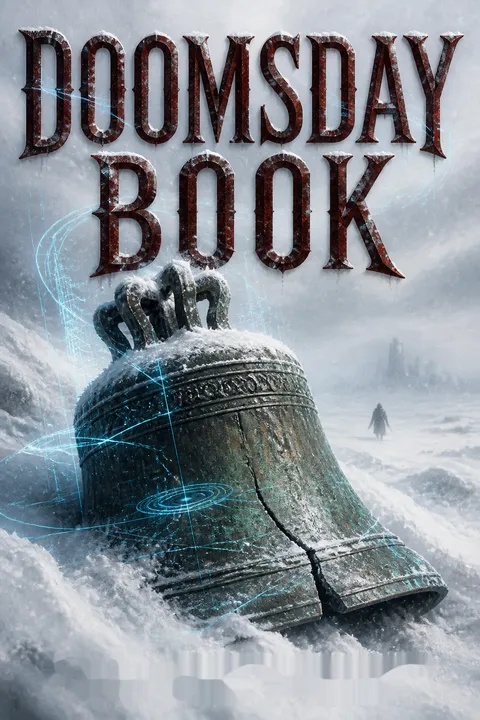
The bell’s meaning changes as it travels across the novel. It first helps Kivrin orient herself, then marks deaths she cannot prevent, and finally guides Dunworthy and Colin to her. It is not a miracle or an answer from beyond history; it is a human act performed by someone refusing to let the dead disappear without witness. Roche’s last gift is practical knowledge, but his importance exceeds that information. He gave Kivrin care when she arrived as a frightened stranger, and she stays to give him the same dignity. Rescue begins only after Dunworthy accepts that Kivrin’s priorities include the dead as well as the living.
A Hand at Last
Dunworthy tells Kivrin that he and Colin have come to take her home. She is wary at first, fearing that Dunworthy may be ill with the plague, but he explains that they have been treated for the modern virus and protected against plague. Kivrin gives Colin the record she has kept, preserving what happened to Roche, Agnes, Rosemund, and the rest of the village.
Dunworthy and Colin then help her leave the church and reach the clearing where the net can open. Badri holds the backup system ready despite his own fragile recovery. As the familiar shimmer forms in the cold air, Kivrin takes Dunworthy’s hand. The three return to their own time, carrying both the rescue and the testimony of people whose lives would otherwise vanish from the record.
The resolution does not undo the dead or convert suffering into a neat triumph. It restores Kivrin’s presence to the people who feared they had abandoned her, while preserving her responsibility to those she witnessed. Dunworthy’s reaching her is not proof that he was always right to worry; it is the result of other people’s work, especially Badri’s backup and Colin’s insistence. Kivrin’s record makes history more than a sequence of dates, naming the intimate acts that official accounts omit: feeding, listening, burying, and keeping vigil. The final handclasp answers the novel’s central fear of separation, but it does so without pretending that care can prevent every loss.
Analysis
Doomsday Book measures history against the limits of care. Its time-travel technology promises access to the past, but the plot repeatedly shows that access is not understanding and information is not rescue. Kivrin’s training can identify a plague and explain contagion, yet she cannot produce antibiotics, clean water, or enough hands to tend the sick. Dunworthy can recognize institutional danger, but his warnings do not give him authority over the net. Badri’s technical competence cannot protect him from fever, and Gilchrist’s confidence converts uncertainty into a disastrous refusal to act. Each character knows something, but no one controls enough of the system to make knowledge decisive.
The parallel epidemics prevent the medieval world from becoming a safe contrast to modernity. Oxford has diagnostics, vaccines, and a sophisticated health service, yet supply shortages, crowded communications, staff illness, and political panic repeatedly obstruct its response. In the village, people lack germ theory, but Roche’s practical generosity and Kivrin’s improvised isolation show that humane conduct does not depend on possessing the correct scientific model. The difference between them is material capacity, not moral worth.
The novel also questions what historical evidence can contain. Official records count deaths and describe institutions; Kivrin’s corder preserves Agnes’s impatience, Rosemund’s fear of marriage, Roche’s care, and the steward’s grief. Her work does not make these lives recoverable in the ordinary sense, but it refuses to let them remain anonymous. The act of recording becomes an ethical promise to remember particular people rather than reduce them to a mortality figure.
Dunworthy’s rescue is therefore not a victory over history. He cannot undo the plague or restore the dead, and his late arrival does not erase the cost of delay. What he can do is return for Kivrin, listen to her account, and acknowledge the lives she chose to witness. The novel’s strongest claim is modest and demanding: care cannot guarantee salvation, but it can keep suffering from being mistaken for mere data, fate, or somebody else’s responsibility.
Review Summary
Doomsday Book by Connie Willis is a time travel novel set in both near-future Oxford and medieval England during the Black Death. While praised for its historical accuracy, compelling characters, and emotional impact, some readers found the pacing slow and repetitive. The parallel storylines of past and present pandemics resonated strongly with many, especially in light of recent events. Despite criticisms of outdated technology and frustrating plot devices, the book's exploration of human resilience and compassion in the face of tragedy left a lasting impression on most readers.
People Also Read


Characters
Kivrin Engle
Historian among strangersKivrin is a young medieval historian whose ambition is to learn how ordinary people actually lived, not merely to confirm what surviving records say. She prepares meticulously, studying language, customs, farming, and medicine before the drop. Her intelligence is practical as well as scholarly: she watches, adapts, and learns from people whom formal histories tend to overlook. She is determined to prove she can manage without being protected, yet she is also capable of recognizing when another person needs her. Kivrin’s deepest tension is between observation and participation. She wants to preserve evidence, but the people she studies quickly become more than subjects. Her compassion grows from attention to particular lives, not from an abstract ideal of the past.
James Dunworthy
Worried historian and tutorDunworthy is an experienced historian at Balliol and Kivrin’s unofficial tutor. His affection for her takes the form of preparation, warnings, and an almost compulsive effort to anticipate danger. He understands the risks of time travel better than Gilchrist does, but his concern can harden into overprotection and make him misread what is happening around him. Dunworthy is also a teacher shaped by his own past journeys; he knows that discovery requires leaving safety behind, even when he dislikes watching a student do it. His loyalty is real but not effortless. He must learn that caring for someone is not the same as controlling the conditions of their life, and that helplessness does not cancel responsibility.
Badri Chaudhuri
Time-net technicianBadri is Balliol’s skilled technician, trusted with complex time-net operations and known for careful checks. He is conscientious and reserved, with a strong sense of responsibility for the people whose journeys he enables. His work places him between abstract calculations and human consequences, a position made especially difficult when a technical error cannot be separated from illness and uncertainty. Badri’s loyalty to Dunworthy and concern for Kivrin drive him to act beyond his assigned role, even when his own health is failing.
Mary Ahrens
Physician and steady allyMary is an Infirmary doctor who prepares Kivrin medically and later directs Oxford’s response to the epidemic. Her manner is brisk, wry, and compassionate, and she balances scientific judgment with an awareness of how fear affects people. She worries over Kivrin and Colin while continuing to care for patients and manage scarce resources. Mary is one of the few people who can challenge Dunworthy without dismissing his concerns. Her practical courage comes from acting where action is possible, even when certainty and time are in short supply.
Colin Templer
Stubborn young helperColin is Mary’s twelve-year-old great-nephew, bright, curious, and delighted by anything he considers apocalyptic. He evades quarantine to reach Oxford and refuses to be sent away from the unfolding crisis. His jokes and schemes can irritate adults, but they also reveal a child’s refusal to treat danger as a reason for passivity. Colin forms a bond with Dunworthy through shared work and blunt questions. He wants to be useful and to know the truth, especially when adults try to protect him by withholding it.
Gilchrist
Ambitious Acting HeadGilchrist is the Acting Head of History at Brasenose, eager to open the medieval period to time travel and secure recognition for his department. He trusts statistical models and institutional authority, but lacks Dunworthy’s practical experience with the net. Gilchrist is not merely careless; he is invested in proving that his project is competent, which makes it difficult for him to admit uncertainty. His confidence can sound like expertise even when essential safeguards have been skipped.
Father Roche
Village priest and caregiverRoche is the parish priest serving the small village and Lord Guillaume’s household. Lady Imeyne regards him as ignorant and inept, but he is attentive to the sick and deeply committed to his people. He tends bodies, offers the sacraments, and listens to concerns that wealthier characters dismiss. His faith is practical rather than showy: he speaks of God as someone to whom the details of the village can be entrusted. Roche’s gentleness gives Kivrin a model of service that does not depend on authority or learning.
Eliwys
Anxious manor's mistressEliwys is Lord Guillaume’s wife and the mother of Rosemund and Agnes. With her husband away, she manages a household under pressure while trying to keep her daughters safe. She is guarded and watchful, often interrupting her own work to check the gate. Her concern for the family is constrained by social dependence and the danger of political decisions she cannot control. Eliwys’s feelings toward Gawyn remain difficult for Kivrin to read, in part because duty and desire are both dangerous in her position.
Rosemund
Daughter facing a forced matchRosemund is Eliwys’s twelve-year-old daughter, serious and eager to be treated as grown. She loves her absent father and takes pride in behaving like a young lady, but her impending marriage to Sir Bloet troubles her. She is protective of her younger sister and sometimes expresses that care through sharp criticism. Kivrin sees the strain beneath Rosemund’s manners: she is old enough to understand that her future is being arranged, but too young to control the arrangement.
Agnes
Restless younger daughterAgnes is Eliwys’s younger daughter, lively, impulsive, and hungry for attention. She loves her puppy, her pony, and the small adventures adults repeatedly tell her to avoid. Her questions and observations give Kivrin an intimate view of family life that formal records would never preserve. Agnes can be difficult to manage, but she is also openhearted and quick to trust. Her closeness with Kivrin grows through stories, games, and the everyday rituals of care.
Lady Imeyne
Suspicious family matriarchImeyne is Guillaume’s mother and the household’s most forceful authority in his absence. She values rank, religious observance, and proper conduct, and she notices every sign that Kivrin may not belong. Her sharp judgments often make life harder for servants and for Father Roche. Beneath her insistence on order is a fear of losing control in a world of political uncertainty. She turns to religious explanations when events exceed her ability to manage them.
Gawyn
Retainer with divided loyaltiesGawyn is Lord Guillaume’s armed retainer and the man who finds Kivrin in the woods. He is brave, capable, and eager to win Eliwys’s regard. His attachment to her shapes his choices, including the stories he tells about rescuing Kivrin. Gawyn moves between the obligations of a household servant and the emotional world of courtly romance, where devotion can be both sincere and self-serving.
Lupe Montoya
Archaeologist at SkendgateMontoya is an American archaeologist excavating a medieval village near Witney. She is focused, ambitious, and fiercely protective of her dig, which she regards as an irreplaceable source of evidence. Her concentration can make her seem indifferent to concerns outside the excavation, but she is capable of dogged work under brutal conditions. Montoya’s archaeological priorities connect the modern epidemic to the physical remains she studies.
Professor Latimer
Kivrin's elderly medieval tutorLatimer is Kivrin’s Brasenose tutor, an aging scholar whose teaching emphasizes linguistic history and formal grammar. He is courteous, learned, and increasingly forgetful, more comfortable with lectures than with practical preparation. His role illustrates the gap between textual expertise and the everyday knowledge Kivrin needs for fieldwork.
Sir Bloet
Rosemund's powerful fiancéBloet is a wealthy lord whose planned marriage to Rosemund would join neighboring holdings. He is confident in his social power and treats courtship as an entitlement, while his gifts are presented as tokens of a negotiated alliance. His presence makes the costs of arranged marriage visible to Kivrin.
Finch
Dunworthy's overburdened secretaryFinch is Dunworthy’s conscientious secretary at Balliol. He manages messages, supplies, rooms, and visitors as the quarantine overwhelms ordinary college routines. His anxiety about practical details can appear comic, but his persistence keeps people fed and housed when the institution begins to fail.
Maisry
Household servant and scapegoatMaisry is a young servant from a poor local family, often blamed by Lady Imeyne for carelessness. She is awkward, fearful of authority, and sometimes unreliable with the children, yet she is not simply the fool the household makes her out to be. Her treatment exposes the class hierarchy operating beneath the family’s polished manners.
William Gaddson
Undergraduate under watchWilliam is a Balliol undergraduate whose mother repeatedly intervenes in his life, despite his capacity to manage himself. He is more independent than she believes and pursues his own relationships while the college is under quarantine. His subplot gently reverses the assumption that young adults need constant protection.
Mrs. Gaddson
Anxious, intrusive motherMrs. Gaddson is William’s formidable mother, convinced that his health and welfare depend on her supervision. Her fear expresses itself through complaints, unsolicited care, and repeated demands on the college. She provides comic friction, but her concern also echoes Dunworthy’s worry over Kivrin in a deliberately uncomfortable way.
Blackie
Agnes's beloved puppyBlackie is Agnes’s small puppy, adored and overhandled by the child. His presence gives Kivrin a way to comfort Agnes and a concrete glimpse of the tenderness and disorder of household life. Agnes’s attachment to him shows how even a very young child creates private rituals of love.
Plot Devices
The time net and fix
Links the two centuriesThe time net sends a traveler to a specified time and place, while a recorded fix gives technicians the information needed to reopen the connection for a return. The net operates under constraints that prevent paradoxes and limit what can pass between eras. In the novel, the fix is the practical tether between Kivrin and Oxford. Errors in the coordinates place her in the plague year, while institutional decisions and technical failures make the original return route unavailable. A backup fix preserves a final possibility of rescue. The device therefore makes time travel less like free movement than a fragile appointment dependent on precision, memory, and cooperation.
Kivrin's implanted corder
Preserves eyewitness testimonyKivrin’s recording system is implanted in her wrists and concealed so it will not look like a modern object to medieval people. She activates it by bringing her palms together, an action that resembles prayer. The corder allows her to record observations when she cannot write openly, preserving details about language, work, illness, and the people who care for her. Its design anticipates the possibility that she may not return, making the historical record a second form of rescue. The device also raises a question the novel keeps pressing: whether documenting someone’s life is enough, or whether the witness must also accept responsibility for the person being observed.
The interpreter implant
Bridges speech unevenlyThe interpreter helps Kivrin understand and speak medieval languages, but it is not a magical guarantee of communication. The local dialect differs sharply from the forms she studied, and her illness makes the device’s first attempts especially unreliable. Kivrin must listen for names, repeated words, and familiar structures before she can make herself understood. The delay forces her to treat language as a relationship built through patience rather than an automatic service. Its partial failure also leaves her dependent on Agnes, Eliwys, and Roche, whose informal speech teaches her more than her formal lessons did.
The plague and influenza
Connects past and presentA virus recovered from a medieval tomb causes the modern influenza outbreak after archaeologists disturb the grave. Kivrin is exposed while working at the excavation, before her medical preparation has fully taken effect, and she enters a world where the related epidemic is already devastating communities. In 1348, she knows the disease as the Black Death, but knowledge cannot supply the antimicrobials or public-health systems available in her own time. The parallel epidemics reveal how quickly fear, shortages, and false certainty can compromise care in either century. The specific origin of the modern outbreak also shows that the past is not inert material.
Bells and recorded time
Signals lives and lossesChurch bells mark prayer, work, feast days, and death. Kivrin first uses their separate sounds to locate villages, then hears them as the plague empties communities. The bells also expose how sound carries information when maps, clocks, and written records are unavailable. In the modern story, the handbell ringers bring comic disorder and then insist on continuing their practice during the epidemic. The final bell is both a funeral signal and a guide to Kivrin’s location. Its meaning comes from human action: someone must be present to pull the rope, and someone else must listen.
FAQ
Synopsis & Basic Details
What is Doomsday Book about?
- Dual Narrative of Survival: Doomsday Book follows Kivrin Engle, a history student from 2054 Oxford, on her first time travel assignment to 1320 England. However, a critical error in the drop sends her to 1348, placing her directly in the path of the Black Death, while simultaneously, her mentor, Mr. Dunworthy, battles a modern-day influenza pandemic in Oxford 2054, desperately trying to rescue her.
- Historical Immersion & Pandemic Parallel: The novel immerses readers in two distinct yet eerily parallel crises: the devastating bubonic plague in the Middle Ages and a rapidly spreading, unknown virus in the future. It explores themes of human resilience, the nature of disease, and the profound impact of historical events on individual lives.
- Quest for Connection & Rescue: As Kivrin struggles for survival and understanding in a world ravaged by plague, Dunworthy races against time and bureaucratic obstacles to locate and retrieve her, highlighting the deep personal connections that drive scientific and historical endeavors.
Why should I read Doomsday Book?
- Unforgettable Emotional Depth: Readers should delve into Doomsday Book for its profound emotional resonance, offering a deeply human perspective on historical catastrophe. The novel masterfully intertwines personal suffering with broader historical events, making the distant past feel intensely immediate and heartbreakingly real.
- Masterful Dual Narrative: Experience a unique narrative structure that brilliantly juxtaposes two pandemics across seven centuries, creating a powerful commentary on human vulnerability and resilience. The parallel storylines amplify the tension and thematic depth, making for a truly immersive reading experience.
- Rich Historical Detail: Beyond the gripping plot, the book offers an incredibly detailed and authentic portrayal of medieval life, from daily customs and language barriers to the devastating realities of the Black Death. It's a historical immersion that educates as much as it entertains, offering fresh insights into the 14th century.
What is the background of Doomsday Book?
- Technological Premise of Time Travel: The story is set in a future (2054) where time travel is a reality, managed by Oxford University's History Faculty. This technology, known as "the net," allows historians to observe the past, but is governed by strict paradox laws and safety protocols, including "slippage" (temporal displacement) and automatic abort mechanisms for historical contamination.
- Historical Context of the Black Death: The narrative's core historical setting is 1348 England, specifically a small Oxfordshire village, during the initial outbreak of the bubonic plague. This period is characterized by widespread fear, superstition, rudimentary medical knowledge, and a profound societal upheaval, which Willis meticulously researches and portrays.
- Author's Inspiration & Research: Connie Willis is renowned for her meticulous historical research. The novel draws heavily on primary sources from the Black Death, such as Brother John Clyn's chronicle (quoted in the dedication), to create an authentic and harrowing depiction of the era, grounding the science fiction elements in stark historical realism.
What are the most memorable quotes in Doomsday Book?
- "Every century's a ten, James.": Mary Ahrens's poignant remark to Dunworthy (Chapter 2) encapsulates the novel's central theme of universal human vulnerability. It highlights that danger and suffering are not unique to any single historical period, challenging the future's perception of the past as inherently more perilous, and foreshadowing the modern pandemic.
- "My God, my God, why hast thou forsaken me?": Dunworthy's internal recitation of Jesus's words on the cross (Chapter 29) reflects his profound despair and feeling of abandonment regarding Kivrin's fate. This quote underscores the novel's exploration of faith, suffering, and the perceived absence of divine intervention in times of overwhelming crisis, mirroring the medieval characters' own questions.
- "I knew you'd come.": Kivrin's simple, powerful statement to Dunworthy upon her rescue (Chapter 36) is the emotional climax of the novel, signifying enduring hope and the unbreakable bond between mentor and student. It transcends the physical dangers and temporal distance, affirming the power of human connection and perseverance against seemingly insurmountable odds.
What writing style, narrative choices, and literary techniques does Connie Willis use?
- Dual Perspective & Alternating Chapters: Willis employs a dual narrative structure, alternating between Kivrin's harrowing experiences in 1348 and Dunworthy's frantic efforts in 2054. This choice creates dramatic irony and heightens tension, as readers often know more about the impending doom in one timeline than the characters in the other, driving the plot forward.
- Immersive Sensory Detail & Emotional Realism: The author excels at creating a visceral sense of place and time through rich sensory details, from the smells of medieval life to the physical sensations of illness. This realism, combined with deep emotional insight into the characters' fear, grief, and determination, makes the historical events profoundly impactful and relatable.
- Subtle Foreshadowing & Repetitive Motifs: Willis masterfully uses subtle foreshadowing, often through seemingly innocuous dialogue or recurring motifs like bells, cold, and specific historical facts. Dunworthy's initial anxieties about the 1300s, Mary's casual remarks about disease, and the repeated mention of the "Slaughter of the Innocents" all build a sense of impending dread and thematic unity across the timelines.
Hidden Details & Subtle Connections
What are some minor details that add significant meaning?
- Colin's Gobstopper as a Time Marker: Colin's constantly changing gobstopper (Chapter 17, 34) subtly tracks the passage of time and his own journey through the modern pandemic. Its transformation from red to mottled blue-green, then purplish-black, and finally sickly yellow, visually represents the decay and uncertainty of their present, mirroring the historical decay Kivrin witnesses.
- The Significance of Bells: Beyond the obvious plot device of the Carfax carillon and the village bells, the recurring motif of bells (Chapter 1, 3, 10, 19, 20, 27, 34) symbolizes both connection and impending doom. They mark time, call to prayer, signal death, and ultimately serve as Kivrin's desperate call for help, linking the two timelines through a shared, ancient sound.
- The Steward's Cow's Persistent Presence: The cow that Kivrin leans on (Chapter 11) and later tries to milk (Chapter 28) becomes a quiet, persistent symbol of the unchanging, cyclical nature of rural life and the basic needs for survival. Its lowing and presence in the background underscore the stark realities of medieval existence, even as human lives are dramatically altered by plague.
What are some subtle foreshadowing and callbacks?
- Dunworthy's "Slaughter of the Innocents" Remark: Dunworthy's bitter comment about the rendezvous date being the "Feast of the Slaughter of the Innocents" (Chapter 1) is a chillingly accurate foreshadowing of the mass deaths Kivrin will witness. It subtly hints at the tragic fate awaiting the medieval villagers, far beyond his initial fears of mere danger.
- Mary's Egypt Trip & Closed Doors: Mary's anecdote about her trip to Egypt during the Pandemic and finding Cairo quarantined (Chapter 1) and the Valley of the Kings inaccessible, mirrors Dunworthy's later experience with the closed tube station and the locked laboratory. This callback emphasizes the cyclical nature of crises and the recurring theme of barriers preventing access or escape.
- Kivrin's "Fairy Tale" Observations: Kivrin's initial thought that the Middle Ages are "like a fairy tale" (Chapter 12), despite Dunworthy's warnings, is subtly undermined by her later observations of the harsh realities. The recurring references to fairy tale elements (red cape, wolf, Rapunzel tower) become ironic as the true horror of the plague unfolds, highlighting the stark contrast between romanticized history and lived experience.
What are some unexpected character connections?
- William Gaddson and the Student Nurse: The seemingly minor subplot of William Gaddson and the student nurse (Chapter 17, 31) reveals a surprising depth of character and resourcefulness. Their clandestine romance and William's ability to forge documents and secure supplies for Dunworthy highlight how personal connections and unconventional methods become crucial in a crisis, subverting his mother's overprotective image.
- The Bell Ringers' Unwitting Role: The American bell ringers, initially a source of comedic frustration for Dunworthy (Chapter 2, 17), become an unexpected symbol of perseverance and community. Their continued practice, even amidst the quarantine, provides a backdrop of human endeavor and a subtle counterpoint to the despair, and their eventual performance of the "Chicago Surprise Minor" (Chapter 32) marks a turning point in the modern crisis.
- Maisry's Transformation and Escape: Maisry, the often-chided and seemingly simple servant girl, makes a surprising escape on Agnes's pony (Chapter 29). This minor detail suggests a hidden resilience and self-preservation instinct, hinting that even the most overlooked characters possess agency and a will to survive, potentially becoming "the ancestor of some noble old family" as Kivrin muses.
Who are the most significant supporting characters?
- Colin Templer: The Unsung Hero: Colin, Mary's great-nephew, evolves from a precocious, "necrotic"-obsessed child into Dunworthy's indispensable and courageous ally (Chapter 17, 34). His youthful optimism, quick thinking (e.g., using the locator, stealing aspirin), and unwavering loyalty are crucial to Dunworthy's rescue mission, providing both practical aid and emotional support.
- Badri Chaudhuri: The Unwitting Catalyst: Badri, the net technician, is the tragic figure whose illness inadvertently triggers the entire crisis (Chapter 2, 24). His fever-induced delirium and fragmented warnings ("It was the rats," "1348") are critical clues that Dunworthy must decipher, making him a pivotal, albeit passive, character in revealing the true temporal displacement.
- Lady Imeyne: The Embodiment of Medieval Authority & Fear: Lord Guillaume's mother, Lady Imeyne, represents the rigid social structures and superstitious fears of the medieval era (Chapter 11, 19). Her constant complaints, suspicion of Kivrin, and desperate prayers highlight the era's struggle to comprehend the plague, making her a foil to Kivrin's scientific understanding and a symbol of the old world's resistance to change.
- The Steward's Family: The Human Cost: The steward and his numerous children (Chapter 27, 28) serve as a stark representation of the plague's devastating impact on common families. Their rapid decline and deaths underscore the indiscriminate nature of the disease and the overwhelming loss experienced by the community, providing a poignant human face to the historical statistics.
Psychological, Emotional, & Relational Analysis
What are some unspoken motivations of the characters?
- Gilchrist's Ambition and Insecurity: Gilchrist's relentless drive to open the Middle Ages for time travel and his dismissal of safety protocols (Chapter 1) are fueled by a deep-seated ambition for academic prestige and a profound insecurity about his own competence. He seeks to prove himself to Basingame and the History Faculty, even at the cost of Kivrin's safety, revealing a self-serving motivation beneath his academic veneer.
- Eliwys's Hidden Strength and Fear: Lady Eliwys's initial wariness and later fierce protectiveness of her family (Chapter 11, 23) stem from a deep fear for her absent husband, Lord Guillaume, and the precariousness of their social standing. Her quiet defiance against Imeyne's demands and her desperate hope for Gawyn's return reveal a hidden strength born of maternal and marital loyalty, even as she grapples with unrequited love.
- Kivrin's Drive for Historical Witness: Beyond academic curiosity, Kivrin's unwavering determination to record every detail of the plague (Chapter 26, 36) is driven by a profound sense of duty and empathy for the forgotten. Her commitment to being a "true historian" like John Clyn, even in the face of her own death, reveals a deep-seated need to give voice and meaning to the suffering she witnesses, transforming her mission into a moral imperative.
What psychological complexities do the characters exhibit?
- Kivrin's Delirium and Disorientation: Kivrin's initial illness and subsequent delirium (Chapter 3, 6) are not merely physical symptoms but a psychological ordeal that blurs the lines between reality and nightmare. Her confusion about language, her imagined cutthroat, and her struggle to reconcile her modern knowledge with medieval beliefs highlight the profound psychological toll of temporal displacement and severe illness.
- Dunworthy's Guilt and Obsession: Dunworthy's escalating anxiety and eventual breakdown (Chapter 25) are rooted in a deep-seated guilt over his perceived failures to protect Kivrin. His obsession with the "fix" and his relentless pursuit of answers, even while ill, reveal a paternalistic love and a desperate need for atonement, transforming his academic concern into a deeply personal quest.
- Father Roche's Enduring Faith Amidst Despair: Father Roche's unwavering faith and compassion, even as he witnesses the decimation of his flock (Chapter 27, 31), present a complex psychological portrait. His ability to find solace and purpose in prayer, despite the overwhelming evidence of suffering, highlights the profound role of spirituality in coping with existential dread, contrasting with Kivrin's scientific perspective.
What are the major emotional turning points?
- Kivrin's Realization of 1348: The moment Kivrin learns she is in 1348, not 1320 (Chapter 23), is a devastating emotional turning point. The initial shock and disbelief give way to a profound sense of betrayal and terror, as she grasps the true horror of her situation and the inevitability of the Black Death, shattering her academic detachment.
- Dunworthy's Loss of the Fix: Dunworthy's collapse upon learning Gilchrist has shut down the net and lost the fix (Chapter 25) marks a moment of utter despair. This emotional nadir signifies the crushing weight of his failure to protect Kivrin and the apparent finality of her abandonment, stripping him of his last hope for her rescue.
- Kivrin's Acceptance of Her Role: Kivrin's decision to stay and tend to the dying, despite knowing she has missed her rendezvous and is likely doomed (Chapter 29, 31), represents a profound emotional shift from self-preservation to selfless compassion. This acceptance of her fate and dedication to the medieval people she has come to love transforms her from an observer into an active participant, finding meaning in her sacrifice.
How do relationship dynamics evolve?
- Kivrin and Father Roche: From Suspicion to Sacred Trust: Their relationship evolves from initial misunderstanding and Kivrin's fear of him as a "cutthroat" (Chapter 6) to a deep bond of mutual respect and sacred trust (Chapter 25, 31). Roche's unwavering kindness and belief in her as a "saint" allow Kivrin to shed her historian's detachment, while her medical knowledge earns his trust, culminating in her performing his last rites.
- Dunworthy and Colin: Mentor-Mentee to Co-Rescuers: The dynamic between Dunworthy and Colin shifts from a reluctant guardianship to a partnership of equals in the rescue mission (Chapter 17, 34). Colin's youthful initiative and resourcefulness challenge Dunworthy's traditional academic approach, forcing him to rely on the boy's practical skills and emotional resilience, forging a bond of shared purpose and mutual dependence.
- Eliwys and Imeyne: Familial Tension to Shared Grief: The strained relationship between Eliwys and her mother-in-law, Lady Imeyne, characterized by constant criticism and unspoken resentments (Chapter 11, 19), transforms under the pressure of the plague. While initial blame is cast, the shared grief and terror of losing their family members eventually lead to a fragile, unspoken understanding and cooperation in the face of overwhelming tragedy.
Interpretation & Debate
Which parts of the story remain ambiguous or open-ended?
- The Long-Term Fate of the Medieval Village: While Kivrin records the immediate devastation of the plague, the ultimate fate of the village of Ashencote (or Skendgate) and its few survivors remains ambiguous (Chapter 31). The narrative focuses on Kivrin's personal experience, leaving the broader historical impact of her presence and the village's future to the reader's imagination, echoing the lost histories of countless real medieval communities.
- The True Nature of the "Paradoxes": The novel frequently references "paradoxes" and the net's mechanisms to prevent historical contamination (Chapter 5, 24), yet the exact scientific explanation for how these work, especially regarding disease transmission, remains somewhat vague. This ambiguity allows for a more philosophical interpretation of time travel's ethical boundaries and the unpredictable nature of cause and effect.
- The Extent of Kivrin's Psychological Scars: While Kivrin is physically rescued, the depth of her psychological trauma from witnessing the Black Death is left largely open-ended (Chapter 36). Her quiet demeanor and the profound impact of her experiences suggest a lasting transformation, inviting readers to ponder the enduring mental and emotional cost of such a harrowing historical immersion.
What are some debatable, controversial scenes or moments in Doomsday Book?
- Gilchrist's Decision to Inflict Injury on Kivrin: The scene where Gilchrist deliberately injures Kivrin to create a "plausible" backstory (Chapter 1) is highly debatable. It raises ethical questions about the dehumanization of historians for the sake of research and the callous disregard for individual well-being in pursuit of academic goals, highlighting the moral compromises inherent in the time travel project.
- The Ethics of Non-Intervention in the Plague: Kivrin's struggle with the imperative of non-intervention versus her desire to help the dying villagers (Chapter 25, 26) presents a profound moral dilemma. Her eventual decision to actively treat the sick, despite the paradox laws, sparks debate about whether historical observation justifies allowing immense suffering, and the limits of an historian's detachment.
- The Role of "God's Will" vs. Scientific Explanation: The contrasting views of Father Roche, who sees the plague as God's will and Kivrin as a saint (Chapter 25), and Kivrin's scientific understanding of disease, create a controversial tension. This highlights the clash between faith and reason in times of crisis, prompting readers to consider the different ways humans seek meaning and cope with the inexplicable.
Doomsday Book Ending Explained: How It Ends & What It Means
- The Rescue and Its Profound Cost: The Doomsday Book ending explained reveals Dunworthy and Colin successfully rescuing Kivrin from 1348, but not without immense personal cost. Dunworthy is physically ill and emotionally scarred, while Colin has matured significantly. Kivrin, though alive, is deeply traumatized, having witnessed unimaginable suffering and lost her medieval friends. The rescue is a triumph of human will and connection, but it underscores the heavy price paid for historical knowledge.
- The Enduring Power of Connection and Witness: The ending signifies that despite the vast temporal distance and the horrors witnessed, human connection and empathy prevail. Kivrin's meticulous recordings, her "Domesday Book," become a testament to the lives lost and a fulfillment of her mission to bear witness, ensuring that "things which should be remembered perish not with time" (Chapter 36). This emphasizes the historian's role not just as an observer, but as a voice for the past.
- A Cycle of Hope and Despair: The final scene, with Kivrin holding Dunworthy's hand and the net opening amidst the joyous clang of bells, offers a bittersweet resolution. It suggests a continuation of life, a return to the future, but also acknowledges the indelible mark of the past. The Doomsday Book ending implies that while humanity faces recurring challenges (pandemics, loss), the capacity for love, courage, and the pursuit of understanding remains a constant, offering a fragile but persistent hope.
Oxford Time Travel Series
About the Author
Other books by Connie Willis

Download PDF
Download EPUB
.epub digital book format is ideal for reading ebooks on phones, tablets, and e-readers.








