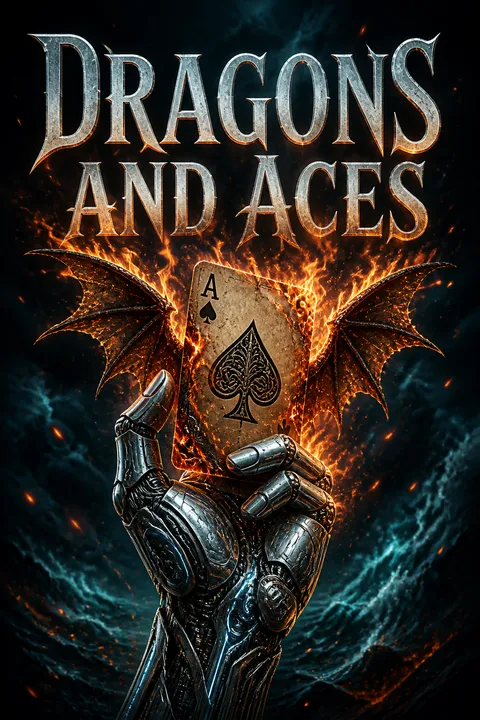


Plot Summary
Prologue
A Maethalian ballad mourns a dragon rider and an enemy pilot lost together at sea. A newspaper report then announces that the famed Silver Wraith has vanished after a fog-bound battle near Rograd Point, along with Paemalla, Maethalia’s most feared dragon rider.
The Admar Air Force publicly promises a rescue, while privately preparing for the possibility that its celebrated ace is dead. His identity remains secret, and the report leaves one question hanging over the story: what happened in the mist?
The opening turns a military disappearance into a contested story before the reader knows the people involved. The ballad makes the deaths sound fated and almost romantic, while the newspaper reduces the same event to uncertain facts, official reassurance, and public morale. That contrast establishes one of the novel’s central pressures: governments narrate war to preserve their authority, but private loyalties keep breaking through the official account. The unknown pilot’s identity also creates dramatic irony. The reader enters a world where a person can be publicly dead, secretly useful, and emotionally changed before anyone else knows what happened.
A Prisoner on the Coast
After a fog-bound dogfight, Charlie’s silver biplane goes down in the sea. He survives the night clinging to its tail, reaches a rocky shore, and discovers he has the wrong emergency bag. It belongs to Kitty Rowley, the reporter he had just flown to the Admar base. Her papers offer him a chance to enter Maethalia as a journalist, so he heads inland rather than risk a desperate swim home.
Princess Essa, a one-armed dragon rider, finds him on a coastal path while searching for Paemalla, her feared elder sister, who was also lost in the battle. Essa disarms and binds the stranger, then brings him toward the palace, where his false identity might keep him alive.
The encounter gives both protagonists a practical reason to keep moving toward one another. Charlie chooses impersonation because his survival depends on access, while Essa treats capture as an opportunity to turn a hated enemy into a controlled guest. Their first physical contest establishes a pattern that continues through the romance: each tries to control the situation, and each discovers that the other is harder to manage than expected. The missing hand is introduced not as a symbol alone but as a visible fact shaping Essa’s tactics, her public identity, and the risks she is willing to take.
Paemalla Comes Home
Inside Charcain, the court displays Paemalla’s body beside her dead dragon, Horban. Charlie recognizes the woman he shot down and sees, for the first time, the grief his victories have caused beyond the cockpit. The Queen, Synaeda, receives him as Kitty Rowley, whose visit Hoatan, her foreign-affairs adviser, had approved.
Rather than punish the visitor, Synaeda assigns Essa to escort him. Paemalla’s death also triggers a contest for the rank of Irska, the leading dragon rider. Essa, now the Queen’s eldest surviving child, must challenge Laynine, her cousin and the second-ranked rider. Essa’s mentor, Aunt Dreya, privately urges her to flee, but Essa refuses to abandon her dragon or her duty.
The funeral collapses Charlie’s heroic self-image into the human cost of his work. His enemies are no longer distant silhouettes: Paemalla had a mother, a cousin, and a kingdom grieving her. For Essa, the same death is both a loss and an imposed succession. The challenge system makes private grief immediately political, leaving no time to mourn before she must risk her life. Dreya’s proposed escape is compassionate, but Essa hears it as confirmation that those who taught her duty no longer believe she can fulfill it. The conflict between protection and recognition begins here.
The Dragon’s Funeral
At Kayumal, the volcanic burial ground where dragons return to fire, Essa watches Horban’s body fall into the magma. A rider attacks Charlie during the funeral procession, accusing him of necromancy because Admar’s machines burn fuel taken from the dead. Essa knocks the attacker down and escorts Charlie back to his room, though she insists she acted from duty rather than concern.
Othura, her bonded dragon, points out that the old custom makes Essa responsible for a life she has saved until that person saves her in return. Essa accepts the Queen’s order to host Charlie and formally casts her rider’s token into the challenge basin. The ritual starts her contest for Irska, leaving no path back to an ordinary life.
The funeral offers Charlie an education that no intelligence briefing could provide: dragons and riders mourn as a community, and their grief is not a performance for outsiders. Essa’s rescue of him creates an ethical debt that cuts across wartime categories, even as she tries to dismiss it. The old custom gives that debt a concrete rule, turning an impulsive act into a continuing relationship. By placing her token in the basin, Essa also converts fear into action. She does not become confident; she chooses to proceed despite the evidence that everyone expects her to fail.
The Ace Studies Dragons
Alone in his room, Charlie searches Kitty’s bag for cigarettes and finds a hidden camera, a revolver, a lighter, and a note directing her to report through the Prelate. Before he can understand her mission, Essa takes him to the Cauldron, where he watches the first challenge trial. In the melee, Othura’s wind knocks other riders from their mounts, but Laynine’s allies corner Essa and drive her into the lake.
She survives, though several riders do not. Charlie sees that Essa’s small, agile dragon has strengths the larger mounts lack, while her missing hand leaves her unable to use a lance. He decides to train her to beat Laynine, partly because a weaker Irska might help Admar win the war.
Charlie’s dual purpose is not a simple matter of good intentions hiding beneath a disguise. He sees a person in danger and a strategic opening at the same time, and initially allows the military calculation to justify the rescue impulse. The first trial gives him evidence that Essa’s disability changes the mechanics of combat, not merely her confidence. Meanwhile, Kitty’s concealed equipment introduces a parallel intelligence plot that destabilizes Charlie’s assumptions about his fiancée. Both protagonists are already living inside stories that their governments, families, and partners have helped construct for them.
A Tour with Teeth
Essa takes Charlie through Issastar’s markets and waterfront, teaching him Maethalian customs while he questions the kingdom’s beliefs about machines, fuel, and the dead. They visit a lonely merman whose people were displaced by the war, and Charlie quietly gives him a coin.
Their differences become harder to reduce to propaganda, but when Charlie claims he can help her defeat Laynine, Essa hears mockery and sends him back to his guarded room.
Charlie escapes at night by climbing down the palace wall, crosses the coast on foot, and enters the sea cave where his plane lies. As the rising tide threatens to trap him, he removes an aluminum support from the wreck and carries it back to Issastar, determined to make a tool that will give Essa a fair chance.
The tour moves the relationship beyond attraction by letting each character encounter the other’s moral vocabulary. Essa’s faith treats machines as a violation of life, while Charlie’s world treats them as ordinary instruments. Their disagreement is sharpened by the merman, whose displacement exposes the cost of the war in a form neither can dismiss. Yet intimacy does not erase mistrust: Charlie’s offer sounds like another outsider claiming authority over Essa’s abilities. His dangerous return to the wreck is a concrete attempt to make help rather than merely promise it.
A Hand Made of Metal
Blacksmith Clua reshapes Charlie’s recovered aluminum into a light lance and helps build a spring clip that attaches Essa’s arm to a modified saddle. The device lets her hold on while freeing her good hand for a weapon, though its machine-made parts risk offending Maethalian law. At the thimble race, Essa survives a dangerous journey through the mountains, including an attack by a rider who uses dragon fire against tradition.
Braimar, her former lover, helps her escape another assault, then urges her to run away with him. Laynine reaches the finish first. When the Queen’s ceremonial bird refuses to take Essa’s thimble, Essa leaves without kneeling, making her resentment of her mother public and deepening the court’s scrutiny of her.
The clip and lance make disability a question of design rather than personal worth. Clua’s craft and Charlie’s technical knowledge combine to change the terms of the contest, while the risk of forbidden machinery shows that adaptation can challenge a culture’s rules as well as its obstacles. The race also complicates the apparent rivalry between Essa and Laynine: Braimar’s rescue and Laynine’s victory do not resolve the political tensions around them. Essa’s refusal to kneel is a small public gesture with large consequences. She asserts dignity, but also makes private hurt legible as political defiance.
Training in the Sky
After Charlie’s gift is fitted, Essa lets him ride behind her on Othura. He teaches her to aim a lance through a loop, stall a pursuer with a cobra maneuver, and turn sharply for an attack. His methods help her work with Othura’s agility instead of imitating larger dragons.
At the hatchery, he sees the infected eggs that Maethalians destroy and secretly takes one, believing it could be studied. He also learns that the eggs at Rograd Point are the kingdom’s last reliable source of dragons.
During a later battle, Laynine keeps Essa in reserve, but Admar planes strike near the hatchery. Othura is wounded, and Charlie rides with Essa as she escapes Braimar’s badly injured, raging dragon. The danger brings them physically closer, though Charlie keeps his real identity hidden.
Training creates a new form of intimacy: Charlie gives Essa skills without asking her to become someone else, and Essa tests his advice against her own knowledge of Othura. Their shared flight makes trust bodily before it becomes verbal. At the same time, Charlie’s theft of the egg reveals that his spy’s habits remain active even as his loyalties shift. He can admire Maethalia’s dragons and still treat one as intelligence to be carried home. The story’s central contradiction is therefore sustained rather than solved: affection changes his motives, but does not immediately undo the harm his earlier choices may cause.
The Egg Hatches
Charlie’s stolen egg cracks in his room, and a red-gold dragon hatchling emerges. He nearly shoots it, then feels its hunger and cold as if they were his own and realizes the creature has bonded with him. He names it Parthar and hides it from the court, feeding it secretly while it grows.
Meanwhile, Essa and Charlie draw closer through training, and she tells him how a skeletal dragon attacked her and her mother when she was five, costing her an arm and leaving her mother’s dragon in a healing sleep. At the Skrathan ball, Essa and Charlie dance, share their feelings, and kiss in a hidden room. A battle horn interrupts them, and they rush toward the attack.
Parthar turns Charlie’s espionage into an intimate, involuntary responsibility. The bond is not an abstract conversion from enemy to ally; hunger, discomfort, and danger now cross the boundary between species and national identity. Essa’s account of her childhood injury gives her public impairment a private history of terror and loss, and Charlie responds by seeing her as whole rather than as a damaged candidate. Their kiss follows that recognition, but the horn interrupts before intimacy can become refuge. Private attachment remains exposed to the larger machinery of war.
The Ball Turns Bloody
As Admar planes attack the hatchery, Braimar and two companions seize Essa in an alley and try to make her unfit for the crown. Charlie intervenes with Kitty’s revolver, freeing her and accepting Braimar’s mortal challenge to a sword duel.
The attack leaves the court searching for a spy, while Charlie’s secret dealings with the Prelate grow more dangerous. The next day, Essa visits the Oracle with Ollie. Her vision shows Kitty Rowley in Admar with Edward Langford, a Secret Intelligence Bureau operative, and reveals crates hidden beneath Issastar that are being overseen by Prelate Kortoi.
Essa sends Rohree to investigate. The sprite discovers skeletal, clay-covered dragon creatures inside the crates, but Hoatan and Kortoi catch her before she can report back.
The ballroom’s interruption turns romantic secrecy into immediate political danger. Braimar’s assault exposes how the succession rules can be weaponized against Essa’s body, while Charlie’s choice to intervene makes his role harder to conceal. The Oracle’s vision then redraws the conflict: the supposed reporter is not the only person moving between nations under a false or incomplete identity. The crates and their contents shift the stakes from battlefield rivalry to a threat against the political order itself. Rohree’s capture makes information costly, and Ollie’s absence leaves the reader unsure which loyalties are secure.
The Wraith Unmasked
Before the duel, Charlie gives the court a clumsy report about Maethalia, then reads a poem about Essa that reveals how deeply he has changed. Essa steps forward as his second. Braimar fights with greater skill and strength, but Charlie uses basic training and improvisation to wound him. When Braimar gains the advantage, Charlie channels heat through Parthar’s bond and burns his face.
Braimar’s dragon attacks, and Parthar dives from Charlie’s window to strike the beast, ending the duel. The court discovers the hatchling and learns Charlie stole its egg. The Queen sentences him to death for bonding with a dragon, while Essa asks that he be exiled instead. Her plea fails, and she leaves knowing Charlie may die before she can see him again.
The duel forces Charlie’s competing identities into the open through action rather than confession. His military training gives him a chance, but the decisive power comes from Parthar, a bond neither nation’s laws anticipated. That intervention saves Charlie while transforming him into a political impossibility: an Admar airman connected to a Maethalian dragon. Essa’s public defense of him shows that affection has become a choice with consequences, not just a private feeling. The Queen’s sentence restores state authority, but also reveals how quickly the court’s commitment to hospitality ends when its categories fail.
Essa Wins the Crown
Before the final challenge, the nobles object to Essa’s metal saddle clip, so she removes it rather than let the dispute stop the contest. She and Laynine joust, grapple in the air, and unleash their dragons’ powers. Othura’s injured wing and Essa’s missing hand leave them at a disadvantage, but Essa uses the maneuvers Charlie taught her and survives a fall by steering Othura’s wind through her dragon stone.
In the final clash, Laynine’s dragon strikes Othura with lightning. Essa attacks Laynine among burning debris; the two fall, and Laynine is fatally impaled on a broken beam. The Queen names Essa Irska. Essa uses her ceremonial wish to ask that Charlie be spared, but the Queen refuses and orders his execution at dawn.
The contest tests more than physical skill. Essa has to decide whether the aid that made her more capable is worth the political cost, and she removes the clip when the nobles use it to challenge her legitimacy. Her victory comes through integrating her own judgment with techniques learned from Charlie, not by erasing her limitations. Laynine’s death makes the title inseparable from grief, while the Queen’s refusal to spare Charlie shows the limits of Essa’s newly acquired authority. She has won leadership, but has not yet gained control over the laws she must now enforce.
The Prisoner Takes Flight
After her investiture, Essa assembles her friends to rescue Parthar, while Ollie urges her to stay away from the palace for several days. She ignores the warning and breaks Charlie out of his tower with Othura.
They flee into a violent storm and land on Rograd Point, where they take shelter in an old dragon den. The next morning, Admar troops arrive amid a bombing operation. Colonel Bloom recognizes Charlie as the Silver Wraith and explains that Charlie’s reports helped the Air Force target dragon strongholds.
Charlie admits the betrayal when Essa asks if it is true. She strikes him and flies back to Maethalia, while Charlie is returned to Admar. He learns that a full attack on Issastar is imminent and steals a plane to return to the battle.
The escape gives the lovers a brief reprieve, but their refuge cannot survive the material facts of war. Charlie’s identity is not the only betrayal: his information has already been converted into military action, and Essa’s trust has helped make that possible. His confession matters because he stops defending himself with a partial truth, though honesty cannot reverse the damage. Essa’s blow and flight are acts of self-protection, not proof that her feelings have vanished. Charlie’s decision to return to battle marks a further change: he now risks his life against the institution that once gave him purpose.
The City Breaks Open
Back in Issastar, Essa warns the Queen that the Gray Brotherhood has taken dragon eggs and worked with golenae, creatures animated by spirits of the void. When Admar launches a full assault, golenae erupt from beneath the city and the Lacunae attack the Skrathan.
Essa frees the trapped dragons by directing Lure’s fire and Pocha’s ice against a dam, sending water over the hatchery’s magical flames. The Queen joins the air battle on her awakened dragon, Autan.
Charlie arrives and initially fights the forces attacking Maethalia, but he follows the Silver Wraith and other planes toward Autan. In the fighting, Charlie’s gunfire fatally wounds the Queen. He later crashes while dueling Carter Blaize, leaving Essa on the battlefield with her dead mother and the city collapsing around her.
The attack makes the novel’s opposing forms of violence collide without allowing either side to remain morally clean. The Brotherhood’s supernatural army violates Maethalia’s own taboo against animating the dead, while Admar’s machines turn Charlie’s intelligence into bombing coordinates. Essa’s dam strategy shows her acting as Irska through coordination rather than brute force, but the breakthrough cannot prevent catastrophe. Charlie’s return is ethically serious yet tragically compromised: he intends to help, but still participates in the aerial assault that kills the Queen. Love does not absolve consequences, and the climax refuses to make good intentions sufficient.
Two Survivors, Separate Paths
After the Queen dies, water threatens to pull Essa and Othura under, and the palace and city are left in ruins. Charlie survives his crash and walks through the wreckage, calling for Essa. She survives too, but returns to the Isle of Dorhane carrying grief, fury, and the new burden of the crown.
Convinced that Charlie’s plane came down nearby, she searches the trenches and battlefield with her sword in hand, intending to kill the man she loved. Charlie searches the same devastation for her, hoping to apologize and find her alive. The novel ends before they meet again. Their relationship remains unresolved, while the attack, the Brotherhood’s conspiracy, and the fate of the missing Rohree remain open.
The ending denies the lovers the reunion that a conventional romance might use to convert sacrifice into reward. Instead, they inhabit the same ruined landscape with incompatible accounts of what the other has done. Essa’s new authority is bound to bereavement and anger; Charlie’s survival offers no absolution for his role in the attack. Their parallel searches preserve the bond while making trust its unanswered test. The larger conflict also remains unfinished: the invasion has devastated Maethalia, but neither the political conspiracy nor the war has reached a settled conclusion.
Analysis
Dragons and Aces builds its romance inside the machinery of war, then refuses to let affection erase what that machinery has done. Charlie’s first instinct is to turn Maethalia into an intelligence map: its hatchery, defenses, and dragon tactics become potential targets. Essa initially sees him through her kingdom’s account of Admar as a necromantic enemy. Their relationship changes because each encounters evidence that does not fit the inherited story. Charlie witnesses dragon mourning and later becomes responsible for Parthar. Essa sees his courage and technical intelligence, but also the damage his reports enable. Their emotional movement is therefore not a clean conversion from hatred to love. It is a struggle to hold care and culpability in the same mind.
The novel makes disability concrete through the repeated mechanics of riding. Essa’s missing arm alters her grip, weapon use, and exposure in the air. The light lance and saddle clip do not cure her or make her injury irrelevant; they change the conditions under which she can act. Their creation also puts her in conflict with religious rules against machines. The story’s tension lies in the difference between a tool that expands agency and a system that claims to define what kinds of tools, bodies, and people are legitimate.
Political authority is equally unstable. The Queen, nobles, Torouman, and Gray Brotherhood all claim to protect Maethalia, yet their competing strategies weaken the state from within. The golenae make the conflict literal: an army built from the dead violates the very moral boundary Maethalia uses to condemn Admar. Meanwhile, Admar’s military leaders turn Charlie’s observations into an assault he cannot control. Neither side retains a simple moral advantage.
The ending’s unresolved separation is therefore structural, not merely romantic suspense. Essa has gained the title she once feared she could not earn, but lost her mother and the security of home. Charlie survives, but cannot separate his love for her from the information he supplied. They search the same devastated front as enemies in each other’s eyes, leaving the sequel’s central question sharpened: can recognition survive responsibility for irreversible harm?
Characters
Essaphine Torholt
The one-armed princessEssa is the Queen’s daughter, a dragon rider, and a lifelong target of pity, underestimation, and political scrutiny. She values courage and duty, but her fierce humor often shields a deep fear that she is not enough for the role expected of her. Her missing forearm shapes how she rides and fights, yet she resists being reduced to it. The bond with Othura gives her both companionship and a source of confidence, while her friends offer a rare space where she can be vulnerable. Essa’s growth centers on claiming her own capacity without pretending that injury, grief, or fear have disappeared.
Charlie Inman
The stranded Admar pilotCharlie is a decorated fighter pilot whose confidence and appetite for danger have been sharpened by years of war. He often measures himself by usefulness, daring, and the recognition attached to his reputation, which makes his unplanned life in Maethalia destabilizing. His impersonation of Kitty gives him access to the enemy court, but his instincts as a spy remain active even as he forms attachments there. He is observant, funny, and capable of tenderness, although he initially hides behind tactical reasoning whenever emotion threatens his self-image. His connection with Essa and the unexpected responsibilities of dragon care challenge his belief that survival and victory are the same thing.
Othura
Essa’s wind dragonOthura is Essa’s bonded libran, a dragon whose power is wind rather than fire. She is perceptive, teasing, and fiercely protective, able to sense the emotional currents Essa tries to conceal. Their relationship is more intimate than ordinary companionship: they share impulses, fears, and tactical awareness. Othura encourages Essa without treating her as fragile, though she can challenge Essa when doubt threatens both their safety. Her agility makes her a natural counter to larger dragons, and her presence gives Essa a partner whose faith is expressed through action as much as affection.
Queen Synaeda
The grieving monarchSynaeda rules Maethalia while carrying the pressures of war, succession, and a court where rival factions watch every choice. She is a powerful sorceress and a controlled public figure, often appearing colder than she feels. Her grief over Paemalla complicates her relationship with Essa, whose abilities she judges through the demands of the throne as well as a mother’s fear. Synaeda tends to express care through caution and command, which leaves her daughter longing for recognition that is rarely offered plainly. Her authority is real, but the story shows how much it depends on alliances she cannot fully control.
Ollyvar, called Ollie
Essa’s sworn protectorOllie is Essa’s Torouman, a warrior-sorcerer assigned to advise and protect her from childhood. His easy humor makes him approachable, but he is also observant, disciplined, and trained to think several moves ahead. He often acts as a stabilizing counterweight to Essa’s impulsiveness, even when he knows she will ignore his advice. His loyalty is personal as well as institutional: he loves Essa as family and understands the cost of the choices she faces. Through his strategic habits and his lessons in Torzame, he offers a view of Maethalian politics that is more complex than a simple contest between good and evil.
Paemalla
The fallen elder sisterPaemalla is Essa’s older sister and Maethalia’s former leading dragon rider, renowned for her skill and feared by Admar pilots. She was harsh toward Essa, treating cruelty as a way to toughen her, but she was also a formidable protector whose presence shaped the family’s hierarchy. Her death changes the succession and forces Essa into a contest she believes she cannot win. Paemalla’s absence continues to influence both nations: to Maethalia she is a lost hero, while Charlie first encounters her as an enemy he has killed.
Laynine
The favored rival riderLaynine is Essa’s cousin, Paemalla’s close friend, and the rider next in line for leadership. She is composed, skilled, and accustomed to the Queen’s mentorship, qualities that make her both an intimidating rival and a reminder of what Essa believes she lacks. Laynine can show concern even while participating in a deadly contest, and her calmness contrasts with Essa’s more visible anger. Her position is shaped by family ties as much as ability, placing personal affection and political succession in constant tension.
Braimar
The ambitious former loverBraimar is a high-ranking dragon rider, Essa’s former lover, and the nephew of Prelate Kortoi. Handsome and physically formidable, he is accustomed to being admired and obeyed. His history with Essa gives his attention an intimacy that she increasingly distrusts, because he often treats her choices as matters he can manage for her. His ambition is entangled with family politics and the Gray Brotherhood, while his pride makes him dangerous when he feels rejected or challenged.
Clua
The resourceful dwarf smithClua is Essa’s dwarf friend and a blacksmith’s apprentice with strong arms, blunt humor, and a practical intelligence. She has trained as a fighter despite being steered toward craft work, and she values being useful without being treated as delicate. Her loyalty to Essa is affectionate but unsentimental. When a problem requires a tool rather than a speech, Clua is often the person who can make a workable answer from whatever materials are available.
Rohree
The sharp-eyed spriteRohree is Essa’s sprite attendant, a refugee from the south who has served the princess since childhood. Her mischievous manner and quick tongue conceal experience, courage, and a strong sense of obligation. She can become nearly invisible, making her useful for delicate errands, but she is not merely a servant who follows orders. Rohree understands what it means to be displaced and different, which helps her recognize the loneliness beneath Essa’s bravado and the vulnerability of outsiders far from home.
Hoatan
The Queen’s Torouman adviserHoatan is the Queen’s bonded Torouman, a senior adviser whose authority rests on long experience, magical knowledge, and political calculation. He presents himself as a careful guardian of the crown, often tempering emotional impulses with strategic concerns. His guidance reflects the Torouman practice of seeking indirect solutions rather than forcing a single obvious path. Because he operates within competing institutions, his choices are difficult to separate from the larger balance of power in Maethalia.
Prelate Kortoi
The void’s high priestKortoi leads the Gray Brotherhood and its formidable Lacunae warriors. Elegant, unnervingly composed, and fond of cryptic claims, he offers hospitality with the same ease that he probes for weakness. His faith is oriented toward the void and its powers, a stark contrast to the life-centered traditions of the dragon riders. Kortoi understands that political influence depends on controlling resources, information, and fear. His relationship with the crown is publicly useful but never entirely comfortable.
Aunt Dreya
Essa’s demanding mentorDreya is Essa’s aunt and durram, the mentor responsible for teaching her to read, fight, ride, and meet the obligations of a princess. She has shown Essa love by refusing to coddle or pity her. As Laynine’s mother, however, Dreya is caught between two girls she helped shape and the deadly custom that forces them into competition. Her advice comes from care, but Essa does not always hear the fear beneath it.
Kitty Rowley
Charlie’s journalist fiancéeKitty is a reporter for the Ironberg Times and Charlie’s fiancée. Ambitious, stylish, and determined to rise beyond the dance halls where she began, she understands that public image can be turned into influence. She is comfortable navigating powerful men and institutions, but her private life is entangled with the wartime machinery around her. Her papers, travel plans, and professional identity become crucial to Charlie’s attempt to survive behind enemy lines.
Edward Langford
The SIB operativeLangford works for Admar’s Secret Intelligence Bureau and maintains a close, unsettling relationship with Kitty. He is controlled, predatory in manner, and accustomed to treating people as instruments in a larger operation. His ability to make threats sound like polite observations reflects the SIB’s shadow world, where private intimacy and state business overlap. He represents the institutional force that continues to shape Charlie’s life even while Charlie is stranded abroad.
Dagar
The irreverent riderDagar is one of Essa’s fellow riders and friends, a lanky, awkward joker who lightens tense gatherings with teasing. Beneath the humor, he is loyal and willing to acknowledge courage even in an enemy. His warmth helps make Essa’s circle feel like a community rather than a collection of competitors.
Pocha
The fierce rider friendPocha is a compact, strong-willed rider with an affectionate manner and a talent for rallying her friends. She brings practical support, humor, and steadiness to Essa’s circle. Her loyalty is active: she is willing to take risks when Essa needs help, rather than limiting friendship to comfort or encouragement.
Lure
The guarded commoner riderLure is a skilled rider from outside the nobility, proud of earning a place among the Skrathan through talent. Their blunt warnings and guarded manner reflect the risks of being an outsider in a hierarchical society. They are skeptical of Admar and its machines, yet their friendship with Essa and openness to difficult questions make them more nuanced than simple hostility.
The Oracle
The mountain seerThe Oracle lives at a remote temple in the Yrdam Mountains and uses a dark basin to see events beyond ordinary reach. She is unexpectedly conversational and admits that her visions require interpretation, even when the images themselves are true. Her role complicates certainty: knowledge can reveal a threat without explaining how to respond to it, and visions may show events that depend on choices still to come.
General Peckham
The Air Force commanderPeckham commands Admar’s Air Force and values morale, operational advantage, and the public usefulness of heroes. He is forceful and paternal toward Charlie, but his concern for an individual never fully overrides military priorities. His decisions show how institutions can praise a pilot while treating his identity and actions as replaceable assets.
Carter Blaize
The replacement Silver WraithBlaize is a skilled, self-assured pilot assigned to take over the Silver Wraith’s public identity after Charlie disappears. He enjoys the status attached to the ace’s name and is eager to prove himself in combat. His rivalry with Charlie turns the stolen identity into more than a matter of publicity, placing both men in direct competition over reputation and authority.
Lord Natath
The ambitious nobleNatath speaks for the noble council and sees the succession crisis as an opening to expand aristocratic power. He invokes law and tradition when they can constrain the Queen, presenting ambition as constitutional duty. His presence reveals that the crown’s conflict is not limited to the war across the sea.
Plot Devices
The Dragon Bond
Shared minds, shared stakesA rider and dragon communicate through a bond that conveys impulses and feelings with unusual precision. Essa and Othura use it to coordinate in flight, sense danger, and recognize emotions each would otherwise conceal. The bond also becomes a bridge between Charlie and Parthar after the hatchling emerges, giving Charlie a responsibility that crosses the enemy boundary. Because dragon communication can carry emotion as well as information, it makes intimacy difficult to fake and separation unusually painful.
The Irska Challenge
Succession by survivalWhen the leading dragon rider dies, the Queen’s heir must enter a series of dangerous trials against the next-ranked rider. The contest tests speed, combat, and the rider’s ability to command a dragon, ending in a lethal final confrontation. Its rules make succession a public spectacle, while Essa’s rank, missing arm, and family ties give every trial political meaning. The challenge provides the plot’s rising-action spine and forces Essa to turn preparation into visible leadership.
The Saddle Clip and Lance
Craft turns access into agencyCharlie recovers aluminum from his wrecked plane, then works with Clua to make a lighter lance and a spring clip that secures Essa to her saddle. The device helps compensate for the hand she lost, allowing her to hold a weapon without sacrificing her grip. Its machine-made materials challenge Maethalian religious law, so the aid creates political risk as well as practical opportunity. The equipment also embodies the unlikely collaboration between Charlie’s technical knowledge and Clua’s craft.
The Scrying Basin
Truth arrives in fragmentsThe Queen and the Oracle use dark water to see distant events, but a vision does not automatically explain its meaning. Essa’s visit to the Oracle reveals Kitty in Admar and crates hidden beneath Issastar, while leaving their purpose to be discovered through investigation. The basin can expose what characters have hidden, but it cannot remove ambiguity or make action safe. Its visions propel the conspiracy plot and underline the danger of mistaking partial knowledge for a complete answer.
Kitty’s Disguise and Papers
A borrowed identity buys entryAfter Charlie’s plane crashes, he finds Kitty’s travel papers in the emergency bag and adopts her reporter identity to enter Maethalia under official hospitality. Her hidden equipment and the instruction to report through the Prelate reveal that her work extends beyond ordinary journalism. The disguise gives Charlie access to the palace, the dragon grounds, and the people he later comes to care about. It also keeps his real military role concealed until its consequences are already in motion.
Download PDF
Download EPUB
.epub digital book format is ideal for reading ebooks on phones, tablets, and e-readers.








