

Key Takeaways
Build your future through the choices still available to you
Agency begins inside constraint. Owen opens with a car crash that crushes the hand he uses to draw. Years earlier, as a seriously ill child in hospital, he had faced a different kind of fear: doctors could not explain his condition, and he watched other young patients die. His grandfather told him he still had a choice about how to face his life, and that someone believed in him. Owen chose to pursue the work he loved, even though neither his health nor his future was guaranteed.
The argument is not that people control every event. It is that choices remain in how they respond, what they attempt, and what they do next. Owen’s life is shaped by many such decisions, some made with very little certainty.
The distinction between controlling events and choosing a response is crucial. It echoes the psychological idea of perceived agency: believing one can take meaningful action often helps people persist through difficulty. But agency is not a cure for illness, poverty, or bad luck, and Owen’s survival should not be read as proof that willpower determines medical outcomes. The strongest version of his message is therefore not “you can overcome anything,” but “your circumstances do not erase every choice.” That framing preserves hope without turning hardship into evidence of personal failure.
Start before you feel ready; later work can give early efforts new value
Early work can matter twice. At six, Owen wrote and illustrated a version of Goldilocks and the Three Bears, added Santa Claus, and sold copies from a wagon for fifteen cents. Decades later, a surviving copy appeared at auction. It sold for $72.50, not because the childhood booklet was suddenly a masterpiece, but because collectors valued the career that grew from it.
Owen sees choices as cumulative: early attempts provide practice, evidence, and material for the next attempt. He began working professionally as a teenager, and his later career changed how people saw the work he had made as a child. The lesson is not that every early project becomes valuable. It is that waiting for a perfect beginning can deprive later work of its raw material.
This is a vivid account of how reputations reshape the meaning of earlier work. In creative careers, a first attempt can function less like a finished product and more like a record of commitment, a source of skills, or a starting point for relationships. The auction story also complicates the idea that value lives entirely inside an object: its meaning depends partly on who made it and what followed. Still, retrospective value is not guaranteed. The practical payoff is to begin making things, not to assume that history will reward every beginning.
Let the work's quality outrank your age, title, or permission
Credibility can be made. As a young artist, Owen repeatedly sent portfolios to comic publishers and received rejections, often because he was considered too young. The independent comic ElfQuest, created by a husband-and-wife team after established publishers turned it down, showed him another route: publish the work yourself and find an audience directly.
Owen and a friend tried a comic shop, then a mail-order business, and finally raised money to exhibit at San Diego Comic-Con. At sixteen, Owen became the youngest professional publisher to exhibit there. Their first comic was imperfect, but customers bought it. The experience taught him that buyers were judging what was on the table, not the creators’ ages. His conclusion: ambition matters, but sustained effort must produce work people value.
The story makes a useful distinction between credentials and evidence. A portfolio, a published comic, or a paying customer can demonstrate ability more concretely than a claim about potential. This resembles portfolio-based hiring, where the work itself serves as proof. Yet quality does not erase structural barriers: access to money, time, mentorship, and distribution still shapes who gets a chance to be seen. Owen’s example is best understood as permission to build an alternative route when gatekeepers say no, not as proof that persistence alone makes opportunity equal.
Treat a closed door as information, not a verdict
A setback can expose a mismatch. Owen moved to Dublin expecting a storyboard job at the Sullivan Bluth animation studio. He and his new wife sold nearly everything they owned to fund the move. After arriving, he learned that the studio had lost financing and was not hiring. The job he had imagined as his destiny was never truly available.
With one Irish pound left, Owen sat in a park and reconsidered what he wanted. He called his wife and said he would return to Arizona and start a publishing company. Friends helped him with food and lodging, and a return ticket already existed because the round-trip fare had been cheaper. The failed move did not make the loss painless, but it clarified that the real goal was creative work, not that particular studio or city.
The episode illustrates a valuable form of adaptation: when a plan fails, separate the underlying aim from the route chosen to reach it. That is close to the distinction between a goal and a strategy in decision science. The failed job revealed bad information about the route, not necessarily the value of the destination. At the same time, it would be misleading to call every catastrophe a hidden gift. Some losses remain losses. Reframing is most useful when it helps someone make a sound next decision, rather than requiring them to pretend the setback was secretly good.
Persist by changing the method, not simply repeating the effort
Commitment can adapt. After the crash, doctors estimated Owen might regain only 30 to 40 percent of his right hand’s use. He refused to abandon comics, but he did not simply insist on working as before. For eight months, he practiced specific hand movements in therapy. He also used his left hand to sketch layouts and rented computer time to typeset a new issue.
When money and time grew tight, he invited other artists to contribute illustrations to StarChild Number Zero, a benefit comic. The book sold tens of thousands of copies, and the next issue sold 17,000. Owen eventually created 20 more issues and sold nearly a quarter of a million comics. The achievement came from persistence paired with new tools, collaborators, and a revised plan.
The story is powerful because resilience here is not mere stubbornness. Owen keeps the aim while changing the means, a pattern also found in rehabilitation and problem-solving: preserve the function that matters, then experiment with routes toward it. That is more useful than treating an original plan as sacred. There is a boundary, however. Persistence should respond to evidence, including pain, risk, and changing priorities. The book’s example supports determined adaptation, not the idea that every ambition deserves unlimited sacrifice.
Make the next line carefully; a life is built in small decisions
Drawing becomes a model for choice. During rehabilitation, Owen realized that drawing is not only a matter of hand control. It also involves deciding what marks to make and where to place them. He could still sketch with his left hand while his right hand healed, because the intention and judgment behind a drawing were not limited to one injured limb.
He connects that process to life. A drawing accumulates marks; a life accumulates decisions and actions. Neither is made all at once. When a line feels uncertain, pause, reconsider, and choose deliberately. This does not mean every decision can be predicted or corrected. It means that the next decision remains an opportunity to shape what comes after, even when earlier choices or circumstances cannot be undone.
The drawing analogy turns a large, abstract question about destiny into a sequence of manageable decisions. It also resembles iterative design: create a version, assess it, and make the next choice with what is now visible. That can reduce paralysis because a person need not solve an entire life before acting. The metaphor has limits, since life offers less control and fewer clean revisions than a sheet of paper. Still, its emphasis on attention is valuable: deliberate choices are not guaranteed to succeed, but they make learning from the result more possible.
Check whether your activity is carrying you toward your actual destination
Motion can disguise drift. After StarChild gained readers, Owen tried several creative ventures, including magazines and animation work. Some projects were beautiful and well reviewed, but his magazine publishing lost substantial money. He describes periods when his days were full of activity yet did not bring him closer to the work he most wanted to do. Pedaling an exercise bike creates motion, but it does not take the rider to another place.
The check is simple: compare a project’s visible busyness with its real contribution to the goal. Owen had once moved away from comics while trying to build skills and earn a living. The lesson was not to reject practical work, but to notice when it had become a substitute for the work those skills were meant to serve.
This is a sharp warning against confusing effort with direction. In organizations, activity metrics can look impressive while outcomes stagnate; the same is true of an individual calendar. A useful review asks what a project produces, what it costs, and whether it builds a capability or audience relevant to the larger aim. Yet not all indirect work is waste. A job that pays bills or develops a skill may be essential even when it is not the destination. The point is to make that trade consciously rather than mistake busyness for progress.
Protect the lasting aim from the emergency's loudest demand
Immediate relief has a price. While deeply in debt, Owen spent weeks in Los Angeles trying to sell projects. He had little money for food or gas when a publisher offered an advance for Here, There Be Dragons. The offer was for a paperback. Owen believed the novel needed a hardcover release, so he refused the deal, even though the money could have paid urgent bills.
A friend then gave him a check for the amount he had turned down, trusting his judgment. Owen returned to Los Angeles, eventually received a hardcover offer from Simon & Schuster, and the book was optioned by Warner Brothers after publication. The story is not a promise that patience pays off. It shows that a choice has meaning when someone recognizes its cost and accepts responsibility for the risk.
The decision resembles an important distinction in behavioral economics: immediate rewards can crowd out larger, delayed goals, even when the longer-term goal matters more. Owen’s refusal is memorable because he was hungry, not because the choice was easy. But the story also contains unusual support: a friend replaced the money he rejected. Readers should not mistake that rescue for a standard outcome. The more transferable lesson is to identify what an offer gives up as well as what it provides, then decide whether the short-term relief is worth that trade.
Turn confidence into help others can join
Belief becomes useful through action. Owen recalls speaking at a school for homeless students. A girl asked whether he ever wondered what would have happened if he had accepted the paperback deal. When he admitted that he did, she said she now believed things might work out for her family. The moment made him realize that some people lack a trusted voice telling them they matter and can imagine another future.
He connects this to the folk story of Stone Soup: a traveler starts a communal meal with a pot, water, and a stone, then invites villagers to add ingredients. His determination draws others into making the soup. Owen’s goal, distilled from years of reflection, is to be happy and help other people. Confidence matters most when it gives others a reason and a role to contribute.
The homeless student’s response shows how a story can function as borrowed possibility. Social support often matters not only because it supplies resources, but because it changes what a person considers thinkable. Stone Soup adds an important practical detail: participation grows when people can make a concrete contribution. Confidence without listening can become performance or pressure, especially when someone faces constraints the speaker has never known. The strongest encouragement does not promise that everything will work out. It communicates respect, shares usable experience, and leaves room for the other person’s reality.
Make the first lines before deciding the dragon is impossible
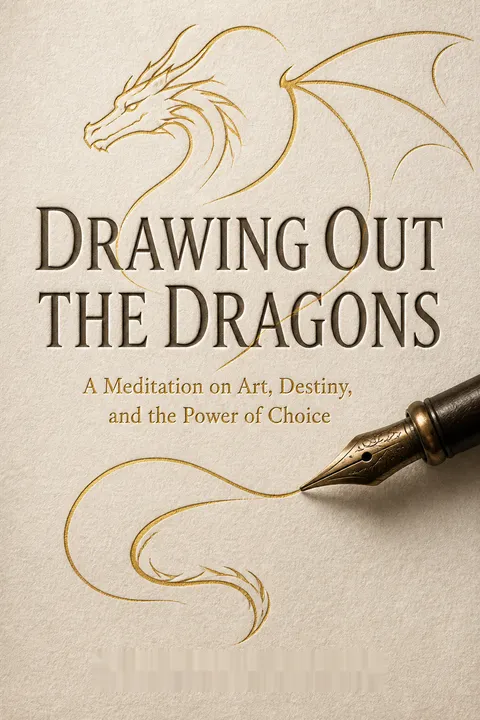
Fear changes when approached. Owen uses dragons as a metaphor for intimidating unknowns. A fear left hidden can grow in the imagination; approaching it can reveal what is actually there and what can be done. In his drawing demonstrations, he begins a dragon with a few simple strokes, then adds detail until the audience can recognize the creature. The picture becomes a lesson in starting before the whole result is visible.
The dragon is not only an enemy to defeat. In Owen’s stories, it can also represent a powerful guardian. Confronting fear may therefore change the relationship, not just remove the threat. The same logic applies to asking for help or making a first attempt: begin with a small action, learn from what appears, and keep going. Owen closes by urging readers to share their own hard-won stories with others.
The metaphor gives courage a practical shape: approach the feared subject in pieces, rather than waiting for certainty about the whole. This fits exposure-based approaches to fear, where gradual contact can reduce avoidance and clarify what is genuinely dangerous. But not every fear is irrational, and some risks call for distance, preparation, or support rather than direct confrontation. The image of a dragon as potential guardian adds a subtler possibility: a challenge can become a source of knowledge or strength without becoming harmless. The first step is investigation, not blind bravery.
Analysis
This memoir is built around a deceptively simple claim: a person may not choose what happens, but can still choose what to do next. Owen makes the idea persuasive by testing it against events that seem to erase choice: severe childhood illness, a damaged drawing hand, a failed move to Ireland, business losses, and a moment of near-poverty. Each episode forces a different response. Sometimes the response is commitment, sometimes adaptation, and sometimes recognizing that a presumed destination was only one route toward the real goal.
The recurring dragon and drawing images give the book its structure. A life, like an illustration, emerges through accumulated decisions whose full meaning is not visible at the start. This image explains why Owen values beginning early, doing quality work, and staying alert to drift. It also connects his personal history to his vocation: art is not merely the subject of the memoir, but its model for how agency works.
The book’s strongest contribution is its account of persistence as relational and practical. Owen’s progress depends on therapy, family, mentors, customers, collaborators, and friends who offer money or shelter. His story is therefore more than a celebration of individual will. It shows how conviction can make a person legible to potential helpers, while help makes continued effort possible.
The tension is that the language of destiny and choice can overstate how much control anyone has. Illness, financial security, and access to opportunity are not evenly distributed, and another person’s hardship cannot be solved by confidence alone. Read with that limitation in view, the message remains potent: hope is not proof of success, but it can preserve the capacity to act. The book asks readers to choose deliberately, adapt when reality changes, and use their own experience to help someone else see a next step.
Review Summary
Drawing Out the Dragons is highly praised as an inspirational book about overcoming obstacles and pursuing dreams. Readers find Owen's personal stories and advice empowering, particularly his emphasis on the power of choice and determination. Many highlight specific quotes that resonated with them, finding the book applicable to various creative pursuits and life challenges. While some view it as life-changing, others see it as a good reminder of simple truths. The book is especially recommended for young people and aspiring artists.
Glossary
Synchronicity
Meaningful signs along a pathOwen uses Synchronicity for signs or events that seem to confirm someone is moving in the right direction. In his account, these moments help a person recognize meaning in the course of a life. The term expresses his spiritual interpretation of coincidence, rather than a method for proving that events have a predetermined purpose.
Guidance
Others confirm a sign's meaningGuidance is Owen’s name for moments when other people appear to help confirm the significance of a sign or experience. He sees this as a way of finding a path toward purpose and using personal gifts in service of it. The term reflects his belief that direction can come through relationships as well as private reflection.
Secret of Drawing
Choose where marks belongThe Secret of Drawing is Owen’s concise account of making art: create marks, and decide where they go. He uses drawing to explain how a larger work develops through many individual choices. Applied to life, the idea encourages attention to the next decision, while recognizing that the full result cannot always be known in advance.
Drawing Out the Dragons
Approach fear to understand itOwen’s dragon metaphor treats fear as something that can grow while hidden and become more understandable when approached. In his work, dragons can be frightening, but can also represent guardians and sources of strength. Drawing them out means confronting uncertainty enough to learn what it contains, rather than treating every unknown as an enemy.
Proper pride
Confidence without belittling othersOwen distinguishes proper pride, satisfaction in work done well, from arrogance that compares oneself favorably by diminishing someone else. He also contrasts pride with false humility, which he describes as fear of expressing confidence. In his view, gratitude for one’s abilities can coexist with respect for other people’s work and accomplishments.
Download PDF
Download EPUB
.epub digital book format is ideal for reading ebooks on phones, tablets, and e-readers.








