

Key Takeaways
Use diagnosis as a map of distress, not a verdict on identity
A guide, not a label. This book turns the DSM-5 into a quick reference for clinicians and interested readers, but warns that its simplified descriptions are not complete diagnostic criteria. A diagnosis can help name distress and guide care; it cannot describe the whole person. Its central idea is to picture mental health as degrees of traits and symptoms rather than a clean division between healthy and ill.
Keep the map flexible. The authors compare rigid diagnosis to forcing people into a preset shape. Their eight-spectrum model is an educational aid, not an official DSM framework, and should not be imposed on patients. Formal diagnosis requires more than this summary, including attention to duration, impairment, context, and the complete criteria.
The map metaphor captures a basic problem in classification: categories are useful because they simplify, and dangerous when their simplification is mistaken for the person. Dimensional thinking can make room for mixed presentations and change over time, while reducing the stigma of an all-or-nothing label. But a spectrum is not automatically more accurate just because it sounds nuanced. It still requires defensible measures and clinical judgment. The book's own warning is especially important here: its memorable drawings and shorthand can aid recall, but they cannot replace careful assessment or the patient's account of what is happening.
Look for trouble at both extremes, not only in excess
Too little can matter. In the authors' model, each spectrum has two problematic ends: too much of a quality and too little. Anxiety illustrates the point. A person with almost no vigilance may miss danger, while someone constantly braced for catastrophe may be unable to live freely. The proposed healthy region is not a life without worry, energy, focus, or emotion, but a workable range in which those capacities remain responsive.
The middle is functional. The book applies this logic to sadness, spontaneity, imagination, attention, pleasure, and connection. Some sorrow can deepen reflection; overwhelming despair can immobilize. Creativity can enrich life; uncontrolled energy and risk taking can damage it. The aim is flexible functioning, not eliminating every trait that can become a symptom.
This both-ends framing resists the simplistic idea that less of every symptom is always better. In other areas of human functioning, too little and too much of the same capacity can both create costs: caution can prevent harm, yet excessive caution can shrink a life. The useful question is therefore not simply how much of a trait is present, but whether it supports adaptation in this person's circumstances. The limitation is that the book's elegant midpoint can sound like a universal ideal. Individual needs, cultures, and environments differ, so a person's best range may not look like a single fixed center.
Treat DSM-5 as a changing symptom language, not a theory of causes
Classification keeps shifting. The DSM is a symptom-based classification system, not a settled account of what causes mental illness. The book traces revisions from DSM-I, with 106 diagnoses, to DSM-IV, with 297, and DSM-5, which it describes as 992 pages. DSM-5 removed the old five-axis format and emphasized severity, development, and diagnostic refinements such as specifiers. The authors contrast this with research ambitions to classify disorders through biological mechanisms, which had not yet replaced symptom-based diagnosis.
Some changes alter the boundaries. DSM-5 grouped autism and Asperger's under Autism Spectrum Disorder, made OCD-related and trauma-related categories distinct, and replaced the dementia label with mild and major neurocognitive disorders. The book also explains that ICD-10 is a separate international coding system, not another name for the DSM. Its discussion of the US coding transition reflects the period around 2015.
The historical account makes an important distinction between a clinical vocabulary and an explanation of disease. Diagnostic manuals can standardize communication and billing without resolving whether two symptom patterns share a cause. That distinction helps readers understand why categories change, sometimes in ways that improve recognition and sometimes in ways that provoke disagreement. The DSM's evolution also shows that definitions have social consequences, not merely technical ones. A useful caution is that the book's compact history cannot represent every debate behind each revision. Its dated coding discussion should be read as a snapshot of the transition it anticipated, not current implementation guidance.
Track duration and consequences, not mood labels alone
Patterns clarify mood. DSM-5's mood changes highlighted persistence in depression and increased energy or activity in mania. Persistent Depressive Disorder brings together chronic depression and the former dysthymia category, emphasizing how long symptoms endure rather than treating severity as the only distinction. The book also notes that bereavement no longer automatically excludes a depression diagnosis, and that clinicians can record anxiety or manic features alongside depression.
Function matters. Gloria, a fictional composite, had long been sociable and creative. As sleep deteriorated, her spending, irritability, distractibility, drinking, and impulsive behavior grew, eventually damaging a valued work relationship. Treatment aimed to reduce the harmful extremes without erasing her creativity. The case shows why a change from someone's usual functioning, its duration, and its consequences matter more than a single description such as energetic or sad.
This emphasis on course and impact counters a common weakness of snapshots: a symptom observed once may mean something different from the same symptom embedded in a sustained pattern. The case also shows how treatment goals need not be framed as erasing personality. Preserving valued capacities while reducing harm is a more humane aim than equating improvement with conformity. At the same time, energy, sleep, spending, and irritability can shift for many reasons. A compact spectrum cannot establish a diagnosis on its own; history, context, and a full assessment are essential before interpreting a mood change.
Separate useful vigilance and imagination from disabling experiences
Signals can overshoot. The book treats anxiety as a protective alarm that becomes costly when it dominates attention and behavior. Too little caution can expose someone to danger; excessive vigilance can amplify perceived threats and encourage avoidance. Psychosis is more difficult to place on a normal-to-ill continuum. The authors discuss dreams, spiritual experiences, and sudden inspiration as experiences that may resemble unusual perceptions without necessarily constituting a disorder.
Assess the disruption. Their contrasting examples are an uninspired person unable to imagine a future and a person overwhelmed by voices and fixed beliefs that disrupt reality testing. The practical distinction is not whether an experience sounds unusual, but whether it is persistent, distressing, impairing, and disconnected from shared reality. The book's discussion is conceptual, not a diagnostic checklist.
The distinction between a mental event and its clinical significance is valuable. People can have vivid dreams, intense beliefs, or intrusive fears without those experiences amounting to a disorder; distress, persistence, impaired functioning, and reality testing help give the experience context. Yet the comparison between inspiration and psychosis needs careful handling. A continuum metaphor may encourage openness, but it can also understate the urgency of severe psychotic symptoms or make culturally meaningful experiences seem pathological. A sound assessment must consider the person's context and safety, not rely on whether an observer finds the experience familiar.
Notice whether attention wanders too easily or gets stuck
Focus has two failure modes. The authors place ADHD and obsessive-compulsive symptoms at opposite ends of an educational focus model. ADHD can involve difficulty sustaining attention, especially when a task loses interest. OCD can involve attention captured by intrusive thoughts and rituals. The book explicitly says DSM-5 does not classify these as one disorder; the shared scale is a mnemonic, not an official diagnostic relationship.
Pete's precision turned costly. A meticulous worker's cleaning and checking routines intensified until he washed his hands every 20 to 30 minutes, damaging his skin, and repeated prayers to prevent imagined harm. Treatment included medication and cognitive behavioral therapy. He later retained useful attention to quality at work without feeling compelled to correct every detail. The story distinguishes a strength from a pattern that consumes time and impairs life.
The contrast is memorable because it separates the ability to sustain attention from the ability to shift it. That distinction can help explain why both distractibility and mental rigidity interfere with ordinary tasks, even though the experiences differ. Pete's case also demonstrates that treatment need not destroy a useful trait to reduce its harmful expression. Still, combining ADHD and OCD on one line risks implying a shared mechanism or direct clinical opposition. The authors flag that risk, and readers should preserve the distinction: this is a teaching analogy, not a validated diagnostic scale.
Measure addictive behavior by craving, harm, and loss of control
Severity replaces a hard split. DSM-5 combined the former substance abuse and dependence diagnoses into Substance Use Disorder, then described severity according to the number of criteria met. The book lists craving, unsuccessful efforts to cut back, time devoted to use, social or work problems, risky use, tolerance, and withdrawal among the signs. Tolerance and withdrawal are not required for a diagnosis. Gambling Disorder was placed with substance-related and addictive disorders because of shared features.
Pleasure can become a trap. The authors' broader model runs from strict denial of pleasure to compulsive pursuit of it. They describe recovery through options including peer support, therapy, structured programs, and medication. But their spectrum is a metaphor about pleasure-seeking, not a rule that everyone should consume moderately. They specifically note that people vulnerable to addiction may need caution, and recovery may require abstinence.
The criteria-based approach focuses attention on what addiction does to a life, rather than assuming that one dramatic symptom defines it. It also explains why tolerance or withdrawal alone cannot tell the whole story. The broader contrast between rigid self-denial and uncontrolled pursuit offers a useful reflection on how people relate to reward, but it should not dilute the specific clinical risks of substance use disorders. Nor is moderation a universal endpoint: for some people, especially those in recovery, avoiding a substance is the safer and more sustainable choice.
Aim for connection with boundaries, not dependence or isolation
Connection needs room. The book describes healthy relationships as neither social disconnection nor enmeshment, where one person's identity and emotional life become overly bound to another's. Its central illustration is Amanda, a nurse whose caretaking gave her a sense of purpose. When her son left for college and her husband began managing his own recovery, she felt useless and anxious. Therapy and Al-Anon helped her address the pattern of organizing life around others' needs.
Do not confuse metaphor with diagnosis. The authors place this idea beside autism, whose DSM-5 category absorbed Asperger's and related diagnoses. They describe autistic people as having difficulties with social communication and restricted or repetitive behaviors, with support needs varying. However, codependency is not an autism diagnosis, and the two conditions are not clinical opposites. The connection scale is the authors' teaching device, not DSM terminology.
Amanda's story makes a subtle point: caring behavior can become a source of identity so complete that another person's growing independence feels like a personal crisis. The goal is not detachment, but a relationship in which care and autonomy can coexist. The authors' analogy, however, carries a real risk. Placing autism opposite codependency can imply that autistic people simply lack connection, while the book itself notes that social-cue difficulties do not equal a lack of feeling. Keeping the distinction explicit protects the useful lesson about boundaries from becoming a misleading account of autism.
Take responsibility without turning every problem into self-blame
Adaptation requires perspective. The personality model contrasts excessive self-blame with persistent blame of others. The authors associate personality disorders with rigid, recurring patterns that interfere with relationships and make it difficult to recognize one's own contribution to problems. At the opposite end, neurotic guilt can spread far beyond a specific action, leaving no clear way to repair the harm. Healthy responsibility, in their account, stays tied to what actually happened and allows correction.
The midpoint is flexible. A person can acknowledge a mistake, make amends, and still recognize when another person shares responsibility. DSM-5 retained the ten personality disorder diagnoses while removing the multiaxial system that had listed them separately. The book's self-blame versus other-blame scale is an interpretive model, not a substitute for the manual's criteria or an assessment of personality disorder.
This framework is useful because it treats accountability as a capacity for learning, not a contest over who deserves blame. Research across interpersonal and organizational settings often distinguishes responsibility that leads to repair from global shame that makes people withdraw or defend themselves. The book's model can help readers examine that distinction in everyday conflict. Its weakness is that a single axis compresses diverse personality patterns into blame style. Someone may externalize blame in one relationship and take too much responsibility in another, so the pattern must be understood over time and across contexts.
Analysis
The book's strongest contribution is not its pocket-sized DSM review but its attempt to make diagnosis feel less like sorting people into boxes. Its recurring question, how much of a trait is present and what does it do to a person's life, gives readers a humane entry point into an intimidating manual. The stories make the framework tangible: Gloria's creativity is not treated as a symptom to erase, and Pete's attention to detail is separated from rituals that damage his skin and consume his day.
That accessibility also creates the book's central methodological tension. The DSM's categories and criteria are formal diagnostic tools; the eight spectrums are the authors' own metaphors. Several pairings, especially ADHD with OCD and autism with codependency, are memorable but do not establish shared causes, clinical opposites, or measurable continua. The text sometimes acknowledges this, yet vivid cartoons may outlive their caveats. The most responsible reading preserves the heuristic while refusing to mistake it for diagnostic science.
The historical and coding sections add another useful layer: diagnostic systems are made, revised, and used for different purposes. A symptom classification can support communication and reimbursement while remaining incomplete as a theory of biology or personal meaning. That distinction matters when readers encounter changing labels or assume a new category represents a definitive scientific discovery.
Overall, this is best used as a memory aid and a prompt for more careful questions, not as a stand-alone guide to diagnosis. Its lasting lesson is to interpret symptoms through duration, impairment, context, and a person's functioning, while remembering that a classification can illuminate suffering without capturing identity.
Review Summary
DSM-5 Insanely Simplified receives mixed reviews, with an average rating of 4.02/5. Some readers appreciate its concise overview of DSM-5 changes and spectrum-based approach, finding it helpful for non-professionals and exam preparation. The illustrations and simplified explanations are praised by many. However, critics argue it oversimplifies complex mental health issues, potentially increasing stigma. Some note the authors' Jungian perspective and lack of recognized psychology PhDs. Readers are divided on whether the book's simplification is beneficial or detrimental to understanding mental health disorders.
People Also Read




Glossary
The 8 Primary Spectrums of Mental Illness
Eight educational dimensionsThe authors' organizing model for thinking about depression, mania, anxiety, psychosis, focus, substance use, social connection, and personality. Each dimension is presented as having problematic expressions at both low and high extremes, with a flexible middle range associated with healthier functioning. The model is an educational heuristic created by the authors, not an official DSM-5 framework or diagnostic instrument.
Specifier
A diagnostic qualifierA DSM-5 term used to add clinically relevant detail to a diagnosis, such as describing anxiety or mixed mood features. In the book's explanation, specifiers are not mutually exclusive: a diagnosis can have more than one. They refine the description of a presentation without replacing the main diagnosis.
Subtype
A distinct diagnostic formA DSM-5 label used to distinguish a particular form of a disorder. The book contrasts subtypes with specifiers by explaining that subtypes are mutually exclusive, while specifiers can be combined. A subtype helps identify which version of a diagnosis applies rather than adding a detail that may coexist with other qualifiers.
Transcendent function
A new response to oppositesA Jungian concept used in the book to describe a psychological process in which opposing positions are held in tension until a new possibility emerges. This result is presented as more than a simple compromise between the poles. The authors connect the idea to their aspiration that people develop flexibility across the dimensions in their spectrum model.
Coniunctio oppositorum
Conjunction of oppositesA Jungian phrase meaning the conjunction of opposites. The book uses it for the integration of contrasting qualities, such as caution and spontaneity, rather than the elimination of one side. In the authors' model, holding opposing tendencies in a workable relationship can support balance and, in Jungian terms, the emergence of a new psychological position.
ICD-10
International diagnostic coding systemThe World Health Organization's International Classification of Diseases, 10th Revision, used to classify health conditions across countries and medical specialties. The book distinguishes it from the DSM-5, which was developed by the American Psychiatric Association for mental disorder classification. ICD-10 codes support standardized reporting and administration; the book's discussion of US implementation refers to the period around 2015.
FAQ
1. What is "DSM-5 Insanely Simplified: Unlocking the Spectrums within DSM-5 and ICD-10" by Steven Buser about?
- Quick-reference DSM-5 guide: The book is a concise, user-friendly overview of the DSM-5 and ICD-10, designed to help clinicians and interested readers quickly grasp the major changes and concepts in psychiatric diagnosis.
- Spectrum-based approach: It introduces the idea that mental illnesses exist along spectrums rather than as binary categories, emphasizing gradations of severity and functioning.
- Visual and mnemonic aids: The authors use cartoons, mnemonics, and simplified language to make complex psychiatric concepts more memorable and accessible.
- Jungian influence: The book incorporates Jungian psychological concepts, particularly the idea of balancing opposites, to frame mental health and illness.
2. Why should I read "DSM-5 Insanely Simplified" by Steven Buser?
- Efficient learning tool: It’s ideal for busy clinicians, students, and laypersons who want a rapid yet comprehensive understanding of DSM-5 and ICD-10 changes.
- Simplifies complexity: The book distills dense psychiatric information into digestible summaries, mnemonics, and visual metaphors, making it easier to remember and apply.
- Spectrum perspective: It offers a modern, less stigmatizing view of mental illness by framing disorders as points along spectrums, which can be empowering for both clinicians and patients.
- Practical reference: The summary pages and quick-reference format make it a handy tool for clinical practice, exam prep, or general knowledge.
3. What are the key takeaways from "DSM-5 Insanely Simplified" by Steven Buser?
- Mental illness as spectrum: The book’s central message is that psychiatric disorders are best understood as existing along spectrums of severity and functioning, not as all-or-nothing categories.
- Eight primary spectrums: It introduces eight primary psychiatric spectrums (e.g., Depression, Mania, Anxiety, Psychosis) as a framework for understanding mental health.
- DSM-5 and ICD-10 changes: The book highlights major updates in DSM-5, such as the removal of the multi-axial system, new diagnostic categories, and the integration of ICD-10 codes.
- Jungian and holistic approach: It encourages clinicians to seek balance and integration, drawing on Jung’s concept of the conjunction of opposites for optimal mental health.
4. How does "DSM-5 Insanely Simplified" by Steven Buser explain the spectrum approach to mental illness?
- From binary to continuum: The book moves away from rigid, binary diagnoses and instead presents mental health conditions as points along a continuum or spectrum.
- Eight spectrums framework: Each of the eight primary spectrums (e.g., Depression: Shallowness vs. Despair; Mania: Boring vs. Bipolar) is illustrated with a range from too little to too much of a trait.
- Middle is optimal: The healthiest functioning is found in the middle of each spectrum, with problems arising at both extremes.
- Destigmatizing mental illness: This approach normalizes the idea that everyone falls somewhere on these spectrums, reducing shame and promoting understanding.
5. What are the Eight Primary Spectrums of Mental Illness in "DSM-5 Insanely Simplified" by Steven Buser?
- Depression Spectrum: Ranges from Shallowness (lack of introspection) to Despair (overwhelming sadness).
- Mania Spectrum: Spans from Boring (low energy/creativity) to Bipolar (excessive energy/impulsivity).
- Anxiety Spectrum: Moves from Carelessness (recklessness) to Anxiousness (over-vigilance).
- Psychosis Spectrum: Goes from Visionless (lack of imagination) to Psychotic (loss of reality).
- Focusing Spectrum: Covers Attention Deficit Disorder (inattention) to Obsessive Compulsive Disorders (over-focus).
- Substance Abuse Spectrum: Ranges from Ascetic (over-control) to Addicted (overindulgence).
- Autism Spectrum: Spans Codependent (over-connected) to Autistic (under-connected).
- Personality Spectrum: Moves from Neurotic (self-blame) to Obnoxious (blaming others).
6. How does "DSM-5 Insanely Simplified" by Steven Buser summarize the major changes in DSM-5 and ICD-10?
- Removal of multi-axial system: DSM-5 no longer uses the five-axis diagnostic system, treating all disorders equally.
- Spectrum and specifiers: Emphasizes spectrum-based diagnoses and introduces subtypes/specifiers for greater diagnostic nuance.
- New and redefined disorders: Adds new categories (e.g., Hoarding Disorder, Binge Eating Disorder), merges others (e.g., Autism Spectrum Disorder), and updates criteria (e.g., bereavement exclusion removed from depression).
- ICD-10 integration: Provides ICD-10 codes alongside DSM-5 codes, preparing clinicians for international coding standards.
7. What practical tools and memory aids does "DSM-5 Insanely Simplified" by Steven Buser provide for clinicians and students?
- Mnemonic devices: The book uses memorable acronyms (e.g., "SIG E CAPSS" for depression symptoms) to aid recall of diagnostic criteria.
- Cartoon illustrations: Visual metaphors and cartoons anchor key concepts and spectrums in memory.
- Summary pages: Quick-reference summary pages list major disorders, criteria, and codes for fast consultation.
- Simplified language: Complex psychiatric terminology is broken down into plain English for easier understanding.
8. How does "DSM-5 Insanely Simplified" by Steven Buser incorporate Jungian psychology into its framework?
- Enantiodromia and opposites: The book draws on Jung’s principle that excess in one direction leads to its opposite, reflected in the spectrum model.
- Coniunctio oppositorum: Emphasizes the psychological integration of opposites, with optimal mental health found at the center of each spectrum.
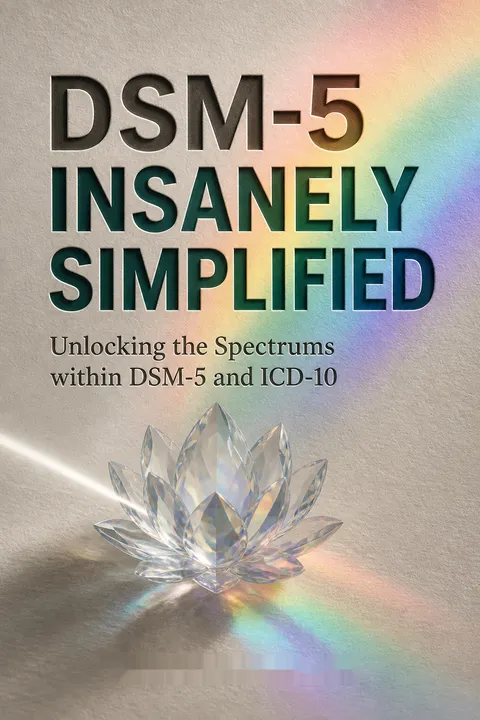
- Lotus flower metaphor: The eight spectrums are visualized as petals of a lotus, with harmony and balance at the center representing the archetypal Self.
- Transcendence of dualities: Encourages clinicians and patients to hold tensions between extremes, fostering growth and transformation.
9. What are some examples of how "DSM-5 Insanely Simplified" by Steven Buser applies the spectrum model to specific disorders?
- Depression: Illustrates a range from emotional shallowness (lack of introspection) to despair (paralyzing sadness), with healthy functioning in between.
- Bipolarity: Describes a continuum from low energy/creativity to manic excess, advocating for a balanced, creative middle ground.
- Anxiety: Shows the dangers of both carelessness (recklessness) and excessive anxiety (hypervigilance), promoting appropriate vigilance.
- Focus: Contrasts ADHD (inattention) with OCD (over-focus), suggesting optimal focus lies between these extremes.
10. How does "DSM-5 Insanely Simplified" by Steven Buser address the secondary areas of diagnosis outside the eight primary spectrums?
- Specialty areas covered: The book discusses trauma-related, neurodevelopmental, neurocognitive, behavioral, dissociative, somatic, eating, elimination, sleep, sexual, gender, and paraphilic disorders.
- Not spectrum-based: These conditions are not included as primary spectrums due to their lack of universality, but are still summarized for clinical relevance.
- Key updates highlighted: Major changes in DSM-5 for these areas are outlined, such as the reclassification of PTSD and the new criteria for eating disorders.
- Quick-reference summaries: Each specialty area is presented with concise diagnostic criteria and coding information.
11. What is the significance of the "Harmony of the Lotus Flower" in "DSM-5 Insanely Simplified" by Steven Buser?
- Visual summary of spectrums: The lotus flower illustration represents the eight primary spectrums as petals, with their optimal midpoints converging at the center.
- Symbol of balance: The center of the lotus symbolizes psychological harmony, balance, and adaptability—key goals in mental health.
- Transcendence of opposites: The model encourages moving beyond simple balance to a new, integrated state, echoing Jung’s transcendent function.
- Clinical application: Clinicians are encouraged to help clients move toward the center of each spectrum, fostering resilience and well-being.
12. What are the best quotes from "DSM-5 Insanely Simplified" by Steven Buser and what do they mean?
- "Everything should be made as simple as possible, but not simpler." (Albert Einstein): Emphasizes the book’s goal to simplify psychiatric concepts without losing essential complexity.
- "The map is not the territory." (Alfred Korzybski): Reminds readers that diagnostic models are tools, not absolute truths, and should not be imposed rigidly on patients.
- "The wound is the place where the Light enters you." (Rumi): Highlights the transformative potential of suffering and introspection in the depression spectrum.
- "The confrontation of the two positions generates a tension charged with energy and creates a living, third thing..." (Jung): Captures the book’s Jungian theme of integrating opposites to achieve psychological growth and harmony.
- "All things in moderation." (Adage): Summarizes the spectrum approach, advocating for balance rather than extremes
Download PDF
Download EPUB
.epub digital book format is ideal for reading ebooks on phones, tablets, and e-readers.








