

Key Takeaways
Money lets strangers specialize in work no household could do alone.
Exchange needs a common unit. Robinson Crusoe and Friday need no money while they live alone on an island. Barter becomes cumbersome when people need different things: a potter may want food, while a hunter has no use for pots. With a thousand goods, barter would require 499,500 separate exchange rates. Money replaces those comparisons with prices in a shared unit.
Trust scales specialization. A standardized medium lets the potter store the value of pots and buy food when needed. The book illustrates the gains with a toaster: one person trying to make one from raw materials faces hundreds of components and dozens of materials. Specialization makes such products possible, while money helps strangers exchange the fruits of their separate work.
Money functions as social infrastructure: it lets people coordinate without knowing one another or negotiating every exchange from scratch. That resembles a shared language or measurement system, which lowers the cost of cooperation across large groups. Yet money alone does not guarantee progress. Skills, reliable rules, and access to markets also matter. The contrast with the Nukak Maku, a community unfamiliar with money and formal property, is vivid, but it should not be read as proof that every society must follow the same path or that monetary exchange is the only form of cooperation.
Gold's limited practical use helped it preserve value across generations.
Useful money has constraints. A good medium of exchange needs to last, travel easily, divide into smaller amounts, and be accepted by others. Societies used many local goods, from salt and rice to tobacco and cowry shells, but each had vulnerabilities: food could spoil, shells could become too abundant, and cattle could not be divided for small purchases.
Gold had unusual advantages. It is durable, compact for its value, and chemically stable. Its supply generally grew slowly, often around 1 to 2 per cent annually in ordinary periods. Gold also had relatively few industrial uses, so hoarding it did not remove a staple food or essential material from everyday use. Its near-uselessness as a practical commodity helped make it useful as a store of value.
The argument highlights a useful design principle: money should be scarce enough to resist arbitrary expansion, but practical enough to circulate. Gold's limited industrial demand also made its monetary role less vulnerable to recessions in particular industries. Still, scarcity by itself does not guarantee stable purchasing power. New discoveries, changing demand, and political rules can shift gold's value, while a rigid supply can make it difficult to meet growing demand for payments. The book presents gold's advantages persuasively, but its own history also shows that no material can remove monetary trade-offs.
When law fixes bad coins at good-coin prices, people hide the good ones.
Face value can mislead. Rulers often reduced the gold or silver in a coin while insisting it remained worth the same amount. The book calls the resulting pattern Gresham's law: when law treats inferior and full-content coins as equal, people spend the inferior coins and hoard, melt, or export the better ones. The principle depends on that enforced equality, not merely on one coin being less valuable in an open market.
Debasement paid rulers. Roman emperors repeatedly reduced the silver in the denarius, which fell from nearly pure silver to about 2 per cent by the empire's end. Henry VIII's government cut the silver content of the pound by 83 per cent in nine years. Elizabeth I's adviser Thomas Gresham warned that replacing bad coinage required addressing the old coins, not just issuing better ones.
This history shows how a nominal rule can collide with people's incentives. If a coin's legal price ignores its metal content, holders behave rationally by spending the less valuable coin first. The same general problem appears whenever official prices diverge from actual scarcity: the rule may conceal the difference, but it rarely erases it. The caution is that debasement did not by itself explain every imperial decline. War costs, trade patterns, and political choices also mattered. The monetary story is strongest as a recurring pressure, not a single-cause theory of history.
Paper receipts became money, then banks learned to lend beyond their metal.
Receipts solved a transport problem. In medieval Chinese trade, and later in European banking, people deposited coins or valuables and received transferable records of the deposit. A merchant could pay another merchant by transferring the claim instead of carrying heavy metal. Bills of exchange extended the idea across borders: they recorded a debt payable elsewhere, and banks could pay the holder early in exchange for a discount.
Claims multiplied through lending. London goldsmiths first issued receipts for deposited metal. They then discovered that depositors did not all demand their money at once, so they could lend some deposits. Some issued additional notes that were not matched by metal in their vaults. This made more credit available and increased profits, but it also left banks exposed if many customers sought redemption together.
The shift from metal to transferable claims is not merely a story of deception. It is also a practical innovation that makes trade faster and allows savings to finance investment. The difficult question is how much liquidity a bank can promise while keeping enough resources to meet withdrawals. That is a problem of maturity and confidence as much as arithmetic. The book emphasizes the danger of issuing claims beyond reserves; a fuller assessment also has to recognize that credit can support productive activity when borrowers can repay and institutions are credible.
Credit-fueled share prices can turn debt into a self-feeding bubble.
Prices can feed on themselves. In France, John Law's bank created paper money that helped buyers purchase shares in the Mississippi Company. As the share price climbed, more investors wanted in, and bank loans supplied more buying power. The price rose from about 500 livres to 20,000 before confidence broke and the scheme collapsed.
The South Sea scheme repeated the pattern. Britain's South Sea Company offered to assume government debt, while rumors of rich trade and rising shares attracted investors. The company even lent against its own stock, helping people buy more of it. In such a Ponzi-like structure, money from later participants supports gains for earlier ones, so the apparent success depends on new buyers continuing to arrive. When they stop, inflated prices can fall abruptly.
The common mechanism is a feedback loop: rising asset prices improve the appearance of wealth, borrowing makes further purchases possible, and those purchases push prices higher. Modern finance calls one version of this reflexivity, where expectations alter the conditions that seem to confirm them. The historical cases make the loop memorable, but they do not mean every price boom is fraudulent or doomed. The key diagnostic question is whether an asset's value can ultimately be supported by income or use, rather than by an ever-expanding queue of buyers.
War makes money printing easy, while making trust expensive to restore.
Urgency favors the printing press. During the American Revolution, Congress issued Continental dollars because taxes and borrowing could not meet immediate war costs. Estimates of the total issue vary, but it was enormous beside the roughly $12 million monetary base that existed beforehand. Prices in Philadelphia rose by more than 1,000 per cent over 1779 and 1780, and the currency became nearly worthless.
Revolutionary finance repeated the pattern. France issued assignats, paper notes initially linked to land confiscated from the Church. Spending needs outran land sales, and new issues followed. By 1795, the assignat had lost almost all of its value. Germany's postwar money-printing ended in even more extreme inflation, with one dollar reaching 4.2 trillion marks before a new currency was introduced. These episodes show how emergency issues can become a lasting fiscal habit.
War and revolution create genuine financing emergencies, so printing money can look like the fastest available response. The danger grows when governments keep issuing currency to cover expenses they cannot fund through taxes or credible borrowing. Inflation then weakens the public's willingness to hold money, making ordinary exchanges harder and further damaging state capacity. Still, the printing press is not a complete explanation for every collapse. A country's ability to produce goods, collect taxes, and maintain political legitimacy also shapes whether new money remains trusted.
Central banks grew from war finance into guardians of the payment system.
War finance created the Bank of England. In 1694, the bank raised £1.2 million and lent it to William III's government, which was fighting France. In return, the institution gained a charter and permission to issue banknotes. Its relationship with the state deepened through repeated loans and privileges. During the Napoleonic Wars, the bank suspended conversion of its notes into gold in 1797, allowing the government to borrow more freely.
Crisis management added a new role. The Bank Act of 1844 tried to limit note issuance and strengthen central control. In the United States, recurring panics, especially the crisis of 1907, helped build support for a central bank. Congress passed the Federal Reserve Act in 1913. The institutions that had grown through public borrowing were now expected to help manage credit and financial emergencies.
A central bank sits at the intersection of public finance and private liquidity. It can make payments more reliable and lend during a panic, but it also gives governments and markets a powerful institution whose decisions affect everyone. The historical sequence matters because central banks were not designed outside politics: war needs and financial crises helped shape them. This makes transparency and accountability essential. At the same time, purely political control can undermine confidence, so the challenge is to constrain monetary power without making emergency action impossible.
Rescue a bank today, and tomorrow's risk-taking may grow bolder.
Rescue can stop contagion. When Argentine debt threatened Barings Bank in 1890, the Bank of England organized a £17 million guarantee fund with help from other institutions. In 1907, J. P. Morgan rallied banks and financiers to support firms and calm markets. These interventions helped prevent immediate failures from spreading through the system.
But rescue changes expectations. Moral hazard is the risk that protection from losses encourages people to take greater risks. The book traces this concern through repeated rescues and the growth of lightly regulated trust companies, which performed bank-like activities with smaller reserves. In the 1907 panic, a crisis that began in a copper stock and connected banks spread to trusts and the wider money market. Authorities faced a difficult choice: contain a panic now, or accept unpredictable damage.
The central tension is between preventing systemic harm and shielding decision-makers from the consequences of their choices. A rescue can protect depositors and businesses that did not create the risk, yet it can also teach investors that losses may be transferred to the public. The distinction between a solvent institution facing a temporary cash shortage and an insolvent one is therefore crucial. The book is right to emphasize incentives, though an effective system also needs orderly ways to let failing firms close without disabling payments or spreading panic.
Misprice gold against silver, and arbitrage drives one metal away.
A fixed ratio invites arbitrage. Governments that promised a fixed exchange between gold and silver often set a rate that differed from the market price. In the United States, the 1834 mint ratio favored gold, so gold flowed to the mint while silver became scarce. Discoveries in California and elsewhere later changed the market balance again. The 1873 Coinage Act omitted the standard silver dollar from the list of coins to be minted, helping establish gold's dominance.
Monetary choice became political. Farmers facing falling prices supported silver because they wanted a larger money supply. William Jennings Bryan made the issue central to his 1896 presidential campaign, but lost. The story shows that choosing gold or silver was not simply a technical decision: changing a ratio reshaped who gained, who lost, and which forms of money remained in circulation.
Bimetallism sounds like diversification, but a fixed conversion rate can create a one-way opportunity whenever market values shift. People move the undervalued metal out of official circulation and bring in the metal that the mint overvalues. This is a clear example of how rules interact with arbitrage rather than command it. The political dispute also matters: a stable currency may benefit creditors, while debtors and producers may prefer more money in circulation. Monetary design always distributes advantages, even when its rules are presented as neutral.
Britain's 1925 gold peg defended prestige by making exports and jobs pay.
The prewar price was costly to restore. After the First World War, the pound's market value was nearer $3.50, but Britain returned to gold in 1925 at its prewar rate of $4.87. That made British goods more expensive for foreign buyers. To compete, industries faced pressure to cut wages and costs, while the country experienced unemployment and falling prices. John Maynard Keynes had argued against returning at the old rate.
Gold's rules changed after the war. Britain left the gold standard in 1931. The gold-exchange standard also spread: central banks held pounds or dollars as reserves, while ordinary citizens could not exchange their own notes directly for gold. The book's larger point is that monetary rules are choices, not natural laws. A commitment may reassure creditors, yet still impose heavy costs on workers and exporters.
The interwar episode separates the appeal of a monetary anchor from the consequences of choosing its exchange rate. A credible promise can reduce uncertainty, but restoring an obsolete price may force adjustment through wages, employment, and output rather than through the currency itself. That is a political choice disguised as a technical necessity. Gold also did not automatically prevent instability: the postwar system relied on reserves held as other currencies, which created chains of dependence. The lesson is not that every fixed rate fails, but that its costs and beneficiaries must be made explicit.
Analysis
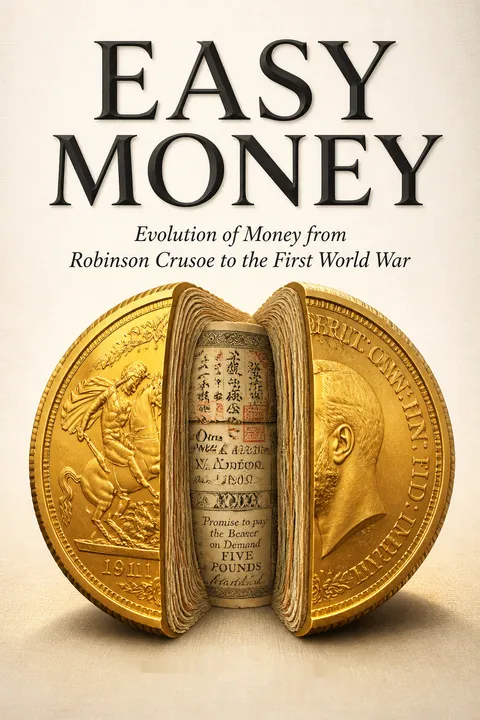
Easy Money is a sweeping monetary history organized around a recurring tension: money makes large-scale cooperation possible, yet the ability to create or alter it gives states and financial institutions a powerful shortcut. The narrative moves from barter and commodity money through coinage, bank receipts, paper currency, central banks, and the gold standard. Its strongest connective idea is institutional rather than material. Money works because people expect others to accept it, and that expectation depends on credible limits, reliable payment systems, and confidence in the issuer.
The book's historical comparisons are memorable because they show similar incentives appearing in very different settings. Roman coin debasement, revolutionary paper issues, John Law's share bubble, wartime borrowing, and the interwar gold return each reveal that monetary arrangements redistribute gains and losses. Yet the recurring pattern should not be mistaken for a single mechanical law. Inflation, crises, and imperial decline arise from several forces at once, including fiscal capacity, production, political conflict, and external trade. The account sometimes gives monetary expansion more explanatory weight than those other forces deserve, and its preference for commodity restraint can make the costs of monetary rigidity seem secondary.
That tension is especially clear in the gold-standard chapters. Gold could constrain governments and support predictable exchange, but the chosen parity could also force deflation and painful wage adjustment. The British decision in 1925 illustrates that a rule can be consistent and still be badly calibrated. Similarly, rescues can preserve payment networks while weakening incentives against reckless risk. The book is most useful when read not as a simple verdict for or against paper money, but as a history of institutional trade-offs. It asks readers to examine who controls the money supply, what backs public confidence, and who bears the cost when promises fail. Those questions remain more durable than any single monetary regime.
Review Summary
Easy Money receives mostly positive reviews for its accessible explanation of money's evolution. Readers appreciate the well-researched historical account, covering topics from barter systems to modern banking. Some find certain sections dry or technical, but overall praise Kaul's ability to simplify complex concepts. The book is recommended for those interested in economics and finance history. Reviewers note it's the first in a trilogy, ending around World War I, and look forward to subsequent volumes.
Glossary
Gresham's law
Bad money displaces goodA pattern in which people spend coins with less valuable metal content while keeping, melting, or exporting better coins. It is especially likely when authorities require both types to be accepted at the same official value. The law describes a response to a mismatch between legal prices and market values, not a claim that inferior money always drives out superior money.
bills of exchange
Transferable trade payment claimsWritten claims used by merchants to arrange payment across locations without transporting large amounts of coin. A creditor could transfer a bill to another party or sell it to a bank at a discount for immediate money. The system helped settle trade between distant markets and allowed claims to circulate through endorsement.
seigniorage
Charge for minting coinsThe fee charged by a mint for turning precious metal into standardized coins. A person bringing gold or silver received coins worth the metal minus this charge. The term also highlights the revenue or advantage an issuing authority can gain from producing money, especially when the face value exceeds the cost of making it.
assignats
French revolutionary land-backed notesPaper notes issued during the French Revolution, initially presented as claims linked to land confiscated from the Church and other public property. The government expected land sales to support their value and remove notes from circulation. Spending needs outpaced those sales, repeated issues followed, and the currency lost nearly all its purchasing power.
Ponzi scheme
New money pays earlier investorsA fraudulent or unsustainable arrangement in which returns to earlier participants are funded primarily by money from newer participants, rather than by productive earnings. The book applies the pattern to financial bubbles in which rising prices depend on a continuing stream of buyers. Once new money stops arriving, the apparent gains can collapse.
moral hazard
Protection encourages greater riskThe possibility that people or institutions take more risk when they expect someone else to absorb some of the losses. In banking, an anticipated government or central-bank rescue can weaken incentives to limit risky lending. The book presents this as a cost of crisis intervention, alongside the immediate benefit of containing financial panic.
lender of last resort
Emergency funding for banksA central bank's role of providing liquidity when banks or financial markets cannot obtain enough short-term funding elsewhere. Such lending may prevent a temporary shortage of cash from causing otherwise viable institutions to fail. It can also encourage excessive risk if institutions assume support will always be available.
gold standard
Currency redeemable for goldA monetary system in which a currency is defined by a fixed amount of gold and the issuer permits conversion at that rate. The system can constrain money creation and stabilize exchange rates, but it can also restrict policy responses when gold is scarce or a currency's fixed rate no longer reflects economic conditions.
gold-exchange standard
Foreign currency reserves linked to goldA system in which countries hold reserve currencies, such as pounds or dollars, that can be exchanged for gold, rather than holding enough gold for all domestic money. Citizens generally cannot redeem their own currency directly for gold. The arrangement reduces the gold required to support international payments but makes countries dependent on the reserve-currency issuers.
wildcat banking
Weakly backed, hard-to-reach banksA period of American banking in which loosely regulated banks, sometimes located in remote places, issued paper notes with inadequate backing. The name is associated with banks in locations where wildcats were said to roam. Their notes could trade at discounts, and failures left holders with claims that were difficult or impossible to redeem.
effective issue
Notes exceeding metal backingThe amount by which the Bank of England's paper money in circulation exceeded the gold or silver held to support it. A positive effective issue indicated that the bank had issued more notes than its metallic reserves. The measure became important when convertibility into gold was suspended during wartime.
Easy Money Trilogy Series
About the Author

Download PDF
Download EPUB
.epub digital book format is ideal for reading ebooks on phones, tablets, and e-readers.








