

Key Takeaways
See animals as the planet's nutrient circulatory system, not just consumers.
Follow the elements. Ecology is often described as a food web: plants capture energy, and animals eat plants or one another. Roman adds another map. Animals move nitrogen, phosphorus, iron, and carbon between places where these elements are plentiful and places where they are scarce. A whale can carry nutrients from deep water to the sunlit surface; seabirds can transfer ocean nutrients onto land; salmon can carry them upriver.
Movement makes ecosystems. These transfers happen through feeding, migration, waste, reproduction, and death. They can fertilize plants, feed scavengers, and alter the habitats that later generations depend on. The claim is not that animals replace plants or microbes, but that ecosystems cannot be understood by studying only the organisms that stay put.
What's striking is the shift from treating animals as links in a food chain to seeing them as mobile infrastructure. The distinction matters: a species can affect an ecosystem not only by what it eats, but by where it goes and what it leaves behind. This is a useful corrective to models that focus on local nutrient supply. It also invites a practical question for conservation: does a protected area contain the routes connecting feeding, breeding, and resting grounds, or only the destinations? The circulation metaphor is powerful, though it should not imply that every nutrient transfer is equally important or beneficial.
Give nutrient-poor places their animal couriers back.
An island begins nearly empty. Surtsey rose from the sea off Iceland in 1963. Its volcanic rock supplied phosphorus, but plants lacked usable nitrogen, and early seeds rarely survived. Seabirds changed the equation. They brought seeds in their feathers and guts, and deposited nitrogen-rich waste, eggs, and carcasses around their nests.
Birds built green ground. Measurements indicated that seabirds supplied about 90 percent of the nitrogen in the soil and plants within the colony. At its center, deposits reached about 60 pounds of nitrogen per acre each year, compared with roughly one pound outside. The colony became a lush grassland, with around fifty times the plant biomass of the surrounding lava. Yet the richest ground did not have the most plant species: a few grasses dominated, while more kinds of plants survived along the shifting boundary.
Surtsey offers an unusually clear ecological experiment because researchers observed life arrive on a new island from its earliest days. The story makes a larger point: nutrient supply can be a product of animal behavior, not just geology or weather. It also resists the easy assumption that greener means healthier in every sense. Nutrient enrichment boosts growth but can let a few competitors crowd out others. Restoration plans therefore need to ask what outcome matters, total plant production, species diversity, or both, rather than treating abundance as a single measure of success.
A whale's dive can fertilize the surface; its death feeds the deep.
Whales reverse the flow. The biological pump moves carbon and nutrients from surface waters into the deep sea as organisms sink. The whale pump works in the opposite direction: deep-diving whales feed below, then surface to breathe and release waste containing nitrogen, phosphorus, and iron. In the Gulf of Maine, Roman and colleagues estimated that whales moved about 24,000 tons of nitrogen into surface waters each year, more than the region's rivers supplied.
Death also feeds life. A whale carcass that reaches the seabed creates a whale fall, a rare, concentrated food source in the deep ocean. Scavengers consume the soft tissue, while specialized worms and microbes draw nutrients from the bones. The carcass can support communities for years, and its sinking body stores carbon in the deep sea.
The whale example links two scales that are usually studied separately: the daily movement of nutrients through an animal and the long-lived habitat created by its remains. It also shows why recovering a large species may have effects beyond its population count. Yet estimates of nutrient transport are not the same as direct proof of a climate benefit. Ocean productivity depends on where nutrients are released, whether organisms can use them, and what happens to the resulting carbon. The strongest case is ecological first: whales reconnect deep and surface waters, and their loss removes a distinctive pathway.
Treat salmon's forest legacy as measurable, powerful, and still debated.
The ocean travels inland. Pacific salmon gain most of their body mass at sea, then return to freshwater streams to spawn and die. Their bodies feed bears, eagles, insects, and other scavengers. Researchers have also traced salmon-derived nitrogen into streamside plants. In one Alaska comparison, spruce trees along salmon streams grew about three times faster than those above barriers that kept salmon out; roughly a quarter of the nitrogen in some nearby leaves appeared marine in origin.
Follow the disagreement. Other researchers question whether isotope measurements prove that salmon fertilize trees directly, and whether the effect is large beyond stream edges. The wider effects are clearer: salmon feed predators, churn streambeds, and support young fish. Removing dams on Washington's Elwha River reopened habitat and fish populations began to recover, demonstrating that restoring migration can revive food-web connections.
This case is valuable partly because the science is not presented as a tidy morality tale. Stable isotopes can reveal nutrient sources, but interpreting their signals requires attention to soils, water movement, and alternative explanations. That uncertainty does not erase the well-established role of salmon as food for predators or the ecological harm of blocking migration. It does sharpen the question: which claims are directly measured, and which are plausible extensions? Good conservation can proceed on strong evidence while researchers continue testing the more contested links.
Predators alter landscapes through fear as well as feeding.
A threat changes behavior. In Yellowstone, wolves returned after an absence of nearly seventy years. Their predation can reduce elk numbers, but their presence may also change where and when elk browse. Ecologists call this kind of indirect effect a trophic cascade: a predator influences plants or other species through its effects on prey. The proposed wolf effect includes recovery of willows and aspens, with possible benefits for beavers, birds, and stream habitat.
Fear has consequences. In field experiments, grasshoppers exposed to nursery-web spiders, including spiders unable to kill them, changed their feeding. They ate more carbohydrate-rich plants, and their altered bodies decomposed more slowly, changing soil nutrients and carbon storage. Yellowstone remains debated because elk, hunting, drought, and wolf behavior all influence the outcome. The broader lesson is firm: predators can shape ecosystems without eating every animal they affect.
The distinction between consumption and fear is a major conceptual advance. It makes animal behavior part of ecosystem science rather than treating it as noise around population numbers. The grasshopper experiment is especially useful because researchers could isolate the predator's presence and observe downstream changes. Large landscapes are harder to interpret. Yellowstone's recovery cannot be assigned to wolves alone when climate, human hunting, and animal adaptation also matter. The right takeaway is neither that wolves magically repair ecosystems nor that indirect effects are imaginary, but that causal claims need to match the evidence available.
Small animals can move more ecology than their size suggests.
Watch the seasonal pulses. Periodical cicadas spend seventeen years underground before emerging in enormous numbers. Most escape predators, die, and decompose, adding nutrients to forest soils. Around Iceland's Lake Myvatn, midge swarms transfer lake-grown nutrients to surrounding land; in high-emergence years, more than 120 tons of midges can fall around the lakeshore. Farmers had long noticed that years with abundant midges could bring better hay harvests.
Even the beach is mobile. Parrotfish bite and grind coral and rock, then release the crushed material as sand. On many tropical beaches, roughly four grains out of five may come from parrotfish feeding. Their grazing also clears surfaces where young corals can settle. Ants move seeds and place them in nutrient-rich refuse piles. These small or easily overlooked animals connect habitats through repeated, local work.
These examples correct a bias toward charismatic megafauna. Small organisms may lack the dramatic range of whales, but their numbers and frequency can produce substantial ecological effects. They also make scale itself a poor guide to importance: a single midge matters little, while a lake-wide emergence can alter surrounding vegetation. The caution is that spectacular pulses are variable. A low-midge year can make a familiar landscape function differently, and the effects of one insect boom should not be generalized to all years or places. Long-term observation is essential.
Wildlife collapse forced farms and industry to replace natural nutrient cycles.
Wild animals became scarce. By weight, wild mammals now make up about 4 percent of the world's mammal biomass, compared with 36 percent for humans and 60 percent for domesticated mammals. Domestic birds outweigh wild birds about three to one. The loss of wild animals removed major routes for moving nutrients, seeds, and food across landscapes.
Industry filled the gap. Nineteenth-century trade moved seabird guano from Peru to farms around the world. Later, the Haber-Bosch process made it possible to manufacture ammonia fertilizer from atmospheric nitrogen. It helped expand food production, but intensive fertilizer use also drives pollution, including algal blooms and low-oxygen dead zones. Phosphorus is increasingly mined rather than recycled. Modern agriculture sustains people at enormous scale, while also replacing ecological processes with industrial inputs and creating new environmental costs.
The contrast between animal movement and industrial fertilizer is not a simple choice between nature and technology. Synthetic nitrogen has supported food production for billions of people, while poorly managed fertilizer contributes to pollution and climate pressures. The deeper issue is a broken accounting system: nutrients are extracted, concentrated, and applied in one place, then lost to waterways elsewhere. Rebuilding wildlife populations alone cannot feed modern societies, but treating animals as irrelevant makes the system more dependent on mined and manufactured inputs. A resilient food system must address both production and the pathways by which nutrients escape.
Turn human waste from a one-way sewage pipe into a nutrient loop.
Waste still contains value. Human urine carries nitrogen and phosphorus that can fertilize crops, but conventional sanitation often sends these nutrients through treatment systems and into waterways. The Rich Earth Institute in Vermont collects urine, sanitizes it, and supplies it to farms as fertilizer. The book estimates that recovering nutrients from wastewater could offset more than 13 percent of agricultural fertilizer demand.
Return what bodies borrow. Composting toilets and human composting offer other ways to return nutrients to soil. The idea resembles older practices in which human waste nourished crops, but safe reuse requires treatment, careful handling, and public trust. The same principle applies to animal manure: what is a pollutant in the wrong place can be a resource when managed within a local cycle. Sanitation protects health; the challenge is to preserve that protection while wasting fewer nutrients.
Waste recovery connects ecology to infrastructure and public health. A nutrient loop is not automatically safe or practical simply because its chemistry is useful; pathogens, contaminants, transport, regulation, and public acceptance all matter. That is why successful reuse needs dependable sanitation standards as well as technical systems. The broader design question is whether treatment plants can become resource-recovery centers rather than endpoints. The transition may be gradual, but even partial recovery can make nutrient flows more visible and reduce the assumption that flushing something away makes it disappear.
Restore keystone species with local consent and honest trade-off accounting.
Recovery can transform a coast. In the 1960s and 1970s, Alaska biologists moved 710 sea otters from the Aleutians to parts of the Pacific coast before a nuclear test. The descendants helped restore otter populations and kelp forests. By eating sea urchins, otters allow kelp to grow into habitat for many fish and invertebrates. But more otters can reduce shellfish available to people. In Sitka, Tlingit hunters manage some otter harvests while supporting cultural practices and local food sources.
People belong in the system. The restoration of bison on tribal lands likewise connects ecological recovery with cultural relationships and stewardship. In Hawaii, reducing sewage discharge helped Kaneohe Bay's coral cover recover. These examples show that wildlife protection works alongside pollution control, local knowledge, and decisions about who bears the costs and receives the benefits.
The otter story rejects the idea that conservation has to mean excluding people or forbidding every form of use. It also refuses to hide the conflict: kelp and fish habitat can recover while shellfish fisheries suffer. Local governance can make trade-offs more legitimate, especially when Indigenous communities have longstanding cultural and ecological relationships with a species. Still, community management is not automatically sustainable; it depends on sound population monitoring, clear limits, and fair authority. Restoration is strongest when ecological goals and human livelihoods are addressed together.
Keep habitats connected, and let animal recovery complement emissions cuts.
Protect movement, not just places. Animals need routes between feeding grounds, breeding sites, rivers, and seasonal ranges. Dams, roads, fences, and development can sever those routes even where fragments of habitat remain protected. The book points to wildlife corridors, road crossings, dam removal, and expanded protected areas as ways to restore movement. It also weighs land sharing, where wildlife and farming coexist, against land sparing, where high-yield agriculture leaves more land available for restoration.
Treat climate benefits carefully. Animal recovery may help store carbon in soils, kelp forests, and deep-sea carcasses, and grazing animals can alter fire and vegetation patterns. One estimate in the book suggests restored animal populations could increase carbon uptake by 6.4 billion tons of carbon dioxide annually. Such estimates are potential contributions, not substitutes for reducing fossil-fuel emissions or resolving conflicts over land.
Connectivity turns conservation from a map of isolated reserves into a question of movement and access. That perspective fits migratory animals especially well, since a protected breeding site is of limited use if a dam or fence blocks the journey to it. The land-sparing debate adds a difficult human dimension: higher yields might spare habitat, but intensive production can carry serious welfare and pollution costs. Climate claims should remain proportional. Wildlife recovery can support climate resilience and carbon storage, but it cannot serve as permission to delay emissions reductions.
Analysis
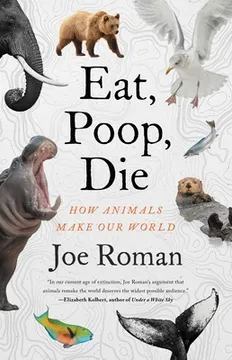
Roman's central argument is that animals are not merely consumers within ecosystems. They are mobile agents that transport nutrients, reshape habitat, and connect places through feeding, migration, reproduction, waste, and death. The book's distinctive contribution is to unite processes often separated by academic boundaries: population ecology, animal behavior, biogeochemistry, and conservation policy. Its recurring examples make the theory tangible. A new volcanic island acquires fertile grassland through seabird deposits; whales move nutrients between ocean depths and the surface; salmon connect marine food webs to rivers and forests; parrotfish help make beaches from reef material.
The narrative also models scientific uncertainty unusually well. The salmon story distinguishes clear consumer effects from the more disputed claim that salmon-derived nitrogen substantially fertilizes trees. The Yellowstone account similarly complicates the popular idea that wolf return alone restored a landscape. These debates strengthen the book's method: compelling ecological stories are hypotheses to test, not just metaphors to celebrate. At times, however, the broad circulatory analogy risks making unlike processes sound interchangeable. A nutrient transfer matters differently depending on its scale, chemical form, timing, and destination. A pile of guano, a whale fall, and a fertilized riverbank do not have identical consequences.
The policy implication is not simply to add animals back. Restoration must also address dams, habitat fragmentation, industrial agriculture, pollution, and the reduction of wild space. It must reckon with conflicts over shellfish, livestock, and land, and recognize Indigenous stewardship as governance rather than ornament. Animal recovery can restore ecological functions and provide climate benefits, but those gains remain conditional and cannot replace direct emissions cuts. The book's strongest practical lesson is therefore to treat biodiversity, nutrient cycles, and human systems as linked design problems. The question is not whether nature or people should prevail, but how to rebuild relationships that sustain both without pretending every trade-off disappears.
Glossary
zoogeochemistry
Animal influence on element cyclesThe study of how animals affect the movement of elements such as carbon, nitrogen, and phosphorus through organisms and the physical environment. It expands biogeochemistry, which often emphasizes plants, soils, microbes, and physical processes, by treating animal movement, feeding, waste, and death as forces that shape chemical cycles.
whale pump
Whales move nutrients upwardThe movement of nutrients from deep ocean waters toward the sunlit surface by whales and other air-breathing marine animals. They feed at depth, return to breathe, and release nitrogen, phosphorus, and other nutrients near the surface, where phytoplankton can use them. The process complements the biological pump, which carries material downward.
biological pump
Carbon moves into deep seasA process in which marine organisms transfer carbon and other nutrients from surface waters into the deep ocean. Phytoplankton and animals die, produce sinking particles, or move through the water column, carrying material toward the seafloor. Some of this carbon remains in deep waters or sediments for long periods.
trophic cascade
Predators ripple through food websA chain of ecological effects in which changes at one level of a food web influence other levels. For example, predators can affect plant communities by reducing herbivore numbers or changing herbivore behavior. The direction and strength of a cascade depend on the species, place, and other environmental pressures.
landscape of fear
Predation risk changes behaviorThe pattern of places and situations that prey animals avoid or use differently because predators may be present. Such avoidance can alter feeding, movement, and physiology even when predators do not kill the prey. Those behavioral changes can then affect plants, soils, and nutrient cycling.
whale fall
A carcass feeds the deep seaA whale carcass that sinks to the ocean floor, creating a concentrated food source in an environment where food is often scarce. Scavengers consume soft tissue, while microbes and specialized organisms use nutrients from the bones. A single carcass can support a changing deep-sea community for years.
Sheldon spectrum
Biomass across marine sizesA proposed pattern in which the total biomass of organisms is roughly similar across successive size classes in the ocean. Smaller organisms occur in greater numbers, while larger organisms are fewer. The book uses the concept to illustrate how intensive fishing and whaling have disproportionately reduced large marine animals.
Shifting baseline syndrome
Each generation accepts less natureA pattern in which each generation treats the diminished abundance or size of wildlife it first encountered as normal. Because people compare nature with their own early memories rather than older conditions, long-term losses can become difficult to recognize. Conservation can also raise these baselines when populations recover.
hippopotamus conveyor belt
Hippos carry grassland nutrientsThe transfer of nutrients from land into rivers by hippos that feed on grasslands and return to water to rest. They deposit large amounts of dung in river pools, where it can fuel aquatic organisms and alter microbial communities. The effect depends on hippo numbers, river conditions, and the timing of nutrient inputs.
phi
Nutrient movement through dungRoman uses the Greek letter phi for the diffusion of nutrients through animal dung: the lateral transfer of nutrients as animals eat in one location, move, and defecate elsewhere. The concept helps estimate how mobile animals redistribute elements such as phosphorus across landscapes, including nutrients that would otherwise remain concentrated near their source.
critterscapes
Land shaped by abundant wildlifeRoman's term for landscapes structured by abundant, free-roaming animals rather than managed mainly for human use. Critterscapes depend on animals moving, feeding, reproducing, and dying across connected habitats. The idea combines wildlife restoration with the ecological functions animals provide, including nutrient movement, habitat creation, and changes to carbon storage.
Download PDF
Download EPUB
.epub digital book format is ideal for reading ebooks on phones, tablets, and e-readers.








