Key Takeaways
1. Edgar Cayce's Clairvoyant Readings Reveal Past Lives
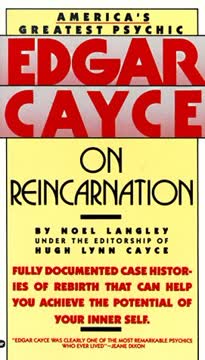
This book is the authentic record of Mr. Cayce’s successful search for proof of reincarnation—the concept that states we live more lives than one.
America's greatest seer. Edgar Cayce, born in 1877, was an American clairvoyant known for his "Life Readings" given while in a self-induced trance. These readings, taken mainly from his extraordinary psychic data, provided detailed accounts of individuals' past lives and their influence on present conditions. His son, Hugh Lynn Cayce, directed the Association for Research and Enlightenment (ARE) to preserve and study this voluminous psychic data.
Unique diagnostic ability. Cayce's abilities manifested early, seeing "visions" as a child and later developing a photographic memory. His medical clairvoyance began when he cured his own throat paralysis by diagnosing himself in a trance. Physicians then utilized his talent to diagnose patients remotely, leading to widespread recognition, including a feature in The New York Times in 1910.
Documented legacy. Upon his death in 1945, Cayce left over 14,000 documented stenographic records of his telepathic readings. These records, cross-indexed under thousands of subject headings, are available for study by psychologists, students, and investigators at the ARE, founded in 1932 to preserve and research his work. This book draws from 2,500 readings given between 1925 and 1944, focusing on psychological problems and karmic patterns.
2. Reincarnation: A Journey of Soul Growth and Opportunity
Karma, as he saw it, was a universal law of cause and effect which provides the soul with opportunities for physical, mental and spiritual growth.
Soul's purpose. Cayce's readings reveal that each soul, or "Entity," re-enters the earth plane as a human being to continue its journey of growth. This process is governed by a universal law of cause and effect, known as karma, which offers opportunities for physical, mental, and spiritual development. The soul carries subconscious access to characteristics, capacities, and skills accumulated in previous lives.
Balancing karmic patterns. The soul's task on Earth is to use successive rebirths to balance its positive and negative karmic patterns. This involves subduing selfish impulses and encouraging creative urges. Cayce's philosophy provides a framework for understanding seemingly "needless" suffering as part of this growth process, offering a practical philosophy for everyday living.
Beyond physical ailments. While Cayce was renowned for diagnosing physical ailments, many of his readings delved into psychological problems like deep-seated fears, mental blocks, vocational talents, and marriage difficulties. These issues were often traced back to "karmic patterns" arising from past lives, highlighting the interconnectedness of a soul's journey across multiple existences.
3. Karma: The Universal Law of Cause and Effect
“Karma is rather the lack of living up to that which ye know ye should do. As ye would be forgiven, so forgive in others. That is the manner to meet karma.”
Not retribution, but reaction. Cayce emphasized that karma is not a brutal punishment but a meticulous and dispassionate law of cause and effect, akin to how food affects the body. Thoughts and actions, generated in this life and previous ones, are the "food" upon which the soul feeds, influencing its health and destiny.
Opportunity for redemption. Every new life offers an opportunity for the soul to build its destiny, carrying both good and bad from the past. There is always a way of redemption, but no way to dodge responsibilities the soul has undertaken. Illness, for instance, is often seen as "sin" (a deviation from divine law) expressing itself because it has not yet been expiated by the soul.
Free will's role. While karmic conditions exist, free will allows individuals to change their attitudes and actions, thereby altering their karmic path. Cayce stressed that "the Lord does not tempt any soul beyond that which it is able to bear," and that individuals create their own circumstances through their choices. The law is perfect, and it will be fulfilled, but individuals decide how it is fulfilled.
4. The Veil of Forgetfulness Protects and Guides Present Life
Suppose you were allowed voluntary access to all your previous lives, and one day, by chance, you stumbled across the memory of having been the greatest monster in history! How would you deal with the horror, the belated remorse?
A necessary amnesia. Cayce explained that souls do not consciously remember past lives to prevent overwhelming despair or pride. If individuals recalled every past blunder or triumph, it would hinder their ability to focus on the present life's lessons. This "veil of forgetfulness" is a protective mechanism, allowing the soul to address current challenges without the burden of infinite past experiences.
Focus on the present. Just as an actor fully embodies a role without recalling all previous performances, the soul immerses itself in the current life. Conscious memory of past lives would disrupt this focus, making it difficult to learn new lessons or overcome specific karmic patterns. The purpose is growth in the now, not dwelling on the then.
Subconscious retention. While conscious memory is veiled, the subconscious mind retains all experiences. This accumulated wisdom, caution, and intuitive appraisal are accessible through dreams or meditation, guiding the individual without overwhelming them. This allows for a fresh start in each incarnation, ensuring that "no soul will ever be permitted such calamitous knowledge of its own past blunders" until it is mature enough to handle it.
5. The Immortal Subconscious Holds All Soul Memories
“One source, apparently, is the record made by an individual in all of its experiences through what we call time. The sum total of the experiences of that soul is written, so to speak, in the subconscious of that individual as well as in what is known as the Akashic Records.”
The soul's memory bank. Cayce described the subconscious mind as the immortal repository of all a soul's experiences across time, akin to the "Akashic Records." This "memory bank" stores every thought, action, and emotion, influencing the present life even if not consciously recalled. It is the true "builder" of destiny, responsive to conscious thought and intention.
Beyond the physical. The subconscious mind survives physical death, becoming the conscious mind of the soul in the astral planes. It is not dependent on matter and retains total recall of worldly experiences. This concept highlights that the "conscious" mind of the earthly shell is temporary, while the deeper levels of consciousness are eternal.
Accessing inner wisdom. While the conscious mind navigates material existence, the subconscious serves as a constant guide and counselor. Through practices like meditation and dream interpretation, individuals can access this inner wisdom, allowing the "still small voice of conscience" to direct them. Cayce believed that "what I can do today, every man will be able to do tomorrow," implying that all souls possess the potential to tap into these deeper levels of knowledge.
6. Past Life Actions Manifest as Present Physical and Emotional Karma
“Hence in meeting same in the present, the Entity, passes under the rod, as it were. She is now being pitied, laughed at, scorned for the inability to take part in any activity that requires the full use of the physical body.”
Karma's varied expressions. Past actions, both positive and negative, manifest in the present life as physical ailments or emotional challenges. Cayce's readings frequently traced conditions like multiple sclerosis, digestive issues, phobias, or personality traits to specific events or attitudes in previous incarnations. For example, gluttony in one life could lead to digestive problems in another.
Specific examples from readings:
- Paul Durbin's paralysis: Linked to excessive indulgence of negative passions, requiring a "change of heart" for healing.
- Irene McGinley's femur erosion: Traced to betraying a friend out of jealousy in Roman times, leading to her being "pitied, laughed at, scorned."
- Moira Schaeffer's claustrophobia: Stemmed from being smothered to death in a root cellar during the Salem witch trials.
- Flora Lingstrand's fear of childbirth: Connected to witnessing her children "taken and scourged in the fire" in the Roanoke Colony.
Lessons learned. These manifestations are not arbitrary punishments but opportunities for the soul to learn and balance its debts. The individual is presented with circumstances that allow them to experience the consequences of their past actions, fostering growth in patience, understanding, and forgiveness.
7. The Law of Grace Offers Redemption Beyond Strict Karma
“Karma is rather the lack of living up to that which ye know ye should do. As ye would be forgiven, so forgive in others. That is the manner to meet karma.”
Transcending strict law. The Law of Grace is a higher principle that supersedes the strict law of cause and effect (karma). It offers a path for souls to work off accumulated debts through unselfish dedication to the welfare of others, forgiveness, and aligning one's will with divine purpose. This means a soul is not eternally bound by past mistakes if it chooses a path of love and service.
Forgiveness as liberation. Cases like Anthony Hollis, who was plagued by choking fits linked to strangling his unfaithful wife in a past life, illustrate this. His fervent prayer for forgiveness—for himself, for her, and for her adultery—broke the karmic cycle, leading to a profound sense of freedom. This demonstrates that conscious acts of forgiveness can resolve deep-seated karmic patterns.
Service and compassion. Vera Aldrich, despite a life of physical suffering, was told her karmic wanderings were over due to her generous and unselfish way of life. Her dedication to others, even without conscious awareness of past debts, had achieved Grace. This highlights that genuine compassion and service can lead to spiritual advancement, potentially negating the need for further earthly incarnations.
8. Free Will Shapes Destiny, Overriding Predetermined Paths
“BUT LET IT BE UNDERSTOOD HERE: NO ACTION OF ANY PLANET OR THE PHASES OF THE SUN, THE MOON, OR ANY OF THE HEAVENLY BODIES, SURPASSES THE RULE OF MAN’S OWN WILL POWER: the power given by the Creator to man in the beginning, when he became a living soul.”
Man's ultimate power. Cayce consistently affirmed that free will is stronger than any predetermined destiny or astrological influence. While planetary positions at birth may indicate inclinations, they do not dictate fate. The power of choice, given by the Creator, allows individuals to shape their own paths and overcome any karmic patterns.
Choice in every moment. Every soul has the capacity to choose how it will act, whether to fulfill its purpose or glorify self. This means that even in the face of challenging karmic conditions, an individual can choose to respond constructively, thereby altering their future. The path of evolution is not rigid; it bends to the will of the soul.
Responsibility and growth. This emphasis on free will places full responsibility on the individual for their experiences. It dismantles the idea of a vengeful God or helpless victimhood, instead empowering individuals to understand that they create their own reality. By making conscious choices aligned with spiritual ideals, souls can accelerate their growth and transcend limitations.
9. Biblical Texts Hint at Reincarnation, Suppressed by History
“Elias truly shall first come and restore all things. But I say unto you that Elias is come already, and they knew him not, but have done unto him whatsoever they listed. Likewise shall also the Son of Man suffer of them. Then the disciples understood that He spake unto them of John the Baptist.”
Hidden truths. Cayce believed that while the Bible does not explicitly condemn reincarnation, it contains numerous subtle references that imply its existence. He suggested that the spirit of the Bible remains whole, despite potential alterations or misinterpretations over centuries of translation and editing.
Scriptural allusions:
- Proverbs 8:22-31: "I was set up from everlasting... my delights were with the Sons of Man," suggesting a soul's pre-existence.
- Wisdom of Solomon 8:19-20: "being good, I came into a body undefiled," implying prior moral development.
- Romans 9:11-13: God's love for Jacob and hatred for Esau before birth makes sense if they had prior lives.
- Malachi 4:5 and Matthew 17:10-13: Jesus's statement that John the Baptist is Elijah, which the disciples understood, strongly suggests reincarnation.
- John 9:1-3: Disciples asking if a man was born blind due to his own sin implies a belief in pre-birth existence.
- John 3:3-14: Jesus's dialogue with Nicodemus about being "born again" could refer to rebirth, not just spiritual conversion.
Historical suppression. The document highlights the Fifth Ecumenical Congress of Constantinople in 553 A.D., instigated by Emperor Justinian and Empress Theodora, as a pivotal moment. This council, influenced by Theodora's agenda, condemned the writings of Origen, a prominent early Church Father who taught the pre-existence of souls and reincarnation. This act effectively removed reincarnation from Western Christian doctrine.
10. Atlantean Souls Return with Extreme Potentials for Humanity
“As we have indicated, the Atlanteans were those who had reached an advancement and had been entrusted with divine activities in the earth, but forget themselves and used such forces for selfish purposes. Thus they brought about that which destroyed the body, though not the soul. There are numbers, great numbers, of Atlanteans in the earth in the present.”
Ancient civilization's legacy. Cayce's readings frequently refer to Atlantis, a highly advanced civilization that spanned the Atlantic Ocean and possessed sophisticated technology, including nuclear energy. Its destruction, around 10,000 B.C., was attributed to the misuse of these powers and a shift from worshipping the One God to totalitarian brute force.
Return of Atlantean souls. Cayce prophesied the return of vast numbers of Atlantean souls in the 20th century, bringing with them extreme potentials. These souls, categorized as "Sons of the One God" (those who used their power for good) and "Sons of Belial" (those who abused it for selfish gain), are found among leaders in all nations, influencing both scientific advancement and societal chaos.
Modern manifestations. The advanced technology of Atlantis, such as electrical communications and nuclear energy, is seen as being brought back by these returning souls. However, the "Sons of Belial" also bring tendencies towards lust, violence, and a refusal to learn from past blunders, leading to societal challenges like discrimination, exploitation, and the creation of destructive weapons. Cayce warned that these "extremists" know no middle ground, making their influence profoundly impactful.
11. Humanity's Future: Evolving Psychic Awareness and Spiritual Understanding
“What will it mean to us if we make this next evolutionary step? Well, it will mean that all of us will be able to see auras.”
The next evolutionary step. Cayce believed humanity is evolving towards a higher state of perception, where psychic abilities like reading auras and telepathy will become commonplace. He described auras as the "weathervane of the soul," radiating a person's history, purpose, and current state through vibrations perceived as colors. This increased transparency would eliminate deceit and foster greater understanding among people.
Conscious mental power. The future will also see an increase in the power of mental concentration. Cayce demonstrated this by influencing individuals to appear at his studio through concentrated thought, though he warned against using such power for control. He emphasized that while mental telepathy is a birthright, its constructive use requires adherence to divine principles, never forcing one's will upon another.
A world of transparency. In this future world, danger, catastrophe, and death would not come unannounced, as individuals would perceive them through their heightened senses. This deeper understanding of life and death would lead to a more profound spiritual perspective, where individuals recognize their interconnectedness and the importance of serving others. The ultimate goal is for humanity to achieve a plateau of higher perception, where the "Sons of the One God" guide the world towards peace and harmony.
Last updated:
Review Summary
Edgar Cayce on Reincarnation receives mixed reviews, averaging 4.12 out of 5 stars. Readers praise its profound impact on understanding karma, life purpose, and reincarnation concepts, with many finding it life-changing. However, critics note the book's heavy Christian bias and outdated 1967 perspectives. Some readers wanted more personal reincarnation stories and less biblical content. Skeptics question Cayce's historical accuracy regarding events like the Exodus and biblical interpretations. Overall, readers find it fascinating and thought-provoking, though recommend approaching it with an open mind.