

Key Takeaways
Defend public schools by treating education as democratic work, not a market product.
A public purpose matters. The book contrasts education as a shared democratic responsibility with a market model built around competition, consumer choice, and test scores. In the democratic vision, schools help every student learn, participate in civic life, and work with people different from themselves. The market vision treats families as shoppers and students as results to be measured, while leaving poverty and unequal resources largely outside the frame.
Choice is not proof of improvement. A 2009 Stanford study cited in the book found that 17 percent of charter schools had significantly stronger academic results than comparable public schools, 37 percent had weaker results, and 46 percent showed no significant difference. The editors are not defending every existing school. They argue that improvement should strengthen public institutions rather than treat privatization as the default solution.
The central dispute is about more than school structure. It concerns what public institutions are for, and who gets to define success. A market can offer useful experimentation, but competition does not guarantee that every child receives a strong education; it can reward institutions for selecting easier-to-serve students. Conversely, public governance can become bureaucratic and unresponsive. The strongest version of the book’s argument is therefore not that public schools are automatically good, but that decisions about a public good require public accountability, transparent evidence, and meaningful participation by the people who live with the consequences.
Treat test scores as evidence about learning, never as a substitute for it.
A measure can distort its target. The book argues that high-stakes testing turns one narrow snapshot into a verdict on students, teachers, and schools. Under No Child Left Behind, schools faced annual testing requirements and sanctions for failing to meet proficiency targets, even when students lacked comparable resources or had only recently begun learning English. Pressure to raise scores could displace arts, social studies, play, and deeper work in subjects that were tested.
Scores carry uncertainty. The book cites estimates that teacher evaluations based on one year of student test data can have a 35 percent error rate, falling to 25 percent when three years are used. Test results also shift with factors outside a teacher’s control. The authors do not reject assessment; they favor multiple kinds of evidence, including student work, teacher observation, and progress over time.
This is a practical warning about proxy measures. In organizational research, Goodhart’s law describes how a measure can become less useful once people are rewarded or punished for hitting it. When a score controls funding or reputation, educators have reason to prioritize the score, even if it captures only part of the learning they value. Still, common tests can reveal patterns that local judgment might miss, including persistent gaps between groups. The more defensible conclusion is not to discard standardized data, but to limit its authority and pair it with evidence that reflects context, growth, and the quality of students’ actual work.
Equal tests can widen inequity when students start from unequal conditions.
Uniform rules are not equal opportunity. Students with disabilities, English-language learners, and children in underfunded schools may face the same exam without having had the same instruction, accommodations, or time to learn the language of the test. Students with disabilities describe being denied diplomas despite completing school and maintaining strong grades. One student in Tennessee, Latricia Wilson, missed the required math score by a few points and was shut out of vocational and college programs despite having completed her coursework.
Standards embody choices. Alfie Kohn challenges the assumption that one national set of specific expectations creates excellence or fairness. A uniform standard can make local differences invisible and define students as failures for reasons unrelated to their potential. The book argues for demanding goals alongside varied routes, culturally relevant teaching, and assessment that recognizes what students have actually learned.
The distinction here is between formal equality, everyone receiving the same rule, and substantive equity, people receiving support that makes success genuinely possible. This distinction appears in disability rights, public health, and legal access: identical treatment can preserve an unequal starting point. Yet flexibility also has risks. If expectations vary without transparency, marginalized students may receive less challenging instruction. A credible system must therefore combine accommodations and context-sensitive assessment with a public guarantee of rigorous learning, rather than treating either uniformity or flexibility as an automatic proxy for fairness.
Make rigorous learning relevant to students’ histories, identities, and questions.
Relevance can deepen rigor. Tucson’s Mexican American and Raza Studies courses built literature and history lessons around students’ cultural experiences, critical inquiry, and social justice, while continuing to address state standards. Teachers used writers and historical material connected to students’ lives instead of centering instruction on test drills. Students reported greater academic confidence and interest in continuing their education.
The results challenged assumptions. The book reports that Latino and Latina students in the courses closed the test-score gap with European American peers, including in math, although the program did not teach math. The gains held across five years and four schools. The authors connect this to students developing a stronger sense of themselves as capable learners. The program faced political attacks, illustrating that successful teaching can still be vulnerable when curriculum becomes a proxy battleground over whose histories belong in school.
The case illustrates a useful principle from learning science: people engage more deeply when new ideas connect to what they already know and care about. Cultural relevance is not a substitute for disciplinary challenge; it can provide the bridge that makes demanding work intelligible and worth doing. The reported outcomes are compelling, but they do not establish that one curriculum alone caused the score changes or that the model transfers unchanged to every setting. The more transferable lesson is to take students’ knowledge seriously, then use it as a starting point for rigorous reading, writing, reasoning, and debate.
Protect the relationships that let children feel safe enough to learn.
Care is part of the work. Felipa Gaudet describes Ivory, a kindergartner whose frightening experiences first appeared at school as aggression and withdrawal. In a classroom where adults and classmates treated her with patience, Ivory gradually learned to care for a toy and explain its needs to the class. The teacher saw this as evidence that Ivory was learning trust, self-control, and how to communicate, not simply following instructions.
Leadership creates room for care. Gaudet credits her principal with shielding teachers from pressure to prioritize test benchmarks over children’s immediate needs. At New York’s P.S. 24, the school combined academic instruction with arts, dual-language learning, family participation, and social-emotional programs. These accounts show that a school’s climate and relationships shape what students can risk attempting, while narrow scores may fail to register that growth.
The classroom here functions as a social environment, not merely a delivery system for content. Research on psychological safety and co-regulation helps explain why students who feel seen and secure may be more willing to take intellectual risks and recover from mistakes. That does not mean every teacher can resolve trauma, or that relationship-building should replace specialized support. The stronger implication is institutional: schools need enough time, training, and discretion to respond to children as people. A benchmark can identify a skill gap, but it cannot by itself tell an educator what kind of support a child needs to learn.
Turn refusal into organized action, not a solitary gesture.
A clear no can expose harm. Macario Guajardo, an eleven-year-old in Texas, refused a state test after test preparation had brought stress into his school and pushed out activities such as recess. His father helped him explain his reasons to classmates and school leaders. Macario’s protest drew attention to other children’s distress and prompted educators to reconsider some practices.
Collective action can change policy. In Chicago, twelve teachers at Curie High School refused to administer a test they believed did not measure what students had learned. They supported their objection with evidence and made their concerns public. The district discontinued the exam systemwide. Latricia Wilson’s challenge to Tennessee’s graduation test also helped bring public scrutiny to the policy; although her lawsuit was dismissed, the state later removed the test as a diploma requirement. Refusal gains force when it is explained, documented, and shared.
These stories make dissent concrete: it is not simply the courage to oppose authority, but the work of making a claim legible to others. Collective action research distinguishes isolated protest from coordinated action supported by shared framing, credible evidence, and relationships. The contributors’ examples show how a small group can alter what officials must publicly answer for. There are risks, however. Students and employees may face unequal consequences for dissent, and a visible win does not guarantee lasting change. Strategic refusal therefore needs preparation, allies, and attention to who bears the cost of speaking first.
Build coalitions around shared democratic rights, not perfect agreement.
Trust takes preparation. In Milwaukee, teachers, parents, civil-rights groups, neighborhood organizations, students, and community leaders formed a coalition against a proposed mayoral takeover of public schools. The groups had different histories and priorities, but agreed on three goals: oppose the takeover, protect voters’ role in school governance, and strengthen parent and community participation. Their work included public meetings, media outreach, rallies, and lobbying.
Relationships outlast a single campaign. At a state hearing, 81 people spoke against the proposal and 20 supported it. The takeover plan was ultimately abandoned. Other parent organizers in the book used plain-language fact sheets, community storytelling, and school-based meetings to help families understand policies and act together. The editors stress patient organizing, not just large demonstrations, as the groundwork that helps a coalition withstand political pressure.
Coalitions solve a coordination problem: people with limited power can become consequential when they align around a specific, shared demand. Milwaukee’s example also shows why trust is built before a crisis, through repeated contact and a willingness to work across disagreement. The goal is not to erase differences or pretend every member has equal influence. Coalitions can reproduce internal hierarchies, especially when affected families are invited to endorse decisions made by professionals. Shared leadership and clear decision rules matter as much as a common slogan if collective action is to deepen democracy rather than merely invoke it.
Put assessment in teachers’ hands and use it to improve teaching.
Assessment should guide learning. Nebraska’s School-based, Teacher-led Assessment and Reporting System, or STARS, asked teachers to develop assessments connected to locally taught curricula. Schools and districts used varied measures, while the state reviewed their technical quality. The design treated assessment as part of teaching and learning, rather than chiefly as a tool for ranking schools or imposing penalties from a distance.
Good practice needs political support. Evaluations described stronger teacher assessment skills, more collaborative school cultures, and steady improvement in student achievement. Yet in 2008, state legislators chose to require state tests under federal pressure. The contributors present this as a reminder that evidence of educational value does not automatically overcome political incentives. Their long-term vision is assessment shaped by students, teachers, families, and communities, supported by policy, and judged by whether it helps people teach and learn.
STARS offers a model of distributed expertise: practitioners closest to the work generate evidence, while broader systems check its quality and support improvement. That approach resembles professional practice in fields where judgment depends on multiple observations rather than a single score. Local assessment is not automatically valid or fair, however; teachers need training, shared criteria, and independent review to guard against inconsistency or bias. The important distinction is between accountability that builds institutional capacity and accountability that mainly assigns blame. The former asks what evidence can help a school improve; the latter can make honest inquiry dangerous.
Analysis
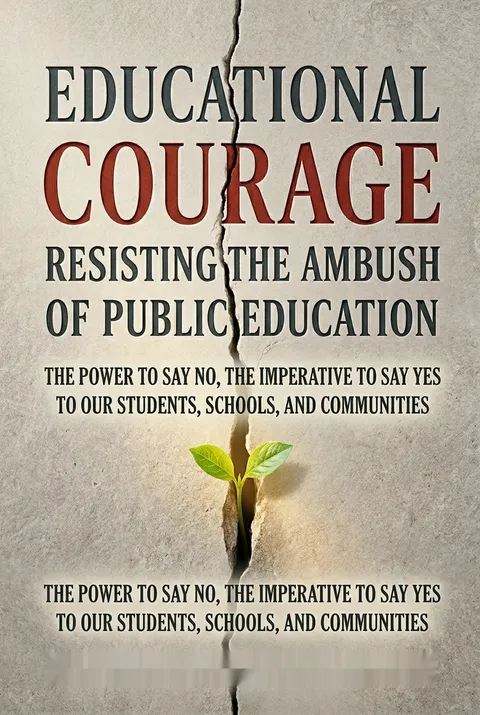
Educational Courage is an advocacy anthology, not a single-author research treatise. Its argument advances through testimony: students describe the humiliation of tests that ignore disability, a teacher recalls a child’s distress, and educators and parents recount organizing against policies they believe damage public schooling. The form is part of the case. The book treats lived experience as evidence that official scores cannot capture on their own, and it invites readers to connect classroom consequences to policy choices.
Its strongest contribution is to make resistance practical rather than merely oppositional. The collection presents several routes: refusing an unjust demand, teaching creatively within constraints, building parent organizations, reforming unions, and creating alternatives such as Nebraska’s teacher-led assessment system. Individual stories become persuasive when they are connected to organized action and concrete outcomes, such as Chicago ending the CASE exam systemwide or Milwaukee stopping a proposed takeover.
The argument is also explicitly normative. It defines public education not only as preparation for employment, but as a democratic institution where people learn to think critically, cooperate across difference, and participate in public life. That vision gives the book coherence, but it also shapes its selection of evidence. Readers hear much more about harms associated with market reforms than about cases where standardized measures or charter schools may have helped identify a problem or serve a student well. The collection’s strongest formulation does not require ignoring those possibilities: it asks that evidence be interpreted alongside context, and that policy serve students rather than metrics.
A further limitation is that compelling narratives establish human stakes more readily than causal proof. A success story can show possibility without isolating which intervention produced the outcome. The book’s more durable lesson is therefore methodological as well as political: include those closest to schools in defining problems, use multiple forms of evidence, and treat policy as something communities can question and shape. Its call for courage is grounded in a specific practice: learn the issue, find allies, tell the story clearly, and keep creating educational spaces that embody the democratic values being defended.
Review Summary
The reviews for Educational Courage are mixed. One reader gave it 2/5, criticizing the book's tone and lack of solutions, but appreciated an essay on Teach For America. Another reader rated it 5/5, praising it as an excellent collection of essays on education reform issues, offering concrete ideas and experiences to resist pressure and work with integrity. They recommend it for teachers and administrators feeling pressured to conform. The overall rating on Goodreads is 3.83 out of 5 based on 18 reviews.
Glossary
Neoliberalism
Market-first policy approachIn this book, neoliberalism describes a political and economic approach that shifts resources and decision-making from public institutions toward private markets. Applied to education, it favors competition, consumer choice, privatization, and business-style measures of performance. The authors argue that this approach treats schooling as a market service rather than a shared public responsibility.
No Child Left Behind (NCLB)
Federal testing and accountability lawA 2002 United States federal education law requiring states receiving federal funds to set learning standards, test students regularly, and report school progress. Schools that failed to meet required targets faced escalating consequences. The book criticizes the law for relying heavily on standardized test scores, imposing unrealistic proficiency goals, and penalizing schools without addressing unequal resources.
Working in the cracks
Teaching authentically within constraintsA form of resistance in which educators use the limited discretion available within test-driven or tightly controlled schools to teach meaningful, student-centered material. Teachers may connect required skills to students’ lives, create culturally relevant lessons, or make room for social and emotional learning. The phrase recognizes both educators’ creativity and the constraints that make such work difficult.
School-based, Teacher-led Assessment and Reporting System (STARS)
Locally designed assessment systemNebraska’s assessment approach, described by Doug Christensen and Chris Gallagher, in which teachers and schools developed assessments linked to locally taught curricula. Districts managed assessment processes, while the state reviewed their technical quality. STARS aimed to make assessment useful for teaching and learning and to place professional judgment closer to the classroom.
Social justice unionism
Community-centered union activismA model of teacher unionism that combines protecting members’ workplace rights with organizing for broader educational and social equity. It emphasizes rank-and-file participation, alliances with parents and communities, antiracist curricula, and collective action on issues beyond contract negotiations. The book presents it as a way for unions to defend public education while also working to transform it.
Value-added model (VAM)
Test-score-based educator evaluationA statistical approach that estimates an educator’s contribution by comparing students’ test-score changes over time. The book questions using VAM for high-stakes decisions, citing instability in scores, error rates, and influences outside school such as poverty, health, and students’ prior learning. It argues that test-score growth alone cannot provide a complete or reliably fair judgment of teaching.
Download PDF
Download EPUB
.epub digital book format is ideal for reading ebooks on phones, tablets, and e-readers.








