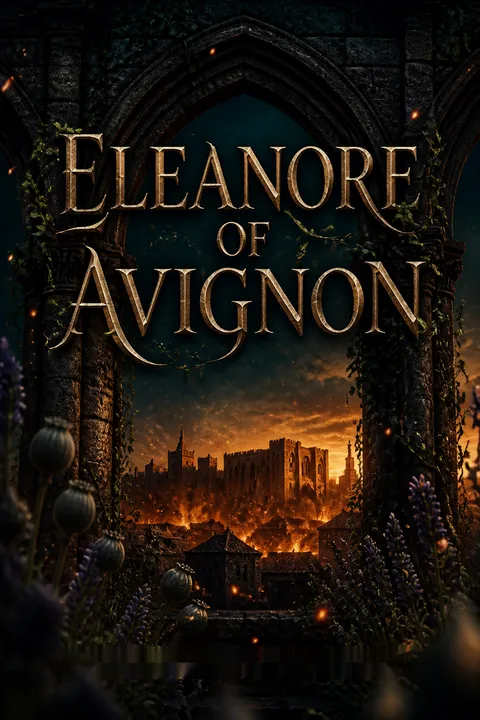


Plot Summary
The Dog in the Meadow
In November 1347, seventeen-year-old Eleanore Blanchet gathers herbs outside Avignon, already dreading the spring wedding that will take her twin Margot into the Dupont household. Their mother, Bietriz, died two years earlier after the family was shunned for her healing work. In a meadow, Eleanore finds a strange dog caught in an iron trap.
She calms him, frees his leg, and leaves food and her cloak nearby, though he limps away before she can help further. At home, Margot and their childhood friend Erec announce their wedding date. Then Erec asks Eleanore to visit his feverish mother, Mathilde, the woman Eleanore holds responsible for Bietriz's abandonment. Remembering her mother's plea for compassion, Eleanore agrees.
Mathilde's Fever Breaks
At the Dupont mansion, Eleanore finds Mathilde delirious in a stifling room, her arm swollen around a festering wound from repeated bloodletting. Rather than trust the physician who overlooked the infection, Eleanore cleans away the dead tissue, stitches the cut, and gives Mathilde fever medicine. The fever eases, but when Mathilde wakes she mistakes Eleanore for Bietriz and accuses her of killing a child.
Erec walks Eleanore home as his mother's cries follow her down the stairs. In the street, they encounter Father Loup, the priest who refused Bietriz her last rites, leading self-whipping penitents and preaching that the world is ending. His return revives Eleanore's fear that the old charge of witchcraft can still destroy her.
A Physician's Impossible Door
Returning to the meadow, Eleanore tends the dog's injured leg again and names him Baldoin. On the road back, she meets Guigo, the pope's physician, searching for hawthorn berries for a dangerously ill patient.
He brings her to the papal palace without first revealing that the patient is Pope Clement VI. Her mother's tonic briefly eases the pope's fever and urinary pain, but the symptoms return. Eleanore examines him herself, senses a swollen kidney, and prescribes a second remedy from Bietriz's book.
When Clement improves, Guigo keeps his bargain and takes Eleanore as his apprentice. She enters a world of medical texts, surgery, and patients, gaining both instruction and a respected patron she could never obtain through a university license.
Marseille Sends a Warning
While Eleanore learns beside Guigo, reports from the eastern ports turn into a warning from Marseille: a lethal illness has arrived on Genoese ships. Guigo and Eleanore search old medical accounts, finding descriptions of fever, bloody coughing, and swollen glands but no reliable cure.
Their first Avignon patient from Marseille, Arye Ravelle, is already coughing blood when they reach him. David, a young Jewish physician whose family died of the disease, confirms that the symptoms match the deadly lung form.
Eleanore's herbs cannot save Arye, who dies within hours. Brother Christophe, the monk who tended him, soon falls ill and dies as well. Eleanore returns to her family only after washing in freezing water, then warns them to stay inside and stock supplies.
The Dead Become Evidence
By February, plague has emptied streets and overwhelmed Avignon's hospitals. With treatments failing, Guigo persuades Clement to lift the ban on human dissection so physicians can study the disease. At La Pignotte, the poorhouse supplying bodies, Father Loup recognizes Eleanore and calls her mother's healing work sorcery.
Guigo defends his apprentice, then asks what happened between her and the priest. Eleanore explains how Mathilde mistook a uterine tumor for a lost child after Bietriz treated it, and how rumors turned the family against her mother.
When Bietriz later died in obstructed labor, no healer would come; twelve-year-old Eleanore delivered her stillborn brother and could not stop the bleeding. Guigo believes her account and tells her that her skill deserves practice, not shame.
A Queen Chooses Her Midwife
In March, Queen Joanna of Naples arrives in plague-struck Avignon to face trial for her first husband's murder. Eleanore watches the procession with Margot, who is moved by the sight of their beloved queen. After the court acquits Joanna, Guigo brings Eleanore to examine her pregnancy.
Joanna initially dismisses the young village healer, but Eleanore insists on her experience and earns a private examination. She recognizes that the child will be a girl, then hears how Joanna fears that any misfortune will be used to weaken her rule.
The queen appoints Eleanore as her midwife. Their bargain gives Eleanore time to return to Guigo's plague work, provided she answers Joanna's summons. Their relationship begins in mistrust, then deepens through care, candor, and shared awareness of women's precarious power.
Mathilde's Body Reveals More
When the slower bubonic plague reaches Avignon, Guigo finds its first victim marked by swollen, dark growths and blackened fingers. Eleanore recognizes the corpse as Mathilde, the woman she had stitched months earlier. Though shaken, she helps Guigo examine the body.
Its infected growths resemble the signs of blood poisoning she once saw Bietriz treat after childbirth. Eleanore remembers her mother's tonic and gives Guigo the recipe. He and Eleanore begin preparing it in quantity while developing a procedure to lance, drain, and close the swellings.
Their next patient is David, now sick with the same plague. Guigo operates while Eleanore and David's uncle hold him still. David survives the dangerous surgery, making the treatment more than a theory and drawing Eleanore into a closeness neither of them can safely pursue.
A Father Dies, A Friend Turns
As David recovers, Eleanore and he speak openly about grief, medicine, and their shared sense of being barred from the lives they want. Their affection grows, but Margot warns Eleanore that a relationship with a Jewish man could put them both in danger.
Soon the lung plague kills their father, Bernard. Eleanore and Guigo stay beside him through his final night, while Margot and Anes wait outside, given tasks to keep them from watching his suffering. After the funeral, Eleanore returns to work and meets Erec at the stables, where she tries to deliver Margot's letter.
Erec instead accuses her of helping desecrate Mathilde's body. He believes Father Loup's claims, rejects Eleanore's explanation, and leaves without taking the letter. Eleanore later burns it, sparing Margot an answer she cannot bear to deliver.
The Square Turns on Jews
In June, Eleanore sees Father Loup draw a furious crowd into the square outside Saint-Agricol. He blames Jews for the plague and urges townspeople to attack them. Erec stands among the listeners. Eleanore escapes the crowd and warns David that he and his family are in danger. She also urges Guigo to intervene, but he trusts the papal guards to keep order.
David later tells her that a mob has already looted and burned a Jewish shop while the guards did nothing. The accusation has become a license for violence. Eleanore cannot protect the Jewish quarter, but she refuses to treat the threat as rumor. Her concern for David now collides with the risk of exposing herself, and with the limits of the authority she has earned.
Guigo's Bubo, Eleanore's Test
When Guigo falls ill with bubonic plague, Eleanore finds him feverish and alone in his rooms. He guides her through the treatment while he is briefly lucid, insisting that she wait until the swelling is ready and operate before the infection reaches his blood.
Eleanore tends him while also attending Joanna, whose pregnancy is nearly due. When Guigo's growth darkens and expands, she lances, drains, and stitches it herself, then gives him the blood-cleansing tonic.
The next day, she returns to the family home for more medicine and finds Margot ready to admit that Erec never answered her letter. Margot apologizes for condemning Eleanore's feelings for David and urges her to accept happiness if it comes. Eleanore returns to the palace carrying both the medicine and her sister's blessing.
A Princess Breathes
As Guigo slowly recovers, Joanna goes into labor. The baby is coming face-up with the umbilical cord around her neck, a position that recalls the stillborn brother Eleanore once failed to save. She reaches into the birth canal, turns the child against the next contraction, and delivers a bruised, silent girl.
Eleanore strikes the baby's back until she breathes. Joanna names her Catherine. When Naples is freed from Hungarian occupation, Joanna offers Eleanore a permanent position at court and a generous income there.
Eleanore declines because Margot and her work in Avignon still need her. The queen is hurt, but later grants Eleanore a title, three hundred sous, and safe passage through her kingdom. That protection cannot shield Eleanore from the hostility gathering outside the palace.
The Witch's Trial
After Joanna's court leaves, a young man tells Eleanore that Margot is ill and leads her away from the guarded palace. He is part of a trap. Eleanore recognizes him from Loup's mob and stabs him with her scalpel, but two monks capture her and lock her in the Dupont dye warehouse. Brother Remy secretly warns her that Loup will try her for witchcraft and burn her at dawn.
At the public hearing, Loup displays Bietriz's remedy book and Eleanore's anatomical drawings as proof of sorcery, falsely claiming that she poisoned Guigo and helped Jews spread the plague. Erec tries to defend her, but monks seize him. The crowd stones Eleanore, and Loup sentences her to burn. They imprison her in Saint-Agricol's crypt beneath her mother's burial place.
Margot Takes Her Place
Before dawn, Paolo and Brother Remy unlock the crypt and guide Eleanore through the church. Outside, Anes, Erec, and Guigo help Paolo put her on a horse. Eleanore rides away believing the group has rescued her; only on the road does Paolo reveal the plan.
Margot had contracted the plague and insisted on taking Eleanore's place at the pyre, hoping her death would prevent Loup from choosing another victim. Guigo carried Margot, dressed in Eleanore's clothes, back into the church. Eleanore's escape succeeds, but her twin dies in her place.
She collapses in the woods, unable to reach Margot through the bond that once made their grief shared. Inside her embroidered cloak, she finds Margot's final note reminding her of their lifelong closeness. Paolo stays beside her as they travel toward Marseille.
The Road Beyond Avignon
In Marseille, Eleanore spends days barely speaking, with Baldoin at her side and Paolo bringing food until she can begin to walk and eat again. Guigo's letter confirms that he is recovering and that Anes has found a place in the palace kitchens. Eleanore boards a ship bound for Naples with Paolo and Baldoin, still carrying Margot's note and the guilt of her survival.
On deck, she encounters David, who is traveling toward Granada, where he hopes to practice medicine among people of different faiths. Their separation had once seemed inevitable; now, away from Avignon's laws and threats, they can choose what comes next. Eleanore takes David's hand, accepting the possibility of a life built around both healing and love.
Epilogue
At sea, Eleanore carries Guigo's news of recovery and Margot's final note while the grief of escape still makes ordinary meals and sunlight feel remote. Baldoin refuses to leave her side. In Marseille, Paolo helps her return to the world one walk at a time, then brings her aboard the ship bound for Naples.
David is on the same vessel, traveling toward Granada. With the dangers of Avignon behind them, Eleanore reaches for his hand and chooses a future with him, though the voyage and the life beyond it remain uncertain.
The ending offers possibility without pretending that survival cancels loss. Eleanore carries her sister's message and Guigo's letter as material ties to the people she has left behind, while Baldoin's presence anchors her in the living world. Her choice of David is not a cure for grief but a decision made after grief has altered what she values. The ship gives her a threshold between coercive local rules and an unknown future, not a guarantee of safety. By reaching for David, Eleanore accepts that love and vocation can coexist, even when neither restores the family she has lost.
Analysis
The novel's central conflict is not simply medicine against superstition. It is a struggle over who is allowed to interpret suffering. Eleanore, Guigo, and David observe bodies, test inherited remedies, and revise their ideas when patients worsen. Their knowledge remains incomplete, but it is accountable to evidence. Father Loup offers a more emotionally satisfying explanation: the plague must be someone's fault, and a frightened community can restore order by punishing a visible enemy. His certainty spreads faster than the physicians' findings because it converts helplessness into action.
Gender and religious prejudice shape who can practice, who is believed, and who is protected. Guigo has crossed class barriers through training; Eleanore's comparable skill remains vulnerable to the label of witchcraft. David's medical learning cannot shield him from anti-Jewish violence. Their different exclusions reveal that expertise alone does not grant safety. It must be backed by institutions, and institutional protection can disappear when a ruler leaves or a crowd decides that law is too slow.
The book also treats care as labor rather than sentiment. Eleanore's work includes cutting infected tissue, changing bandages, carrying medicine, and sitting through deaths she cannot prevent. Guigo teaches her that a physician's duty is presence, not mastery over mortality. Her grief for her mother, father, and sister repeatedly tempts her to understand each loss as a personal failure. The distinction between care and control becomes essential to her survival.
Finally, the twins offer two forms of agency rather than a simple opposition between freedom and domesticity. Margot seeks safety through home and attachment; Eleanore seeks it through knowledge and work. Each can misunderstand the other's choices, yet their bond allows them to revise those judgments. Eleanore's eventual movement toward David does not replace that bond. It carries its lessons forward: survival can mean accepting help, continuing one's work, and choosing love without pretending that loss has been repaired.
Review Summary
Eleanore of Avignon receives overwhelmingly positive reviews, praised for its engaging historical fiction set during the Black Death. Readers appreciate the well-researched portrayal of 14th-century France, the strong female protagonist, and the exploration of medicine and herbalism. Many consider it a captivating debut novel with rich characters and a compelling plot. Some criticisms include pacing issues and occasional implausibility. Overall, reviewers recommend it for those interested in historical fiction, particularly stories featuring women in medicine during challenging times.
Characters
Eleanore Blanchet
The instinctive healerA young herbalist and midwife in Avignon, Eleanore is the daughter of Bietriz and twin sister of Margot. She inherits her mother's remedies and an unusual ability to read illness through touch, but has no formal license or social protection. Her work is driven by the wish to save people her mother could not, and by a hunger to learn medicine on her own terms. That ambition gives her courage, but grief and self-blame make every failure feel personal. Eleanore must learn that healing is not the same as defeating death, and that responsibility does not require her to erase her own needs. Her relationship with Margot, Guigo, and David gives different forms to her need for belonging.
Margot Blanchet
Eleanore's twin and anchorEleanore's identical twin is sociable, practical, and skilled at household accounts and needlework. Where Eleanore seeks independence through medicine, Margot imagines security through marriage and family. Their intimacy is profound, but it does not make them interchangeable: Margot wants a protected home, while Eleanore fears that marriage would limit her life. She has also experienced the cost of being left behind while her mother and sister worked together. Her affection can make her protective to the point of judgment, especially when Eleanore's choices seem dangerous. Margot's embroidery, domestic labor, and capacity to comfort turn care into a craft as serious as Eleanore's healing.
Guigo
The generous physicianGuy de Chauliac, known as Guigo, is Pope Clement's physician and a surgeon who rose from a poor farming family through ability and study. Large, curious, and often cheerfully blunt, he combines technical confidence with a genuine respect for knowledge beyond university texts. He recruits Eleanore because he recognizes her skill, then teaches her anatomy and surgery without treating her as a curiosity. His mentoring rests on a demanding view of medicine: physicians cannot promise cures, but they must remain present and useful. Guigo's loyalty to Avignon and his patients puts him at odds with the impulse to retreat from danger. He gives Eleanore professional recognition while insisting that she accept the weight of the work.
David
The grieving young physicianA Jewish physician trained under his uncle, Jacob Farissol, David comes to Avignon carrying the trauma of losing his family to plague. He is observant, intellectually serious, and drawn to medicine as a response to suffering rather than a route to status. His grief sometimes makes him question why he survived, yet he continues treating patients and confronting danger. With Eleanore, he finds someone who understands both the cost of loss and the frustration of being barred from a full professional life. Their affection is shaped by religious prejudice and social law, but David refuses to reduce Eleanore to a romantic escape. He imagines a place where their skills and identities might be less constrained.
Queen Joanna
The embattled queenJoanna rules Naples and Provence amid political accusation, military threat, and the expectations imposed on a female monarch. She is commanding, strategic, and accustomed to reading the motives of everyone around her. Beneath her cultivated authority is a woman deeply invested in her kingdom and her family, who knows that private vulnerability can become public ammunition. She initially tests Eleanore's competence, then develops trust through their shared work and candid exchanges. Joanna's power can protect Eleanore, but it also comes with demands and limits. Her relationship with Eleanore reveals the uneasy balance between patronage and independence: a royal favor may open doors, yet accepting it can redirect an entire life.
Paolo di Rosa
The court's tender musicianA Neapolitan court musician and composer, Paolo is the younger brother of Joanna's confidante, Imilia. He is playful, perceptive, and emotionally generous, using music and humor to ease the strain around him. His artistry marks him as different from the masculine ideal prized by his father, and his past gives him a particular understanding of grief and fear. Paolo offers Eleanore companionship without demanding that she mistake comfort for romance. He also knows how to act decisively when someone he loves is in danger. His warm presence provides a counterpoint to the book's harsher forms of power and devotion.
Erec Dupont
Margot's childhood belovedErec is the son of a wealthy merchant and a childhood friend of both Blanchet twins. His bond with Margot is longstanding, and his kindness once made him part of their family life. He is also shaped by merchant status, masculine expectations, and the religious suspicions circulating through Avignon. Erec's grief and insecurity can narrow his moral vision, making him vulnerable to people who offer certainty and someone to blame. His relationship with Eleanore begins in familiarity, but their opposing understandings of medicine and responsibility test that bond. He represents how fear can convert personal loss into public allegiance.
Anes
The family's kitchen heartAnes is the Blanchet household's cook and housekeeper, but her place in the family is closer to kin than servant. Orphaned by pox as a child, she has built belonging through food, practical competence, and fierce loyalty. Her blunt humor often cuts through Eleanore's self-absorption, while her watchfulness catches changes others miss. Anes worries about Eleanore's safety and does not pretend that professional ambition is harmless in a city hostile to independent women. Her kitchen is a refuge where care becomes tangible: meals, clean linens, and the work of keeping a household alive.
Bernard Blanchet
The twins' devoted fatherBernard is a papal notary whose injury ended an athletic youth and left him with a lifelong limp. He is affectionate and proud of his daughters, though he tends to interpret security through conventional marriage and respectable income. His work connects the family to the palace and the politics shaping Avignon, while his home life keeps him grounded in small rituals and practical affection. Bernard forgives where Eleanore struggles to forgive, especially when grief has made blame feel like a form of control. His steadiness gives the twins a shared center even as they imagine very different futures.
Mathilde Dupont
Erec's troubled motherMathilde is the wife of the wealthy merchant Allistair Dupont and Erec's mother. Her repeated miscarriages and grief leave her vulnerable to illness and periods of confusion. She once shared friendship with Bietriz, but their relationship is damaged by a devastating misunderstanding around a uterine tumor. Mathilde's history exposes how a woman's reproductive suffering could be misread by herself, her family, and the community, then turned into accusation. She matters to Eleanore not simply as an antagonist but as a person caught in a crisis no one around her knows how to interpret.
Father Loup
The preacher of suspicionA former priest of Saint-Agricol, Father Loup returns to Avignon as a leader among the flagellants. He uses religious language to turn uncertainty into certainty and suffering into a case against outsiders. His hostility toward Bietriz and Eleanore is personal, but he knows how to make private prejudice sound like public duty. Loup's authority depends on a frightened audience, which makes his performance especially dangerous during plague. He is a human antagonist rather than a supernatural one: his influence comes from rhetoric, institutional access, and a crowd ready to believe.
Baldoin
The wild, loyal dogBaldoin is a large, wary dog whom Eleanore first finds injured in a trap outside the city. He is slow to trust and carries the look of an animal not fully tamed, but responds to patience and careful handling. Eleanore's bond with him echoes her mother's ease with animals while becoming something distinctly her own. Baldoin offers companionship without explanation or judgment. His appearances in the woods, the family yard, and moments of crisis keep Eleanore connected to the living natural world beyond Avignon's walls.
Pope Clement VI
The lavish papal patronClement is Avignon's powerful pope, a lover of ceremony and luxury who relies on Guigo's medical skill. He is politically calculating but capable of recognizing competence outside established ranks. His decisions affect the city's response to plague, the practice of dissection, and the security of its residents. Clement's patronage gives Eleanore a rare institutional foothold, though the protection of a ruler is never absolute. He embodies the contradiction of a religious authority who governs through worldly power while facing a crisis no doctrine or title can immediately solve.
Jacob Farissol
David's physician uncleJacob Farissol is a Jewish physician in Avignon and David's uncle, a colleague and old friend of Guigo. He approaches medicine with seriousness and treats Eleanore as a fellow practitioner. His household offers a glimpse of Jewish civic life beyond the prejudices Christian neighbors repeat. Jacob's concern for David combines professional judgment with the intimacy of a guardian who has already witnessed terrible loss. He is also alert to the political danger facing Jewish families as plague rumors spread.
Brother Remy
The hesitant monkBrother Remy serves among Father Loup's monks but retains enough compassion to warn Eleanore about the danger facing her. He is cautious, not openly defiant, and his small acts of help carry risk precisely because they are quiet. Remy represents the possibility of moral judgment within a compromised institution.
Plot Devices
Bietriz's remedy book
Inherited medical memoryThe battered book contains Bietriz's herbal recipes, surgical notes, and practical knowledge passed from her physician father. Eleanore uses it to make medicine, interpret symptoms, and continue learning beyond the education available to women. Guigo's respect for its contents helps establish Eleanore as a serious apprentice rather than a curious folk healer. The same object can be read in radically different ways: to Eleanore it is a record of care and observation, while Father Loup recasts it as a book of spells. Its physical pages make the conflict between knowledge and superstition visible.
Eleanore's healing intuition
Hands before doctrineEleanore can sense when an animal or a patient's body is asking for attention, though she cannot always explain how she knows. She uses this instinct to calm Baldoin, identify Mathilde's infected wound, and locate the pope's swollen kidney. The gift complements, rather than replaces, her study with Guigo: touch identifies a problem, while anatomy, experience, and remedies help her respond. Because the ability has no accepted medical explanation, it resembles witchcraft to people already disposed to fear a knowledgeable woman. It gives Eleanore confidence, but also makes her vulnerable to accusations.
Plague theories and treatments
Medicine under uncertaintyAvignon's physicians have no knowledge of germs and interpret plague through inherited medical texts, humors, poisoned air, religion, and observation. Guigo and Eleanore test remedies, record symptoms, and eventually study bodies to develop a procedure for bubonic swellings. Their work cannot save everyone, and the lung form remains beyond their reach. This uncertainty is not background alone: it shapes public behavior, creates room for fraud and panic, and allows preachers to present prejudice as explanation. The treatment becomes a fragile form of hope rather than a simple cure.
Margot's embroidered cloak
A twin's lasting presenceMargot embroiders Eleanore's cloak with the herbs and plants that define her sister's work. It replaces the cloak Eleanore left for Baldoin and becomes a practical gift of affection during a season when the twins fear losing one another. The stitching gathers their family history into something Eleanore can carry: Margot's skill, their mother's botanical knowledge, and the warmth of home. Later, the cloak holds Margot's final written message. Its meaning shifts from an expression of closeness to a keepsake that helps Eleanore bear separation.
Loup's public accusations
Fear made prosecutableFather Loup repeatedly turns public crises into accusations against Jews, healers, and women who cross accepted boundaries. His sermons supply simple enemies for people facing plague, hunger, and bereavement. As his influence grows, rumor moves from the street to the scaffold, where Eleanore's remedies and anatomical drawings are presented as evidence of witchcraft. The device shows how persecution gains force: an accusation becomes credible not because it is true, but because it fits the audience's fear and is delivered by someone with authority. Its consequences reach beyond Eleanore to the whole city.
Download PDF
Download EPUB
.epub digital book format is ideal for reading ebooks on phones, tablets, and e-readers.








