

Plot Summary
The First Fallen Tile
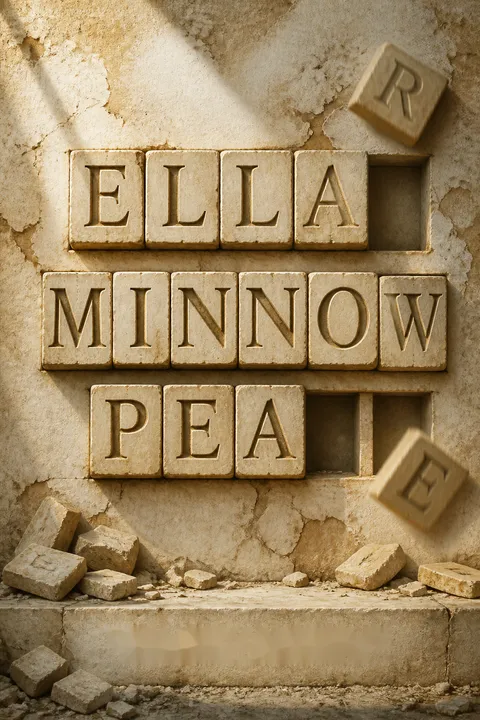
Ella Minnow Pea, a young islander who treasures language, writes to her cousin Tassie after a tile falls from the monument to Nevin Nollop, the island’s revered author. The council rejects ordinary explanations and declares the missing letter a command from beyond the grave.
It bans that letter from speech and writing, then sets penalties that escalate from public reprimand to flogging, public confinement, exile, and death. Ella initially tries to imagine the restriction as a manageable test.
Tassie, newly returned from the island’s rural village, sees the danger immediately: the council has turned an unexplained accident into authority over what people may say. Their letters become the first record of a society beginning to police its own thoughts.
The tile’s fall matters less than the council’s decision to claim exclusive authority over its meaning. By treating uncertainty as divine instruction, the rulers make disagreement appear not merely political but sacrilegious. Ella’s hesitation is psychologically credible: people often accommodate an unreasonable rule when it arrives disguised as a limited inconvenience. Tassie recognizes the deeper injury sooner because she sees that the law controls not only vocabulary but the terms on which citizens can question power.
A Vocabulary Becomes Contraband
When the prohibition takes effect, the island library closes and its books are removed, while teachers struggle to instruct children without textbooks or ordinary speech. Accidental slips become punishable offenses, and neighbors report one another.
A beekeeper is placed in the public stocks after describing his bees with a forbidden word. William Creevy, a young rule-breaker who deliberately challenges the ban, chooses flogging for his second offense, then insults the officers and is expelled.
A second tile falls, this time bearing another letter, and the council adds it to the ban rather than reconsidering its interpretation. The Island Tribune’s editor publishes a defiant final edition and leaves the island. Each response makes the rules harder to obey and public life harder to sustain.
The law converts ordinary competence into risk. A teacher’s fluency, a beekeeper’s need to describe his livelihood, and a child’s impulse to speak all become potential evidence against them. This is more than censorship: it makes citizens participate in their own surveillance by forcing them to monitor every sentence. William’s expulsion shows the difference between private dissent and public resistance. His courage is real, but the regime controls the punishment, turning his protest into a warning to everyone who remains.
The Glue Beneath the Miracle
As more tiles loosen, Tassie’s mother, Mittie Purcy, accidentally uses a banned letter while teaching and is publicly reprimanded after a pupil reports her. Meanwhile, American researcher Nate Warren sends evidence from chemists who examined fragments of the fallen tiles: the century-old adhesive is simply failing.
The council answers with a declaration that treats any practical explanation as heresy, and the bans continue to spread. The restrictions reach letters essential to past-tense verbs, making even accounts of recent events difficult to write.
Nate seeks a route onto the island and asks Mittie to host him under the cover of an old family acquaintance. His scientific explanation offers a factual counterweight to the council’s claims, but the rulers have made belief in their interpretation a test of loyalty.
The failing adhesive offers a mundane cause, but evidence cannot settle a dispute when the authorities have made their status depend on rejecting it. The council’s logic is self-sealing: agreement proves obedience, while doubt proves heresy. Mittie’s reprimand also shows how coercion travels through institutions, recruiting a child and a school into enforcement. The loss of a grammatical tool for describing the past is especially pointed. The state is not only restricting what people can say now; it is making shared memory harder to preserve.
A Thirty-Two-Letter Challenge
Nate reaches Mittie’s home and meets Tassie, who is drawn to his wit and his determination to investigate the crisis. He presents the chemical findings to Rederick Lyttle, the least rigid council member, but Lyttle insists that science cannot rule out divine purpose.
Nate shifts the argument: the council venerates Nollop for a short sentence containing every letter, so another person should be able to make one too. Lyttle accepts a contest, setting a limit of thirty-two letters and a deadline of Nollop’s birthday, November 16.
Ella’s family begins secret meetings to organize resistance, while the Rasmussens publicly defy the latest ban and are flogged. The contest gives the islanders a concrete task, even as the council continues to punish dissent and seize property left behind by emigrants.
Nate finds a way to challenge the regime on its own chosen ground. Rather than asking the council to abandon faith, he asks it to accept a test of the claim that sustains its authority. The contest therefore turns an abstract argument into a shared intellectual labor. Its strict limit makes success seem almost impossible, yet the work gives frightened people something to do together. The Rasmussens’ punishment exposes the cost of that hope: public protest can inspire others, but it also lets the council display its power.
The Island Empties
The contest begins with dozens of islanders searching for a sentence, often passing attempts through children too young to be punished. Progress slows at forty-seven letters as additional bans make writing increasingly difficult.
Nate is arrested for entering the island as an American researcher and is swiftly deported, leaving Tassie to continue the work without him. Mittie receives a second-offense sentence after a letter to her sister contains forbidden letters, and she chooses the stocks rather than a flogging.
As the council takes over abandoned property, Amos Minnow Pea, Ella’s father, loses his livelihood and returns to drinking after years of sobriety. He is expelled after a confrontation with officials. His departure leaves Ella with his farewell letter and the unfinished campaign.
The accelerating bans attack both public language and private stability. The contest’s stalled progress makes political hope feel fragile, while deportation separates Tassie from Nate just as their affection is becoming serious. Mittie’s punishment and Amos’s relapse show that resistance is not a clean heroic posture: people are exhausted, ashamed, and vulnerable to old coping habits. The council’s seizure of empty homes also changes the meaning of emigration. Leaving is no longer simply escape; it can mean surrendering the material life that might make return possible.
A Prison Door Opens
Tassie writes anonymous threats to the council and is arrested as their suspected author. Nate, already expelled once, secretly returns to the island and persuades a prison guard to help free her.
He takes Tassie and Mittie away, and both leave for the United States, where Nate can protect them and Tassie can survive without the island’s restrictions. Ella stays behind, committed to the sentence contest and to the people still on Nollop. The separation turns her family into an absent presence: she has lost her parents and cousin, while her letters to them must still obey the remaining bans.
In the village, Georgeanne Towgate, who once reported Mittie’s classroom slip, is left behind after her husband and son depart. She begins seeking help from the very people she had helped police.
Nate’s return reverses his earlier deportation, but rescue requires another separation: Tassie and Mittie can leave only because Ella remains. The choice clarifies Ella’s emerging role without making it triumphant. She is not protected from grief; she accepts responsibility because others have gone. Georgeanne’s changed position adds moral complexity to the island’s collapse. Having once trusted the authorities enough to report a neighbor, she now experiences the isolation that such trust helped create, and must approach Mittie as a person rather than an opponent.
The Last Searchers
The island’s remaining residents dwindle as the bans strip away more letters and ordinary services fail. Professor Mannheim, who has helped drive the sentence search, is shot by police while trying to escape arrest; his daughter Paula is left without a home and comes under Ella’s care.
Tom, Mannheim’s young assistant and Ella’s fellow worker, hides from the authorities but continues the effort. Georgeanne, increasingly isolated, paints her body with old paint containing lead and dies from poisoning.
Ella also hears that Agnes, a baker who has withdrawn from writing to avoid mistakes, is being expelled after one slip. Lyttle remains on the council but begins helping with the search himself. With the November deadline close and only a few letters still available, Ella keeps working beside Tom and the few people who have not fled.
The contest’s intellectual stakes are inseparable from bodily danger. A professor is killed, a child becomes an orphan, and Georgeanne’s attempt to make beauty from discarded materials destroys her. The regime’s violence has narrowed the community until acts of care become as important as acts of defiance. Ella’s care for Paula gives the search a human future beyond its formal deadline. Lyttle’s decision to help marks a quiet fracture inside the ruling body, though his change comes after the institutions he served have inflicted losses that cannot be reversed.
Amos’s Accidental Answer
With the deadline nearly upon them, several tiles fall in quick succession, leaving the island’s language close to collapse. Ella nearly loses hope, but rereads Amos’s final letter. Among its practical instructions is an accidental sentence asking her to pack a box with five dozen liquor jugs.
It uses every letter of the alphabet in exactly thirty-two letters, satisfying Lyttle’s challenge. Ella sends it to the council and credits her father, explaining that he wrote it without trying to imitate Nollop.
Lyttle accepts the sentence on the council’s behalf, and the alphabet bans are rescinded. The result arrives not through a celebrated scholar or a planned act of genius, but through an ordinary family message that Amos wrote while preparing for exile.
The solution breaks the council’s central myth by making linguistic greatness ordinary and accidental. Amos’s sentence is not a polished monument to a singular genius; it is a useful instruction born from family life and material need. That origin matters because the contest has been framed as proof that Nollop alone possessed a rare gift. Ella’s act of attribution also resists replacing one idol with another. She gives her father credit while insisting that the achievement belongs to common human capacity, not supernatural authority.
The Monument Comes Down
After accepting the sentence, Lyttle takes Ella and Tom into a government archive that escaped the destruction of most printed material. There they find a childhood book belonging to Nollop, whose handwritten notes contain the ideas and wording behind his celebrated pangram.
The discovery suggests that the island’s founder may have adapted rather than invented the sentence the council treated as proof of his uniqueness. The other council members resign, and surviving islanders join Lyttle, Ella, and Tom in breaking apart the cenotaph.
They hold a bonfire and celebrate the return of unrestricted speech. Ella proposes a memorial to those harmed by the regime, one that avoids turning another sentence into a sacred object. Her family and Tassie are invited home, though their losses remain part of the island’s history.
The archive does not simply reveal a historical detail; it dismantles the mechanism by which the council made authority sacred. Nollop’s achievement becomes human, inherited, and possibly borrowed, rather than proof of divine election. Destroying the cenotaph is therefore an act of revision, not a rejection of language itself. Ella’s proposed memorial recognizes the danger of replacing one unquestionable monument with another. The ending imagines remembrance as an account of people and consequences, not a new command demanding obedience.
Epilogue
After the island’s crisis has ended, Nate asks a computer science friend to search for short sentences containing every letter. The friend returns several possibilities, including one of twenty-six letters that depends on a proper name, along with alternatives of twenty-nine and thirty-two letters.
The result confirms that Nollop’s sentence was not beyond human invention, and that Amos’s solution was one of several possible arrangements. The final exchange extends the novel’s joke into a quiet rebuttal: once the supposed miracle becomes a problem people can test, it loses its power to demand worship.
The computer’s results do not diminish Amos’s contribution; they place it in a larger field of possibility. The island’s catastrophe began when a contingent human achievement was mistaken for evidence of a uniquely chosen authority. The postscript applies a different method: experimentation, comparison, and shared knowledge. Its lightness is deliberate. The final joke does not erase the people harmed by the council, but it shows how quickly intellectual mystique can collapse when a claim is opened to ordinary scrutiny.
Analysis
Ella Minnow Pea treats language not as ornament but as social infrastructure. The island’s citizens need words to teach, work, remember, joke, name family members, and challenge authority. When the council removes letters, it does not merely shrink a vocabulary; it makes ordinary relationships harder to maintain and gives the state new ways to punish people for being human. The epistolary form makes that pressure audible in the changing texture of each message. Early letters can be expansive and playful. Later ones labor around omissions, expose the sender’s fatigue, or stop altogether.
The council’s power depends on a mistaken conversion: a physical accident becomes a divine command, then an unquestionable law. Its officials maintain that conversion by treating doubt as disloyalty and evidence as irrelevant. The fallen tiles therefore function as a model of authoritarian interpretation. Power does not need to invent every sign; it needs only to claim the right to explain signs for everyone else.
The sentence contest counters this monopoly with collective experimentation. Its solution comes from Amos’s ordinary farewell instruction, not from a chosen genius. That origin matters because it returns linguistic creativity to common life. Ella refuses to replace Nollop with a new idol, even when the sentence saves the islanders. The later archive discovery further punctures the founder’s supposed uniqueness, while the final computer-generated alternatives show that claims of miraculous singularity can be tested rather than worshipped.
The novel does not pretend that liberation repairs everything. People are expelled, families scatter, and some die before the laws are lifted. Its hope is more modest and more credible: once people can speak freely, they can recover the capacity to interpret their world together. The book’s central warning is therefore not simply that censorship is cruel. It is that a society becomes vulnerable when it gives any authority exclusive control over meaning.
Review Summary
Ella Minnow Pea is a clever, satirical novel about an island society that bans letters as they fall from a statue. Told through letters, it explores themes of censorship, totalitarianism, and language. Readers appreciate its wordplay and linguistic creativity, though some find the plot weak. The book's unique premise and execution garner praise, with many enjoying its humor and allegory. However, some critics find it gimmicky or lacking in character development. Overall, it's a quick, entertaining read that celebrates language while critiquing authoritarianism.
People Also Read


Characters
Ella Minnow Pea
The letter-saving rebelElla is a young islander, daughter of Amos and Gwenette, and cousin to Tassie. She begins with a cautious faith that the council may be interpreting Nollop’s wishes correctly, but her letters reveal an observant mind increasingly disturbed by the cost of obedience. She is practical as well as imaginative, working at the launderette and later helping sustain the search for a sentence. Family ties give her a reason to keep writing even when communication becomes exhausting. Ella’s strength is not fearlessness; it is her ability to keep making connections among people, evidence, and words when public life is designed to break those connections.
Tassie Purcy
The village’s sharp witnessTassie is Ella’s cousin and the daughter of teacher Mittie Purcy. Intelligent, lonely, and keenly alert to injustice, she recognizes early that the language bans threaten more than convenience. Her letters move between political observation and intimate self-disclosure, making her a vivid witness to the village’s fear and her own desire for companionship. Tassie is drawn to the outsider Nate because he combines curiosity with a willingness to challenge the island’s official story. Her loyalty to her mother and her attachment to Ella shape how she weighs private happiness against responsibility to others.
Mittie Purcy
The teacher under pressureMittie is Tassie’s mother, a village teacher and longtime friend of Gwenette. She values education and care for children, which makes the destruction of books and the policing of classroom speech especially painful. Her accidental violation exposes the impossible burden placed on people whose work depends on fluent language. Mittie’s shame initially makes her withdraw, but her relationships with Tassie, Ella, and Rory help her recover a sense of connection beyond the council’s judgments. She is compassionate without being naïve, and her instinct to help even a former accuser reflects a moral independence that the regime cannot fully suppress.
Amos Minnow Pea
The artisan and fatherAmos is Ella’s father, Gwenette’s husband, and a maker of miniature vessels whose craft supports the family when island work is scarce. He is affectionate and resourceful, with a history of sobriety that makes his return to drinking a sign of how deeply the crisis has wounded him. Amos’s practical outlook contrasts with the council’s grand claims: he thinks about work, money, food, and the people he loves. His family sees both his tenderness and his vulnerability. He remains important to Ella not as a perfect hero, but as a father whose ordinary life carries consequences far beyond what he intends.
Nate Warren
The outsider investigatorNate is an American graduate student and editor of a journal devoted to Nollop. His research gives him access to chemical evidence that the islanders cannot easily obtain, while his academic interest makes him willing to question the legend surrounding Nollop. Nate is persistent and intellectually nimble, shifting from scientific proof to a challenge aimed at the council’s deepest claim. His growing relationship with Tassie gives his investigation personal stakes. He is not merely a rescuer or an expert from outside; he depends on the islanders’ trust, labor, and courage to make his evidence matter.
Rederick Lyttle
The council’s wavering elderLyttle is an elderly member of the High Island Council and the most intellectually cautious of its leaders. He does not immediately reject the possibility that the tiles carry divine meaning, but he is more willing than his colleagues to entertain evidence and argument. His status gives him a route into the debate that ordinary islanders do not possess. Lyttle’s uncertainty makes him a hinge between the council’s official doctrine and the contest that tests it. He represents the possibility that a person inside a compromised institution can still recognize a valid challenge.
Tom
The hidden language partnerTom is Professor Mannheim’s young assistant and one of the few people who continues working on the sentence contest as the island empties. He becomes Ella’s collaborator and friend, sharing both the technical labor of the search and the risks created by police scrutiny. His intelligence is paired with loyalty to the professor and his daughter. Tom’s presence gives Ella a companion in the last stages of the effort, when the wider community has been reduced to a small and vulnerable handful.
Gwenette Minnow Pea
The steady family anchorGwenette is Ella’s mother and Amos’s wife, a warm, observant presence within the Minnow Pea family. Her long marriage and enduring friendship with Mittie give the family a history that predates the crisis. Gwenette tries to protect those she loves without pretending the danger is manageable, and she supports Mittie when shame and fear threaten to isolate her. Her steadiness is measured in domestic acts and emotional attention, not public speeches.
Nevin Nollop
The island’s manufactured saintNollop is the dead author whose celebrated sentence gives the island its name and its cultural pride. His monument becomes the object through which the council claims to receive instructions. Although absent from the present action, his reputation shapes the islanders’ education, identity, and political life. The gap between the historical man and the sacred figure constructed around him is central to the story’s conflict.
Professor Mannheim
The sentence-search professorMannheim is a university professor who organizes one of the most sustained efforts to find a short sentence containing every letter. He works alongside students and his daughter Paula, treating the challenge as both a linguistic puzzle and a form of resistance. His persistence helps give the scattered searchers a shared purpose. Mannheim’s care for Paula sits beside his intellectual focus, connecting the abstract task to the vulnerable people who depend on him.
Georgeanne Towgate
The repentant village loyalistGeorgeanne is a village woman who trusts the council’s interpretation of Nollop and reports Mittie’s classroom slip. As the crisis deepens, she experiences isolation and hardship herself, and her relationship with Mittie changes from accusation to a plea for mutual recognition. Georgeanne’s belief is sincere, though it makes her complicit in a system she does not fully understand. Her changing circumstances expose how quickly civic loyalty can become personal vulnerability.
Rory Cummels
The market’s humane keeperRory owns the village market and is a neighbor of Mittie’s. His family leaves the island, while his property and livelihood make departure difficult. Rory is unusually adept at finding ways to communicate under the restrictions, and his companionship offers Mittie a measure of ease and warmth. His attachment to his home gives the council’s property seizures a personal face.
William Creevy
The defiant young exileWilliam is a rebellious young man whom Tassie admires despite his troublemaking. He openly rejects the council’s authority and accepts punishment rather than pretending to comply. His fate warns the islanders that public defiance can bring swift, permanent consequences.
Agnes Prather
The village’s quiet bakerAgnes is Mittie’s close friend, known for baking cookies and caring for her family. As the bans accumulate, the effort required to speak and write becomes so taxing that she withdraws from communication. Her experience shows how censorship can silence people without requiring them to change their beliefs.
Paula Mannheim
The professor’s young daughterPaula is Professor Mannheim’s young daughter and a capable participant in the sentence search. Her dependence on adults becomes increasingly important as the island’s violence disrupts family life. Through her, the contest’s future is connected to the children who will inherit whatever remains of Nollop.
Plot Devices
The falling cenotaph tiles
A false divine instructionTiles bearing letters fall from Nollop’s monument as its old adhesive decays. The council interprets each fall as an order to remove that letter from speech and writing, then uses the interpretation to justify escalating penalties. The physical cause is ordinary, but the political meaning assigned to it becomes the engine of the plot. The tiles also make the crisis visible: every fall turns an abstract restriction into an event the islanders can witness and fear.
The islanders’ letters
A record under censorshipThe story unfolds through letters, notes, official notices, and private messages exchanged among Ella, Tassie, Mittie, and others. As letters are banned, the writing itself changes, becoming more difficult and revealing how each restriction affects thought, memory, intimacy, and practical life. The form lets readers experience both the ingenuity required to communicate and the uneven access people have to information. It also makes private correspondence a fragile counterarchive to the council’s official account.
The expanding letter bans
Language becomes a trapEach new prohibition removes useful words and letter combinations, turning ordinary speech into a field of accidental offenses. The rules affect teaching, journalism, family names, dates, and the ability to describe the past. Their escalation dramatizes how censorship can become self-reinforcing: citizens monitor themselves, neighbors report one another, and the state can punish mistakes as readily as deliberate resistance. The restrictions also shape the novel’s verbal play, making each surviving message a small act of adaptation.
The thirty-two-letter contest
A test of Nollop’s uniquenessNate proposes that the islanders produce a sentence containing every letter in no more than thirty-two letters. Lyttle accepts the challenge, giving the resistance a deadline and a measurable way to question the sacred status of Nollop’s famous sentence. The search brings together professors, children, families, and isolated neighbors. Its strict formal limit sustains suspense while linking a linguistic puzzle to the islanders’ political survival.
Children as couriers
A narrow channel of speechChildren below the council’s age threshold can still write freely, so adults enlist them to carry sentence attempts and messages. This loophole lets the search continue, but it also exposes the absurdity of the law: children become essential intermediaries in a society that has made ordinary adult communication dangerous. Their role combines ingenuity with vulnerability, since the council can still exploit families and institutions around them.
FAQ
0. Synopsis & Basic Details
What is Ella Minnow Pea: A Novel in Letters about?
- A Linguistic Dystopia: Ella Minnow Pea is an epistolary novel chronicling the gradual collapse of a utopian island society, Nollop, as its governing High Council progressively bans letters of the alphabet, believing fallen tiles from a statue of their revered linguist, Nevin Nollop, are divine commands.
- Fight for Free Speech: The story follows young Ella Minnow Pea and her community as they struggle to communicate, maintain their sanity, and ultimately resist the increasingly draconian laws that threaten to silence them completely, forcing them to find a pangram to save their language.
- Satirical Allegory: Through a clever lipogrammatic constraint, the novel satirizes authoritarianism, censorship, and the dangers of blind faith, exploring the profound connection between language, identity, and freedom in a world where words are literally disappearing.
Why should I read Ella Minnow Pea: A Novel in Letters?
- Unique Literary Experiment: Readers seeking a truly original and intellectually stimulating experience will be captivated by Mark Dunn's ingenious use of lipograms, which forces both characters and the author to adapt their language as letters are banned, creating a narrative that is both challenging and deeply immersive.
- Timely Social Commentary: Beyond its clever premise, the novel offers a powerful and enduring allegory for the dangers of censorship, the erosion of civil liberties, and the insidious nature of authoritarian control, making its themes of freedom of speech and resistance highly relevant in any era.
- Heartfelt Human Story: Despite the linguistic gymnastics, Ella Minnow Pea is fundamentally a story about human resilience, love, and community, showcasing how individuals cope with unimaginable loss and fight to preserve their connections and identity in the face of overwhelming adversity, making it a moving and memorable read.
What is the background of Ella Minnow Pea: A Novel in Letters?
- Fictional Island Nation: Nollop is an autonomous island nation established in the 1840s by dispossessed Southern Americans, later declaring independence in 1870. Its culture, as described in the book's epigraph, emphasizes liberal arts education and scholarship, elevating language to an art form while shunning modern technology.
- Homage to Pangrams: The island is named after Nevin Nollop, the fictional author of the famous pangram "The quick brown fox jumps over the lazy dog." This reverence for language and Nollop's creation forms the bedrock of their society, making the High Council's decrees particularly ironic and devastating.
- Epistolary Tradition: The novel's format as a series of letters reflects Nollop's insular, pre-technological society, where letter-writing is the primary mode of communication, underscoring the cultural context that makes the linguistic bans so impactful on daily life and personal relationships.
What are the most memorable quotes in Ella Minnow Pea: A Novel in Letters?
- "The quick brown fox jumps over the lazy dog.": This iconic pangram, central to Nollopian identity and the catalyst for the entire plot, symbolizes the perfection of language that the islanders strive to protect, and its gradual mutilation visually represents the erosion of their freedom and culture.
- "We are, when it comes right down to it, all of us: mere monkeys at typewriters.": Ella's profound realization at the novel's climax challenges the notion of Nollop's divine genius, asserting that creativity and even genius can arise from accidental, ordinary sources, democratizing the power of language and undermining the Council's authority.
- "Dead dogs tell no tails.": The proposed new inscription for the cenotaph, a deliberate anti-pangram, serves as a powerful, ironic statement against the previous veneration of Nollop's sentence, ensuring that future generations will not fall prey to similar linguistic idolatry and the tyranny it can breed.
What writing style, narrative choices, and literary techniques does Mark Dunn use?
- Progressive Lipogrammatic Constraint: Mark Dunn masterfully employs a lipogram, where each banned letter is systematically removed from the narrative itself, forcing the author's prose to mirror the characters' struggles, creating a unique and immersive reading experience that directly reflects the story's central conflict.
- Epistolary Narrative: The entire novel unfolds through letters, notes, and other written communications between characters, providing intimate, first-person perspectives that reveal emotional states, personal struggles, and the gradual breakdown of society, making the reader a direct witness to the unfolding crisis.
- Satirical Tone and Allegory: Dunn uses a blend of whimsical absurdity and sharp satire to critique authoritarianism and the dangers of dogmatic belief, transforming the seemingly lighthearted premise of a disappearing alphabet into a profound allegory for real-world issues of censorship, freedom of speech, and the abuse of power.
1. Hidden Details & Subtle Connections
What are some minor details that add significant meaning?
- Amos's Moonshine Jugs: Initially a seemingly trivial hobby for Ella's father, Amos, his miniature moonshine jugs become the unexpected source of the saving pangram, "Pack my box with five dozen liquor jugs." This detail subtly reinforces the theme that profound solutions can emerge from the most ordinary, even overlooked, aspects of life, challenging the Council's elitist view of language.
- The Secretary's Failed Challenge: The Council's letter of September 11 mentions Nollop's "saucy stenographer" who was cashiered for claiming she could create a pangram and failing. This seemingly throwaway anecdote directly foreshadows the ultimate challenge presented to the islanders, highlighting the Council's hubris and Nollop's own insecurity, while setting the stage for the eventual success of ordinary people.
- Georgeanne Towgate's Paint: Georgeanne's descent into painting her body with "remnant paint" from the hardware store, leading to her death from lead poisoning, is a tragic, subtle detail. It symbolizes the toxic environment created by the Council's tyranny, where even attempts at self-expression become self-destructive, and highlights the hidden costs of societal breakdown beyond just linguistic loss.
What are some subtle foreshadowing and callbacks?
- Ella's Early Linguistic Play: In her first letter, Ella notes her own ability to substitute words for "Z" (e.g., "gaze" to "looked," "snooze" to "sleep"), even musing, "Perhaps I may actually grow to embrace this challenge." This early, almost playful, engagement with linguistic adaptation subtly foreshadows her eventual central role in solving the pangram challenge and her resilience in the face of escalating restrictions.
- Nate's "Charlatan" Theory: Nate Warren's early assertion that Nollop was a "pure charlatan" and "without any merit" directly foreshadows the discovery in the vault that Nollop's famous pangram was likely derived from a children's storybook. This callback validates Nate's skepticism and exposes the foundational lie upon which the Council's authority was built, revealing the true nature of Nollop's "genius."
- The "Monkeys at Typewriters" Metaphor: Ella's final reflection that "any one of us could have come up with such a sentence. We are, when it comes right down to it, all of us: mere monkeys at typewriters" echoes the Council's earlier dismissal of Nollop's secretary. This callback powerfully subverts the Council's elitist view of creativity, suggesting that genius is not exclusive but inherent in ordinary human endeavor, and that even random chance can yield profound results.
What are some unexpected character connections?
- Mittie Purcy and Rory Cummels: Tassie's mother, Mittie, finds an unexpected romantic connection with Rory Cummels, the market owner, after both are deeply affected by the Council's decrees and personal losses. This relationship, blossoming amidst despair, highlights the enduring human need for companionship and hope, even as their world crumbles, offering a poignant counterpoint to the widespread isolation.
- Ella Minnow Pea and Tom: Tom, Professor Mannheim's young assistant, becomes Ella's primary partner in the final, desperate push for Enterprise 32 after Mannheim's death. Their collaboration, marked by mutual respect and a burgeoning affection, demonstrates how shared purpose and adversity can forge strong, unexpected bonds, transcending previous social hierarchies (university assistant and laundress).
- Georgeanne Towgate's Late Redemption: The initially antagonistic Georgeanne, who reported Mittie, later seeks solace and friendship from Mittie and Ella as her own family leaves and she faces isolation. Her final, tragic letters, expressing regret and a desire for connection, reveal a complex character driven by fear, not malice, and underscore the devastating, isolating impact of the Council's policies on even its unwitting enforcers.
Who are the most significant supporting characters?
- Professor Mannheim: A university instructor who dedicates himself to Enterprise 32, Professor Mannheim represents the intellectual and academic resistance to the Council's tyranny. His tireless efforts to find a new pangram, culminating in a 44-letter sentence, provide crucial momentum and expertise to the cause, making his eventual death a significant blow and a symbol of the regime's brutality.
- Tanya T. (the woman in the orange hat): Tanya, Ella's new neighbor, quickly becomes a vital ally and friend, offering practical support and emotional solidarity. Her willingness to connect with Ella, despite the pervasive fear, and her eventual role in caring for Georgeanne and Paula, highlight the importance of community and mutual aid in times of crisis, embodying the spirit of human connection.
- Sentry William P.: This unnamed prison sentry, who allows Nate to free Tassie and Mittie, is a pivotal character whose single act of defiance changes the course of the narrative. His decision to accept flogging rather than betray his conscience demonstrates that even within the oppressive system, individual morality and compassion can prevail, offering a powerful moment of hope and resistance.
2. Psychological, Emotional, & Relational Analysis
What are some unspoken motivations of the characters?
- High Council's Power Consolidation: Beyond their stated reverence for Nollop, the Council members, particularly Willingham and Houston, are subtly motivated by a desire for absolute power and control. Their increasingly arbitrary rules, property confiscations, and the creation of "Nollopian tax-exempt ecclesiastical boroughs" (Satto-gatto, September 30) reveal a clear agenda to enrich themselves and solidify their authority under the guise of divine will, rather than genuine piety.
- Mittie Purcy's Search for Solace: Mittie's rapid embrace of Nate Warren's visit and later Rory Cummels's company, despite her initial despair, suggests an unspoken, deep-seated need for intellectual stimulation and emotional connection. Her willingness to "act so hastily" (Monday, September 4) in inviting Nate, and her appreciation for Rory's "ease with language" (Fribs, September 29), reveal a yearning to fill the void left by her husband's absence and the intellectual vacuum created by the bans.
- Amos Minnow Pea's Return to Alcohol: Amos's relapse into drinking, described by Gwenette as "fallen totally off the wagon" (Thurby, September 28), is an unspoken coping mechanism for his profound sense of powerlessness and despair. His inability to work, the threat of exile, and the unraveling of his family's life likely fuel this return to an old addiction, highlighting the psychological toll of the tyranny on even the most grounded individuals.
What psychological complexities do the characters exhibit?
- Mittie's Fluctuating Resilience: Mittie Purcy exhibits a complex psychological journey, oscillating between deep despair and surprising resilience. After her public reprimand, she feels "shame for myself" (Tuesday, August 8) and struggles to teach, yet later finds renewed purpose in the pangram challenge and a new relationship, demonstrating the human capacity for both vulnerability and recovery under duress.
- Georgeanne Towgate's Fear-Driven Conformity: Georgeanne's initial eagerness to report violations and her rigid adherence to Council decrees stem from a deep-seated fear of losing her property and family, rather than genuine malice. Her later isolation and tragic death from lead poisoning, coupled with her desperate pleas for connection, reveal the psychological torment and ultimate self-destruction that can result from prioritizing security over conscience.
- Rederick Lyttle's Moral Awakening: Councilman Lyttle, initially a "taciturn rubber-stamper" (Friday, September 15), displays a complex internal conflict between loyalty to the Council and a growing recognition of its absurdity. His willingness to "entertain" Nate's challenge and his eventual resignation and participation in the cenotaph's destruction show a moral awakening, highlighting the potential for individual conscience to challenge systemic corruption.
What are the major emotional turning points?
- The Rasmussen Family Flogging: The public flogging of the Rasmussen family, including young children, for a "Q"-related protest (Wednesday, September 6) is a major emotional turning point. It shatters the illusion of a benign authority, igniting a "rage burns deep within me" in Tassie and galvanizing Ella's family to form a "nascent underground movement," transforming passive fear into active resistance.
- Nate Warren's Banishment: Nate's swift banishment (Thurby, October 5) after being discovered as a scholar is a devastating emotional blow, particularly for Tassie, who expresses a profound "terrible loss." This event underscores the Council's ruthlessness and the high stakes of resistance, pushing the remaining characters to the brink of despair but also solidifying their resolve to continue Enterprise 32 in his absence.
- Amos's Farewell Letter and the Pangram Discovery: Amos's poignant farewell letter (Sunshine, Octane 22), written in despair before his banishment, becomes an unexpected emotional turning point when Ella discovers the saving pangram within it. This moment transforms personal grief into collective triumph, demonstrating how love and ordinary human expression can unexpectedly provide salvation, even in the darkest hours.
How do relationship dynamics evolve?
- Family Bonds Under Strain and Strengthening: The Minnow Pea and Purcy families experience immense strain due to banishment and fear, with Amos's relapse and Mittie's despair. However, these challenges also deepen their emotional connections, as seen in Gwenette's unwavering support for Amos and Ella's fierce loyalty to her family, ultimately strengthening their resolve to fight for their shared future.
- From Skepticism to Solidarity: The relationship between the islanders and outsiders, exemplified by Nate Warren, evolves from initial suspicion to crucial solidarity. Nate's scientific evidence and willingness to risk his safety bridge the gap between Nollop's insular world and external reality, fostering a collaborative spirit essential for the resistance movement.
- Community Fragmentation and Re-formation: The Council's decrees initially fragment the community, turning "Neighbor turning in neighbor" (Friday, August 11) and leading to widespread isolation. However, the shared adversity also sparks the re-formation of community bonds among the resistors, like Ella and Tanya, who actively seek out and support one another, demonstrating the human need for collective action and mutual aid.
4. Interpretation & Debate
Which parts of the story remain ambiguous or open-ended?
- The True Nature of Nollop's Genius: While Ella's final letter suggests Nollop was a "charlatan" and his pangram an "accident" derived from a children's book, the exact degree of his original linguistic genius remains somewhat ambiguous. The book doesn't definitively prove he couldn't have created it independently, leaving a slight opening for debate on whether his initial achievement was truly unique or merely fortunate, impacting the extent of his "apotheosis."
- The Fate of Exiled Nollopians: The novel concludes with the bans rescinded and the invitation for exiles to return, but it doesn't explicitly detail the experiences or reintegration of all those who left. Ella mentions reports of expatriates having a "rough time in the States," feeling "at sea" (Sunshine, October 15), leaving the long-term psychological and cultural impact of their displacement and their ability to fully "melt into the proverbial American melting pot" open to interpretation.
- The Future of Nollopian Governance: While the High Council resigns and Lyttle takes a more benevolent role, the specific structure of the "New Order" and the long-term political future of Nollop are not fully elaborated. The proposed "Dead dogs tell no tails" monument suggests a rejection of past idolatry, but the mechanisms to prevent future abuses of power or the rise of new dogmas remain an open question for the island's future.
What are some debatable, controversial scenes or moments in Ella Minnow Pea: A Novel in Letters?
- The Council's Initial Interpretation of the Fallen "Z": The High Council's immediate leap to interpreting the fallen "Z" tile as a "terrestrial manifestation of an empyrean Nollopian desire" (Wednesday, July 19) is highly debatable. Many islanders, including Ella, initially view it as "mere happenstance," highlighting the controversial nature of their dogmatic, faith-based interpretation over a simple, logical explanation, setting the stage for all subsequent tyranny.
- Georgeanne Towgate's Informant Role: Georgeanne's repeated actions as an informant, reporting Mittie Purcy for a linguistic slip (Tuesday, August 22) and later for a "Z" violation (Ribs, October 13), are controversial. While she acts out of fear for her property and family, her willingness to betray neighbors for perceived security raises ethical questions about complicity in an oppressive regime and the moral compromises individuals make under duress.
- The "Proxy Letters" Edict (Statute 28-63): The Council's decision to allow "proxy letters" (e.g., "ewe" for "you," "phrom" for "from") in writing only, while forbidding them orally (Tewstay, Nophemger 7), is a controversial and absurd attempt to control language. It highlights the Council's arbitrary power and their desperate, illogical efforts to maintain control, creating a system that is both confusing and ripe for misinterpretation and further punishment.
Ella Minnow Pea: A Novel in Letters Ending Explained: How It Ends & What It Means
- Triumph of the Ordinary: The novel concludes with Ella presenting Amos's accidental pangram, "Pack my box with five dozen liquor jugs," to the High Council, which, being exactly 32 letters, fulfills the challenge. This ending signifies the triumph of ordinary, unintentional creativity over rigid, dogmatic "genius," proving that linguistic brilliance is not exclusive to a revered few but accessible to all, even by chance.
- Dismantling False Idolatry: Upon discovering Nollop's original pangram was likely inspired by a children's book, the Council members (save Lyttle) resign, and the cenotaph is symbolically destroyed. This act represents the dismantling of false idolatry and the rejection of a system built on a lie, allowing the islanders to reclaim their history and rebuild their society on a foundation of truth and reason, rather than blind worship.
- A Cautionary, Yet Hopeful Future: The new proposed inscription, "Dead dogs tell no tails," is a deliberate anti-pangram, designed to be unremarkable and prevent future generations from deifying language. This ending offers a nuanced message: while freedom is restored, the experience leaves a lasting scar, and vigilance is required to prevent the recurrence of tyranny. It's a hopeful ending, but one tempered by the hard-won lesson that even language, when revered too much, can become a tool of oppression.
Download PDF
Download EPUB
.epub digital book format is ideal for reading ebooks on phones, tablets, and e-readers.








