

Key Takeaways
Use component knowledge as a practical map, not a theory-first course
A reference, not a course. This encyclopedia is designed for readers who need to identify a component, understand its job, or refresh their memory. It does not teach electronics in a step-by-step sequence. Instead, entries are grouped by subject paths, so a reader can start with a task or component and find relevant options.
Its promise is useful context. The book aims to bring scattered information into a consistent format: what a component does, how it works, what alternatives exist, how to use it, and what commonly goes wrong. That fills gaps left by datasheets, which often omit practical requirements and comparisons, and by online material that can be uneven or hard to verify.
What's striking is that the book treats organization as part of engineering. A reliable classification system can reduce the search burden before a reader even understands the circuit. Grouping components by function also helps someone discover alternatives, not just confirm a part number already in hand. The tradeoff is that every taxonomy has awkward border cases, and the book acknowledges that its placements involve judgment. The reference works best as a map into a topic, not as a substitute for learning the underlying theory or checking a current manufacturer's datasheet.
Treat a battery's amp-hour label as a test result, not a promise
Capacity depends on the test. An amp-hour rating describes how much current a battery supplied over a specified period. It is not a guarantee that capacity scales evenly with load. In the modern method described here, a 4Ah battery tested for 20 hours supplied 0.2A, but that does not mean it can supply 1A for four hours.
High drain changes the result. The Peukert number is an exponent used to estimate how a battery's usable capacity falls as discharge current rises. For example, a 100Ah battery with a Peukert number of 1.2 may provide only about 70Ah at a 30A draw. Temperature, age, chemistry, and charging practice also affect performance. Lead-acid batteries, for instance, can be damaged by deep discharge.
The useful shift is from treating capacity as a fixed property to treating it as a performance measurement under stated conditions. That is a broader lesson in engineering: a rating is meaningful only alongside its test method and operating environment. The Peukert adjustment makes high-current behavior more visible, but it remains an estimate, not a substitute for testing the actual load. Battery choice should follow the real pattern of use, including brief surges and cold conditions, rather than a single appealing number on a label.
Place a correctly rated fuse near the power source
Protection must match the fault. A fuse interrupts a circuit when excess current melts its internal element. Its current rating is not a target for continuous operation: the book notes that manufacturers commonly recommend loading a fuse to no more than 75% of its rating at 25 degrees Celsius. A fuse also needs a suitable voltage rating and response speed. Slow-blowing types tolerate brief startup surges; fast-acting types better protect vulnerable electronics.
Surges have duration. The I2t value describes fuse response to a surge by combining current squared with the surge's duration. Place the fuse close to the power source so it protects as much of the circuit as possible. Repeated failures call for finding the fault, not installing a larger fuse or replacing the fuse with wire.
A fuse is a deliberately sacrificial part, but it is not a magic safety guarantee. Its protection depends on the fault current, voltage, timing, and placement, so choosing by amperage alone can create false confidence. This resembles reliability engineering's emphasis on layers of defense: a fuse limits one class of failure, while sound wiring, appropriate components, and safe construction address others. The book's insistence on investigating repeated fuse failures is especially important. A protective device that keeps operating is reporting a system problem, not merely creating an inconvenience.
Specify switches by electrical behavior and physical fit, not appearance
A switch is more than its lever. Poles count the separate circuits a switch controls; throws count the contact choices for each circuit. A single-pole, double-throw switch, for example, connects one circuit to either of two contacts. A momentary switch returns when released, while a latching version stays in its new state. These distinctions determine what the component actually does, even when two switches look alike.
The installation matters too. Current and voltage ratings, contact material, mounting style, sealing, and terminal type all affect suitability. Switch contacts can arc under heavy or inductive loads, bounce briefly when they close, or become unreliable through contamination and wear. A physically incompatible terminal or mounting arrangement can make an electrically suitable switch unusable.
Switch choice sits at the intersection of circuit design and human interaction. A crisp toggle, a sealed pushbutton, and a tiny slide switch may all open or close a circuit, but they communicate different states and tolerate different conditions. That makes physical feel and mounting more than cosmetic concerns. The book also usefully separates electrical labels from operating behavior: a parts description may say how many poles and throws are present without clarifying whether the action is momentary or maintained. Good selection requires both kinds of information.
Design around how capacitors and inductors shape signals over time
A capacitor changes with time. It stores charge, blocks steady DC after charging, and responds differently to changing signals. In an RC network, a resistor and capacitor work together to set the charging and discharging rate, called the time constant. This makes capacitors useful for bypassing noise, coupling signal between circuit sections, smoothing rectified power, and building high-pass or low-pass filters.
Real parts have limits. Capacitors differ in dielectric, polarity, voltage rating, leakage, and equivalent series resistance (ESR), the effective resistance that accompanies a real capacitor. Inductors store energy in magnetic fields and resist changes in current, so they can filter signals or create voltage spikes when current changes. A nominal capacitance or inductance alone does not describe the component's full behavior.
This is a shift from thinking of passive parts as static values to seeing them as time-dependent elements. That perspective connects circuit design to the study of dynamic systems: the same component can store energy, delay a response, or reshape a signal depending on its neighbors. The book's practical examples make those roles concrete. A useful caution follows from the same point: ideal circuit symbols hide leakage, resistance, heat, and frequency limits. The simplest calculation is a starting model, not proof that the physical circuit will behave ideally.
Choose power conversion for efficiency, isolation, and noise requirements
Different jobs need different supplies. A transformer changes AC voltage; a rectifier converts AC into DC; and a regulator stabilizes the DC output. A linear regulated supply is straightforward, but it wastes more energy as heat when it must drop a large voltage. A switching supply uses rapid switching, and a DC-DC converter can raise or lower DC voltage while remaining relatively efficient.
Efficiency is not the only test. Pulse-width modulation, or PWM, controls a switching converter by varying the fraction of each cycle that its switch is on. This enables compact, efficient conversion, but the high-frequency switching can create electrical noise, making filtering and bypass capacitors important. Some converters isolate input from output; others share a common connection. The right choice depends on the load and circuit requirements.
Power architecture is a tradeoff, not a contest with one universal winner. The linear supply's simplicity can be valuable, while a switching design can reduce size, heat, and energy loss. Yet efficiency at the converter level does not guarantee clean power at sensitive circuitry. Noise, isolation, load behavior, and heat all belong in the same design decision. This is a useful systems perspective: a component that performs well in isolation may still complicate the larger device. The book's comparisons encourage readers to consider the whole power path rather than shop by output voltage alone.
Treat every switched coil as a source of voltage spikes
Coils store magnetic energy. A relay uses current through a coil to move an armature and change separate contacts. This lets a relatively small control signal switch another circuit, but it does not make the coil electrically inert. When current changes, the magnetic field changes too, inducing a voltage called back-EMF that can disturb or damage other components.
Add protection deliberately. In a DC circuit, a diode placed across a relay coil can provide a path for the voltage surge. A snubber, usually a resistor-capacitor network, can help protect contacts switching an inductive load. The choice depends on whether the circuit uses AC or DC and on the load. Relay pinouts, coil polarity, contact ratings, and the risk of chatter or arcing also need checking.
The key insight is that switching a load does not simply stop or start energy. A coil's magnetic field stores energy, and interrupting its current forces that energy somewhere. This is a useful mental model for troubleshooting: an apparently unrelated glitch may come from a transient at the boundary between a control circuit and a load. Protection components help manage the transient, but they must match the circuit. A diode suitable for DC cannot simply be carried over to AC, so the physical cause of the spike matters as much as the proposed fix.
Use current-controlled BJTs and voltage-controlled FETs for different jobs
The control input changes the design. A bipolar transistor, or BJT, uses a small base current to control a larger current between collector and emitter. A field-effect transistor, or FET, uses voltage at its gate to control current through a channel, usually with very little gate current. An enhancement MOSFET is normally off until its gate voltage turns it on, while a JFET normally conducts and can be pinched off.
Amplification can be stacked. A Darlington pair connects two bipolar transistors so the first transistor's output drives the second. Their current gains multiply, allowing a small input to control a much larger output. Diodes provide a different service: they favor current flow in one direction, while a Zener diode can regulate or clamp voltage when reverse-biased. Bias, pinout, heat, and current limits matter across all these devices.
The comparison is useful because it begins with the physical control mechanism rather than the package name. A circuit that can readily supply base current may suit a BJT, while a high-impedance gate input makes many FETs convenient for logic-driven switching. Neither category is automatically superior: voltage, current, speed, heat, and protection requirements still decide the part. The same principle applies to the diode distinction. A Zener is not just a generic diode with a different label; its intended reverse-biased behavior changes how the circuit must be designed.
Match the motor to the kind of motion your device needs
Motion has different control needs. A basic DC motor turns continuously, with direction changed by reversing its supply polarity. A servo motor instead seeks a commanded angle; a small RC servo interprets pulse widths and uses internal position feedback to hold its setting. A stepper motor advances in discrete increments, making it useful when movement can be controlled by counting steps, although step loss is a recognized failure mode.
The mechanism completes the choice. Speed, torque, current, heat, noise, mounting, and shaft dimensions all affect whether a motor suits a device. Gearheads trade speed for torque, while gears can introduce backlash, the slack between meshing teeth. The book treats motors as practical assemblies, not abstract spinning parts: their electrical control, mechanical load, and operating environment must fit together.
The central distinction is between making motion and controlling motion. A continuously rotating motor, a position-seeking servo, and an incrementally driven stepper solve different problems, even when all three ultimately turn a shaft. The choice also exposes a common engineering boundary: control precision can be undermined by mechanical slack, excessive load, or an unsuitable mount. A step count is not the same thing as verified position, just as a commanded angle is not proof that a mechanism can reach it. Matching the motor to the task includes the entire transmission.
Analysis
This volume is best understood as a practical engineering reference organized around decisions rather than derivations. Its entries follow a recurring path: identify what a part does, understand its operating principle, compare variants and ratings, then anticipate misuse and failure. That structure is well suited to electronics, where a component's name rarely tells the whole story. A capacitor is not merely a value, a switch is not merely an on-off symbol, and a motor is not merely a source of rotation. The surrounding circuit, load, environment, and physical installation determine whether the part works.
The book's central contribution is synthesis. Datasheets state limits but may omit necessary supporting parts or alternatives. General reference sites may offer theory without reliable hands-on guidance. Vendor tutorials can be authoritative yet selective. Platt's answer is a cross-referenced, consistent account that makes selection and troubleshooting part of basic component literacy. This is especially valuable to makers and working hobbyists who need enough understanding to choose responsibly without reading a textbook on every subject.
That same practicality imposes limits. The preface explicitly prioritizes use over proofs, historical context, and formal derivations. Readers must supply foundational electrical theory elsewhere, and the volume's component categories necessarily involve judgment calls. Moreover, a reference published in 2012 can explain durable principles while specific parts, ratings, and availability change. Its guidance should therefore inform, not replace, the current datasheet for the exact component being purchased.
The most transferable method is a short sequence of questions: What function is needed? What conditions will the part face? Which rating governs that condition? What supporting components are required? What predictable failure would follow from a wrong choice? The book's insistence on common mistakes makes this sequence unusually concrete. It turns component literacy from memorizing names into tracing energy, signals, and mechanical forces through a system.
Review Summary
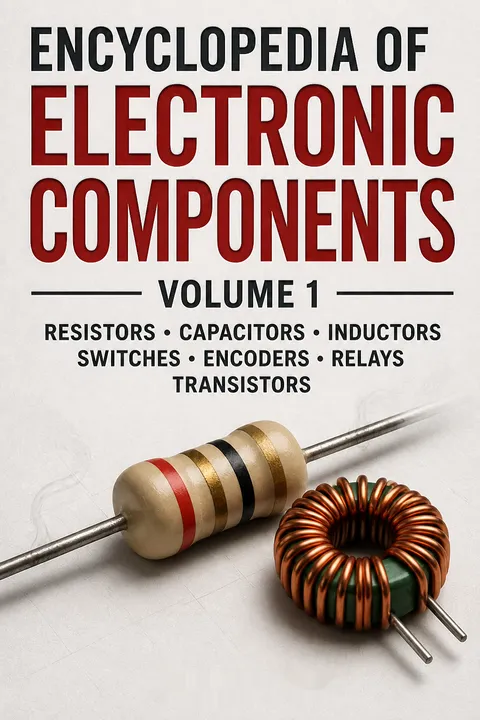
Encyclopedia of Electronic Components Volume 1 receives high praise from readers, with an average rating of 4.30/5. Reviewers commend its usefulness for hobbyists, beginners, and professionals alike. The book is praised for its simplicity in explaining complex topics, broad coverage, and easy readability. Many consider it a must-read for enthusiasts and engineering students. Some readers note its limitations in depth and specific applications. Overall, it's highly recommended as an introductory reference, though not comprehensive for advanced topics.
Glossary
Peukert number
Capacity loss with higher drainAn exponent used to estimate how a battery's usable capacity changes as discharge current increases. A higher value indicates that capacity falls more sharply under heavy loads. The estimate depends on the battery's rating method and test duration, and the book notes that a rechargeable battery's Peukert number can increase as it ages.
I2t
Surge current over timeA measure used to describe how a fuse responds to a brief current surge. It is calculated as current squared multiplied by the surge duration. Because a short high-current pulse and a longer moderate overload can affect a fuse differently, I2t helps relate fuse behavior to the duration as well as the size of a surge.
RC network
Resistor-capacitor timing circuitA circuit combining a resistor and capacitor, often in series, whose values determine how quickly the capacitor charges or discharges. Its time constant is the resistance multiplied by the capacitance. RC networks can shape signal timing and frequency response, or provide functions such as filtering and transient suppression.
Equivalent series resistance
Capacitor's internal resistanceA real capacitor behaves partly as if a small resistance were connected in series with an ideal capacitor. This equivalent series resistance, abbreviated ESR, affects how the component responds to changing current and contributes to energy loss. It is one reason that capacitance alone does not fully describe a capacitor's suitability.
Pulse-width modulation
Control by varying pulse durationA method of controlling average power by switching a signal on and off repeatedly and varying the duration of each on interval. In a DC-DC converter, changing this duty cycle helps regulate output voltage. In small RC servo systems, pulse duration communicates a desired motor position.
back-EMF
Voltage induced by changing currentA voltage induced by a changing magnetic field in a coil. When current through a coil begins to change, the induced voltage opposes that change. When the current is interrupted, the collapsing field can create a voltage spike, which may disturb nearby circuitry or damage components unless managed.
Darlington pair
Two transistors with combined gainA pair of bipolar transistors connected so the emitter of the first drives the base of the second. The arrangement behaves broadly like a single transistor with much greater current gain, allowing a small input current to control a larger output current. Multiple pairs can also be packaged together in one integrated component.
FAQ
What is "Encyclopedia of Electronic Components Volume 1" by Charles Platt about?
- Comprehensive component reference: The book is an encyclopedia focused on fundamental electronic components such as resistors, capacitors, inductors, switches, relays, transistors, and transformers.
- Practical and accessible: It emphasizes practical usage and real-world advice over deep electrical theory, making it accessible to beginners and useful for experienced users.
- Organized by function: Components are grouped by their roles in circuits (e.g., power, moderation, conversion), helping readers understand how parts interact.
- Reference and tutorial: Designed as both a reference guide and a tutorial, it supports learning and troubleshooting for electronics enthusiasts, students, and professionals.
Why should I read "Encyclopedia of Electronic Components Volume 1" by Charles Platt?
- Time-saving resource: The book consolidates reliable, cross-referenced information, reducing the need to search through datasheets and scattered tutorials.
- Practical focus: It provides hands-on advice, common pitfalls, and real-world examples, making it ideal for building and troubleshooting circuits.
- Broad audience: Suitable for hobbyists, students, and professionals seeking a thorough understanding of discrete electronic components.
- Bridges theory and practice: Offers enough theory to understand component function, but focuses on practical application and problem-solving.
What are the key takeaways from "Encyclopedia of Electronic Components Volume 1" by Charles Platt?
- Component understanding: Readers gain a clear grasp of how basic electronic components work, their variants, and how to use them effectively.
- Application guidance: The book provides practical advice for selecting, connecting, and troubleshooting components in real circuits.
- Datasheet navigation: It explains how to interpret datasheets and supplement them with practical knowledge.
- Common issues addressed: Highlights typical problems and solutions for each component, helping readers avoid mistakes.
How does Charles Platt recommend using datasheets and other resources in "Encyclopedia of Electronic Components Volume 1"?
- Datasheet limitations: Datasheets provide technical specs but often lack practical usage advice, alternative options, and warnings about common pitfalls.
- Supplemental resources: Manufacturer tutorials and guides can be helpful but may be inconsistent or biased; cross-referencing multiple sources is advised.
- Encyclopedic approach: The book serves as a consolidated, practical, and cross-referenced resource to fill gaps left by datasheets and scattered tutorials.
- Error reduction: Using the book helps readers avoid common mistakes and saves time in component selection and application.
How does "Encyclopedia of Electronic Components Volume 1" by Charles Platt explain resistors and their practical use?
- Basic function: Resistors impede current flow, create voltage drops, and are used for current limiting, voltage division, and signal conditioning.
- Types and materials: Covers carbon composite, carbon film, metal film, wire-wound, and metal foil resistors, explaining their stability, noise, and power ratings.
- Common applications: Includes use in series with LEDs, as pullup/pulldown resistors in logic circuits, in audio tone control, RC networks, and voltage dividers.
- Selection advice: Offers formulas, examples, and tips for choosing the right resistor for specific applications.
What does Charles Platt’s book say about capacitors, their types, and applications?
- Energy storage: Capacitors store electrical energy by accumulating charge on plates separated by a dielectric, and can pass AC while blocking DC.
- Variants and dielectrics: Details electrolytic, tantalum, ceramic, plastic film, and mica capacitors, including construction, polarity, and typical uses.
- Practical uses: Explains bypass capacitors for noise filtering, coupling capacitors for signal transmission, filters, smoothing in power supplies, and snubbers for switch protection.
- Selection and issues: Discusses how to choose the right capacitor and avoid common problems like incorrect polarity or voltage rating.
How are inductors described and used according to "Encyclopedia of Electronic Components Volume 1" by Charles Platt?
- Magnetic field generation: Inductors are coils of wire that generate magnetic fields when current passes through, storing energy magnetically.
- Core materials and shapes: Explains air cores, magnetic cores (iron, ferrite, powdered iron), and their effects on inductance, losses, and frequency response.
- Applications: Used to block or filter AC signals, store energy, and in tuning circuits, filters, and power supplies.
- Common issues: Covers inductive reactance, back-EMF, saturation, hysteresis, and practical selection tips.
What practical advice does Charles Platt give about switches, pushbuttons, and encoders in "Encyclopedia of Electronic Components Volume 1"?
- Switch types: Differentiates between pushbuttons (momentary), toggle, rocker, slide, rotary switches, and their schematic symbols.
- Variants and uses: Discusses latching pushbuttons, keypads, membrane pads, tactile switches, and rotary switches, including mechanical and electrical characteristics.
- Rotary encoders: Explains the difference between rotary switches (absolute position) and encoders (incremental feedback), with advice on debouncing and noise.
- Common problems: Addresses contact bounce, arcing, mounting issues, and choosing the right switch or encoder for reliability.
How does "Encyclopedia of Electronic Components Volume 1" by Charles Platt explain relays and their practical use?
- Electromechanical switching: Relays use a coil to create a magnetic field that moves an armature, allowing low-power signals to control high-power circuits.
- Types and configurations: Covers single-pole, double-pole, latching, nonlatching, reed, automotive, and time-delay relays, with typical ratings and pinouts.
- Protection advice: Recommends using snubbers and diodes to suppress back-EMF and protect circuits.
- Common issues: Warns about incorrect coil voltage, wrong pinouts, and environmental hazards like vibration and contamination.
What does Charles Platt’s book say about transformers and power supplies?
- Transformer basics: Explains how transformers convert AC voltages up or down using primary and secondary coils on a magnetic core.
- Types and construction: Describes step-up, step-down, isolation, autotransformers, and variable transformers, with core shapes like shell, E-I, and toroidal.
- Power supply types: Compares linear regulated power supplies (simple, robust, but bulky and inefficient) with switching power supplies (efficient, compact, but can generate EMI).
- Safety and troubleshooting: Provides guidance on safe use, avoiding shock hazards, and troubleshooting common transformer and power supply issues.
How are DC-DC converters, diodes, and their applications explained in "Encyclopedia of Electronic Components Volume 1" by Charles Platt?
- DC-DC converters: Describes how these circuits convert a DC input to a regulated DC output, using topologies like buck, boost, buck-boost, and flyback.
- Diode basics: Explains that diodes allow current flow in one direction, with variants like signal, rectifier, Zener, Schottky, varactor, and tunnel diodes.
- Applications: Covers uses in voltage regulation, rectification, voltage clamping, back-EMF suppression, and logic gates.
- Selection and issues: Discusses datasheet parameters, efficiency, load regulation, and common problems like overload and reversed polarity.
What does Charles Platt’s book cover about motors (DC, AC, servo, and stepper) and their control?
- DC motors: Explains operation using coils and magnetic fields, with variants like gearhead and brushless motors, and control via PWM or H-bridge circuits.
- AC motors: Describes single-phase and three-phase induction motors, synchronous motors, and control with variable frequency drives.
- Servo motors: Details position-seeking devices with PWM control and feedback, used in robotics and automation, including modification tips.
- Stepper motors: Covers precise step rotation, control methods, and common issues like step loss and resonance, with applications in printers and robotics.
What are the best quotes from "Encyclopedia of Electronic Components Volume 1" by Charles Platt and what do they mean?
- "Datasheets provide specifications but often lack practical usage advice." This highlights the book’s mission to bridge the gap between technical data and real-world application.
- "Practical knowledge is more useful than theory for most electronics projects." Emphasizes the book’s focus on hands-on advice and troubleshooting.
- "Cross-referencing multiple sources is advised." Encourages readers to verify information and avoid relying solely on one resource.
- "Choosing the right component can save time and prevent errors." Underlines the importance of informed component selection, a central theme of the book.
Download PDF
Download EPUB
.epub digital book format is ideal for reading ebooks on phones, tablets, and e-readers.








