

Key Takeaways
Build a brand buyers and answer engines recognize before they need a salesperson.
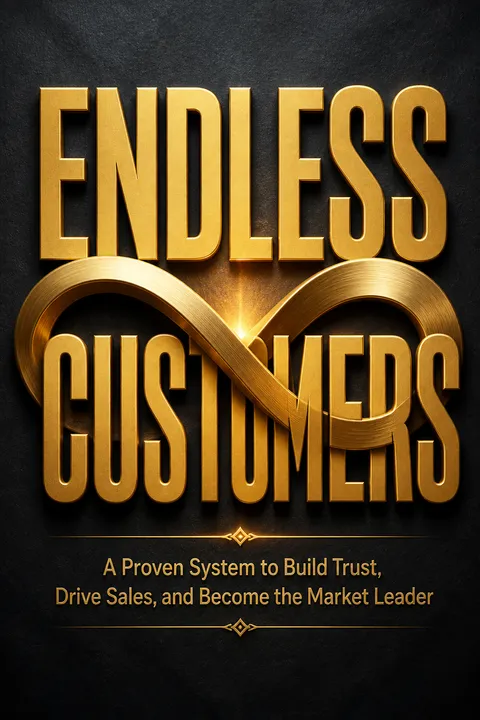
Trust is the acquisition strategy. Endless Customers is a business system for earning recognition and trust by answering real buyer needs across marketing, sales, websites, video, and company culture. Its central premise is that buyers research independently, expect control, and often complete much of their decision-making before speaking with a seller. The book cites estimates that roughly 80% of the buying process happens before that conversation.
Visibility is changing. In a zero-click search, a user gets an answer without visiting the source website. The book cites estimates that about 62% of Google searches now end this way. The response is not to abandon search, but to build recognizable expertise across channels and measure more than site visits, including mentions, engagement, and qualified sales.
The strategy treats trust as an asset that compounds across encounters: a useful article, a clear price range, and a familiar expert all make the next interaction less uncertain. That is a stronger goal than chasing clicks alone, because attention does not always convert immediately. Still, signals such as mentions and engagement are imperfect proxies for trust, and AI recommendations are not fully controllable. Businesses should pair visibility measures with outcomes such as qualified inquiries, close rates, and customer retention, so a memorable brand is also a commercially useful one.
Publish the uncomfortable answers buyers search for before they contact you.
Answer the purchase questions. The Big 5 is the book's name for five subjects buyers commonly investigate before a significant purchase: likely cost, possible drawbacks, comparisons, customer reviews, and the strongest available options. Companies often avoid these topics because they fear revealing prices, acknowledging weaknesses, or mentioning competitors. The book argues that silence sends buyers elsewhere for answers.
Transparency can sell. River Pools published a detailed explanation of what affects fiberglass pool costs without pretending there was one exact price. The article explained options, packages, and why prices differ. Sheridan reports that it generated more than $35 million in sales. The point is not to publish every secret. It is to explain what buyers need to judge value and fit, including reasons a product may not suit them.
This approach turns the sales team's recurring explanations into public education, helping buyers arrive with better questions and fewer avoidable surprises. It also challenges the common assumption that withholding information protects a sale. The important distinction is between honest context and indiscriminate disclosure. Pricing ranges need caveats, comparisons need fair criteria, and claims about product problems need evidence. Transparency earns credibility when it helps a buyer make a sound decision, not when candor is used as a clever performance to make the company look unusually virtuous.
Make proof visible by turning expertise into video buyers can inspect.
Show, do not just claim. The Selling 7 is the book's set of video formats designed to help buyers evaluate a business: explain pricing, answer common questions, demonstrate product or service fit, clarify what happens after a form is submitted, tell customer stories, introduce team members, and substantiate company claims. The larger point is to let people see processes, people, and evidence that competitors merely describe.
Make viewing easy. Opes Partners, a New Zealand property investment company, filmed developers answering tough questions about projects being considered for its portfolio. The series revealed how investments were evaluated and made the process watchable. For longer videos, the book recommends a quick opening, clear sections, and a useful next step. Short clips should get to their point quickly and end when the promised payoff arrives.
Video can reduce the gap between a company's assertion and a buyer's ability to judge it. A filmed process, demonstration, or candid explanation gives expertise a human voice and makes abstract claims more concrete. But video is not proof by itself. A polished production can also conceal weak evidence, and constant publishing can consume resources without helping buyers. The best test is whether a particular video resolves a real uncertainty or advances a decision. A modest, credible demonstration can be more persuasive than a glossy brand film.
Give buyers control with useful tools, not a forced sales conversation.
Make self-service genuinely helpful. Self-service tools let buyers complete parts of the buying journey independently. The book groups them into tools for assessing a need, choosing among options, configuring a product, scheduling a meeting, and estimating a price. Their value is not merely convenience. They help customers understand what they want before a sales conversation and can reveal whether a prospect is a good fit.
Reduce uncertainty early. Shasta Pools built a tool that let buyers choose pool features and see estimated costs. In one month, 83 of 166 families scheduled for a first design appointment had already used it. The book presents this as evidence that self-service can make appointments more productive. A useful tool should explain its assumptions and options, rather than presenting a confident-looking number without enough context.
These tools apply choice architecture: the business organizes information so customers can make decisions without needing a salesperson to interpret every step. That can improve access for people who prefer to research privately and spare staff repetitive work. Yet the design matters. A quiz can steer people toward the seller's preferred answer while appearing neutral, and an estimator can create false certainty. Transparent criteria, visible alternatives, and an easy route to a person make self-service a genuine extension of service rather than a disguised sales funnel.
Teach before selling, and let buyer education qualify the conversation.
Put content inside the sales process. Assignment Selling is the practice of giving prospects specific educational material to review before a sales conversation. The material should match the buyer's stage and answer a real question, rather than functioning as generic homework. The book's script organizes the request around why the material matters, what to review, and when to do it.
Measure readiness, not obedience. At River Pools, prospects who consumed at least 30 pages of website content before an appointment bought 80% of the time, compared with 25% among those who did not. After the team built education into its process, it reports selling 95 pools in 120 appointments, up from 75 in 250. These are company-specific results, not a guaranteed benchmark, but they show how better-informed conversations can improve both efficiency and close rates.
This method makes content operational: salespeople can use it to prepare customers, keep explanations consistent, and reserve meeting time for individual needs. It also gives marketing a direct connection to revenue rather than treating publication as an end in itself. The risk is turning education into a gate. Buyers may have limited time, accessibility needs, or questions that require conversation. A sound process offers relevant resources and a clear reason to use them, while allowing flexibility when a prospect is ready to talk sooner.
Use human expertise to give AI-generated scale a recognizable voice.
Put people behind the message. The book urges businesses to make employees, leaders, and customers visible through stories, real examples, personal introductions, and direct video. Website messaging should make clear what the company does, whose problem it solves, and what a visitor can do next. The customer is the central character; the business is the guide, not the hero of every page.
Use AI with boundaries. AI can help brainstorm, draft, edit, and repurpose content, but the book insists that people supply expertise and verify claims. Its proposed digital representatives should disclose that they are AI, rely on verified company knowledge, protect user data, and offer an easy handoff to a human. La-Z-Boy Southeast customers reportedly began asking for salesperson Ellie by name after seeing her company videos, illustrating how familiarity can start before a store visit.
Human presence matters not because audiences need every interaction to be manual, but because responsibility, perspective, and empathy are easier to recognize when attached to real people. AI can extend access to expertise, yet a simulated personality is not equivalent to a relationship. The dividing line is disclosure and accountability: users should know what the system is, where its knowledge comes from, and when a human can intervene. Informal language alone cannot manufacture authenticity; consistency between the public voice and the actual customer experience does more to earn it.
Make trust a company operating system, not a marketing department project.
Coordinate the whole journey. The 5 Components of Endless Customers are the areas the book says must work together: content, the website, sales activities, technology, and a performance-focused culture. Salespeople and subject matter experts contribute real buyer questions; marketing turns them into useful resources; and sales uses those resources with prospects. A shared customer relationship system helps teams track interactions and connect activity to outcomes.
Build a repeatable rhythm. The book recommends an organization-wide kickoff, quarterly planning around a small number of priorities, and a scorecard covering the five components. Teams rate ten prompts from 0 to 10 and revisit the results. Its typical implementation horizon is 18 to 24 months, a reminder that this is an operating change, not a campaign. The book also advises building an in-house content capability and publishing consistently, with workload scaled to the company's size.
The organizational design is one of the book's strongest insights: customer trust cannot be delegated to a marketing team if sales, leadership, and service behave differently. Shared content and shared metrics can reduce the familiar split between attracting leads and closing them. However, the scorecard's self-ratings can reward activity over impact unless paired with customer evidence and business results. Publishing targets are useful as a forcing mechanism, but output volume should not become the definition of quality. The operating rhythm matters most when it helps teams learn and adjust.
Keep disrupting after success, because comfort opens the door to decline.
Do not wait for a crisis. The Pride Cycle describes four stages: pain prompts experimentation, successful experiments bring growth, growth can harden into pride, and pride can become complacency. The danger is that an approach that once worked begins to feel permanent, even as buyer expectations and technology change. The book points to companies that missed major shifts and argues that resources alone do not prevent decline.
Look for buyer friction. River Pools challenged the industry's use of sand beneath fiberglass pools, adopted crushed stone, and then explained the difference publicly. The book says roughly 80% of fiberglass pools in the United States eventually used stone rather than sand. The broader practice is to find a persistent customer frustration, improve the experience or standard, and make the reasoning visible. Disruption is valuable when it solves a real problem, not simply because it attracts attention.
The cycle is a useful warning against treating past performance as proof that the current model remains fit for purpose. Its most practical implication is institutional: preserve ways for uncomfortable customer feedback and small experiments to reach decision-makers even when the business is thriving. Still, novelty is not inherently progress. A dramatic campaign or new tool can distract from ordinary failures in service. The test is whether a change improves the buyer's decision or experience and whether the organization can sustain the improvement after the attention fades.
Analysis
Endless Customers reframes marketing as the design of a trustworthy buying experience. Its central move is to shift the unit of analysis from the campaign to the whole customer journey: what a person can learn before contact, what the website lets them do independently, how sales uses educational material, and whether the organization can deliver what its public claims promise. That makes the book more operational than a standard content-marketing argument.
The system is particularly compelling where purchases are expensive, complex, or risky. In those settings, answering questions about cost, drawbacks, and alternatives can reduce information asymmetry, the gap between what the seller knows and what the buyer can discover. Video and self-service tools extend that reduction by making processes and choices inspectable. The internal emphasis on sales participation also addresses a common organizational failure: marketing often lacks access to the tacit knowledge that frontline employees use every day.
The book's evidence is mainly practitioner case studies and reported company outcomes. These stories make the recommendations concrete, but they do not establish that the same tactics will produce comparable results in every market. A pricing page may matter less for impulse purchases; an unusually candid comparison may be risky where data are weak or regulated; a large publishing cadence may overwhelm a small team. The transferable principle is not maximum disclosure or maximum output. It is useful, accurate information delivered at the point of buyer uncertainty.
The AI-era argument is strongest when it treats technology as distribution and assistance, not as a substitute for expertise. Search visibility can shift, but a company still needs distinctive knowledge, an accountable voice, and a customer experience that confirms its promises. The book's deepest challenge is therefore cultural: stop asking whether a practice is conventional and ask whether it helps buyers make informed choices. That question is also a safeguard against turning transparency, video, and disruption into fashionable tactics detached from service.
Glossary
Endless Customers System™
Trust-centered growth systemThe book's integrated approach to earning market recognition and customer trust through useful content, an effective website, coordinated sales activity, suitable technology, and a culture of performance. It builds on the idea that businesses should openly address buyer questions and make the purchasing process more informative and convenient.
The Big 5
Five buyer research topicsA content-planning framework for the topics buyers commonly investigate before making a significant purchase: price, potential problems, comparisons, reviews, and leading options. The framework encourages businesses to address these questions directly rather than leaving buyers to find answers from competitors or third parties.
The Selling 7
Seven sales-focused video formatsA group of video types intended to answer common buyer questions and support sales. The categories cover cost, recurring questions, product or service fit, what happens after a form submission, customer experiences, employee introductions, and evidence behind company claims. The videos can appear on websites, social platforms, and in direct sales communication.
Assignment Selling
Education before sales meetingsThe practice of sending prospects specific educational content to review at a defined point in the sales process. The aim is to prepare buyers, answer recurring questions, and leave sales conversations more time for their particular needs. The book recommends explaining the purpose, specifying the material, and setting a clear time for review.
Ostrich Marketing
Avoiding difficult buyer questionsThe book's label for marketing that ignores uncomfortable topics buyers want addressed, such as price, drawbacks, or competitor comparisons. This avoidance can make a company appear to be withholding information and can push prospective customers to seek answers elsewhere.
Law of the Coin
Explain both sides of a purchaseThe principle that a trustworthy explanation should address both the benefits and limitations of a product or service. It asks businesses to identify who is a good fit, who is not, and what problems or trade-offs buyers should understand before deciding.
The Pride Cycle
Success turning into complacencyA four-stage pattern in which pain encourages experimentation, successful changes produce growth, growth can foster pride, and pride can lead to complacency. The book uses the cycle to explain why successful companies may stop adapting and urges leaders to keep questioning assumptions even when results are strong.
The 5 Components of Endless Customers
Five areas for implementationThe book's implementation framework covers content, the website, sales activities, technology, and company culture. It treats these areas as interdependent: useful content needs a strong digital home, sales teams need to use it, technology should support coordination, and leadership must make sustained improvement a priority.
Zero-click search
Search answered without a visitA search experience in which a user receives an answer directly on the results page and does not click through to the originating website. The book argues that this trend makes website traffic an incomplete measure of visibility and increases the value of recognizable expertise across multiple platforms.
Download PDF
Download EPUB
.epub digital book format is ideal for reading ebooks on phones, tablets, and e-readers.








