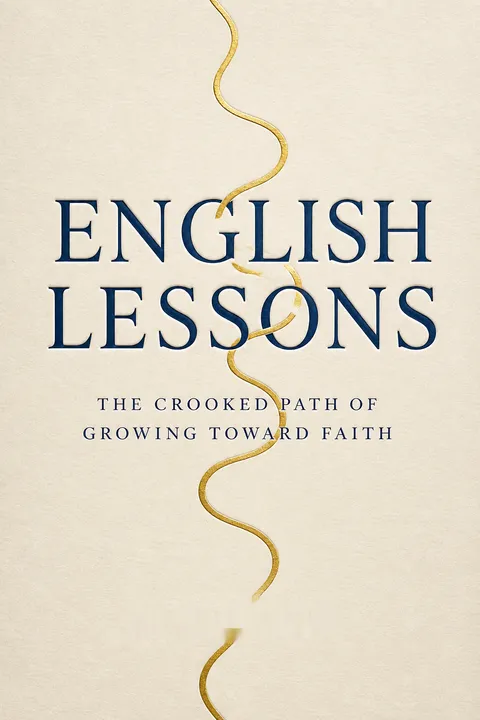


Key Takeaways
Grow toward faith by shedding what no longer fits
Faith under pressure. Andrea Lucado arrives in Oxford at twenty-two as a pastor’s daughter, raised in a Christian home and community. Surrounded by classmates who do not share her beliefs, she begins to question whether her faith is truly hers or simply part of her inheritance. She likens early adulthood to a cricket nymph molting: growth means losing layers, and the process can feel awkward and painful rather than graceful.
Change makes room. Oxford unsettles her assumptions about God, herself, and other people. The experience does not offer a neat conversion from certainty to doubt, or doubt back to certainty. Instead, it makes space for a faith examined through study, relationships, and uncertainty. The central claim is that growing up in faith means allowing inherited beliefs to be tested, while staying open to what remains meaningful.
The cricket image gives spiritual development a useful, unsentimental biology: growth is not always an elegant reveal, and shedding can feel like exposure before it feels like freedom. Identity research likewise distinguishes inherited belonging from commitments people have examined and chosen. That distinction need not devalue family influence; it clarifies why questioning can deepen rather than negate a tradition. The account is strongest when it treats doubt as part of development, not as proof of maturity by itself. Some inherited beliefs deserve revision, while others may survive scrutiny. The important shift is from passive possession to conscious participation.
Cross the cultural glass by inviting people into ordinary life
A shared language is not enough. Lucado expects England to feel familiar because she speaks English and has visited Oxford before. But at lunch beside the Thames, British classmates’ jokes, references, and everyday vocabulary leave her feeling shut out. She realizes that people speak from their customs and upbringing as much as from dictionary definitions. Knowing the words does not automatically mean knowing the culture.
Start before you fit in. Church routines and solitary walks do not resolve her loneliness. Eventually, she invites classmates, including non-Christian friends, to dinner. They cook curry together, share chestnuts and chocolate, and talk. The evening does not erase their differences, but it creates genuine connection. Her lesson is practical: friendship may begin not when an outsider has mastered every social code, but when someone risks hospitality while still feeling out of place.
This story captures a distinction familiar in sociolinguistics: communication depends on shared assumptions and context, not simply shared vocabulary. A person can understand every sentence and still miss the joke, the status cue, or the invitation beneath it. Hospitality helps because it creates a setting where people can build context together rather than pass a test of cultural fluency first. Still, one dinner cannot dissolve structural barriers or guarantee acceptance. Its importance is smaller and more credible: it turns strangers into people with names, tastes, and stories, which is often where belonging begins.
Borrow another person's faith when your own light goes dim
A companion can guide. In Oxford, Lucado’s private habits of Bible reading and prayer no longer settle her questions. Her friendship with Jisu, a Korean-Austrian man with a quiet, steady faith, gives her room to breathe. He does not argue her back into belief. He listens, spends time with her, and sometimes rides ahead on his bicycle because her front light has no battery.
Front lights explained. Lucado uses “front lights” for people whose faith helps guide someone who cannot see clearly for a time. Jisu offers his headlamp and even offers to ride uphill to meet her after class. Accepting help feels uncomfortable to someone proud of spiritual independence, but she comes to understand faith as something people can support in one another. She also sees that receiving care does not eliminate the need to think and struggle for herself.
The image turns companionship into a form of practical care rather than an abstract religious ideal. Social support often works this way: a trusted person lends steadiness, perspective, or even a literal ride while someone is depleted. The metaphor also resists the fantasy of total self-sufficiency, which can make vulnerability seem like failure. Its useful limit is that a guide is not an unquestionable authority. Support should help a person regain agency, not replace it. Jisu’s quiet presence matters precisely because he does not force a conclusion; he makes uncertainty less isolating.
Treat communal remembrance as part of believing, not evidence against it
Faith has a history. Lucado worries that relying on her father’s faith makes her belief weak. A lecture by Oxford mathematician and Christian apologist John Lennox briefly reassures her, though she later cannot recall his arguments. What she remembers is the confidence of someone who has thought deeply about belief. More enduring still is her father’s example, embodied in the comfort she felt holding his hands as a child.
Remember together. She comes to see church as more than a weekly gathering for people who already believe. It is a community that retells and preserves a story across generations, much as schools pass along knowledge that no individual discovers alone. Believers need reminders, teachers, and each other. That dependence is not necessarily a flaw. It becomes troubling only if inheritance is treated as a reason to forbid honest questions or to silence people whose experience differs.
Most knowledge rests on forms of epistemic trust: people rely on teachers, communities, and records because no one can personally verify every claim from scratch. Religious belief is not unique in this respect, though its claims and stakes are distinct. The memoir usefully separates dependence from mindlessness; a tradition can provide the starting conditions for inquiry rather than its substitute. The needed nuance is that communities can preserve error as effectively as insight. Shared memory deserves both gratitude and examination, especially when institutions decide whose stories are repeated and whose are left out.
Look for truth in art, not a Christian label
Art can unsettle categories. At a London conference on Christianity and art, Lucado hears that an artist’s task is to tell the truth, not necessarily to make explicitly religious work. This changes how she sees the novels she loves, including Arundhati Roy’s The God of Small Things, a painful story about caste, forbidden love, and a man killed by the people enforcing social order.
Darkness can disclose. Lucado sees echoes of sacrifice and the gospel in Roy’s story, although Roy was not a Christian. The experience challenges her neat division between Christian art and secular art. A work need not announce its religious message to illuminate truth, human suffering, or self-giving love. For her, difficult art can make readers recognize realities that cheerful, tidy stories sometimes leave out. The question becomes less about the label and more about whether the work faces life honestly.
This is a strong account of how art can produce moral attention. Stories let readers inhabit consequences and relationships that abstract arguments can flatten, while unsettling work can make room for empathy across differences. The claim that truth in art points toward God is a theological interpretation, not a conclusion every reader must share. That distinction does not diminish the insight: religious readers can recognize meaning beyond explicitly religious settings, and nonreligious readers can value the same work on other grounds. Nor is bleakness automatically honest. A work can romanticize suffering, just as a comforting story can conceal it.
Choose the uncertain next step over familiar escape when it rings false
Comfort looked persuasive. During a lonely Oxford winter, Lucado plans to leave early for Dallas, where friends, familiar food, and American conveniences await. She arranges the move, but cannot bring herself to send the final email. After days of prayer and walks, she decides to stay through the summer. The choice is modest, not a dramatic test of destiny, but it lets her keep living the chapter she had wanted to escape.
Trust is not a map. Lucado describes the inner combination of joy and peace that can accompany a frightening but fitting choice. She does not claim that moving to Dallas would have ruined her life or that every uneasy feeling carries divine instruction. She believes she could have been fine there. The point is that choosing the unknown sometimes develops trust and reveals possibilities that a retreat to the familiar would have hidden.
The story is persuasive because it does not inflate the decision into a single correct path with cosmic consequences. Decision-making research often treats emotion as information about values, but feelings can also reflect fear, exhaustion, or short-term discomfort. Lucado’s unease becomes meaningful only alongside reflection, time, and attention to what she wants her life to serve. That makes the lesson more robust than simply following intuition. A familiar option can be wise, and a new one can be reckless. The useful question is whether comfort is the real reason for retreat, or just one factor among many.
Trade perfect control for a life that can breathe
Control became a trap. After gaining weight during study abroad, Lucado restricts food and feels proud of her discipline. Her thoughts become dominated by calories, menus, and exercise. She sometimes feels dizzy, yet classmates praise how she looks. Her friend Ashley, who had struggled with an eating disorder, recognizes warning signs and challenges her. Lucado resists the concern because control feels like success.
A different norm helps. Back in Oxford, she notices English friends eating ordinary meals without constant talk of dieting, makeup, or body size. Over time, she becomes less restrictive. One night she eats a whole serving of banoffee pie and discovers that the feared loss of control does not arrive. The book links this shift to a wider atmosphere of acceptance, represented by English gardens allowed to grow untidily. The lesson is not that a change of scenery cures disordered eating, but that social norms can either reinforce or loosen harmful rules.
The contrast between visible appearance and private distress is important: praise can reward a pattern that is harming someone, especially when a culture equates thinness with virtue. The story also illustrates how norms are learned socially; seeing friends eat without constant self-surveillance can make another way of living imaginable. But recovery from an eating disorder is not simply a matter of adopting a relaxed attitude or finding a more accepting circle. People facing persistent restriction, fear, or physical symptoms may need qualified clinical support. The memoir’s account is valuable as lived experience, not as a treatment plan.
Be a truthful friend, not a sales pitch for faith
People resist categories. Lucado befriends Ben, who left Christianity as a teenager, and Erik, who faces a difficult return home without sharing her beliefs. She initially struggles to understand how Ben could believe and then stop, and she regrets not sharing the gospel more boldly with Erik. When she finally speaks, she tells him she will pray for him. He appreciates the offer but describes hope in his own terms.
Presence is not failure. Lucado recognizes that she had treated conversations as opportunities to produce a conversion story. Erik’s response makes her reconsider that pressure. Her faith is part of who she is, but friendship does not require turning another person into a project. She can speak honestly about prayer and belief, while also listening and respecting someone who does not want to share those beliefs. The book leaves room for quiet forms of witness that do not end in agreement.
This section makes a useful ethical distinction between sharing a conviction and instrumentalizing a relationship. When every conversation is evaluated by whether it changes another person, listening becomes strategy and friendship loses its reciprocity. Respectful disclosure allows both people to remain fully present, including when they disagree. There is also a real tension: fear of imposing can become a reason to conceal a central part of one’s identity. Lucado’s exchange with Erik offers a middle path. She states what she believes without pretending that his response is hers to control.
Say the goodbye aloud, then carry the changed self forward
Endings need attention. Before leaving Oxford, Lucado takes a long walk through places that shaped her year. She has finished her thesis, made friends, and grown beyond the assumptions she brought with her. But her farewell to Jisu, a close friend and almost-romance, remains awkward and incomplete. At a celebration, he gives her a book, they exchange a brief hug, and she finally says goodbye without saying everything she wishes she could.
Change keeps moving. The book treats farewells as part of becoming, not as proof that a relationship or place was insignificant. Lucado leaves Oxford carrying memories and questions, then realizes that one intense year did not complete her education in faith or life. The memoir’s crooked path is its central shape: growth proceeds through detours, losses, and partial understanding. No one arrives at a final version of the self; change continues as new experiences unsettle old certainties.
Rituals of farewell can help people acknowledge that a relationship or chapter has changed, while autobiographical memory gives those experiences a place in an evolving sense of self. Lucado’s walk makes the city legible as part of her personal history, even when the goodbye with Jisu cannot become the ideal conversation she imagines. That is a useful corrective to the fantasy of perfect closure. Not every ending can be repaired through one final exchange, and some relationships require distance for safety or dignity. Saying goodbye matters, but it does not require a tidy emotional resolution.
Analysis
This memoir uses one year in Oxford to examine a problem larger than travel: how a person can inherit a faith, question it seriously, and still choose to inhabit it without pretending uncertainty has vanished. Its structure is associative rather than instructional. Rivers, cricket molting, gardens, bicycle lights, and memorials recur as images that let the author connect daily events to spiritual questions. That design keeps abstract theology grounded in scenes: an awkward lunch, a friend riding ahead in the dark, an unsent email, and a goodbye outside a bar.
The book’s strongest contribution is its refusal to reduce belief to either certainty or collapse. Lucado’s faith is shaped by parents and church, challenged by intelligent nonbelievers, sustained through friendship, and clarified through literature. The result is a relational account of belief. Dependence on others is not merely a temporary crutch; communities preserve stories and lend strength. Yet the memoir also suggests that such dependence must coexist with personal scrutiny. Inherited conviction can be both a gift and a source of social pressure.
Its most productive tension concerns the interpretation of experience. Lucado often reads peace, beauty, and coincidence as signs of God’s presence. That reading gives coherence to her story, but it does not function as evidence that readers outside her faith must accept. The memoir is most persuasive when it presents these moments as her lived interpretation, and least universal when it treats inner certainty as proof. Likewise, her account of recovery from restrictive eating is illuminating but cannot replace clinical understanding.
The book’s title captures its method: growth is crooked, slow, and incomplete. Doubt does not guarantee wisdom, belonging does not require sameness, and a goodbye need not erase love. Its durable invitation is to remain teachable: test inherited beliefs, receive help, tell the truth about what is uncertain, and allow experience to complicate rather than merely confirm the person one thought one was.
Review Summary
English Lessons by Andrea Lucado receives mixed reviews. Many readers appreciate her honest reflections on faith and culture shock while studying in Oxford. The memoir resonates with those who have questioned their beliefs or experienced living abroad. Some find her writing style engaging and relatable, while others feel it lacks depth or resolution. Critics note the book may appeal more to younger readers or those from similar backgrounds. Overall, reviewers commend Lucado's vulnerability in sharing her struggles with doubt and identity, though some wished for more spiritual growth by the end.
People Also Read







Glossary
Front lights
Faithful guides in uncertaintyLucado’s metaphor for people whose steadiness and care help someone navigate a period of spiritual uncertainty. It comes from the bicycle lights required for safe night riding in Oxford. Her friend Jisu offers to ride ahead or lend her a headlamp when her own light is unusable, making spiritual support a practical act rather than an argument.
The Babel Effect
Cultural barriers to belongingLucado’s framing of the loneliness that arises when people appear to share a language but not the assumptions, customs, or references that give it meaning. Her Oxford classmates speak English, yet jokes and ordinary words leave her feeling excluded. The biblical Tower of Babel story becomes a metaphor for cultural distance, including distance between people in the same city.
River conversations
Unresolved, branching choicesLucado’s term for conversations that feel consequential because they could have led in several emotional or relational directions. Her riverside talk with Jisu about whether they might become more than friends leaves her replaying alternate possibilities. The metaphor emphasizes that a conversation can be revisited in memory, but the real event continues forward rather than reopening for a different choice.
Crooked path
Growth through detoursThe memoir’s central image for development that proceeds through uncertainty, mistakes, loss, and unexpected relationships rather than a straight route toward settled answers. Lucado’s year in Oxford changes her faith and self-understanding through experiences she did not plan. The crookedness is not presented as failure; it is where learning and greater humility take shape.
Download PDF
Download EPUB
.epub digital book format is ideal for reading ebooks on phones, tablets, and e-readers.








