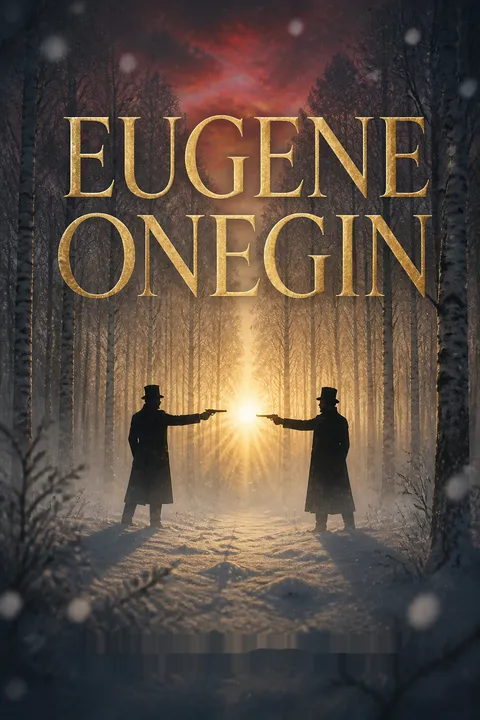


Plot Summary
The Heir Who Cannot Stay
Eugene Onegin has been schooled in French manners, fine clothes, flirtation, and the nightly round of Petersburg society. After years of balls, theatres, romantic pursuits, and reading, each pleasure leaves him more bored than before. He tries writing, then abandons that effort too. When his father dies burdened by debt, Eugene yields the estate to creditors rather than fight them.
Soon word arrives that a wealthy uncle is dying. Eugene hurries to the country, expecting an inheritance, but finds his uncle already dead. The estate is his. For a few days its fields and streams please him; then country life grows as dull as the city. His new position as a landowner, however, brings him into contact with neighbors he cannot simply escape.
Eugene's boredom is not mere idleness: each available role, from fashionable lover to would-be writer, feels borrowed and quickly exhausted. His response to his father's creditors reveals the same detachment as his social life; he avoids conflict rather than invest himself in an outcome. The uncle's death gives him a fresh setting, but not a fresh purpose. That distinction matters: the country can alter his surroundings without changing his habits of attention. His inheritance therefore begins the plot while exposing its central predicament, a man with freedom of movement who cannot make freedom meaningful.
Two Sisters, One Visitor
Among Eugene's new neighbors is Vladimir Lensky, an earnest young poet recently returned from Germany, where he has absorbed romantic ideals and faith in love. Lensky is devoted to Olga Larin, a cheerful girl he has known since childhood; their families expect them to marry.
He and Eugene become friends despite their opposing temperaments, arguing about life while riding through the countryside. Lensky eventually takes Eugene to visit the Larin family. Olga is bright and sociable, but Eugene notices her shy older sister, Tatyana, sitting apart from the company.
Tatyana has grown up inward, devoted to novels and solitary thought. The visit gives her a face for the romantic longing her reading has already awakened, while local gossip about her and Eugene helps turn curiosity into expectation.
The two couples begin as contrasts in how stories are lived. Lensky treats romantic ideals as truths that can organize a life; Tatyana has learned to recognize desire through novels, while Eugene regards both literary and social conventions with suspicion. Olga, by contrast, moves easily through the familiar rituals of courtship. The narrator's irony complicates these distinctions without erasing the characters' feelings. Their roles may be shaped by books and custom, but the consequences are real: Tatyana's imagination attaches itself to Eugene, and the friends' intimacy places them within the same family circle.
A Letter Without Armor
Tatyana falls intensely in love with Eugene, imagining him through the romantic books that have long furnished her inner life. Unable to confide in her family, she tells her nurse how distressed she is, then writes Eugene a private letter in French, the language she can use for intimate feelings.
She entrusts it to the nurse's grandson for delivery and spends the next day waiting, exposed to the possibility that Eugene will mock or reject her.
When he finally meets her in the garden, he explains that he is not suited to marriage and would eventually grow indifferent even to a wife he loved. He praises her candor but warns her against trusting so openly. His restraint spares her a false promise, yet his cool lesson leaves her humiliated and heartbroken.
Tatyana's letter is an act of emotional authorship: rather than wait for a suitor to define her future, she states her desire directly, even though the risks are steeply unequal. Eugene's answer is ethically more complicated than simple cruelty. He refuses to convert her trust into an affair, but he frames his inability to love as fixed nature and delivers the warning from a position of power. His candor protects her from one kind of harm while denying her the intimacy she sought. The scene makes self-knowledge consequential, but shows that insight without reciprocal vulnerability can still wound.
The Name-Day Snare
During the winter holiday season, Tatyana takes part in traditional fortune-telling and dreams that a bear leads her through a snowy wilderness to a gathering of monsters. Eugene presides over them; in the dream he drives away the others, then kills Lensky when Olga arrives.
The vision unsettles her, but its meaning remains unclear. At Tatyana's name-day celebration, the crowded country gathering overwhelms her. Eugene notices her distress and resents the attention surrounding them.
Seeking revenge on Lensky for bringing him to a party he dislikes, he gives Olga his attention, dances with her repeatedly, and keeps her beside him. Lensky watches his fiancée accept Eugene's flirtation and feels betrayed. When Olga refuses the dance Lensky expected because she has promised it to Eugene, Lensky leaves the celebration in anger.
The dream offers Tatyana an image of danger before she can interpret it, turning her private anxieties into a scene that the later plot will make painfully legible. At the party, the real threat is less Eugene's desire for Olga than his use of her as an instrument against Lensky. A minor grievance becomes public humiliation because both men are governed by the audience around them: Eugene performs indifference, Lensky reads the performance as an assault on honor. Olga's easy sociability is mistaken for calculated betrayal. Pushkin lets these mismatched interpretations gather force inside a rigid social code.
The Mill at Dawn
Lensky challenges Eugene to a duel through Zaretsky, a former rake who now acts as the neighborhood's authority on dueling. Eugene recognizes that he provoked the quarrel and considers apologizing, but fears becoming a target of gossip if he withdraws. Lensky visits Olga before the duel; her untroubled affection calms his jealousy, yet he still convinces himself he must protect her from Eugene.
At dawn the men meet near a mill. Eugene arrives late and brings his French servant, Guillot, as his second, while Zaretsky enforces the formal rules. The former friends take their positions and advance. Eugene fires first, killing Lensky. Only after the shot does he feel the full weight of what pride and public expectation have made him do.
The duel is not an eruption of unstoppable passion. It is a sequence of chances to stop: Eugene could apologize, Lensky could reconsider after Olga's welcome, and Zaretsky could treat the ritual less mechanically. Instead, each man lets reputation narrow the available choices. Eugene's fear of ridicule proves stronger than his affection for Lensky, while Lensky turns a brief jealous injury into a chivalric duty. The formal precision of the duel makes its result more disturbing, not less: a social script gives private resentment the appearance of necessity and leaves its participants responsible for obeying it.
The House of Books
Lensky's death leaves Olga grieving only briefly. She soon marries a military officer and leaves the family home, while Tatyana remains alone with her attachment to Eugene and her anger over the duel. She visits his now-empty estate, where the housekeeper, Anisya, shows her his study.
Tatyana returns the next day to read the books Eugene left behind. The marked passages and notes in the margins reveal his attraction to skeptical, disillusioned heroes. Instead of finding the singular romantic figure she had imagined, Tatyana begins to see a man assembled from fashionable literary poses.
Her mother, meanwhile, worries that Tatyana refuses local suitors. With help from a relative, she decides to take her daughter to Moscow, where a wider circle of eligible men might offer a future.
The library changes Tatyana's method of understanding Eugene. Her first approach was imaginative projection: novels supplied a role, and she placed him inside it. Now his annotations let her read him as a reader, someone whose apparent individuality may be composed of admired characters and borrowed attitudes. This is not simply disillusionment. It is a new kind of attention, grounded in evidence rather than fantasy. Lensky's quick replacement in Olga's life further unsettles romantic permanence, while the planned move to Moscow shifts Tatyana from private interpretation toward the public decisions that will shape her adult identity.
Moscow's Marriage Market
Tatyana leaves the countryside reluctantly, grieving her familiar landscapes and the freedom of solitary walks. In Moscow, her aunt introduces her to a stream of relatives and social gatherings. The talk strikes Tatyana as empty, and she keeps her feelings to herself rather than join the young women trading romantic confidences.
At a grand assembly, however, a dignified general notices her while she stands apart from the crowd. The book does not stage their courtship; by the time Eugene next returns to high society, Tatyana is the general's wife and an assured figure in Petersburg's aristocratic world.
Her transformation is not merely a change of clothes or address. She has learned to move through the society that once seemed alien, while preserving an inward reserve beneath its ceremonies.
Moscow does not heal Tatyana by making her less reflective. Instead, it tests whether her inwardness can survive institutions built to classify and arrange young women. Her silence at family gatherings is not evidence that she has nothing to say; it is a form of self-protection in a world that turns private feeling into social currency. The general's appearance links her future to the formal order of rank and marriage, but the narrative skips the courtship, refusing to pretend that a socially acceptable match must resemble romantic revelation. Her adulthood emerges through adaptation without total surrender.
A Dandy Learns Desire
After Lensky's death, Eugene leaves the countryside and travels, but movement does not free him from memory. When he returns to Petersburg, he attends a society gathering and sees a composed, highly regarded princess beside a general. He learns that she is Tatyana, the young woman whose letter he once rejected. She receives him without visible agitation, asks after his travels, and leaves with her husband.
Eugene is stunned by the distance between the provincial girl he remembers and the woman who commands the room without seeking attention. The change in Tatyana reverses their old positions: she now belongs securely to the world he once treated as dull, while he has no claim on her. His curiosity becomes an urgent, belated desire.
Recognition arrives unevenly. Eugene sees Tatyana first as a social figure, then as the person whose vulnerability he once handled with a lesson; he cannot reconcile those versions because he had mistaken her youth for her whole identity. Her composure does not prove that the earlier feeling was false. It shows that she has acquired control over what she reveals. The reversal exposes Eugene's dependence on scarcity: what he once declined becomes precious when it is no longer available to him. His new passion may be sincere, but its timing makes sincerity insufficient as a moral claim.
The Unanswered Letters
Eugene accepts an invitation to see Tatyana again, then begins arranging his days around the chance of encountering her. He visits her home, follows her through public gatherings, and tries to attract her attention with small acts of service.
Tatyana remains courteous but gives him no private encouragement. Eugene, who once dismissed letters as ineffective, finally writes her an impassioned confession. When she does not answer, he writes again, then a third time. His disappointment deepens into illness and withdrawal; he turns back to books, though his thoughts keep returning to her.
In spring he goes to her house without warning. He finds Tatyana alone, reading one of his letters and crying, and falls at her feet. Her visible emotion forces him to see that silence has not meant indifference.
Eugene's pursuit repeats the old story with its roles reversed, but not with equal power. As a young woman in the countryside, Tatyana had risked exposure by writing once; now Eugene can send repeated letters and appear at her home, while her silence carries the burden of protecting an established life. His gestures show genuine distress, yet they also center his need for an answer. Finding her in tears unsettles his assumption that composure equals indifference. The scene brings private feeling into view without resolving what feeling permits either person to do.
The Door Closes
Tatyana lets Eugene rise and explains how sharply she remembers his rejection in the garden. She asks why he seeks her now, suggesting that her rank, wealth, or the attention she commands may have awakened his desire. Eugene cannot easily dismiss the suspicion: he wanted none of her when she was a shy country girl.
Tatyana admits that she still loves him and that a different choice might have made them happy. But her mother urged her to marry, and she has since bound herself to another man. The grandeur of her life does not satisfy her, yet she refuses to betray her husband. She leaves Eugene with that decision. When her husband enters, the narrator ends the story without showing what Eugene does next.
Tatyana's refusal does not cancel her love; it demonstrates that love is not the only value by which she understands herself. She names the possibility of happiness she has lost, but will not treat her marriage as disposable simply because Eugene has finally become emotionally available. Her question about his motives also preserves the asymmetry between his late desire and her earlier confession. The ending denies both lovers a neat moral reward: Eugene must face the consequence of delay, while Tatyana's fidelity costs her something real. The narrator's abrupt departure leaves their lives open without weakening her choice.
Analysis
Eugene Onegin makes romantic disappointment inseparable from the social forms through which people learn to desire. Tatyana reads novels and, at first, recognizes Eugene through the roles they have made available to her. Lensky gives poetry a similar authority, interpreting love and friendship as ideals that ought to remain pure. Eugene believes he has escaped such illusions, yet he too performs a recognizable role: the bored, superior man who treats attachment as a weakness. The novel's irony catches all three inside inherited scripts, while its sympathy insists that scripted feelings still hurt real people.
The duel demonstrates how social convention converts a preventable conflict into a fatal act. Eugene understands his responsibility but chooses the protection of reputation over the risk of public embarrassment. Lensky's idealism and jealousy also contribute, but the ritual makes neither man less accountable. Its carefully managed procedure reveals a society capable of calling violence honorable when it follows familiar rules.
Tatyana's development is not a simple triumph of maturity over youthful feeling. She learns to read Eugene more accurately, enters a world whose codes once seemed foreign, and becomes capable of protecting her private life. At the end, she acknowledges that she loves him while refusing to betray her marriage. Her choice is costly precisely because her feeling remains alive. Eugene, meanwhile, discovers desire only after he has lost the chance to act on it responsibly.
The narrator's digressions keep the story from becoming a conventional morality tale. He shifts between teasing social observation, personal memory, and grief, making the reader notice how literature shapes life even as the poem exposes its own construction. The unfinished futures of the characters preserve the difference between an ending and a completed life: the lovers' immediate choices are clear, but the novel refuses to pretend that their histories stop there.
Review Summary
Eugene Onegin is widely praised as a masterpiece of Russian literature. Readers appreciate Pushkin's witty and ironic writing style, the complex characters, and the tragic love story. Many note the difficulty of translating the novel's poetic form and cultural allusions. Some find the plot simple but admire Pushkin's insights into human nature and Russian society. The narrator's voice and Pushkin's ability to blend humor, romance, and social commentary are frequently highlighted. While some struggle with the verse format, most consider it a groundbreaking and influential work.
People Also Read





Characters
Eugene Onegin
The socially bored dandyEugene is a wealthy young Petersburg aristocrat trained to move smoothly through fashion, flirtation, and conversation. He is intelligent enough to recognize the hollowness of those pursuits, but recognition rarely becomes commitment: he abandons writing, tires of books, and treats intimacy as another experience to sample. His wit protects him from embarrassment while also making him careless with other people's vulnerability. He resists conventional roles, yet often lets social expectation dictate his actions when his reputation feels threatened. Beneath his practiced detachment is a capacity for self-scrutiny, though it tends to arrive after consequences have become irreversible. His character raises a difficult distinction between seeing through a social script and having the courage to act outside it.
Tatyana Larin
The inward country readerTatyana is the older Larin daughter, quiet among her sociable relatives and more at home with books, solitude, and the rhythms of the countryside. Romantic novels give her a vocabulary for longing, but her feelings are not merely borrowed: she experiences them with a candor that makes concealment difficult. She is observant, imaginative, and vulnerable to the meanings she assigns to signs, dreams, and people. As she encounters wider society, she learns to govern what she discloses without losing her inward seriousness. Her strength is not immunity to desire; it is the ability to acknowledge desire while weighing it against other obligations. She becomes a counterpoint to Eugene's habit of postponing responsibility.
Vladimir Lensky
The ardent young poetLensky is a young landowner and poet who has returned from Germany full of romantic ideals, philosophical questions, and faith in sincere love. His friendship with Eugene fascinates him because Eugene's skepticism differs so sharply from his own hopefulness. Lensky loves Olga, his childhood companion, and imagines their future through the elevated language of poetry. His openness is generous, but it also leaves him prone to interpreting ordinary social gestures through a dramatic ideal. He wants friendship, honor, and love to be pure and permanent, an expectation that gives his feelings intensity and makes them fragile. Through Lensky, the novel treats youthful idealism with both affection and irony.
Olga Larin
The easygoing younger sisterOlga is Tatyana's younger sister, attractive, cheerful, and comfortable with the ordinary pleasures of rural society. She shares a long-standing attachment with Lensky, though she does not invest every gesture with the grave meaning he gives it. Her ease makes her popular with neighbors and an appealing contrast to Tatyana's reserve. The narrator gently suggests that Olga resembles the familiar heroine of conventional fiction, but she remains a person rather than a mere type. Her behavior is often spontaneous rather than strategic, a quality that can be misread by people who expect love to follow a poetic script.
The Narrator
The self-aware witnessThe narrator presents himself as a friend of Eugene and a companion to the reader, but he is also a conspicuous maker of the story. He pauses to recall his own youth, comment on Russian customs, shift tone, and question the conventions that shape his characters. His sympathy moves among them without settling into a single moral verdict. He can mock Eugene's dandyism and Lensky's romantic excess while still registering the pain their choices cause. The narrator's digressions are not detachable decoration: they remind us that literary patterns influence how people imagine themselves and interpret one another. His voice makes the reader both witness to events and aware of their artifice.
Madame Larin
The accommodating matriarchMadame Larin manages a traditional country household and cares deeply about her daughters' prospects. Her own early marriage taught her to adapt to circumstances, and she trusts habit and practical arrangements more than romantic idealism. She is affectionate but not especially attuned to Tatyana's private emotional life, so she responds to her daughter's unhappiness through the social solution available to her: finding a suitable match. Her decisions reflect the limited agency of women within the marriage customs of her world, as well as the protective and constraining force of family concern.
Filatyevna
Tatyana's trusted nurseFilatyevna is Tatyana's elderly nurse and a familiar source of care. When Tatyana confides her distress, the nurse initially interprets it through the practical and religious language of illness, then helps deliver her letter. Her memories of her own arranged marriage reveal a generation for whom personal choice in courtship was far more limited. She cannot fully share Tatyana's romantic vocabulary, but her presence offers the girl a patient listener and a small measure of privacy.
Zaretsky
The duel's local brokerZaretsky is a country gentleman with a disreputable past as a gambler, brawler, and maker of quarrels. He has since settled into respectable rural life, yet he retains authority in the rituals of honor. His practical knowledge and reputation make him an influential intermediary when Lensky challenges Eugene. Zaretsky follows the accepted procedures carefully, illustrating how a community can treat a dangerous convention as respectable simply because it is familiar.
Prince N.
The courtly generalPrince N. is a respected general and a member of the aristocratic world Eugene re-enters in Petersburg. His assured manner and recognized position contrast with Eugene's restless outsider posture. He is also a connection to Tatyana's life beyond the countryside, though he does not make a display of his influence. The prince represents the stability and public respectability that Eugene has never learned to value consistently.
Guillot
Onegin's French secondGuillot is Eugene's French servant, whom Eugene appoints as his second for the duel. His unfamiliarity with the local aristocratic circle underscores the improvised and socially awkward character of Eugene's participation in the ritual.
Anisya
The estate's housekeeperAnisya keeps Eugene's country house and guides Tatyana through its rooms. Her practical memories of the estate turn an abandoned study into a personal archive for Tatyana, who studies the books and markings Eugene left behind.
Onegin's Uncle
The reluctant benefactorEugene's wealthy uncle is known to him chiefly through the prospect of inheritance. His illness summons Eugene from Petersburg to the countryside and sets the central chain of encounters in motion.
Plot Devices
Literary roles and borrowed poses
Fiction shapes self-imageThe novel repeatedly shows characters understanding themselves through books and social conventions. Tatyana's romances help her imagine love before she knows Eugene; Lensky's romantic reading intensifies his ideals; Eugene borrows the manner of fashionable, disillusioned heroes. These patterns make the characters legible to one another, but can also distort what they see. The device connects courtship and social behavior to the act of reading, asking how much of an identity is chosen and how much is performed. The narrator's irony exposes those patterns without declaring the characters' feelings unreal.
Tatyana's dream and divination
Foreshadow dangerTatyana trusts folk customs, signs, and dreams, and a winter dream places Eugene among monsters before showing him kill Lensky. The vision gathers her fears about love, danger, and Eugene into a symbolic scene. She consults a dream book but cannot settle its meaning. Later events give the dream a grim resonance, though it does not function as a simple prediction that she can use to alter what happens.
The exchanged letters
Expose unequal vulnerabilityTatyana's private letter makes her feelings explicit and places her reputation and emotional security in Eugene's hands. Years later, Eugene writes to her in a similar posture of confession, but his repeated letters receive no answer. The reversal lets the novel compare their vulnerability across different moments in their lives. A letter can preserve feeling while also creating distance: the writer offers an inner life, but cannot control how the recipient responds. The contrast is central to the lovers' changed power and timing.
The duel code
Turn pride into violenceThe duel's conventions transform a quarrel among friends into a formal test of honor. Zaretsky manages the challenge, the seconds, the distance, and the timing, lending procedural order to a conflict that could still have been stopped. Eugene understands that he has behaved badly, yet fears social ridicule more than the act of apologizing. The ritual shows how a public code can narrow private choices without removing responsibility from the people who follow it.
Onegin's annotated books
Let margins reveal characterWhen Tatyana enters Eugene's abandoned study, she reads not only his chosen books but also the marks and comments he has left in them. These traces help her compare the man she imagined with the tastes and literary models that shaped him. The device turns reading into a form of character study: the books do not deliver a definitive answer, but they give Tatyana evidence with which to revise her understanding. It also joins the novel's concern with literary influence to a concrete object in the plot.
FAQ
Synopsis & Basic Details
What is Eugene Onegin about?
- A Byronic anti-hero's journey: The narrative follows Eugene Onegin, a jaded and privileged young aristocrat from St. Petersburg, as he attempts to escape his profound ennui by relocating to his inherited country estate. His arrival disrupts the quiet provincial life, setting in motion a series of events that explore themes of love, friendship, and societal expectations.
- Unrequited love and tragic consequences: The story centers on the unrequited love of Tatyana Larin, a shy and imaginative country girl, for Onegin. Her heartfelt confession is met with a cold rejection, leading to a chain of events, including a fatal duel with his friend Lensky, that irrevocably alters the lives of all involved.
- A panoramic view of Russian society: Beyond the central romance, the novel in verse offers a vivid, satirical, and often poignant portrayal of early 19th-century Russian aristocratic life, contrasting the superficiality of city salons with the traditions of the countryside, all filtered through the witty and self-aware voice of the narrator.
Why should I read Eugene Onegin?
- Masterpiece of narrative verse: It's a unique "novel in verse" that blends poetic lyricism with novelistic scope, showcasing Pushkin's unparalleled linguistic versatility and his innovative use of the "Onegin stanza" (Introduction). This form allows for both deep emotional expression and playful narrative digression.
- Profound character studies: The work introduces archetypal characters like the "superfluous man" (Onegin) and the "ideal Russian woman" (Tatyana), whose psychological complexities and evolving fates offer timeless insights into human nature, love, and the impact of societal constraints.
- Rich cultural and literary tapestry: Pushkin weaves together literary allusion and self-reference, social satire, and autobiographical elements, creating a multi-layered text that is both a commentary on its own literary traditions and a vibrant "encyclopedia of Russian life" (Introduction).
What is the background of Eugene Onegin?
- Pushkin's personal and artistic evolution: Composed over eight years (1823-1831), Eugene Onegin reflects Pushkin's own transition from romantic poet to a more "prosaic" novelist, bridging two literary eras (Introduction). His personal experiences, including exile and a fascination with Byron, deeply inform the work's themes and characters.
- A critique of Russian aristocratic society: The novel is set in the imperial Russia of the 1820s, depicting the limited opportunities and pervasive ennui within the aristocratic milieu. Pushkin, himself from the landed gentry, subtly critiques the "arbitrary power of the autocracy" and the "triviality and hypocrisy of the monde" (Introduction).
- Linguistic and literary innovation: Pushkin came of age when the Russian literary language was being shaped, and he "modernized the diction and syntax of literary texts with infusions of living contemporary speech" (Introduction). The novel's self-referential nature and its play with literary conventions were groundbreaking for its time.
What are the most memorable quotes in Eugene Onegin?
- "My uncle, man of firm convictions... By falling gravely ill, he's won / A due respect for his afflictions— / The only clever thing he's done." (Chapter 1, Stanza 1): This opening, mimicking a Krylov fable, immediately establishes Onegin's cynical, detached, and darkly humorous perspective, setting the tone for his character and the novel's ironic voice.
- "I love you (why should I dissemble?); / But I am now another's wife, / And I'll be faithful all my life." (Chapter 8, Stanza 47): Tatyana's climactic declaration encapsulates her profound moral integrity and steadfastness, even in the face of enduring love, defining her as a heroine of duty and self-mastery.
- "Oh, blest is he who rightly gauges / The time to quit the feast and fly, / Who never drained life's chalice dry, / Nor read its novel's final pages; / But all at once for good withdrew— / As I from my Onegin do." (Chapter 8, Stanza 51): The narrator's poignant farewell reflects on the bittersweet nature of life's unfinished stories, the wisdom of knowing when to depart, and the enduring, open-ended quality of both human experience and artistic creation.
What writing style, narrative choices, and literary techniques does Alexander Pushkin use?
- "Novel in Verse" with Onegin Stanza: Pushkin innovates by crafting a full-fledged novel within a strict poetic form, the "Onegin stanza" (ababccddeffegg, iambic tetrameter), which provides both structural elegance and a conversational flow, making the verse feel "as natural as familiar prose" (Introduction). This unique form allows for both lyrical beauty and sharp, concise observations.
- Omnipresent, Self-Aware Narrator: The narrator is a distinct character, frequently intruding with "authorial digression and commentary" (Introduction) on the plot, literary matters, and his own life. This "chameleon-like" persona (Introduction) creates layers of irony, humor, and intimacy, blurring the lines between author, character, and reader, and inviting meta-commentary on the act of storytelling itself.
- Blend of Romanticism and Realism: The novel navigates between the "Byronic" romanticism embodied by Lensky and Onegin's initial poses, and a burgeoning realism that depicts "all the mundane trivia of everyday existence" (Introduction) and the social realities of 19th-century Russia. This hybrid nature allows Pushkin to both celebrate and satirize literary conventions, offering a nuanced portrayal of human experience.
Hidden Details & Subtle Connections
What are some minor details that add significant meaning?
- Onegin's "Bolivar" hat (Chapter 1, Stanza 15): This seemingly trivial fashion detail, a wide-brimmed top hat named after the South American liberator, subtly links Onegin to the fashionable, yet ultimately superficial, adoption of revolutionary or "Byronic" ideals prevalent in European society, highlighting his performative rather than deeply felt nonconformity.
- Tatyana's "E and O" on the window (Chapter 3, Stanza 38): Her tracing of "E and O" (Eugene Onegin) on the misted windowpane is a quiet, intimate detail that powerfully conveys her obsessive, yet innocent, infatuation. It symbolizes her private world of longing, contrasting sharply with the public spectacle of the name-day party and foreshadowing her later, more profound, connection to Onegin's inner world through his books.
- The "broken set" of Malvina (Chapter 5, Stanza 23): The detail that the pedlar sold the Larins a "broken set" of Mme Cottin's novel Malvina (along with other outdated books) subtly underscores the provincial isolation and the slightly out-of-touch nature of the Larin household's literary tastes, which in turn shapes Tatyana's idealized, somewhat anachronistic, romantic worldview.
What are some subtle foreshadowing and callbacks?
- Onegin's initial boredom with city life (Chapter 1, Stanza 37): His rapid disillusionment with "social buzz," "beauties," and "friends" foreshadows his similar, almost immediate, boredom with country life (Chapter 1, Stanza 54). This establishes his inherent "spleen" (Russian soul) as an internal condition, rather than merely a reaction to external circumstances, hinting at his inability to find lasting satisfaction anywhere.
- The narrator's musings on fate and chance (Chapter 1, Stanza 51): The narrator explicitly states that "fate took matters into hand" regarding Onegin's inheritance and subsequent move to the country. This early emphasis on fate subtly prefigures the seemingly accidental, yet ultimately predetermined, nature of the duel and other pivotal events, suggesting that characters are often swept along by forces beyond their control.
- Tatyana's dream of the bear and monsters (Chapter 5, Stanzas 11-20): Beyond its explicit foreshadowing of Lensky's death, the dream's imagery of Onegin as a "huge and matted bear" who leads her to a hut filled with "monsters" and then asserts "She's mine!" subtly prefigures his destructive influence on her life and the lives around her, and his eventual possessive desire for her, even as it highlights her subconscious fears and desires.
What are some unexpected character connections?
- The Narrator's "Friendship" with Onegin (Chapter 1, Stanza 45): The narrator claims a bond with Onegin, stating, "I liked his ways and we made friends." This connection is unexpected because the narrator often critiques Onegin's cynicism and idleness, yet he also admits to sharing similar "bitterness" and being "sated" with passion's game. This blurs the line between author and character, suggesting Onegin is a projection or an alter ego for Pushkin himself, exploring his own "prosaic" self (Introduction).
- Olga's Swift Recovery and Marriage (Chapter 7, Stanza 10): Olga, Lensky's fiancée, quickly marries a lancer after his death, demonstrating a surprising lack of prolonged grief. This unexpected adaptability, almost a superficiality, contrasts sharply with Tatyana's deep and lasting emotional impact from the duel, highlighting Olga's conventional nature and her inability to truly grasp the depth of Lensky's romantic idealism.
- Zaretsky's Role as a "Man of Honour" (Chapter 6, Stanza 4): Zaretsky, initially described as a "rowdy clown" and "arch rake," unexpectedly reappears as a "man of honour" who strictly adheres to dueling protocols. This transformation, though presented ironically by the narrator, connects the seemingly disparate worlds of past dissipation and present respectability, revealing the performative nature of social roles and the rigid, often absurd, codes of honor that govern the aristocracy.
Who are the most significant supporting characters?
- Filatyevna (Tatyana's Nurse): She serves as Tatyana's primary confidante and a link to traditional Russian folklore and superstition (Chapter 3, Stanza 17-20; Chapter 5, Stanza 10). Her presence grounds Tatyana's romantic fantasies in a more earthy, authentic Russian context, and her simple wisdom provides a foil to the characters' more complex, often self-inflicted, woes.
- Zaretsky (Lensky's Second): Beyond his past as a rake, Zaretsky's insistence on strict dueling etiquette (Chapter 6, Stanza 26) is crucial. He embodies the rigid, almost absurd, social conventions that trap Onegin and Lensky, making the duel, which could have been avoided, tragically inevitable due to his adherence to "rules, traditions, ancient ways."
- Prince N. (Tatyana's Husband): Though largely a background figure, Prince N. is significant as the embodiment of the societal stability and honor that Tatyana chooses over passionate love. His "dignified" and "honorable" presence (Chapter 8, Stanza 14) represents the "decreed" fate Tatyana accepts, highlighting her moral strength and the societal constraints that ultimately define her path.
Psychological, Emotional, & Relational Analysis
What are some unspoken motivations of the characters?
- Onegin's Fear of Commitment and Authenticity: Onegin's "spleen" (ennui) and his rejection of Tatyana's love (Chapter 4, Stanza 14) are driven by an unspoken fear of genuine emotional engagement and the vulnerability it entails. He is "not made for exaltation" and believes "in wedlock we would both be broken," suggesting a deep-seated inability to sustain true connection, perhaps stemming from his pampered, superficial upbringing.
- Tatyana's Quest for a Literary Ideal: Tatyana's intense love for Onegin is motivated by an unspoken desire to live out the romantic narratives she devours (Chapter 3, Stanza 9). She projects onto him the "heroes of her beloved books," seeking a grand, transformative love that transcends her mundane provincial reality, even if Onegin himself is "no Grandison in Russian dress."
- Lensky's Need for Poetic Validation: Lensky's fervent romanticism and his challenge to Onegin are subtly motivated by a need to validate his poetic ideals and his self-image as a passionate, noble soul (Chapter 2, Stanza 8-9). His "ardent agitation" and "noble aspiration" are tied to a worldview where honor and love are absolute, making Onegin's perceived slight an existential threat to his identity.
What psychological complexities do the characters exhibit?
- Onegin's Paradoxical Detachment and Latent Sensitivity: Onegin is outwardly cynical and "cold" (Chapter 1, Stanza 45), yet he is "profoundly stirred" by Tatyana's letter (Chapter 4, Stanza 11) and later consumed by "anguish" and "desire" (Chapter 8, Stanza 41) when he realizes what he lost. This complexity reveals a man who consciously suppresses his emotions, only for them to resurface with devastating force when it's too late, highlighting the psychological cost of his "spleen."
- Tatyana's Blend of Shyness and Boldness: Tatyana is initially "shy as a doe and apprehensive" (Chapter 2, Stanza 25), yet she exhibits extraordinary boldness in writing her letter to Onegin (Chapter 3, Stanza 21) and later in her resolute rejection of him (Chapter 8, Stanza 47). This duality showcases a deep inner strength and authenticity that allows her to act on her true feelings, even when they defy social norms, making her a complex figure of both vulnerability and moral fortitude.
- Lensky's Idealism as a Shield Against Reality: Lensky's "soul still knew the warm effusion / Of maiden's touch and friendship's clasp" (Chapter 2, Stanza 7), and he "fed on hope's eternal ration." His unwavering idealism, while charming, also serves as a psychological shield, preventing him from seeing the world, or Olga, with clear eyes. This makes him tragically unprepared for the harsh realities of human imperfection and social convention, leading to his downfall.
What are the major emotional turning points?
- Tatyana's Letter of Confession (Chapter 3, Stanza 21): This act of raw vulnerability, where Tatyana "pours forth a maiden's blameless plighting," is a pivotal emotional turning point. It marks her transition from passive dreamer to active agent in her own fate, exposing her deepest feelings and setting the stage for her subsequent heartbreak and growth.
- Onegin's "Sermonette" Rejection (Chapter 4, Stanza 12-16): Onegin's cold, rational speech to Tatyana, where he "lectured gravely on desire," is a devastating emotional blow. It shatters Tatyana's romantic illusions and forces her to confront the harsh reality of unrequited love, initiating her journey of disillusionment and self-discovery.
- The Duel and Lensky's Death (Chapter 6, Stanza 31): The senseless killing of Lensky is the novel's most dramatic emotional climax. It plunges Onegin into profound guilt and remorse, forcing him to confront the destructive consequences of his actions and his own "idle, slothful ways" (Chapter 4, Stanza 44), leading to his subsequent aimless wandering.
How do relationship dynamics evolve?
- Onegin and Lensky: From Contrasting Friendship to Fatal Enmity: Initially, their friendship is a curious blend of opposites—"like wave with mountain, / Like verse with prose, like flame with fountain" (Chapter 2, Stanza 13). Onegin tolerates Lensky's idealism, while Lensky admires Onegin's worldliness. However, Onegin's boredom and spite at Tatyana's name-day party (Chapter 5, Stanza 41) escalate into a fatal challenge, transforming their bond into a tragic, senseless conflict driven by pride and misunderstanding.
- Onegin and Tatyana: From Indifference to Obsession: Their relationship undergoes a complete reversal. Onegin initially dismisses Tatyana as a "naive provincial girl" (Introduction), rejecting her heartfelt confession. Years later, after her transformation into a dignified princess, Onegin becomes consumed by a desperate, unrequited love, pursuing her with the same intensity she once showed him (Chapter 8, Stanza 30). This evolution highlights the irony of missed opportunities and the changing nature of desire.
- Olga and Lensky: Idealized Romance to Swift Forgetfulness: Lensky idealizes Olga as his "incandescent Olga" (Chapter 6, Stanza 20), seeing her as the embodiment of his poetic dreams. Their relationship is portrayed as a conventional, sweet romance. However, after Lensky's death, Olga quickly marries a lancer (Chapter 7, Stanza 10), demonstrating her superficiality and capacity for swift emotional recovery, which contrasts sharply with Tatyana's enduring grief and loyalty.
Interpretation & Debate
Which parts of the story remain ambiguous or open-ended?
- Onegin's Ultimate Fate and Transformation: The novel abruptly ends with Onegin "forsaken" and "seared, as if by heaven's fire" (Chapter 8, Stanza 48), leaving his future unresolved. The narrator explicitly states, "Their stories, abruptly abandoned in typically Pushkinian fashion, remain incomplete, their ultimate fates still unresolved" (Introduction). It's ambiguous whether his suffering will lead to genuine redemption, a new purpose, or simply a continuation of his "spleen."
- The Narrator's True Feelings and Identity: While the narrator is a constant presence, his true feelings about his characters and the events remain elusive. He often shifts between ironic detachment, affectionate concern, and self-parody, making it debatable how much of his commentary is sincere and how much is a literary game. This "peculiar instability and elusiveness of Pushkin's artistic personality" (Introduction) leaves the reader to interpret the author's ultimate stance.
- The Nature of Tatyana's "Happiness": Tatyana states, "And happiness was ours… so nearly! / It came so close!" (Chapter 8, Stanza 47), referring to a potential life with Onegin. Her final choice to remain faithful to her husband, despite still loving Onegin, leaves her in a state of "undeniable sadness" (Introduction). It's open to interpretation whether her fidelity is a true triumph of moral strength or a tragic resignation to societal constraints, sacrificing personal happiness for honor.
What are some debatable, controversial scenes or moments in Eugene Onegin?
- The Duel Between Onegin and Lensky (Chapter 6): The duel is highly debatable. Onegin, despite recognizing his fault and Lensky's youth (Chapter 6, Stanza 10), proceeds with the duel, seemingly out of fear of "the mob's opinion." This raises questions about his character: was he truly trapped by social codes, or did his inherent "coldness" and "spleen" prevent him from seeking reconciliation? The senselessness of Lensky's death, a "bagatelle when you'd been drinking" (Chapter 6, Stanza 34), highlights the absurdity and destructive power of aristocratic honor codes.
- Tatyana's Final Rejection of Onegin (Chapter 8, Stanza 47): Tatyana's declaration, "I love you... But I am now another's wife, / And I'll be faithful all my life," is often seen as a moment of moral triumph. However, some interpretations debate whether this is truly a free choice or a capitulation to societal expectations and the "tyranny of human institutions" (Introduction). Her enduring love for Onegin, coupled with her adherence to duty, presents a complex and poignant dilemma, leaving readers to ponder the true meaning of her "fidelity."
- Onegin's Initial Rejection of Tatyana (Chapter 4, Stanza 12-16): Onegin's "sermonette" is controversial because he, a jaded man, lectures
Download PDF
Download EPUB
.epub digital book format is ideal for reading ebooks on phones, tablets, and e-readers.








