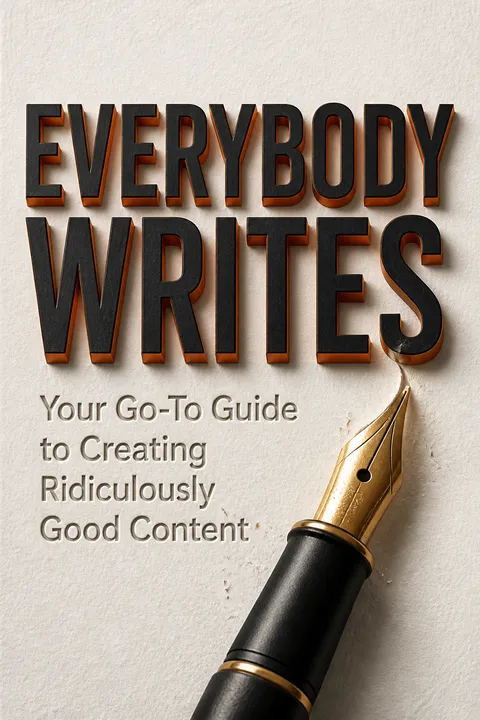


Key Takeaways
Treat every email, post, and page as evidence of how you think
Writing is already part of the job. Handley argues that anyone who sends email, posts online, or writes a website is a writer, whether or not that title appears on a business card. The words a company publishes become part of its customer experience, shaping whether it seems capable, human, and trustworthy. The author’s own push-up story makes the point personally: she once saw herself as incapable, then built strength through repeated effort.
Quality needs three ingredients. Useful content helps readers do something that matters; inspired content offers a fresh, well-made perspective; empathetic content starts from the audience’s needs. Handley treats these as mutually necessary: if any one is absent, the content disappoints. Her example is a clear dishwasher-repair guide, valuable because it solves a real problem rather than merely promoting a brand.
The useful shift here is from seeing writing as a specialist craft to seeing it as part of an organization’s everyday conduct. A confusing help page can undermine a polished campaign because customers experience both as the same company. The three-part quality test also resists a common production trap: optimizing for novelty, usefulness, or warmth alone. Its limitation is that these qualities are not easily measured on one scale. Teams need to ask readers what helped them, not assume that internal enthusiasm equals audience value.
Practice writing on a schedule instead of waiting for inspiration
Repetition builds capacity. Handley compares writing to physical training: regular practice develops a skill that people often mistake for an inborn gift. Writers as different as Maya Angelou, Ernest Hemingway, Charles Dickens, and Oliver Sacks used routines to make creative work part of ordinary life. The point is not to copy their habits, but to stop treating a writing session as a rare event that requires perfect conditions.
Measure finished work. A daily word target gives effort a visible result. Start small, then raise the target as writing becomes easier. The book contrasts five hours of writing on one Saturday with half an hour each day, favoring the steady rhythm. A firm deadline also limits endless tinkering. The aim is not maximum volume at any cost, but a reliable practice that produces complete ideas.
A routine reduces the number of decisions required to begin, which is one reason repeated work can feel easier than sporadic bursts. The word-count measure is especially useful for longer projects because time spent at a desk can disguise avoidance. Still, output is only a proxy for progress. Research, rest, and reflection may be essential parts of writing even when they produce no immediate word count. The strongest use of a target is as a starting structure, paired with a quality check before publication.
Plan around the reader's problem before choosing your format
Think before composing. Handley’s Writing GPS is a flexible process for turning an uncertain assignment into a piece with direction. Begin with the business goal, then translate it into a reader benefit: why should someone care? Keep asking what the benefit is until the answer becomes concrete. A company promoting collaborative software, for instance, should explain how it prevents lost edits and reduces frustration, rather than merely announcing a product launch.
Give the idea a route. State the central message, gather credible evidence and examples, then choose a structure that suits the material, such as a guide, case study, or comparison. An outline, a list, or a mind map can all work. The process also includes drafting, stepping away, revising, editing, checking readability, and deciding what readers should do next. The sequence is guidance, not a rigid formula.
This process separates two problems that often get confused: having something to say and finding a way to say it. The repeated question about reader benefit is a practical defense against company-centered material that has no audience reason to exist. The approach also makes format a consequence of the message, rather than a fashionable choice made first. Its discipline should not suppress exploratory writing, however. Some writers discover their argument through drafting, so an outline can remain provisional while the core point takes shape.
Let the first draft be rough, then revise for the reader
Separate invention from judgment. The Ugly First Draft, or TUFD, is an intentionally unpolished version written to get ideas out of the writer’s head. It is private working material, not permission to publish careless work. Handley advises writers to keep moving when a sentence is clumsy, mark places that need evidence, and resist self-criticism until the raw material exists. A break creates distance before revision.
Edit in two passes. First use the chainsaw: remove sections that do not support the main idea, reorder paragraphs, and strengthen the overall argument. Then use finer tools to improve sentences, word choice, and transitions. On this pass, trade places with the reader. What questions remain? Where is the explanation demanding unnecessary effort? Grammar matters, but fixing commas cannot rescue a draft whose central point is buried or irrelevant.
The distinction between generating and evaluating ideas is valuable because constant self-monitoring can choke off both. Revision then becomes more than proofreading: it is a second act of reasoning about structure, relevance, and the reader’s likely confusion. This resembles iterative design, where an early prototype is made to reveal what needs work rather than to impress. The reader-first test should still be balanced with the writer’s purpose. Serving an audience does not mean flattening a distinctive voice or avoiding ideas that challenge its assumptions.
Put the point first and make every word earn its place
Clarity respects attention. Handley recommends putting the main idea near the beginning of a sentence instead of leading with throat-clearing such as a long citation or a phrase like it is important to remember. Prefer active constructions, specific nouns, and strong verbs. Replace corporate jargon and inflated phrasing with ordinary language. A sentence about people posting pizza photos, for example, is more direct than one that hides the people behind a passive construction.
Make the page readable. Short paragraphs, descriptive subheads, lists, and white space help online readers scan. These are tools, not laws: technical readers may need technical vocabulary, and a complex subject may require more words. Analogies can make abstract data concrete, but only when the comparison is familiar to the audience. The goal is not to make every idea tiny. It is to make the intended meaning easier to find.
The book treats plain language as an ethical choice, not merely a style preference: the writer takes on the work of clarity instead of transferring it to the reader. That is especially important in instructions, public information, and high-stakes decisions. Yet brevity can also conceal complexity if writers remove necessary qualifications or distinctions. A short sentence is not automatically a clear one. The best test is whether readers can accurately explain what the passage means, not whether a readability score looks attractive.
Tell a true brand story with the customer at its center
Make the story specific and human. A compelling business story shows real people facing real situations, and explains how the company matters in their lives. Handley points to Chipotle’s animated film about industrial food production as a story tied to the company’s stated interest in more responsible sourcing. Skype’s story about two girls who connect despite living far apart makes the product’s human value clearer than a discussion of technical features would.
Make voice recognizable. A brand’s voice reflects its personality and point of view; its tone can shift to fit the situation. A playful tone may suit a casual update, while a frustrated customer needs direct help. Stories can also draw on surprising analogies from outside the industry. The customer should not disappear behind corporate self-praise: the company’s story earns attention when it helps the audience understand its own world.
These examples show why story is more than an emotional wrapper around a product. A human situation can make an abstract promise legible, while a consistent voice helps a customer recognize who is speaking across different experiences. The distinction between stable voice and flexible tone is particularly useful for organizations that want personality without sounding tone-deaf. A story can also become manipulation if its facts or implied impact exceed reality. The practical safeguard is to make the narrative vivid without making it less truthful.
Use publishing access carefully, because every careless claim spends trust
Act like a responsible publisher. Handley urges businesses to adopt journalistic habits even when their content is promotional. Check names, numbers, and claims; seek people close to the subject; identify sources’ possible interests; and include perspectives that complicate a preferred argument. A company can take a position, but it should represent relevant counterarguments fairly rather than pretending they do not exist.
Credit work and respect rights. Cite original sources as you write, and make clear where facts, ideas, and images came from. Curation is more than collecting links: it adds context and a distinct point of view while crediting the original creator. Attribution alone does not grant permission to reproduce protected work. When reuse is needed, seek written permission and follow its terms. Trust is built through these small, verifiable acts, not just through a brand’s claims about its own integrity.
The publisher’s ethical burden is unusually visible in marketing because readers know the organization has commercial interests. Disclosure and careful sourcing do not eliminate bias, but they allow readers to judge it. The distinction between presenting a point of view and pretending to be neutral is a strong one: credibility can coexist with advocacy when evidence and opposing arguments are treated fairly. These standards also require workable editorial processes. A team cannot reliably fact-check or document rights if deadlines, approvals, and responsibilities are left ambiguous.
Look beyond company announcements for stories readers actually need
Find the real point of interest. A product update or new hire may matter internally without being useful news to an audience. Handley proposes asking whether a reader would stop what they are doing to tell someone else about it. If not, the information may belong in a media archive rather than on the company’s main publishing channel.
Notice timely connections. Newsjacking means contributing a relevant perspective to a developing news story while public attention is rising. Kapost used the acquisition of a competitor to explain a wider industry trend, rather than making the news about itself. Content opportunities can also come from culture outside the company’s field: a library turned a basketball tournament format into an author competition, and an insurance publication used a monster movie to explore catastrophe coverage. Relevance, speed, and a useful angle matter more than forced cleverness.
This is a useful antidote to the assumption that a content calendar is a list of company milestones. Timely connection lets an organization demonstrate judgment and expertise in public, but the window is narrow and the reputational risk is real. A brand that comments before it understands the event can appear opportunistic or uninformed. The strongest contribution adds interpretation or service, not merely a logo beside a trending topic. A quick relevance check helps: does the connection genuinely clarify something for the intended reader?
Shape each channel around its audience and the next useful step
Match the message to the moment. A home page should quickly explain whom the business helps and why that matters. An About page can tell the company’s history, but in relation to the visitor. An email should feel like a relevant message from a person, not an undifferentiated blast. On social media, context and conversation work better than a bare link or a disguised sales pitch.
Remove friction from action. A landing page should repeat the promise that brought someone there, deliver the promised value, and make the next action obvious. In one MarketingProfs test, a benefit-focused headline converted 26 percent better than a product-focused one. The book also gives format-specific guidance for headlines, blogs, profiles, and reports. These examples share one rule: design words, visuals, and calls to action as one reader experience.
The channel-specific advice is strongest when it focuses on the user’s task rather than platform etiquette. A visitor arriving from a particular offer needs continuity, while a social follower needs a reason to engage beyond being sold to. The landing-page example makes that logic measurable: small changes in framing can affect behavior. Such results are context-dependent, though. A winning headline in one campaign does not establish a universal formula. Each channel needs its own testing, and each test needs a clearly defined audience and outcome.
Treat content benchmarks as testable guesses, not universal rules
Use numbers as starting points. The book reports suggested lengths such as roughly 1,500 words for a search-oriented blog post, about 22 minutes for a podcast, and 120 to 130 characters for a tweet. These figures are presented as benchmarks drawn from research available at publication, not commands to pad a useful article or cut a necessary explanation. Platform behavior and audience habits change, so a number that once described a pattern may stop doing so.
Test what your readers respond to. Compare headlines, landing-page copy, posting times, and formats against a defined goal. Handley describes trying different offers and using social responses to decide whether an idea merits a longer article or talk. Treat performance data as evidence about a particular audience in a particular context, then revise. The right length is the shortest form that delivers the promised value, not the length that satisfies a chart.
This is the book’s most durable protection against its own tactical advice becoming formula. Benchmarks can focus attention and help teams begin testing, but they can also invite metric substitution, where a proxy such as clicks stands in for usefulness or trust. A good experiment specifies both the behavioral outcome and the reader benefit, then examines whether one improved at the expense of the other. Because the book’s platform figures date from 2014, they are best read as examples of how to reason from evidence, not as current platform prescriptions.
Analysis
Everybody Writes is a practical guide to a world in which publishing has become ordinary work. Its central argument is not that every employee must become an artist, but that every public-facing sentence helps constitute a company’s identity and customer experience. Handley joins three domains that are often kept apart: the mechanics of writing, the ethics of publishing, and the commercial design of marketing content. That combination makes the book more useful than a grammar manual or a collection of headline tricks.
Its most powerful recurring move is to relocate the writer’s attention. Instead of asking what the company wants to say, ask what the reader needs to understand, feel, or do. The writing process, the editing advice, the brand story examples, and the landing-page recommendations all follow from that reversal. The result is a coherent theory of communication: usefulness earns attention, specificity makes claims credible, and revision reduces the effort imposed on readers.
The book also holds a productive tension between persuasion and journalism. A brand is not an impartial newsroom, yet its commercial motive does not excuse factual carelessness. Handley’s answer is neither to conceal the motive nor to abandon storytelling, but to report accurately, cite sources, acknowledge competing views, and make the customer’s interests visible. This is a demanding standard because good intentions alone cannot resolve conflicts between business goals and audience welfare. Editorial independence and clear review practices matter as much as individual writer virtue.
The guide’s tactical material reflects the digital environment of 2014. Specific platform norms, tools, and performance benchmarks age quickly, and should not be mistaken for timeless laws. The more lasting contribution is its method: clarify the purpose, identify the reader’s problem, gather evidence, choose a suitable form, draft without paralysis, revise with empathy, and test the result. In an era of automated text production, that method becomes even more important. Fluency is easy to generate; judgment about truth, relevance, originality, and human consequence remains the harder work.
Review Summary
Everybody Writes receives mixed reviews, with an average rating of 3.97 out of 5. Many readers find it helpful for improving business and content marketing writing skills, praising its practical tips and accessible style. Some appreciate the focus on reader-centric writing and empathy. However, some experienced writers find it too basic or repetitive. Critics note that much of the information can be found online. Despite this, many readers consider it a valuable resource for beginners and a handy reference guide for content creators.
People Also Read


Glossary
The Ugly First Draft (TUFD)
Unpolished idea captureA deliberately rough first version written to move ideas out of the writer’s head and onto the page. The writer postpones sentence-level correction, spelling, and self-judgment, marking gaps that need research or examples instead. TUFD is a private stage in a larger process; it must be revised before publication.
Writing GPS
A flexible writing processHandley’s metaphor for a sequence of checkpoints that guides a writer from an assignment toward finished content. It includes clarifying the goal, reframing it around the reader, stating the central message, gathering evidence, organizing, drafting, revising, editing, checking readability, and choosing a next step for the audience. The order can vary.
Think before ink
Clarify before composingA planning principle that asks writers to establish a piece’s purpose, point of view, and relevance to its audience before focusing on polished wording. It does not prohibit exploratory drafting. Rather, it encourages a writer to know the general direction and reader benefit so that writing does not drift without a central point.
Quality Content
Useful, inspired, empathetic contentHandley’s model for content that combines practical utility, creative inspiration, and empathy for the intended audience. Utility means helping readers accomplish something that matters to them. Inspiration means offering a fresh and well-made perspective. Empathy means understanding the reader’s situation and needs. The model treats these as interdependent qualities rather than optional enhancements.
Brand journalism
Reporting within a brandAn editorial approach in which a company uses reporting and storytelling skills to create valuable content about its work, customers, employees, and wider industry. Unlike independent journalism, it is not impartial about the company. Its credibility depends on truthful reporting, audience relevance, careful sourcing, and an honest understanding of its commercial purpose.
Newsjacking
Timely contribution to newsA practice of adding a relevant perspective to a breaking or developing news story while public attention is growing. The company connects the event to a broader issue its audience cares about, rather than simply inserting a product mention. Timing matters, but the contribution must also be accurate and genuinely useful.
FAQ
What's Everybody Writes about?
- Focus on Writing Skills: Everybody Writes by Ann Handley emphasizes that writing is a crucial skill for everyone, not just trained writers. It aims to empower individuals to improve their writing abilities for better communication in a content-driven world.
- Content Creation Guide: The book serves as a comprehensive guide to creating high-quality content, offering practical advice on writing techniques, grammar, storytelling, and publishing rules.
- Content as a Business Asset: Handley argues that writing is a crucial business skill, and that everyone in an organization should be able to communicate effectively through written content.
Why should I read Everybody Writes?
- Improve Communication: Reading this book will help you enhance your writing skills, which are essential for effective communication in both personal and professional contexts.
- Practical Tips: The book is filled with actionable advice and strategies that can be immediately applied to your writing, making it a valuable resource for marketers, business professionals, and anyone who creates content.
- Build Trust with Audiences: The book teaches how to create content that builds trust and engagement with audiences, which is essential for any brand or business.
What are the key takeaways of Everybody Writes?
- Writing is a Habit: One of the main takeaways is that "writing is a habit, not an art," emphasizing the importance of regular practice to improve your skills.
- Empathy for Readers: Handley stresses the need to "swap places with your reader," encouraging writers to consider their audience's perspective and needs when crafting content.
- Quality Over Quantity: The book stresses the importance of quality content over sheer volume. Handley encourages writers to focus on creating valuable, useful content that meets the needs of their audience.
What are the best quotes from Everybody Writes and what do they mean?
- "Writing is a habit, not an art.": This quote underscores the idea that anyone can become a better writer through practice and dedication, rather than relying solely on innate talent.
- "A good lede invites you to the party and a good kicker makes you wish you could stay longer.": This emphasizes the importance of strong opening and closing sentences in engaging readers and leaving a lasting impression.
- "Show, don't tell.": This classic writing advice encourages writers to use descriptive language and examples to illustrate their points, making the content more vivid and engaging.
What specific writing techniques does Ann Handley recommend in Everybody Writes?
- Follow a Writing GPS: Handley suggests using a structured approach to writing, which she refers to as a "writing GPS," to help navigate the writing process from brainstorming to final edits.
- Develop Pathological Empathy: She encourages writers to cultivate "pathological empathy" for their readers, ensuring that the content is relevant and engaging for the audience.
- End on a Strong Note: Handley advises writers to "end on an I-can't-wait-to-get-back-to-it note," leaving readers with a compelling conclusion that encourages further engagement.
How does Everybody Writes address grammar and usage?
- Practical Grammar Tips: The book provides straightforward grammar rules tailored for marketers, helping them avoid common pitfalls and improve clarity in their writing.
- Focus on Real Communication: Handley emphasizes that grammar should serve the purpose of clear communication, rather than being an obstacle that intimidates writers.
- Encouragement to Break Rules: While it covers grammar, the book also encourages writers to break certain rules when it enhances readability and engagement, promoting a more flexible approach to writing.
What is the importance of storytelling in Everybody Writes?
- Connect with Audiences: Handley emphasizes that storytelling is essential for creating a connection with readers, making content more relatable and memorable.
- Unique Brand Voice: The book discusses how a compelling brand story can differentiate a business, highlighting the importance of authenticity and originality in storytelling.
- Human Element: Handley argues that stories should focus on real people and experiences, as this human element makes the content more engaging and impactful.
What are some common mistakes marketers make in writing, according to Everybody Writes?
- Overuse of Jargon: Handley points out that many marketers fall into the trap of using jargon and buzzwords, which can dilute their message and alienate their audience.
- Neglecting Readability: The book highlights the importance of readability, warning against long, complex sentences that can confuse readers.
- Ignoring the Audience: A common mistake is failing to consider the reader's perspective, which can lead to content that is self-indulgent rather than reader-focused.
How does Everybody Writes define brand journalism?
- Brand Journalism Explained: Handley defines brand journalism as a way for companies to tell their stories through a journalistic lens. It involves creating content that is informative, engaging, and relevant to the audience.
- Focus on Audience Needs: The book emphasizes that brand journalism should prioritize the needs and interests of the audience over the company's promotional messages. This approach helps to build trust and credibility.
- Incorporate Storytelling: Handley encourages brands to use storytelling techniques in their content. By sharing real stories and experiences, brands can connect with their audience on a deeper level.
What is the importance of headlines according to Everybody Writes?
- Headlines Grab Attention: Handley states that headlines are crucial for capturing the reader's attention. A compelling headline can make the difference between someone reading your content or scrolling past it.
- Promise Value: The book advises that headlines should clearly convey the value of the content. They should promise what the reader will gain by engaging with the material.
- Use Numbers and Specificity: Handley suggests using numbers and specific language in headlines to make them more enticing. For example, "5 Tips for Effective Writing" is more appealing than "Tips for Writing."
How does Everybody Writes suggest using data in content?
- Ground Content in Facts: Handley encourages writers to support their claims with credible data and research. This practice enhances the credibility of the content and builds trust with the audience.
- Use Data to Tell Stories: The book suggests using data as a storytelling tool. By presenting data in a narrative format, writers can make complex information more relatable and engaging.
- Visualize Data: Handley advocates for using visuals, such as infographics, to present data. This approach makes information more accessible and easier to understand for readers.
How can I apply the principles from Everybody Writes to my own writing?
- Set Writing Goals: Start by setting specific writing goals based on word count rather than time spent, allowing you to measure your progress effectively.
- Practice Regularly: Incorporate writing into your daily routine to develop the habit, as suggested by Handley, and embrace the process of creating "The Ugly First Draft."
- Seek Feedback: Find a writing buddy or mentor to provide constructive feedback, helping you refine your work and improve your skills over time.
About the Author

Download PDF
Download EPUB
.epub digital book format is ideal for reading ebooks on phones, tablets, and e-readers.








