

Key Takeaways
Check the base rate before trusting a positive test
Start with prevalence. A prior probability is the chance of a condition before new evidence arrives. A test result cannot be interpreted without it. In the book’s example, mammography correctly detects 80% of cancers and correctly clears 90% of people without cancer. If 1% of 100,000 women tested have cancer, there are 800 true positives but 9,900 false positives. Among all positive results, the chance of actually having cancer is about 7%, not 80% or 90%.
Count real people. This arithmetic is easier to grasp as a group than as abstract percentages. The same test becomes more informative in a higher-risk population, because the proportion of true positives rises. Screening decisions also weigh false alarms, follow-up procedures, anxiety, and cost.
What's striking is how a simple change in the population changes the meaning of an unchanged test. This is a central lesson in risk communication: report absolute frequencies, not just sensitivity or specificity. A clinician saying a test is highly accurate may be technically correct and still leave a patient badly misinformed. The same arithmetic matters in security screening, fraud detection, and rare-disease diagnosis. Base rates are not a reason to dismiss a positive result; they are the context needed to interpret it responsibly.
A rare DNA match is not the chance your suspect is innocent
Reverse the question carefully. The prosecutor’s fallacy confuses the chance of a DNA match if someone is innocent with the chance that someone is innocent given a match. A match expected once in three million does not establish a one-in-three-million chance of innocence. If investigators searched a population of 65 million, chance alone could produce roughly 20 matches, besides the perpetrator. Under the book’s simplified assumptions, a random match would therefore be more likely to implicate an innocent person than the culprit.
Selection matters too. In the Monty Hall puzzle, switching doors raises the chance of winning from one-third to two-thirds only because the host knows where the car is and deliberately opens a goat door. If a door opens randomly, it does not provide the same evidence. The process that produced a clue changes what the clue means.
The shared insight is that evidence has no fixed force apart from the process that generated it. Forensic analysis needs the population searched, the way suspects were selected, and the possibility of innocent contact with evidence. A courtroom should also separate a statistical match from the broader question of guilt, which depends on many facts. The Monty Hall example makes this vivid: identical visible outcomes can carry different information under different procedures. Conditional probability is not a technical footnote. It is part of the story of how evidence arose.
Never assign zero to uncertain claims, or evidence cannot move you
Beliefs can move. Bayes’ theorem describes how to revise a probability when new evidence arrives. A prior is the starting estimate; the posterior is the revised estimate after evidence is included. The posterior then becomes the next prior. These probabilities express a person’s state of knowledge, not a magical property attached to the event. Different people can reasonably update differently when they begin with different information or assumptions.
Keep a crack open. Cromwell’s rule advises against assigning exact zero or one to claims that are not logically certain. If rain seems virtually impossible in a place that has been dry for ages, repeated wet pavements can still shift the estimate. A prior of exactly zero cannot budge, because multiplying zero by any evidence still gives zero.
This account avoids two bad extremes: pretending uncertainty can be eliminated, and pretending every belief is equally defensible. Priors are personal, but they can be scrutinized against background data, expert knowledge, and alternative reasonable starting assumptions. The practical discipline is to state what would change a belief before an argument begins. A stubbornly low probability can be rational; an immovable probability is a warning that evidence has been shut out. Confidence should reflect both the quality of evidence and the credibility of the assumptions beneath it.
A p-value measures surprise under a null, not truth of a theory
Read the statistic literally. A p-value is the probability of results at least as extreme as the observed ones, assuming a specified null hypothesis is true. It is not the probability that the hypothesis is false, nor the chance that results are due to luck. A p-value below 0.05 is a conventional threshold, not a certificate of truth.
Small choices compound. In a replication project, researchers repeated 100 psychology studies. Although 97 original studies reported statistically significant results, only 36 replications did. Flexible analyses, repeated peeking at results, and publication preferences for exciting findings can manufacture apparent discoveries. The book calls one practice HARKing, forming a hypothesis after seeing the results. Preregistration and publication of results regardless of outcome help reduce these pressures.
The crisis is not simply that scientists sometimes make mistakes. It is that a statistical convention was routinely asked to answer a question it was not designed to answer, while career rewards favored novel findings. The distinction resembles diagnostic testing: a false-positive rate is not the same as the probability that a positive claim is false. Bayesian analysis can make prior plausibility explicit, but no statistical method repairs selective reporting or a poorly designed study. Better incentives, transparent methods, and independent replication matter whatever framework is used.
Before believing a startling result, compare rival explanations
Evidence has competitors. A highly unlikely result can count against a familiar theory, but it may also indicate faulty equipment, fraud, or an unmodeled factor. In 2011, a CERN experiment appeared to find neutrinos arriving about 60 nanoseconds faster than light, an extraordinary result with a tiny p-value. The apparent effect was traced to a poorly connected fiber-optic cable, not new physics.
Do not force a false choice. British parapsychologist Samuel Soal reported striking card-guessing results, but later investigation found that he had manipulated numbers. Psychic ability and pure chance were not the only possible explanations. A sound inference compares plausible alternatives, including errors in measurement and procedure, rather than treating one surprising result as a choice between the headline claim and coincidence.
This is a useful corrective to both credulity and reflexive dismissal. A startling finding should trigger investigation, not automatic acceptance or suppression. In complex systems, an observation can be real while its proposed cause is wrong, as the cable failure illustrates. Scientific skepticism is strongest when it generates tests that distinguish explanations. There is a limitation: the list of alternatives can never be guaranteed complete. That makes replication, instrument checks, and independent methods essential safeguards, not bureaucratic obstacles to an exciting discovery.
Forecast from the outside view, then update with local evidence
Begin with a comparison class. The outside view starts from how often similar events occur, then adjusts for details of the particular case. At a wedding, a forecaster might start with the share of British marriages that end in divorce, rather than treating the couple’s celebration as decisive evidence. The inside view, such as the couple’s apparent compatibility, then modifies that starting estimate.
Make forecasts testable. Philip Tetlock asked 284 experts to make more than 30,000 precise predictions. The average forecaster performed only slightly better than chance, while a small top group, the superforecasters, did notably better. They used probabilities, broke questions into smaller estimates, consulted reliable peers, and recorded outcomes. A Brier score measures forecast accuracy by penalizing the squared gap between a forecast and what happened.
Forecasting improves when vague confidence becomes a number that can be checked. Calibration asks whether events assigned a 70% chance occur about seven times in ten. That is different from being right on every individual call, and it gives forecasters a way to learn without pretending uncertainty has vanished. Reference classes can mislead when the case is genuinely unprecedented or the world has changed. The strongest forecasters therefore use base rates as anchors, not cages, and keep track of when new evidence justifies leaving them.
Let consequences, not odds alone, determine what is worth doing
Probability is not a decision. Utility means the value or cost a person assigns to an outcome. Expected utility combines each outcome’s probability with its value. A low-probability event can justify action if the payoff is enormous; a likely outcome may not be worth pursuing if its benefit is small or its cost is high.
The numbers can guide choice. In the book’s hypothetical lottery, one ticket costs £1, the jackpot is £150 million, and the chance of winning is one in about 131 million. Ignoring complications such as shared prizes, the expected payout is about £1.14, so the ticket has a small positive expected monetary value. Real preferences are not identical to money, however. Risk tolerance, fairness, and the consequences of being wrong all matter.
This framework connects probability to economics and ethics: a forecast only becomes a choice when its outcomes are valued. The same odds can rationally support different decisions for people with different resources or responsibilities. A public-health agency, for example, may weigh a small risk across millions of people differently from an individual weighing a personal risk. Expected value is a useful benchmark, not a complete description of human welfare. Money is convenient to calculate, but it is only a proxy for health, security, time, and preference.
Your brain sees a prediction checked against sensory evidence
Perception is an inference. Predictive processing describes the brain as generating expectations about incoming sensory signals and revising them when they do not fit. The Dress, an image that some viewers saw as blue and black and others as white and gold, illustrates how the same ambiguous light can support different interpretations. The brain infers both an object’s color and the lighting around it.
Mismatch gets attention. A checkerboard illusion makes two identical gray squares look different because one appears to be in shadow. The brain uses its assumptions about lighting to interpret the image. In experiments combining sight and touch, people relied more on whichever sense was more precise. In this account, prediction error is the mismatch between expected and incoming information, a signal that the brain may need to revise its model.
The model links perception to statistical inference and explains why illusions are informative rather than mere failures. Sensory input is often ambiguous, so prior experience helps stabilize a usable world. The tradeoff is that the same expectations can conceal surprising information, as the hollow-mask illusion shows. Predictive processing is a powerful research framework, but it should not be treated as a settled explanation for every aspect of consciousness. Its value lies partly in producing testable claims about perception, attention, and the way sensory reliability influences judgment.
Use the right shortcut for the task, then audit it at high stakes
Context changes reasoning. In Wason’s abstract card puzzle, fewer than one in ten people in the original study chose the logically correct cards. But when the same rule was framed as checking whether minors were drinking alcohol at a party, people found the relevant cases much more readily. Familiar situations can make the structure of a problem easier to see.
Shortcuts can be skillful. The gaze heuristic helps someone catch a ball: keep looking at it and adjust movement so its position in view stays stable. This avoids calculating its full trajectory. Such heuristics are efficient in familiar environments, but they can fail when vivid examples distort risk or when a decision depends on rare-event probabilities. In those cases, slow down and make the base rate explicit.
The important distinction is not between rational people and irrational people, but between tools suited to a task and tools that misfire. Ecological rationality studies how a shortcut performs in the environment where it is used. A fast visual strategy can be excellent for catching a ball and useless for estimating a rare medical risk. Expertise often consists partly of learning which cues deserve attention. The caution is that familiar-feeling situations can hide unfamiliar statistics, so high consequences justify explicit checks even when intuition feels fluent.
Test whether a predictor learned a model, not just a pattern
Prediction can reveal structure. Language models are trained to predict what text comes next, which has led critics to call them elaborate autocomplete. But the book describes an Othello-playing model trained on sequences of game moves. It made legal moves in unfamiliar game positions, and researchers could identify an internal representation of the board that influenced its choices.
A model is not a mind. This evidence suggests that next-step prediction can encourage an AI to build useful representations of the environment it encounters. It does not establish that the system understands the world as a person does. The distinction matters: a predictor can generalize beyond memorized examples while remaining limited by its training data, objectives, and the situations it has never encountered.
The Othello result offers a concrete way to examine claims about machine intelligence: test generalization and inspect whether internal states track relevant features of the task. Similar logic appears in science more broadly, where a model earns trust by predicting observations beyond the data used to construct it. Yet successful prediction does not settle questions about consciousness, meaning, or human-like understanding. A system can possess a useful task model without possessing the rich, embodied experience associated with human knowledge.
Analysis
The book’s most important move is to change the question from “How surprising is this evidence under a hypothesis?” to “How much should this evidence change a belief?” That shift connects medical diagnosis, DNA evidence, scientific studies, forecasting, perception, and machine learning. In each case, evidence becomes informative only against a starting model of what was plausible and an account of how the evidence was generated.
This is not an argument that all beliefs are equally subjective. A prior can be disciplined by prevalence data, previous experiments, expert knowledge, or a well-chosen reference class. It can also be exposed as fragile by checking whether conclusions change under other defensible priors. The practical ideal is not perfect calculation, which is often impossible, but visible assumptions and proportionate updating.
The book is strongest when it makes conditional probability concrete. A positive screen, a DNA match, or a revealed game-show door means different things in different populations and procedures. Its account of scientific significance is also valuable: a small p-value is not a posterior probability, and research incentives can turn flexibility into a factory for false discoveries. Still, Bayesian methods do not solve every scientific problem. A poorly specified model, biased data, or a misleading likelihood can produce confident but wrong posteriors. Nor does a subjective probability by itself decide what society should do. Decisions require values, consequences, and distributional questions, not just likelihoods.
The brain chapters extend the same idea from explicit reasoning to perception. Predictive processing gives a compelling account of why ambiguity, attention, and illusion are linked, while the discussion of AI suggests that prediction can build internal structure. These are illuminating frameworks, not universal proofs that every mental or computational process is Bayesian in a strict mathematical sense. The durable lesson is more modest and more useful: treat beliefs as revisable models, ask what evidence would distinguish competing explanations, and notice when a confidence level is doing more work than the facts justify.
Review Summary
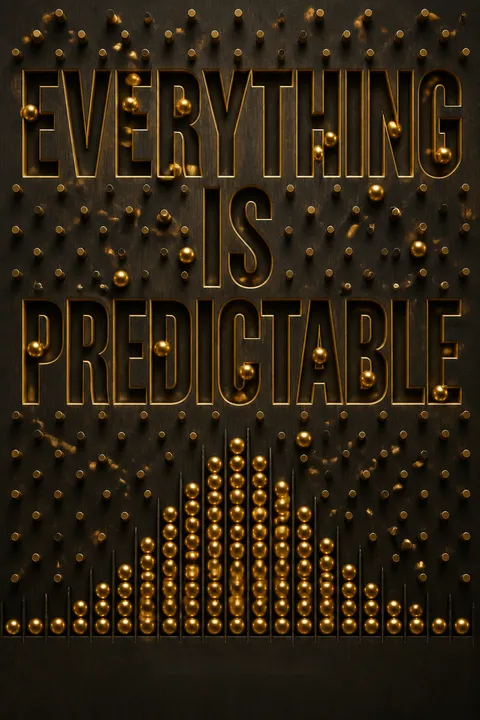
Everything Is Predictable by Tom Chivers explores Bayesian statistics and its applications in science, decision-making, and everyday life. Readers praise Chivers' accessible writing style, engaging explanations, and use of real-world examples. The book covers the history of Bayesian thinking, contrasts it with frequentist approaches, and discusses its relevance to the replication crisis in science. While some found certain sections challenging or repetitive, many recommend it as an insightful introduction to Bayesian reasoning for a general audience, highlighting its potential to reshape how we understand uncertainty and make predictions.
People Also Read









Glossary
Bayes' theorem
Rule for updating probabilityA mathematical rule for revising the probability of a hypothesis after new evidence arrives. It combines the prior probability of the hypothesis with how likely the evidence would be if the hypothesis were true, while accounting for how common the evidence is overall. It clarifies why evidence cannot be interpreted without context.
prior probability
Starting probability before evidenceThe probability assigned to a hypothesis before considering a particular new piece of evidence. A prior can reflect background prevalence, previous findings, expert knowledge, or a reasoned judgment. In Bayesian reasoning, it is updated rather than discarded. Different reasonable priors can produce different conclusions, especially when evidence is limited.
posterior probability
Updated probability after evidenceThe probability assigned to a hypothesis after new evidence has been combined with a prior. It represents the revised state of knowledge, not necessarily an objective frequency in the world. When further evidence arrives, the posterior from one update can serve as the prior for the next.
likelihood ratio
Evidence strength between hypothesesA comparison of how likely a piece of evidence is under one hypothesis rather than another. If evidence is four times as likely when a claim is true as when it is false, its likelihood ratio is four to one. A likelihood ratio describes the evidence’s force, but does not by itself give the final probability of the claim.
p-value
Data surprise under nullThe probability, assuming a specified null hypothesis, of observing results at least as extreme as those obtained. It does not give the probability that the null hypothesis is true or that a finding is false. Its interpretation depends on the study design, analysis choices, and the assumptions behind the null model.
HARKing
Hypothesis formed after resultsAn abbreviation for hypothesizing after results are known. It describes presenting a hypothesis developed after inspecting data as though it had been specified before the study. This can make an exploratory discovery look like a successful prediction, especially when researchers test many outcomes or analysis choices.
Brier score
Score for probabilistic forecastsA measure of forecast accuracy based on the squared difference between a predicted probability and the outcome. For a binary event, a forecast of 80% receives a smaller penalty if the event occurs than if it does not. Lower scores indicate better performance across a collection of forecasts.
Cromwell's rule
Avoid absolute certaintyA Bayesian principle against assigning probability zero or one to claims that are not logically certain. A probability of zero prevents any future evidence from raising a claim’s probability, while one prevents evidence from lowering it. The rule preserves the possibility of learning from unexpected information.
predictive processing
Perception through predictionA model of brain function in which the brain generates expectations about sensory input and compares them with signals arriving from the senses. When expected and actual signals differ, the mismatch can prompt revision of the brain’s model. The account also treats movement as a way to test expectations and gather useful information.
prediction error
Mismatch between expectation and inputThe difference between a predicted signal or outcome and the information actually received. In predictive-processing accounts, mismatches can draw attention and lead the brain to revise its model, while well-predicted signals may require less processing. The term is also used in statistical and machine-learning models to describe failed predictions.
utility
Value assigned to outcomesThe value or cost a decision-maker assigns to an outcome. Decision theory combines utilities with probabilities to compare available actions. Money is a convenient proxy in many examples, but utility can represent health, security, time, preferences, or other valued consequences. Different people can rationally choose differently because their utilities differ.
gaze heuristic
Track a target while movingA simple strategy for catching a moving object: keep looking at it and adjust movement so its apparent position remains stable in the visual field. Rather than calculating the object’s full trajectory, the catcher uses ongoing visual feedback. The book presents it as an example of a shortcut that can work well in a familiar environment.
FAQ
What's Everything Is Predictable about?
- Focus on Bayesian Statistics: The book explores how Bayesian statistics can be used to understand and predict various phenomena in our world.
- Bayes' Theorem: It introduces Bayes' theorem, a fundamental concept in probability that helps update beliefs based on new evidence.
- Real-World Applications: The author illustrates the practical implications of Bayesian thinking in fields like medicine, law, and artificial intelligence.
- Interdisciplinary Approach: Insights from psychology, neuroscience, and statistics are combined to present a comprehensive view of decision-making.
Why should I read Everything Is Predictable?
- Understanding Uncertainty: The book provides insights into navigating uncertainty by applying Bayesian principles.
- Enhances Critical Thinking: It encourages readers to question assumptions and understand the probabilistic nature of knowledge.
- Engaging and Accessible: Tom Chivers uses relatable examples and anecdotes to explain complex concepts, making them accessible to a broad audience.
- Practical Decision-Making: Offers tools to evaluate risks and benefits more effectively in personal and professional contexts.
What are the key takeaways of Everything Is Predictable?
- Bayesian Framework: Emphasizes viewing beliefs and decisions through a Bayesian lens, updating prior probabilities with new evidence.
- Avoiding Extremes: Advises against assigning probabilities of zero or one, suggesting a range to account for uncertainty.
- Real-World Implications: Discusses the role of Bayesian thinking in addressing the replication crisis in science and improving decision-making.
What is Bayes' theorem, as defined in Everything Is Predictable?
- Basic Definition: Bayes' theorem is a formula for updating the probability of a hypothesis based on new evidence.
- Formula Breakdown: It states that the probability of event A given event B is proportional to the probability of event B given event A, multiplied by the prior probability of A, divided by the probability of B.
- Practical Example: The book uses medical testing to illustrate how Bayes' theorem can lead to counterintuitive results.
How does Everything Is Predictable explain the concept of prior probabilities?
- Definition of Prior Probabilities: They represent initial beliefs about the likelihood of a hypothesis before considering new evidence.
- Influence on Decision-Making: These priors significantly affect how new data is interpreted, making them essential in any analysis.
- Dynamic Updating: Prior probabilities should be updated as new evidence emerges, allowing for more accurate predictions.
What are some real-world applications of Bayesian statistics discussed in Everything Is Predictable?
- Medical Testing: Bayes' theorem is used to interpret medical test results, emphasizing the importance of prior probabilities.
- Legal Evidence: Bayesian reasoning can be applied in legal contexts to evaluate the strength of forensic evidence.
- Artificial Intelligence: Bayesian methods play a role in AI, where algorithms predict outcomes based on prior data and new information.
How does Everything Is Predictable address the replication crisis in science?
- Critical Examination: Discusses the replication crisis, where many studies fail to reproduce results, questioning research reliability.
- Statistical Practices: Argues that frequentist methods, particularly p-values, contribute to this crisis by encouraging statistically significant results over true findings.
- Bayesian Solutions: Suggests Bayesian methods, which incorporate prior knowledge, could help mitigate these issues.
How does Everything Is Predictable differentiate between Bayesian and frequentist statistics?
- Bayesian Approach: Focuses on updating beliefs based on prior knowledge and new evidence, allowing for flexible data interpretation.
- Frequentist Approach: Relies on p-values and the null hypothesis, often leading to binary decisions without considering prior beliefs.
- Implications for Science: Frequentist methods can lead to misleading conclusions, while Bayesian methods provide a coherent framework for understanding uncertainty.
What is the significance of prior probabilities in Everything Is Predictable?
- Foundation of Bayesian Thinking: Prior probabilities influence how new information is interpreted, shaping expectations and guiding decisions.
- Dynamic Updating: They should be updated with new evidence for more accurate predictions.
- Real-World Examples: Examples like medical testing show how prior probabilities affect outcomes and interpretations.
How does Everything Is Predictable relate to decision-making?
- Bayesian Decision Theory: Provides a structured approach to making choices under uncertainty by combining prior beliefs with new evidence.
- Utility and Expected Value: Discusses these concepts to quantify benefits and risks, aiding in rational evaluation of options.
- Practical Applications: Understanding Bayesian decision-making can improve everyday choices, from financial investments to health decisions.
What is the role of confirmation bias in Everything Is Predictable?
- Understanding Confirmation Bias: It's the tendency to favor information that supports existing beliefs, leading to skewed perceptions.
- Bayesian Perspective: A Bayesian approach can help mitigate confirmation bias by encouraging consideration of alternative hypotheses.
- Real-World Implications: Recognizing this bias is essential for making rational decisions and forming accurate beliefs.
What are the best quotes from Everything Is Predictable and what do they mean?
- "Life isn’t chess, a game of perfect information, one that can in theory be 'solved.' It’s poker, a game where you’re trying to make the best decisions using the limited information you have.": Emphasizes the uncertainty in real-life decision-making.
- "Bayes’ theorem is strange. It is a simple equation... but it has profound implications.": Highlights the paradox of Bayes' theorem being easy to understand yet capable of explaining complex phenomena.
- "You can’t make sense of pretty much any form of medical testing without invoking Bayes.": Underscores the critical role of Bayesian statistics in interpreting medical tests.
Download PDF
Download EPUB
.epub digital book format is ideal for reading ebooks on phones, tablets, and e-readers.








