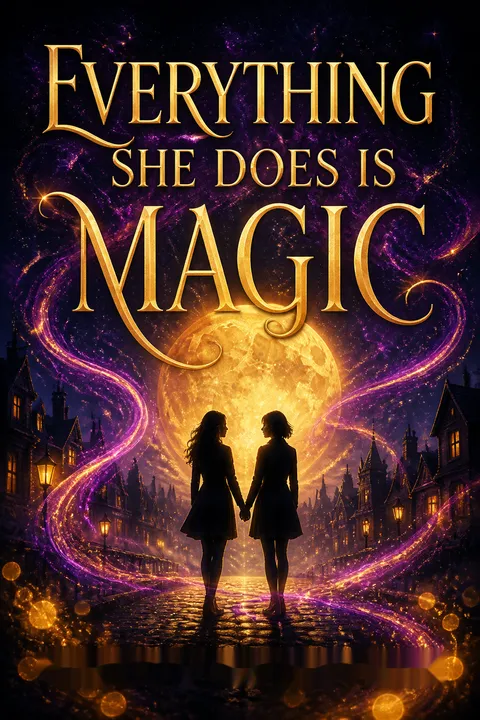


Plot Summary
The Witch at Paint Night
Every October, seventeen-year-old Darcy Keller helps her parents turn Fableview into a town of pretend witches, teaching tourists a painting trick while insisting that its magic is make-believe. Then her parents announce that she will take over their art shop next year, though Darcy has never agreed to stay.
Anya Doyle, the withdrawn new girl in Darcy’s French class, arrives at the shop and catches Darcy escaping the announcement. Outside, Anya admits she is a witch, but Darcy laughs, convinced she is joking. Anya retreats to the safer excuse that she wants to join the class. She has been told to bring a mortal friend to her coven initiation, and has already named Darcy to her parents without asking her.
Both girls enter the story under the pressure of roles assigned before they can consent. Darcy’s inherited place in the town is disguised as praise, while Anya’s family tradition makes friendship sound like a recruitment task. Their first encounter turns on a mismatch of knowledge: Anya tells the truth and is disbelieved, while Darcy exposes a real longing to leave beneath her cheerful performance. The romance begins not with mutual understanding but with each girl recognizing, in the other, a possible escape from a life designed by someone else.
A Committee Learns to Bend
Darcy invites Anya to a meeting of the Fableview Fall Planning Committee, where the older members resist even modest changes to the town’s Halloween parade. Anya suggests linking local shops through a scavenger hunt, and Darcy recognizes a way to experiment without asking permission first. After the meeting, Darcy recruits her to help.
At the parade, Darcy hands out discount cards that will bring visitors into several businesses, hiding the promotion from her parents until they can see whether it works. She tells Anya she has decided to take over Pam’s Paints, but her answer lacks conviction. Anya hears the uncertainty and lets it stand, while the two begin working together on a small act of rebellion disguised as community service.
The committee gives the girls a practical arena in which to test their differences. Anya’s instinct is to question why a successful custom cannot improve, while Darcy has learned that challenging her parents directly risks being treated as disloyal. Their secret promotion is therefore more than a marketing scheme: it lets Darcy try authorship without first having to reject her family. Anya’s restraint matters too. Rather than force Darcy to admit what she wants, she creates room for her to discover it through action.
The Torn Costume Mends
When Darcy’s parents refuse a small change to the witch painting, Anya asks for the basset hound Grace invented, and Darcy tries to include it anyway. Her parents stop her. Later, Darcy breaks several cherished ceramics in a rush of nerves, and Anya arrives with her silent aunt, Cal, to help clean the shards.
During the parade, Grace’s little sister Maddie tears one of her costume wings and begins to cry. Anya takes the fabric aside, concentrates, and returns it whole before anyone can see how she did it. Maddie is comforted, but Darcy and Grace are left staring at a repair too fast and seamless to explain. Darcy dismisses it as a trick; Anya’s aunt quietly draws her away.
Anya’s first public use of magic is an act of care, not display. The torn wing gives her a problem she can solve immediately, and the child’s distress overrides her fear of attracting demands. Darcy, meanwhile, reads skill through the practical world she knows: tricks, craft, performance. Her skepticism protects the playful logic of Fableview, but it also keeps her from seeing Anya clearly. The repaired wing becomes a small contradiction that both girls carry forward, one as evidence and the other as a fact she cannot yet name.
Two Pink Butterflies
At the pumpkin patch party, Anya mistakes a red-haired visitor for Julia, the former friend whose rejection still shapes her fear of trusting people. Grace intercepts her before she can chase the woman, and Darcy leads Anya to the Pam’s Paints booth. When four-year-old Maddie panics about face painting, Anya offers to have a butterfly painted too, giving Maddie the courage to choose one.
Darcy paints matching pink butterflies on both of them. Anya admits that pretty girls make her shy, and Darcy returns the compliment. While she paints, Darcy reveals that she secretly applied to an out-of-state college. Anya encourages her, then shares that Julia once accused her of selfishness after Anya could not grant an impossible request.
The paired butterflies make vulnerability collaborative: Anya helps Maddie by exposing her own embarrassment, and Darcy answers by letting Anya see the uncertainty beneath her confidence. Their attraction develops through attention to one another’s small needs rather than through grand declarations. Anya’s account of Julia also complicates her reserve. Silence is not indifference but a learned defense after being punished for having limits. Darcy’s application is another confession, revealing that her wish to leave is real even while she continues telling everyone she will inherit the shop.
The Gnome Comes Whole
At a ceramics class, Anya chooses to paint a black cat while Darcy hovers nearby. She slips into the supply closet and finds Julia, now visiting Fableview, but turns away before she can confront her. Instead, she uses her mending gift to restore Darcy’s shattered gnome, then begins repairing a broken mug and cuts her hand on a shard.
Darcy finds her, bandages the wound, and nearly kisses her before Anya abruptly invites her to dinner with her parents. Once Anya leaves, Darcy notices that the gnome is perfectly restored. Julia, still at the shop, warns Darcy that Anya lies and cannot be trusted. Darcy refuses to take Julia’s side, but Anya’s secrets now feel personal.
The repaired gnome is an intimate gift Anya intends to give without claiming credit. That secrecy reflects her old strategy: offer useful magic while withholding the self that might be judged or exploited. Darcy discovers the evidence precisely as their almost-kiss makes her want greater honesty. Julia’s warning therefore lands in a vulnerable moment, yet the reader knows Julia’s account is not neutral. The scene makes trust more difficult without making it simple: Anya has concealed crucial facts, but the person condemning her has already taught her that vulnerability can be used as leverage.
Apples, Then a Kiss
Anya’s parents arrive in Fableview earlier than expected, and Cal’s brief vision leaves Anya worried that her aunt knows she is hiding something. At the apple orchard, Darcy is with her own parents when she spots Anya’s family. Anya avoids the reunion by entering the apple-bobbing contest, where she beats Kyle Holtzenberg and wins the five-hundred-dollar prize.
Darcy finds her afterward and checks the hand she injured at the shop. Their teasing gives way to the kiss neither managed in the supply closet. For Darcy, the kiss clarifies that she wants Anya, not the familiar future she once imagined with Kyle. For Anya, it turns an approaching family dinner into a more frightening prospect.
The contest gives Anya a way to act decisively while postponing the conversation she fears. Her success is comic, but it also establishes that she can participate in Fableview on her own terms rather than merely observe its customs. The kiss follows not as a reward for winning but as the result of Darcy choosing to risk clarity. Darcy’s old idea of a safe future with Kyle was built from habit; her response to Anya is both less predictable and more genuinely hers. Anya’s joy, however, remains shadowed by the truths she has not disclosed.
A Rose Reborn
Anya sneaks out to meet Darcy by Fableview Creek, and the two share a quiet night away from their hovering families. As they talk about the dinner ahead, Anya revives a dried rose with her magic, making its petals bloom in her hands. Darcy finally believes that Anya is a real witch and learns that she belongs to the Doyle coven, where she is expected to name a mortal protector before her eighteenth birthday.
Anya has already told her family that Darcy will fill that role. Darcy accepts the revelation that magic exists, but she does not yet know the full weight of the choice Anya has made for her. They leave the creek closer, with the family dinner still waiting.
The rose turns belief from an abstract question into shared evidence. Darcy does not surrender her skepticism because Anya argues persuasively; she changes her understanding because she watches a deadened flower return to life. The scene also binds the book’s two forms of inheritance. Anya’s mending gift is tangible, while Darcy’s family legacy has so far been a set of traditions presented as destiny. The protector revelation complicates their intimacy: Anya has finally shown Darcy who she is, but she has also made a consequential decision on Darcy’s behalf.
Protector Plans Collide
At dinner with both families, Darcy finally reveals that she may attend college out of state. The announcement startles her parents. Cal then explains that Anya expects Darcy to become her mortal protector, a lifelong role Darcy never agreed to and cannot combine with the future she is considering.
Darcy feels that Anya has repeated her parents’ mistake by planning her life without asking. The families separate, and Anya tells her mother she may lose her powers because she has no suitable protector.
Her mother and Cal comfort her rather than trying to force a quick solution. Darcy confronts her parents about the shop and college; they keep her grounded, arguing that she also withheld her plans from them. Neither girl is ready to repair the hurt.
The dinner is a collision between two legitimate grievances, not a simple misunderstanding. Darcy objects to being assigned a future, while Anya has been so afraid of rejection and banishment that she treated Darcy’s consent as an obstacle to manage later. Their families mirror the same failure in different forms: care becomes control when it assumes the loved one’s answer. The rupture forces both girls to see that good intentions do not erase the effects of secrecy. Their separate conversations with family provide comfort, but neither comfort substitutes for an apology between them.
Grace Climbs the Ladder
After Darcy avoids her at school, Anya retreats to Cal’s house, where Grace climbs a ladder to reach her bedroom window. Grace admits she misjudged Anya and wants to help her reconnect with Darcy. Anya explains what happened with Julia: when Julia’s grandfather was dying of cancer, Anya could not use her power to save him, and Julia turned that refusal into a story of selfishness.
Grace recognizes that Anya’s reserve comes from being wounded, not from lacking care. She proposes that they use the upcoming haunted carnival to create the scarier attraction Darcy has always wanted. Anya agrees to help, though she is still unsure how to mend the relationship or what her magic can do beyond repair.
Grace’s visit makes friendship concrete: she crosses the physical distance to Anya rather than waiting for Anya to become easier to approach. Her own theatricality stops being mere comic excess and becomes a language for risk, invitation, and emotional honesty. Anya’s account of Julia clarifies why her refusal to save a dying person remains a source of shame even though the request exceeded her power and violated her training. Grace does not demand that Anya prove herself. She offers a shared project, letting trust grow through cooperation instead of interrogation.
Ground Rules at Home
Darcy tells her parents that she loves Fableview but feels every part of her life has been arranged around their shop and traditions. Her parents explain that they hoped she would love the town as much as they do, then admit they should have asked rather than assumed. They help her research colleges that fit her interests in art, music, and language, although she remains grounded and cannot attend the haunted carnival with Grace.
Darcy’s parents take over the carnival shift to spend the evening with her, making a rare public concession to the Holtzenbergs. Their reconciliation does not decide where Darcy will live, but it changes the conversation: her future can be explored rather than inherited automatically.
This repair differs from the dinner argument because Darcy and her parents finally name the same problem from both sides. Her parents recognize that affection and sacrifice became a plan they expected her to inhabit; Darcy acknowledges that she had concealed her application instead of inviting them into the decision. Their compromise does not erase the grounding or resolve every practical question, but it changes the family’s posture from ownership to collaboration. Darcy can now imagine leaving without treating departure as proof that she has failed to love her home.
A Haunted House Breaks
With Darcy grounded, Anya and Grace sneak into the carnival to transform its mild haunted house. Anya uses her magic to tear open the tent, then helps stage a scene in which vines catch fire and crumble as Grace appears to fight back. The teenagers inside scream for real, and the attraction draws a crowd.
When the Holtzenbergs catch them, Kyle claims the stunt was his idea and takes the blame. Outside, Julia confronts Anya about using magic and again accuses her of refusing to save her grandfather. This time Anya answers that she never lied about being unable to change his fate. Kyle backs her up, tells Julia the town will stand by Anya, and sends her away.
Anya’s magic changes direction here: she uses it to disrupt and frighten rather than mend. The shift matters because she has understood her gift almost entirely through usefulness, as if her worth depends on repairing what others break. The haunted-house performance lets her experiment with power as play and theatrical authorship. Julia’s return then tests whether Anya will again accept the identity imposed on her. She does not. Kyle’s unexpected defense matters less as rescue than as public recognition that Anya’s limits do not make her cruel.
The Ferris Wheel Truce
After the haunted-house confrontation, Anya reaches Darcy at the Ferris wheel. Grace gives them space, and the two girls apologize: Anya for naming Darcy as her protector without asking, Darcy for failing to hear the truth when Anya tried to explain. They agree that their relationship is real, but that love does not oblige Darcy to stay in Fableview or accept a magical duty.
Anya tells Darcy that her family may ask Kyle to protect her instead, though she does not want to decide under pressure. Darcy offers support without taking the choice from her. They call themselves girlfriends as the wheel carries them over the carnival, finally separating romance from the protector role that had threatened to swallow it.
The Ferris wheel lifts the girls above the town without making them imagine that they have escaped its consequences. Their reconciliation depends on restoring choice: Darcy can love Anya without promising to remain, and Anya can love Darcy without converting that love into protection. This distinction is the emotional answer to the dinner conflict. The scene also marks a change in how they apologize. Neither asks the other to forget the harm; each accepts responsibility and offers a different way forward. Their relationship becomes mutual precisely when it stops functioning as a solution imposed by Anya’s family.
Magic at the Fall Ball
At the Fall Ball, Darcy and Anya dance with Grace and her love interest, Parker Holt. Grace eats a cookie containing almonds and suffers a severe allergic reaction, but her bag and EpiPen are locked away with the guests’ coats. While Darcy searches, Anya uses her magic to reopen Grace’s airways enough for her to survive until paramedics arrive.
Darcy tells adults that Grace received her EpiPen, keeping Anya’s power secret. Anya leaves, afraid that intervening in a life-threatening emergency has broken her coven’s rule against changing the natural order. Cal later tells her the act may support, rather than disqualify, her initiation because she used her gift to help a friend and her community.
The emergency converts Anya’s deepest conflict into an immediate ethical decision. She can obey a rule designed to protect the coven’s balance, or act when someone she loves may die. Her magic does not replace medical care; it buys time for it, preserving the difference between aid and control that haunted her past with Julia. Darcy’s cover story protects Anya, but the cost is that Anya must carry the choice before she knows how her family will judge it. Cal’s response offers a more humane reading of tradition without pretending the risk was imaginary.
A Protector of Her Own
On Halloween, Anya’s family accepts that helping Grace was an act of loyalty rather than a reason to cast her out. Cal reveals that her earlier vision showed Anya holding Grace, but she had stayed silent so Anya could make her own decisions. Darcy’s parents help dress Anya as the town’s familiar witch, and the two girls go trick-or-treating together, openly expressing their love.
They visit Grace, who is recovering at home. Anya gives her a lizard pin and asks her to become her protector. Grace accepts, delighted to be trusted with a role that suits her. Anya gains a future in the coven without binding Darcy to it, while Darcy can still pursue the college life she wants.
The protector choice resolves the book’s central conflict by making kinship an act of consent rather than inheritance. Grace is not selected because she is the most convenient substitute for Darcy; she is chosen because she has shown up, challenged Anya honestly, and offered care without demanding that Anya become someone else. Cal’s silence also changes meaning: what once seemed like withdrawal becomes a decision to leave room for Anya’s agency. On Halloween, the town’s costume ritual welcomes Anya without requiring her to perform a false identity.
Epilogue
A few months later, Darcy gathers her parents, Anya, and Grace around the family’s old computer to check her college applications. She gets into three schools, and her parents and friends celebrate with balloons and confetti. Anya has completed her coven initiation and revealed that her magic can now break as well as mend.
Darcy’s parents announce that Grace will take over Pam’s Paints and lead Fableview’s fall festivities, so Darcy can leave without feeling that the town will collapse in her absence. The gathered community cheers both girls’ futures. Darcy and Anya remain together, facing the distance ahead as something they will have to work out rather than a reason to let go.
The ending refuses the false choice between belonging and becoming. Darcy’s college acceptance does not require her parents to abandon Fableview, and Grace’s succession ensures that Darcy’s departure is not framed as betrayal or catastrophe. Anya’s expanded power likewise turns change into part of inheritance rather than its enemy. The old computer, the shop, and the town’s seasonal customs remain, but their custodianship shifts. The final gathering makes community a support structure for change, not a mechanism for preventing it. Darcy and Anya do not receive a guaranteed long-distance solution; they receive something more credible, the trust to make one together.
Analysis
The novel treats inheritance not as a possession but as a set of practices that can either sustain people or narrow their choices. Darcy’s parents love Fableview and hope she will inherit the shop; Anya’s family protects its coven through a rule that asks her to recruit a mortal for life. Neither tradition is presented as inherently cruel. The harm begins when affection is used to presume consent. Darcy’s parents mistake continuity for security, while Anya mistakes a name given to her family for a decision already shared with Darcy.
The romance becomes a test of whether care can survive the removal of usefulness. Anya has learned to mend objects because her power makes her needed, and Darcy has learned to lead because her competence makes her dependable. Both roles conceal a fear: Anya fears rejection if she cannot help, while Darcy fears that refusing responsibility will make her ungrateful. Their separation follows from these habits, not from a lack of feeling. Repair occurs only when each acknowledges that good intentions do not grant authority over another person’s future.
Magic and art provide complementary models of change. Darcy’s paintings make wonder through deliberate construction, while Anya’s power alters the physical world. The story does not dismiss performance as false; Fableview’s costumes, crafts, and festivals create real joy even when their magic is theatrical. Anya’s actual magic then unsettles the boundary between pretending and believing without making the town’s imaginative life meaningless. The haunted house, where she turns destruction into play, lets her practice a power beyond service.
The ending preserves both departure and attachment. Darcy can leave for college because Grace can inherit the shop, and Anya can join her coven because she chooses a protector who is truly her friend. Belonging becomes durable when it permits change rather than requiring people to stay unchanged.
Review Summary
Everything She Does Is Magic is a cozy, witchy YA romance set in the Halloween-obsessed town of Fableview. Readers praised the charming small-town atmosphere, cute sapphic romance, and well-developed characters. Many enjoyed the grumpy/sunshine dynamic between Anya and Darcy. While some found the plot predictable or underdeveloped, most appreciated the book's heartwarming tone and Halloween vibes. The audiobook narration received positive mentions. Overall, reviewers recommend it as a perfect fall read for those seeking a light, magical romance.
Characters
Darcy Keller
Fableview’s eager artistDarcy is a seventeen-year-old artist, teacher, and organizer whose bright confidence makes her seem more certain than she is. She loves helping people create and knows how to keep a room engaged, but she has learned to present family expectations as if they were her own decisions. The town’s Halloween traditions give her a source of pride and belonging, as well as a demanding script she has never been invited to revise. Darcy is drawn to challenges and new possibilities, even when she fears disappointing the parents who waited so long for her. Her warmth is genuine, but so is her need to discover which parts of her life belong to her.
Anya Doyle
A guarded young witchAnya is a quiet, observant teenager raised among relatives who train her in the Doyle coven’s magic. Her gift is mending, a power that has made her useful to others and burdened her with the belief that usefulness is the price of belonging. She dresses in black, favors precision over small talk, and notices details other people miss, including Darcy’s art and the fear tucked beneath her confidence. Anya’s reserve protects her after a painful friendship taught her that a refusal can be turned into an accusation. She longs for a life and identity that are not wholly defined by her family’s expectations, though she is afraid of what independence might cost.
Grace Manalo
Darcy’s glittering best friendGrace is Darcy’s theatrical best friend, known for elaborate costumes, strong opinions, and a love of reptiles and glitter. Her dramatic style can make her seem unserious, but she is perceptive about other people and deeply attentive to the relationships she values. Grace uses jokes, performance, and extravagant enthusiasm to make social risk feel survivable. She is wary of Anya at first, partly because she wants to protect Darcy, but her judgments are not fixed once she sees evidence that she was wrong. Her own romantic hopes and family bonds give her an emotional life beyond the role of Darcy’s sidekick.
Aunt Cal
Anya’s silent mentorCal is Anya’s aunt and current mentor, a reserved witch whose power involves unpredictable visions of the future. She limits her speech for a time in an effort to deepen her connection to that gift, communicating through notes and gestures instead. Cal’s stillness can read as judgment or indifference, especially to someone already afraid of being unwanted. Beneath it is a deliberate respect for the danger of directing another person’s choices. Her painful history with a former protector has shaped her caution about mixing romance and obligation, while her odd habits and bluntness make her a memorable presence in Fableview.
Pam Keller
Darcy’s devoted motherPam is Darcy’s mother, co-owner of Pam’s Paints, and one of the chief architects of Fableview’s Halloween identity. Her affection for Darcy is abundant and sometimes overprotective; she has spent years imagining how the family shop and traditions will continue through her only child. Pam is good at creating festive experiences and less practiced at noticing when care has become assumption. She and her husband share a deep attachment to the town, but her warmth also helps the family find its way back to honest conversation when old expectations begin to hurt.
Darcy’s father
The town’s showman dadDarcy’s father works beside Pam in the family art shop and helps organize Fableview’s autumn events. He leans into costumes and theatrical jokes, using performance to keep tourists and neighbors engaged. His pride in Darcy is sincere, but he has also assumed she will inherit the work he and Pam built. More comfortable with practical plans than emotional subtleties, he can miss how heavily that assumption weighs on her. He remains deeply attached to family routines and to the town that shaped his life.
Anya’s mother
The Doyle family’s optimistAnya’s mother is an enthusiastic witch with a gift for growing plants, and she approaches family life with a warmth that can fill a room. She loves her daughter openly, even though years of Anya living with different relatives have left them with gaps in their daily understanding of each other. Her optimism can sometimes make difficult conversations feel crowded by reassurance, but she is willing to listen when Anya finally names what she needs. She represents a version of family belonging that Anya fears losing.
Anya’s father
Anya’s steady parentAnya’s father is a mortal member of the Doyle family’s orbit, quieter than his exuberant wife and less inclined to take over a conversation. He gives Anya practical, low-key support and offers a calm presence when family expectations become overwhelming. His connection to the coven reflects the possibility of belonging without possessing the same magic. Though he is not as prominent as Anya’s mother or Aunt Cal, his steadiness helps make the family feel like more than a tradition Anya must obey.
Kyle Holtzenberg
The town’s earnest athleteKyle is a muscular, competitive classmate whose jokes and confident manner often make him seem self-absorbed. He is tied to Darcy through a brief childhood romance and the familiar social habits of a small town, but he has more tenderness than Darcy initially gives him credit for. His affection for his younger brother reveals a thoughtful side that his gym-class bravado tends to obscure. Kyle is not skilled at reading every situation, yet he can surprise people by recognizing when someone needs support rather than another joke.
Piper Blake
The quiet social chameleonPiper is a younger classmate and friend of Darcy and Grace who moves easily between social groups. Her neat clothes and restrained style contrast with their louder costumes, but she is observant and often sees the shape of a situation before the others admit it. Piper divides her time between her divorced parents and does not demand attention to remain part of the group. Her family is connected to Fableview’s older magical history, though she herself tends to be a calm, understated presence.
Julia
Anya’s former friendJulia is a red-haired girl from Anya’s past whose friendship once gave Anya hope of finding a lasting companion. She is direct, forceful, and accustomed to making her needs known, qualities that can make her seem persuasive even when she is acting from pain. Anya’s memories of Julia are tangled with affection, pressure, and an old accusation that she has never fully escaped. Julia’s presence brings that history into the present and tests how Anya understands her own limits.
Maddie Manalo
Grace’s costume-loving sisterMaddie is Grace’s four-year-old sister, an energetic child who loves frightening costumes and takes her Halloween creations seriously. When a tear in her wings upsets her, Anya’s kindness gives her a reason to trust someone new. Maddie’s directness helps reveal how easily care can be offered without turning into a demand.
Parker Holt
Grace’s complicated crushParker is Grace’s former romantic interest, whose history with her has left both affection and hurt behind. Their relationship matters to Grace, who approaches love with far more sincerity than her flamboyant manner initially suggests. Parker’s return to her life gives Grace a parallel romance of her own, one that tests whether an apology can make room for a new attempt.
Mark Blake
Piper’s distant fatherMark is Piper’s father and the former protector of Aunt Cal. His past relationship with Cal is part of the reason she distrusts romantic attachment within a protector bond. Though he appears mainly through family history, his choices have helped shape Cal’s rules and the caution she passes on to Anya.
Plot Devices
Anya’s mending magic
Repair, then disruptionAnya can restore damaged objects and revive plants through focused breath and intention. At first, the gift appears to make her valuable mainly because she can fix what other people break: a child’s torn wings, a ceramic gnome, and a flower. Her relationship with Darcy helps her understand the gift as part of herself rather than a service she owes everyone. Later, Anya discovers that her magic can also break or alter things, complicating the family’s fixed expectations of what a mender should be. The power supplies the fantasy’s tangible wonder while giving Anya a concrete way to confront questions of usefulness, consent, and change.
The mortal protector
Kinship under obligationDoyle witches are expected to name a mortal protector who will help safeguard them and keep the coven connected to a wider community. The rule is inherited from an old story of a witch who needed human protection, but Anya questions whether the tradition still fits her life. Naming Darcy without asking turns a possible bond of care into a plan made on someone else’s behalf. The device brings the romance into direct conflict with family duty, then makes the eventual choice meaningful because Anya must find protection through freely offered trust instead of treating love as a contractual solution.
Fableview’s October calendar
A townwide countdownThe story moves through the weeks leading to Halloween, with each date marked by a public event such as the parade, pumpkin party, apple contest, haunted carnival, and Fall Ball. These occasions repeatedly bring Darcy and Anya together outside school, giving their connection a sequence of shared tasks rather than a single abrupt leap into romance. The calendar also intensifies pressure: Anya’s birthday and coven initiation approach, while Darcy’s college plans remain uncertain. Fableview’s traditions create a vivid social world, but their familiar rhythm also makes visible the question of who is allowed to change them.
Pam’s Paints
Making change visibleThe family art shop is both Darcy’s workplace and the physical center of her inherited future. Its paintings, ceramics, costumes, and repeatable tricks show how Fableview manufactures a public sense of magic through craft and performance. Darcy’s desire to alter a familiar witch painting becomes an early test of whether tradition can admit new ideas. Anya’s private repairs in the shop turn the same creative space into a place where real magic enters the town’s staged version. The shop links artistic authorship to family inheritance: making something beautiful can be a source of belonging, but it need not dictate who must own it next.
Download PDF
Download EPUB
.epub digital book format is ideal for reading ebooks on phones, tablets, and e-readers.








