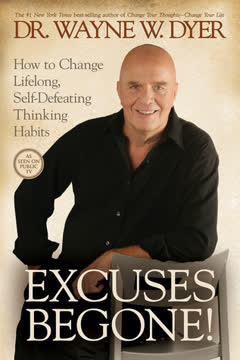
Key Takeaways
1. Excuses are Learned, Not Innate Limitations
Your beliefs, all of those formless energy patterns that you've adopted as your self-image, have the ability to change dramatically and give you the power to conquer unwanted traits, or what you unhappily presume to be your fate.
Challenge your perceived fate. Many believe their limitations—be it depression, shyness, or financial struggles—are fixed by genetics or early conditioning (memes). However, groundbreaking research in cell biology, like that by Bruce Lipton, Ph.D., reveals that life is not controlled by genes, but by the invisible energy of our beliefs and perceptions.
Beliefs override biology. Your personal belief systems can actually trump your genetic inheritance and cellular DNA. The placebo effect in medicine, even in surgery, powerfully demonstrates the mind's ability to influence physical reality. This means you can rewire your internal circuitry and process physical or health problems from an entirely new perspective.
Deprogramming is possible. Every self-limiting thought you use to explain why you're not living life to the fullest is something you can challenge and reverse. You are not a victim of your genetic makeup or the "mind viruses" (memes) absorbed from your environment; you have the power to deprogram yourself and live an excuse-free life.
2. Your Mind Operates in Creative and Habitual Modes
The mind's highest good is the knowledge of God.
Two minds at play. You possess two minds: the "creative conscious mind" and the "habitual mind" (what many call the subconscious). Your creative consciousness makes daily decisions and can learn new skills, but it's often overwhelmed by ego-driven thoughts.
The habitual mind is accessible. While conventional wisdom suggests the subconscious runs on automatic pilot, I contend it's not inaccessible. Any thought patterns that don't enhance your joyous development are simply excuses, and you have the power to reprogram them.
Choose consciously. Everything you think, say, and do is a choice. You don't have to be stuck with lifelong programming. By shifting to your creative mind, you can explore options and direct your life toward greater happiness, success, and health, rather than being imprisoned by your excuse inventory.
3. Cultivate Awareness to Dispel Ego-Driven Excuses
Awareness and ego cannot coexist.
First step to freedom. Becoming aware is the preliminary activity in meeting your authentic self. Living oblivious to your thinking patterns and beliefs day after day encourages your ego or false self, but awareness encourages your authentic self to be the center of your life.
Observe without judgment. Simply being cognizant of your excuse-making opens vast new possibilities. By paying uncritical attention to your ego's chatter, you discover the ability to overcome long-established habits. This leads to seeing all that you've been blinded to by excuse making, allowing the Divine to grow within you.
Awareness transforms. Just being conscious of your actions can lead to profound changes. A Harvard study showed hotel room attendants who perceived their work as exercise experienced significant health benefits, simply by being aware of their activity. Awareness itself is a powerful tool for instantaneous healing and shifting your reality.
4. Align Your Thoughts with Universal Source Energy
Relinquish the notion that you are separated from the all-knowing mind of the universe. Then you can recover your original pure insight and see through all illusions.
Harmonize with Source. Alignment is a basic truth: by thinking in harmony with the universal Source of being, you allow whatever you desire to flow to you. This Source energy is creating, giving, abundant, loving, joyful, and always in endless supply.
Excuses are misalignments. Every excuse—like "I don't have enough money" or "I need to be healed"—is a misaligned thought. Source energy transmits at a frequency of "all things are possible," and you must tune your thoughts to match this frequency to receive its beneficence.
Awareness in action. Alignment is the active process of shifting your thoughts and behaviors to match your awareness of your essential, Divine nature. By consciously thinking in aligned ways, you move away from ego-dominated excuses and into co-creation with Source.
5. Live Fully in the Present Moment, Free from Past or Future
Memories of the past and anticipation of the future exist only now, and thus to try to live completely in the present is to strive for what already is the case.
The now is all there is. While often a cliché, the truth is that the present moment is your only reality. Excuses are simply what you've developed to explain now moments that are tangled in the past or future.
Antidote to pain. Immersing yourself 100 percent in the now, experiencing it and nothing else, is an antidote to pain and difficulties. When you remove ego from the moment and focus on being fully present, discomfort and excuses disappear.
Befriend the now. See the present moment as your ally, not an obstacle. Observe how creatures in nature live fully in each instant, without regret or worry. This non-judgmental immersion in the present is a powerful way to shed long-held thinking habits and connect with your Source of being.
6. Contemplate Your Desires to Actively Manifest Them
There is nothing more powerful than an idea whose time has come.
Imagination as creation. Contemplation is the mental activity behind all creation and invention. Whatever you focus on invariably shows up in your life, whether you want it or not. Therefore, it's your sacred duty to contemplate only that which originates from your authentic self.
The creative process. Thomas Troward explains that Spirit creates by self-contemplation, and since you are individualized Spirit, "what you contemplate as the law of your being becomes the law of your being." Your thoughts are like things that initiate materialization.
Align with abundance. When your contemplation aligns with originating Spirit, you gain the cooperation of Divine mind, attracting and fulfilling your desires. Excuses, conversely, focus on what you can't do or have, hindering this creative force.
7. Embrace Willingness, Passion, and Compassion
If you are willing to be lived by it, you will see it everywhere, even in the most ordinary things.
Willingness to surrender. True willingness means taking total responsibility for your life and surrendering to something greater than your ego. It's about letting go of the life you've planned to embrace the one waiting to materialize, even if it means enduring criticism or perceived uncooperative circumstances.
Passion trumps excuses. Passion is "God in us," a vigorous enthusiasm that propels you beyond excuses. When you're passionate, nothing seems difficult or risky; you're answering your highest calling. As Nikos Kazantzakis noted, "By believing passionately in something that does not yet exist we create it."
Compassion as service. Compassion shifts your focus from "What's in it for me?" to "How may I serve?" This selfless giving eliminates blame and aligns you with the universal mind, which is always giving. As Tolstoy's hermit taught, the most important thing to do at all times is to do good to the person before you.
8. Challenge Every Excuse with a Seven-Question Paradigm
If you correct your mind, the rest of your life will fall into place.
Outgrow your problems. The Excuses Begone! paradigm is a practical framework to fundamentally change how your brain works and eradicate old mind viruses. It helps you "outgrow" problems by shifting from a human being having a spiritual experience to a spiritual being having a temporary human experience.
Core ideas for change:
- Remove self-limiting labels.
- Converse directly with your habitual mind.
- Practice mindfulness in every action.
- Commit to overcoming inertia.
- Use powerful affirmations to reshape your reality.
- Believe in a helpful, supportive universe.
- Stop complaining and explaining your shortcomings.
The truth sets you free. The paradigm begins by asking "Is it true?" about your excuses, then "Where did they come from?" and "What's the payoff?" These questions reveal the falsehoods and hidden rewards that sustain self-defeating habits.
9. Continuously Reinforce Your New, Excuse-Free Way of Being
But by constant practice ... the mind in truth can be trained.
Constant practice is key. To make your new, excuse-free way of being permanent, constant practice is essential. This involves daily or even hourly reinforcement of the principles and paradigm questions, allowing your mind to become harmonious with your Source.
Nine reinforcement strategies:
- Know It: Cultivate an inner knowing that you and Source are inseparable.
- Act as Source: Ask "What would God do right now?" to guide your responses.
- Converse with Habitual Mind: Tell it you're making conscious choices, not reacting.
- Get Quiet: Reduce external and internal noise through silence and meditation.
- Reenergize Surroundings: Surround yourself with positive, high-energy people and environments.
- Don't Complain—Don't Explain: Avoid these ego-driven habits that perpetuate excuses.
- Practice the Four Cardinal Virtues: Reverence for all life, natural sincerity, gentleness, and supportiveness.
- Forgive Everyone: Release blame and self-reproach for past actions.
- Live in Gratitude: Appreciate all that is, aligning with abundance.
Unite with Source. By consistently training your mind to align with your Source, you dissolve the need for bad habits and excuses. This continuous reinforcement transforms your personality and fills your heart with profound peace, uniting you with the Divine.
Last updated:
Review Summary
Excuses Begone! by Wayne Dyer receives mixed reviews averaging 4.12/5 stars. Positive reviewers praise its empowering message about choosing optimistic thoughts over debilitating ones and appreciate Dyer's practical approach to eliminating excuse-making. Many find it transformative for breaking negative thinking patterns. Critical reviewers cite repetitiveness, overly simplistic solutions, and Dyer's shift toward spiritual content over scientific reasoning. Some note the book draws heavily from diverse philosophical sources, occasionally lacking proper attribution. Several reviewers mention the material works better as audio and requires multiple readings for full comprehension.
Similar Books