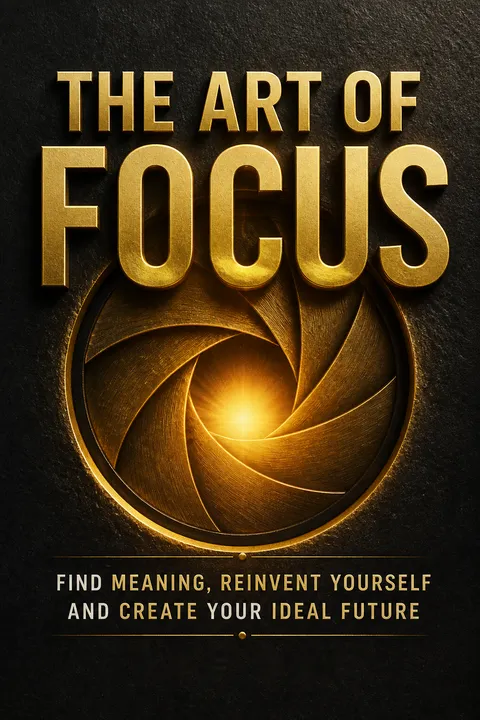


Key Takeaways
Your life follows whatever repeatedly captures your attention.
Focus is more than concentration. Koe defines focus as attention directed by intention. It shapes what enters awareness, how events are interpreted, and which actions become possible. The book cites estimates of roughly 50 bits of information processed consciously per second, compared with millions handled unconsciously. The precise numbers matter less than the contrast: deliberate attention is limited, while habits and automatic reactions carry much of daily life.
Attention compounds into a life. A familiar bush may go unnoticed until it bears fruit; once it becomes relevant, it stands out. The same pattern applies to opportunities. A goal can help a person notice useful information, while distraction fragments attention across worries and trivial demands.
What's useful here is treating attention as a scarce resource that shapes perception, not merely as a productivity tool. Cognitive science distinguishes selective attention from the much broader processing that happens outside awareness, which supports the book's emphasis on choosing what deserves conscious effort. Still, attention is not the only thing a person controls. Poverty, illness, caregiving, and workplace demands constrain choice. The strongest reading is not that anyone can simply focus their way past every barrier, but that intentional attention helps people identify which barriers they can address and where support is needed.
Choose the goals that organize your attention before others do.
Mental order takes upkeep. Koe uses entropy to describe how systems tend toward disorder unless energy maintains them. He calls the resulting mental chaos psychic entropy: the stress, overwhelm, and anxious confusion that grow when attention lacks a clear organizing purpose. A daily routine, a business process, or even a library catalogue can reduce that disorder, but each requires maintenance and revision.
Build a hierarchy of goals. A large aim becomes manageable when it is broken into smaller objectives, each revealing the next useful action. Without chosen goals, other systems supply them: school, work, status, or social media. These can be useful structures, but accepting them without examination risks spending years pursuing priorities that were never personally chosen.
This argument connects well with control theory: systems become easier to steer when they have a target, feedback, and a way to correct course. A hierarchy of goals can reduce decision fatigue by making small choices legible in relation to a larger aim. Yet planning can also become its own form of avoidance. A carefully organized plan has little value if it is not tested against reality, and some uncertainty cannot be tidied away. The practical distinction is between structure that enables action and structure that merely makes a person feel temporarily in control.
Use defensiveness to locate the identity you are trying to protect.
The self is partly constructed. Koe describes identity as a web of associations built from repeated experiences, beliefs, affiliations, and habits. A challenged belief can feel like a threat to the whole self, even when the issue seems small. His example is a child reacting strongly when a sibling crosses into his room: the room has become attached to a sense of ownership and safety.
Treat emotion as information. When a comment provokes a disproportionate reaction, trace what it seems to threaten. Perhaps criticism of coffee feels like criticism of a person's productivity or social identity. The aim is not to erase the self, but to revise it carefully. Koe compares change to renovating a house: remove a supporting beam too quickly, and the whole structure may shake.
The idea has a close cousin in social identity research: people often experience attacks on group membership or deeply held beliefs as personal threats. That helps explain why arguments about politics, religion, or lifestyle can become so heated so quickly. Emotional reactions can therefore be useful clues, but they are not reliable diagnoses by themselves. Defensiveness might signal a fragile identity, or it might be a proportionate response to disrespect or coercion. Reflection works best when paired with context, not when every strong feeling is treated as evidence of personal error.
Accept the present conflict, then look for the system it can change.
Reality is not a failed plan. The book presents life as cycles of creation, disruption, and adjustment. In this view, struggle is not proof that events have gone wrong; it can expose a problem that a person or system must address. Koe uses nature's cycles and ordinary disagreements to show how opposing forces can sometimes produce a new understanding or solution.
Acceptance is a starting point. It means recognizing what is happening before spending energy wishing the facts were different. Someone losing money in a business still needs to respond, but clear action is harder while attention is consumed by denial or blame. The book's broad spiritual language treats the Universe as an encompassing perspective on change and connection, rather than a literal, testable mechanism.
Acceptance has practical overlap with mindfulness-based approaches, which train people to notice experience without immediately reacting to it. That pause can create room for more deliberate choices. The book's cyclical lens also makes setbacks easier to place in a wider narrative, rather than turning one bad period into a permanent verdict. A necessary boundary is that not all conflict is constructive, and not every painful condition should be accepted as inevitable. Acceptance is most useful as accurate contact with reality, followed by action where action can help.
Turn your purpose into quests small enough to play today.
Purpose becomes practical through structure. Koe's purpose, path, and priority framework begins with a meaningful aim, maps a route toward it, and identifies the next pressing problem to solve. The purpose may be broad, such as improving health; the priority might be learning what is preventing consistent exercise. The path turns that problem into actions that can be attempted and reviewed.
Think like a player, not a spectator. Koe compares life to a role-playing game, where a character learns the rules, practices basic moves, and takes on challenges matched to their abilities. He also draws on flow research: tasks tend to engage people when the challenge is slightly beyond their current skill, rather than far below or far above it. If the next step feels impossible, reduce its size or build the missing skill.
The framework makes an abstract aspiration operational without pretending that a universal checklist can design every person's life. Its game analogy is especially effective because it combines direction with feedback: a quest can be completed, adjusted, or abandoned based on what happens. Flow research likewise emphasizes the relationship between challenge and skill, although real work includes interruptions, unequal resources, and tasks that cannot be made intrinsically engaging. The useful test is not whether life feels like a game at every moment, but whether the next action is clear enough to begin and informative enough to learn from.
Let the life you reject clarify what you want to build.
Start with the unwanted future. Koe calls this an anti-vision: a written account of what a person does not want, why it matters, and what patterns could lead there. His prompts ask readers to imagine an unfulfilling day, an unhealthy way of living, or work that drains them. The point is not to dwell on fear, but to use concrete experience as material for imagining a better alternative.
Explore beyond familiar choices. Once a vision takes shape, pursue it through small steps into the unknown. Koe also names tactical stress for deliberately entering a demanding situation when the person believes they have enough skill to handle it. He offers examples such as taking on a difficult challenge or asking for a higher rate, while warning against using this pressure tactic constantly.
Negative examples can sharpen preferences because people often recognize what they reject before they can describe an ideal future in detail. In decision science, this resembles evaluating options by comparing possible losses as well as gains. The method becomes less helpful if fear dominates the picture or if a vivid worst case is mistaken for a likely outcome. Tactical stress also deserves caution: chosen challenge can interrupt avoidance, but financial or physical risks are not automatically growth experiences. The sound principle is to use discomfort deliberately, with a realistic appraisal of capacity and consequences.
Start a real project, then learn only what its problems require.
Projects turn theory into experience. Koe argues that learning becomes understanding when ideas meet practical consequences. He recalls spending weeks consuming design tutorials before realizing he could not apply much of the material. His approach changed: choose a project, identify what is blocking progress, find the specific information needed, and put it to use immediately.
Experiment, then refine. A person solving a health, relationship, or work problem can try several reasonable approaches, observe what happens, and keep what proves sustainable. Koe compares this to building muscle through periods of growth followed by periods of adjustment. He also recommends teaching what has been learned, because trying to explain an idea can expose gaps in understanding. A project gives curiosity a focus and produces evidence beyond online advice.
This is a strong case for learning by doing. Educational research often distinguishes passive exposure from retrieval, application, and feedback, which help learners discover what they can actually use. A project supplies those conditions naturally. It also counters tutorial hoarding, where familiarity with explanations is mistaken for competence. There is a caveat: experimentation is not a substitute for expert guidance in high-risk areas such as medical treatment, legal decisions, or safety-critical work. In those domains, the project still matters, but the quality of evidence and supervision matters just as much.
Combine a deep interest with skills that make it useful to others.
A distinctive career is assembled. Koe argues that automation makes repeatable tasks vulnerable, while personally developed knowledge and judgment are harder to standardize. He calls for a skill stack: a combination of specialized expertise and broadly useful abilities, including writing, speaking, marketing, and sales. Specific knowledge, in his usage, is knowledge developed through personal curiosity and experience rather than a generic curriculum.
Make value understandable and accessible. A creator needs a valuable message, a medium for distributing it, and practical skills that produce results. Koe's own path moved through web design, consulting, writing, and online education. The internet let him reach people beyond a local market, but reach alone is not value. A skill becomes useful when it solves a problem for a particular audience.
The skill-stack idea fits an economy where digital tools lower the cost of publishing, teaching, and finding customers. Combining abilities can create a profile that is less interchangeable than any one skill alone. But the book's optimism about personal reinvention should not obscure uneven access to time, money, networks, and stable internet. Nor does a public audience guarantee income. The durable insight is to combine complementary capabilities around a problem people care about, while treating distribution as a skill to learn rather than a magical reward for being authentic.
Turn problems you have solved into products others can use.
Personal work can become shared value. Koe's business path illustrates the conversion. He began with web design projects, took on client work, studied how to find customers, then built an audience and created products, including a planner shaped by his own experiments. His central proposal is to solve a real problem first, document the process, and share a solution with people facing something similar.
Choose a suitable offer. He distinguishes services done for a customer, collaborative help such as coaching or consulting, and products customers can use independently. In his account, services can be a practical starting point because they require fewer buyers than a low-priced product. Over time, a tested service can inform a product. A business is not merely a way to earn; it can also be a vehicle for work the creator finds meaningful.
The project-to-product path resembles lean entrepreneurship: test a solution with real users before investing heavily in scale. Services are especially useful for learning because customer conversations reveal where the problem and the proposed fix do not match. The method also turns personal experience into a source of empathy, not just a marketing story. Its limit is that a solution that worked for one person may not generalize. Ethical creators need to distinguish a compelling anecdote from reliable evidence, and should avoid promising outcomes their product cannot control.
Protect creative work with deliberate limits and genuine rest.
More hours are not always better. Koe proposes a four-hour workday as a useful target for concentrated creative work, not a universal requirement. He points to accounts of Charles Darwin working in several short blocks, taking walks, and stopping his formal work by midday. The larger point is that focused effort and recovery can reinforce one another, while long, distracted days may consume energy without producing better work.
Design before optimizing. Koe suggests auditing how time is spent, removing low-value commitments, and building a weekly routine that fits a person's energy and responsibilities. He advises beginning with short periods of undistracted work, then gradually extending them. A person with a demanding job or caregiving duties may have less room to redesign the day, so the useful principle is to protect a workable block, however modest, and take rest seriously.
The emphasis on recovery echoes research on incubation, the process by which stepping away from a difficult problem can support new associations. It also challenges workplace cultures that treat visible busyness as a proxy for contribution. Still, four hours is a guiding ideal drawn from creative work, not a broadly proven prescription for every occupation. Some roles require presence, coordination, or care that cannot be compressed into solitary focus. The more defensible lesson is to measure work by useful output where possible, and to design recovery around the actual demands of the job.
Analysis
The book is an unusual blend of spiritual philosophy, attention training, self-directed learning, and internet entrepreneurship. Its central move is to treat focus not as a technique for finishing tasks, but as the mechanism by which a person selects goals, interprets experience, builds identity, and shapes a livelihood. The argument then travels from inner life to public work: choose a direction, encounter problems, learn through action, and turn useful discoveries into value for others.
That progression is the book's chief strength. Its metaphors make difficult abstractions tangible. Life becomes a game with quests, a story with changing chapters, or a system that needs maintenance. The practical framework of purpose, path, and priority gives readers a way to translate existential unease into a next action. The account of Koe's own false starts in business also grounds the entrepreneurial argument in iteration rather than effortless success.
The same breadth creates a risk. Terms from physics, neuroscience, spirituality, and psychology sometimes sit side by side as if they were equally established explanations. Entropy is a precise physical concept, while psychic entropy is a metaphor for mental disorder. The distinction matters: metaphors can guide attention without proving that the mind follows the same laws as a library or the cosmos. Likewise, claims about attention, evolution, and the future of work are often presented with more certainty than the evidence in the text can support.
The entrepreneurial prescription also has a limited scope. Digital distribution opens real possibilities, but platform dependence, income volatility, unequal access, and the value of stable employment receive less weight than autonomy. Not everyone can make a personal interest commercially viable, and not every important contribution belongs in a market. Read at its best, the book is not a guarantee of freedom or wealth. It is an invitation to question inherited goals, build competence through real projects, and direct attention toward work that feels both meaningful and useful.
Review Summary
The Art of Focus receives mixed reviews, with ratings ranging from 1 to 5 stars. Some readers find it thought-provoking and valuable for entrepreneurs, praising its insights on finding meaning and shaping one's future. However, many criticize its lack of focus, repetitive content, and unclear thesis. Critics argue that it fails to deliver practical advice on improving focus and instead rambles about entrepreneurship and spirituality. Some appreciate the author's unique perspective, while others find the writing style confusing and the content lacking substance.
People Also Read








Glossary
Psychic entropy
Mental disorder and overloadKoe's term for a state of mental disorder in everyday life, marked by stress, anxiety, overwhelm, and a sense of being lost. He links it to unfocused attention and to the absence of clear mental structures. Unlike entropy in physics, this is a metaphor for psychological confusion, not a measurable physical quantity.
The 3 Pillars
Focus, energy, and experienceKoe's framework for explaining how a person directs attention and creates a more satisfying life. Focus is attention guided by intention. Energy describes the attention, intention, and will available for action. Experience refers to direct contact with the present, rather than being absorbed in imagined futures or remembered pasts.
Purpose, path, and priority
Goal, route, next problemA framework for turning a meaningful aim into action. Purpose is the result or direction a person cares about. Path is the plan or sequence of steps that could lead there. Priority is the immediate problem or action that deserves attention now. The framework is meant to reduce overwhelm by connecting daily decisions to a larger goal.
Anti-vision
A picture of what to avoidA written description of a future or lifestyle a person does not want, including the conditions and habits that could produce it. Koe uses this exercise to make dissatisfaction specific and actionable. By clarifying what to avoid, a person can begin to imagine and choose an alternative direction.
Tactical stress
Chosen pressure for growthKoe's term for deliberately entering a demanding situation to break from familiar routines and confront fear. It is intended for moments when a person believes they have enough ability to meet the challenge. Examples include taking on a difficult commitment or making a bolder professional request. The book presents it as an occasional tactic, not a sustainable default.
Specific knowledge
Experience-shaped expertiseKnowledge developed by following personal curiosity, studying a chosen subject, and testing ideas through direct experience. Koe contrasts it with general instruction that many people receive through formal education. In his account, specific knowledge becomes valuable when paired with the ability to communicate it and solve problems for others.
Skill stack
A distinctive mix of abilitiesA combination of specialized expertise and complementary skills used to solve problems or create work. Koe's examples include pairing a subject of deep interest with abilities such as writing, marketing, sales, design, or distribution. The combination can make a person's contribution more distinctive than reliance on a single, easily replicated skill.
Done for you, done with you, do it yourself
Three offer typesKoe's categories for packaging a service or product. Done for you means the provider carries out the work for the customer. Done with you means the provider collaborates with or guides the customer, as in coaching or consulting. Do it yourself describes products, such as courses or tools, that customers use independently.
Value creator
A creator who solves problemsKoe's term for someone who develops useful knowledge or skills, shares them publicly, and earns income by helping others. A value creator may use writing, speaking, products, or services to distribute solutions. The concept describes a way of working, not a single business model, and emphasizes both personal development and practical usefulness.
FAQ
What's The Art of Focus about?
- Focus on Meaning and Purpose: The Art of Focus by Dan Koe explores how to find meaning in life, reinvent oneself, and create an ideal future. It emphasizes focus as a tool for personal development and fulfillment.
- Three Main Sections: The book is divided into three parts: "Find Meaning," "Reinvent Yourself," and "Create Your Ideal Future," each offering insights and practical advice for navigating life's challenges.
- Holistic Approach: Koe combines philosophy, psychology, and spirituality to present a comprehensive guide for readers seeking to improve their lives, encouraging self-exploration and critical thinking.
Why should I read The Art of Focus?
- Transformative Insights: The book offers valuable insights that can lead to significant personal transformation, challenging readers to question their current life paths.
- Practical Tools: Koe provides practical tools and frameworks designed to help individuals take control of their focus and direct it toward meaningful goals.
- Inspiration for Change: If you feel stuck or unfulfilled, this book serves as a motivational guide to help you break free from mediocrity and pursue a life of purpose and passion.
What are the key takeaways of The Art of Focus?
- Focus is a Superpower: Focus is a crucial skill that can be developed and trained, forming the foundation for success in various life aspects.
- Embrace Struggle and Growth: Struggle is an inherent part of life and personal growth, and embracing challenges leads to greater fulfillment.
- Create Your Own Game: Life can be viewed as a game where you set your own rules and goals, fostering creativity and enjoyment.
What are the best quotes from The Art of Focus and what do they mean?
- “Focus is attention with intention.”: This quote highlights that true focus requires purposeful direction, suggesting that without intention, focus can become aimless.
- “You cannot solve a problem from the same level of mind that created it.”: It emphasizes the need for personal growth and perspective shifts to effectively address challenges.
- “Your actions will only serve a collective heaven after you experience the personal hell that comes with identity change.”: This reflects the idea that personal transformation often involves discomfort and struggle.
How does Dan Koe define focus in The Art of Focus?
- Attention with Intention: Focus is the ability to direct attention toward specific goals with a clear intention, underscoring the importance of being purposeful.
- A Muscle to Train: Koe likens focus to a muscle that can be strengthened through practice and discipline, enhancing adeptness in maintaining it.
- Key to Overcoming Distractions: Focus is essential for navigating modern life's distractions, achieving greater clarity and productivity.
What is the "Purpose, Path, and Priority" framework in The Art of Focus?
- Purpose: Identifying the most pressing problem in your life that you want to solve, crucial for directing energy and efforts effectively.
- Path: Creating a clear strategy or plan to address your purpose, including setting actionable goals and breaking them down into manageable steps.
- Priority: Focusing on the most impactful actions that lead to progress, maintaining focus and momentum by aligning tasks with your purpose.
What are the three pillars mentioned in The Art of Focus?
- Focus: Directing attention toward meaningful goals, a skill that can be cultivated for personal and professional success.
- Energy: The role of mental energy in achieving goals, influencing the ability to create and maintain focus.
- Experience: The significance of direct experience in personal growth, using experiences as a foundation for future actions.
How does The Art of Focus address the concept of identity?
- Identity as a Construct: Identity is formed through experiences, beliefs, and societal influences, encouraging critical examination and recognition of its non-fixed nature.
- The Role of Choice: Individuals have the power to redefine their identities through conscious choices, empowering control over personal narratives.
- Navigating Identity Change: Changing one’s identity can be challenging and may involve discomfort, but embracing this struggle is necessary for personal growth.
How does The Art of Focus relate to modern distractions?
- Understanding Distractions: Modern life is filled with distractions that can derail focus and productivity, requiring conscious recognition and mitigation.
- Creating Boundaries: Establishing boundaries to protect focus and mental energy, such as limiting exposure to social media and news.
- Cultivating Mindfulness: Mindfulness practices enhance awareness and presence, helping manage distractions and maintain focus on goals.
What role does curiosity play in The Art of Focus?
- Driving Force for Exploration: Curiosity is a fundamental driver for personal growth and exploration, essential for discovering new opportunities.
- Fuel for Creativity: It fuels creativity, allowing individuals to generate innovative ideas and solutions, vital for overcoming challenges.
- Encouragement to Learn: Cultivating curiosity as a means of lifelong learning, remaining open to new experiences and knowledge.
How does The Art of Focus address the concept of self-discipline?
- Definition of Self-Discipline: Self-discipline is the ability to prioritize long-term goals over immediate pleasures, central to achieving personal growth.
- Integration of Desires: Integrating both light and dark aspects of oneself to achieve self-discipline, leading to more authentic decision-making.
- Practical Strategies: Setting clear goals and creating systems that support consistent action, helping readers stay focused on their objectives.
How can I apply the lessons from The Art of Focus to my life?
- Set Clear Goals: Identify your purpose and set clear, actionable goals that align with your values, providing direction and motivation.
- Practice Self-Reflection: Regularly engage in self-reflection to assess progress and identify areas for improvement, using journaling as a tool.
- Embrace Curiosity: Cultivate a mindset of curiosity by exploring new ideas and experiences, enhancing creativity and opening new growth opportunities.
Download PDF
Download EPUB
.epub digital book format is ideal for reading ebooks on phones, tablets, and e-readers.








