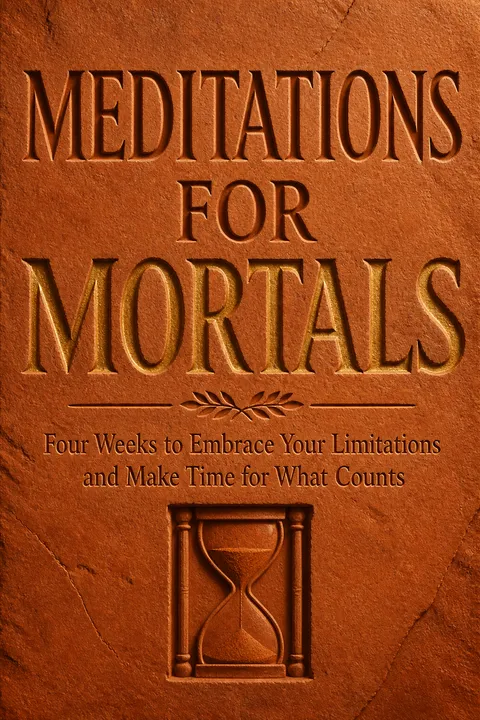


Key Takeaways
Accept that life's list is endless, then choose what deserves your time.
The list never ends. Burkeman calls his outlook imperfectionism: treating human limits as part of life, not defects to eliminate before life can begin. There will always be more worthwhile tasks than available hours, and no productivity system can close that gap. Trying to believe otherwise can make every neglected task feel like personal failure. Accepting the real limit may sting, but it releases attention for what can actually be done now.
Defeat can free you. The writer Sasha Chapin once imagined success meant becoming a celebrated novelist. When that ideal proved unreachable, he could finally write as the person he was, rather than waiting to become someone else. The point is not to abandon ambition. It is to stop requiring perfection or total control before acting.
This reframing resembles a useful distinction in clinical psychology: accepting an experience is not the same as approving of it or giving up. Acceptance can reduce the energy spent denying reality, leaving more for deliberate action. The important caveat is that limits are not always personal or fixed. Poverty, discrimination, illness, and caregiving can sharply constrain options. A humane reading treats finitude as a reason to choose carefully, not as an excuse to ignore conditions that could be changed collectively.
Do the thing once before trying to become the kind of person who does it.
Start with the activity. A plan to become a meditator, writer, or entrepreneur can feel productive while postponing the vulnerable act itself. Burkeman’s alternative is to choose one worthwhile activity and do a small piece of it today, without demanding that it become a permanent habit. Five minutes of meditation, for instance, is an actual experience; researching the perfect meditation routine is not.
Make a choice real. Decisions become consequential when they enter the world. A person unsure about leaving a job could begin by asking a trusted friend for a conversation, rather than privately debating every possible future. Small actions do not guarantee the next step, but they replace imagined progress with information, movement, and contact with reality.
This approach has an affinity with behavioral activation, a therapeutic method that uses manageable action to interrupt avoidance and low mood. Action can generate evidence about whether a goal fits, instead of requiring certainty in advance. It also corrects a common bias: people often mistake preparation for progress because preparation feels safer. Still, some preparation is essential when choices carry serious financial, medical, or relational risks. The useful test is whether planning is enabling a next step or endlessly substituting for one.
Treat choices as trade-offs you can own, not doors you cannot open.
Freedom has a price. A friend of Burkeman’s felt trapped between leaving a troubled marriage and remaining in it. Both options would hurt someone, so he waited for a painless alternative. Seeing that no such option existed helped him choose, accept the consequences, and leave. The broader principle is that “I cannot” often means “I am unwilling to pay the cost,” though that cost may be entirely reasonable to avoid.
Name the trade-off. Declining a request may disappoint someone; accepting may cost time or rest. These consequences matter, but they do not erase the choice. The relevant questions are what each path costs and whether that cost is worth bearing. Serious risks, including abuse or financial ruin, deserve particular care.
The idea clarifies agency by separating choice from consequence-free control. It also makes room for responsibility: a person who chooses a difficult path still owes others honesty and care where possible. The framing needs nuance because not everyone faces equal costs. A missed shift may be minor for one worker and a threat to housing for another. Calling every constraint a choice can obscure coercion, unequal power, or material hardship. The insight is strongest when used to examine real options rather than shame people for lacking them.
Record what you finish instead of measuring yourself against infinity.
Reject imaginary debt. Productivity debt is the feeling that each day begins with an existential bill to pay through accomplishment. The standard is impossible: even a successful day leaves more tasks undone, and success can simply raise tomorrow’s expectations. Burkeman suggests a done list, a record of completed actions rather than planned ones. It makes visible what a person actually contributed, including small tasks that a demanding inner scorekeeper might dismiss.
Change the comparison. A done list invites comparison with doing nothing, rather than with every task that could theoretically be completed. That can ease self-criticism and help direct effort toward a few meaningful tasks. It does not make responsibilities disappear. It changes the measure from “Did I finish everything?” to “What did I move forward with the time I had?”
The done list is a modest tool for correcting negativity bias, the tendency to notice unfinished obligations more readily than completed work. It can also help distinguish workload from self-worth. Its value depends on how it is used: a list of tiny wins can become another performance metric if the goal is to prove constant productivity. The deeper shift is not to produce a more flattering ledger, but to stop treating output as the price of belonging or rest.
Spend attention like a scarce resource, not a duty owed to every crisis.
Information has no finish line. A 2024 estimate cited in the book puts worldwide data at 147 trillion gigabytes, far beyond anyone’s ability to absorb. Better recommendations may help people find interesting material, but they also feed an effectively endless stream of things worth reading or watching. Burkeman advises treating a reading backlog as a river: select a few items as they pass, without treating every discovered link as an obligation.
Care needs selection, too. Online news and advocacy compete for attention, often presenting each issue as urgent. Constant exposure can leave people distressed but ineffective. The book’s example of a man who avoided news while restoring local wetlands raises a useful question: is sustained work on a few concerns more valuable than intense concern about everything?
This is an argument about allocating scarce attention, not cultivating indifference. In economics, scarcity forces choices even when every option has value; public concern works similarly. A person may serve a cause better through durable expertise or local effort than through repeated exposure to alarming headlines. Yet opting out can also be a privilege, especially when policies directly threaten someone’s safety. Selectivity is most defensible when it leads to meaningful participation, rather than merely insulating the comfortable from other people’s realities.
Move toward the difficult task your actual circumstances are asking of you.
Find the life task. Burkeman uses this term for the demanding next step that seems to emerge from a person’s particular circumstances, abilities, and responsibilities. As a teenager, Carl Jung had avoided school for months. Hearing his father worry that he might never earn a living jolted him into returning to his studies. That task was not a universal command to work harder; it was the challenge that fit Jung’s situation.
Approach, do not attack. Dutch Zen teacher Paul Loomans describes avoided worries as “gnawing rats.” His advice is to approach them gently: enter the cluttered shed and look around before demanding a full clean-out. Psychologist Virginia Valian, stuck on her thesis, found fifteen minutes of daily work tolerable when longer sessions felt impossible. Contact with the problem can reduce its power without requiring a heroic start.
The idea combines practical judgment with a question of vocation: what does this situation call for, rather than what would look impressive from the outside? That can uncover an action hidden beneath competing expectations. It should not be treated as an infallible inner voice. Anxiety, social pressure, and burnout can distort intuition, and a difficult task is not automatically the right one. The strongest guide is a step that is both challenging and feasible within the person’s actual resources.
Be kind enough to let desire, not self-bullying, power the work.
Stop adding needless resistance. Burkeman challenges the assumption that worthwhile work must feel punishing. Asking what would make a task easier can expose needless complexity, perfectionist standards, or fear disguised as preparation. Meditation teacher Susan Piver found that following her genuine inclination sometimes helped her complete the very activities she had been trying to force through rigid schedules.
Use the reverse golden rule. Philosopher Iddo Landau’s term means not treating oneself with a cruelty one would reject toward another person. The point is not indulgence or avoiding commitments. It is to replace contempt with a more workable relationship to effort. Likewise, when a generous impulse arises, acting on it promptly can prevent perfectionist deliberation from turning a simple kindness into an elaborate project.
Self-compassion is often mistaken for lowering standards, but a less hostile inner voice can make it easier to recover from mistakes and continue. This also connects to intrinsic motivation: an activity is more sustainable when it has some personal meaning, not merely an imposed reward or threat. Desire is not always a reliable guide, however. Immediate preference can conflict with care obligations or long-term commitments. The aim is not to obey every impulse, but to stop assuming that self-punishment is the only route to responsibility.
Build humane rhythms around finite focus, not flawless streaks.
Work within attention’s limits. Burkeman’s three-to-four-hour rule suggests that people doing demanding work with ideas and language should protect roughly three or four hours for intense focus, where their circumstances allow. He points to writers and thinkers who produced substantial work in limited daily sessions, then rested or turned to other activities. It is not a universal quota, but a reminder that concentrated effort cannot be stretched indefinitely.
Let rules serve the work. The term dailyish means returning to a practice regularly without demanding an unbroken daily streak. A writer can also define a small deliverable, such as finishing one section, instead of treating a whole book as a single daunting task. Problems will continue to arise; the aim is a sustainable rhythm, not a life without interruptions or unfinished work.
The emphasis on limits aligns with research on cognitive fatigue and with the broader distinction between deep work and fragmented activity. The practical contribution is permission to stop before exhaustion becomes the default. But the historical examples of authors with long stretches of protected time do not represent every worker, especially those with shift work, care duties, or little control over schedules. The principle is adaptable: protect whatever interval is realistically available, rather than turning a suggested range into another standard for self-judgment.
Let surprises enter your day without declaring your plans ruined.
The future is unavailable. Worry often tries to solve problems that do not yet exist or cannot yet be solved. A person waiting on a decision, for example, cannot obtain certainty by rehearsing every possible outcome. The practical task is to do what is useful now and trust that future problems can be met when they become real.
Stay open to what arrives. Calling an event an interruption assumes in advance that the original plan was the only worthwhile use of time. Burkeman describes a child bursting into his office to share excitement about a school play. The moment could be treated as a disruption or as a valuable encounter. This openness is related to resonance, Hartmut Rosa’s term for a responsive connection in which people act on the world and remain receptive to its response.
Planning reduces some risks, but certainty is not a realistic planning outcome. This distinction resembles psychological flexibility: maintaining goals while adjusting behavior when circumstances change. It also challenges workplace cultures that treat every deviation as lost productivity. Openness should not mean surrendering boundaries. A parent can acknowledge a child warmly and still explain that a conversation must wait. The point is to respond to what actually happened, rather than automatically labeling it a failure of the plan.
Let imperfect moments and modest acts matter without demanding permanence or applause.
Connection does not need staging. Writer Jack King calls it scruffy hospitality when people welcome friends without first making the home immaculate or preparing an impressive meal. A lived-in room can signal trust rather than failure, because it lets guests meet the hosts as they are. The same openness can make it easier to begin difficult work or relationships without pretending to be flawless.
Local meaning counts. The book resists the idea that an action matters only if it changes history or earns public recognition. Caring for an older relative, helping a neighbor, or enjoying a walk can be worthwhile in its own right. A moment cannot be stored for later as a possession. Its passing is part of what makes the experience particular, and attention is how a person participates in it.
This view counters a culture that equates significance with scale, visibility, and permanence. Care ethics offers a complementary lens: moral life often consists of attentive responses to particular people, not only abstract calculations about total impact. Small actions do not cancel the need to address systemic harms, and some decisions require comparing consequences beyond one’s immediate circle. Still, scale is not the only measure of value. A life can matter through forms of attention and care that never become publicly legible.
Analysis
The book’s central move is to reinterpret limitation from a defect to be repaired into the condition that makes choice meaningful. That shift links its apparently separate topics: an endless task list, an unread article queue, anxiety about the future, perfectionism, and guilt about global crises all become versions of the same attempt to escape finitude. The four-week progression gives the argument a useful rhythm: first face the limits, then act, then loosen the habits of control, and finally inhabit the present those efforts were meant to serve.
Its strongest contribution is not a productivity technique but a changed test for action. Instead of asking whether a person has achieved mastery, it asks whether the next step is worthwhile, possible, and being taken in reality. That test helps explain why small decisions, gentle approaches to avoidance, and permission to stop can produce more movement than grand plans. It also makes room for pleasure and relationships without requiring them to justify themselves through future benefits.
The main interpretive risk is turning acceptance into passivity. The book argues against fantasies of total control, not against planning, ambition, or structural change. Its best examples retain agency: someone chooses despite consequences, protects time for focused work, or invests in a local cause. A careful reader should therefore distinguish limits that are constitutive of human life from constraints imposed by institutions or injustice. The former invite accommodation and choice; the latter may call for resistance and collective action.
The book’s four-week format is suggestive rather than a promise of transformation. Its own philosophy rules out a final state in which the reader has mastered imperfection. The useful outcome is more modest and more durable: fewer imaginary prerequisites, more honest trade-offs, and a greater willingness to participate in an unfinished life.
Review Summary
Meditations for Mortals receives overwhelmingly positive reviews, with readers praising its practical wisdom and refreshing perspective on embracing life's limitations. Many found the book's structure of 28 short chapters ideal for daily reflection. Reviewers appreciated Burkeman's down-to-earth advice on focusing on what truly matters, letting go of perfectionism, and finding peace in imperfection. While some felt it lacked depth in certain areas, most found it a valuable guide for living more mindfully and making the most of one's finite time.
People Also Read








Glossary
imperfectionism
Life within human limitsAn outlook that treats limited time, imperfect work, uncertain futures, and incomplete control as unavoidable features of human life, rather than flaws that must be eliminated before meaningful living can begin. It encourages choosing worthwhile actions within those limits instead of waiting for perfect conditions or a final state of control.
productivity debt
An imagined output obligationThe feeling that a person must accomplish enough each day to earn rest, self-respect, or the right to exist. Because the amount of possible work is effectively endless, the debt can never be fully paid. New achievements may raise the standard, creating ongoing anxiety rather than a lasting sense of completion.
efficiency trap
Efficiency that expands demandA pattern in which becoming faster or more responsive does not reduce total work. Instead, improved capacity can attract more tasks, messages, and expectations. Faster email replies, for instance, may prompt more replies and encourage others to send more messages, leaving the person busier despite improved efficiency.
life task
A fitting next challengeA demanding action that seems called for by a person’s actual circumstances, capacities, and responsibilities. It is not necessarily a grand calling or an external expectation. A life task should involve effort, but it must also be possible in the person’s current situation, perhaps through an initial step toward the larger challenge.
gnawing rats
Anxiety-provoking avoided tasksPaul Loomans’s image for unfinished tasks or difficult parts of life that people avoid because they provoke anxiety. Instead of attacking or ignoring them, he recommends making gentle contact with them, such as entering a neglected shed just to look around. This can reduce the dread and make later action more approachable.
dailyish
Regular, not perfect, practiceA flexible standard for returning to an activity frequently without insisting on an unbroken daily streak. It recognizes that moods, obligations, and circumstances vary. The term preserves commitment while avoiding the brittle expectation that one missed day invalidates the practice.
three-to-four-hour rule
A limit for deep focusA practical guideline suggesting that knowledge workers protect roughly three or four hours a day for intense mental work when their circumstances permit. The rest of the day need not be perfectly controlled. The rule reflects limited capacity for sustained concentration, not a universal productivity quota.
resonance
Responsive contact with lifeHartmut Rosa’s term for a relationship with the world in which a person acts, is affected in return, and remains open to the experience. It contrasts with trying to make everything fully controllable. Meaningful encounters, art, nature, and unpredictable events can feel resonant because they are not entirely managed or predetermined.
reverse golden rule
Do not mistreat yourselfIddo Landau’s principle of avoiding treatment of oneself that would seem cruel or unacceptable if directed at another person. It challenges the assumption that harsh self-criticism is necessary for responsibility. The idea is not to excuse every impulse, but to replace self-punishment with a more humane basis for action.
scruffy hospitality
Welcome without a flawless facadeJack King’s term for inviting people into one’s home without waiting for perfect tidiness, elaborate food, or an impressive presentation. It treats an ordinary, imperfect home as compatible with friendship and hospitality. More broadly, it suggests that showing one’s real circumstances can reduce shame and help people connect.
done list
A record of completed actionsA list that records what has already been completed, rather than what remains to be done. It makes actual effort visible and counters the tendency to judge a day only against an endless supply of possible tasks. The list can include small acts, especially when someone is stuck or overwhelmed.
FAQ
What's "Meditations for Mortals" about?
- Embracing Limitations: The book explores how accepting our limitations as finite beings can lead to a more meaningful and fulfilling life.
- Imperfectionism Philosophy: It introduces the concept of "imperfectionism," which suggests that our limitations are not obstacles but pathways to a saner, freer life.
- Four-Week Guide: The book is structured as a four-week guide, with daily chapters that encourage readers to live more fully in the present.
- Practical and Philosophical: It combines practical advice with philosophical insights to help readers focus on what truly matters.
Why should I read "Meditations for Mortals"?
- Shift in Perspective: It offers a refreshing perspective on productivity and life, challenging the conventional quest for control and perfection.
- Practical Guidance: The book provides actionable steps and reflections to help readers embrace their limitations and focus on meaningful actions.
- Relatable Insights: Oliver Burkeman shares personal anecdotes and relatable insights that resonate with the struggles of modern life.
- Mindful Living: It encourages a mindful approach to living, emphasizing the importance of being present and accepting life's unpredictability.
What are the key takeaways of "Meditations for Mortals"?
- Acceptance of Finitude: Embrace the reality of limited time and control to live a more meaningful life.
- Imperfectionism as Freedom: Accepting imperfections can lead to greater freedom and accomplishment.
- Action Over Perfection: Focus on taking imperfect action rather than striving for perfect outcomes.
- Present Moment Focus: Prioritize living in the present rather than constantly planning for the future.
How does "Meditations for Mortals" define "imperfectionism"?
- Philosophical Outlook: Imperfectionism is a philosophy that views limitations as integral to a meaningful life, not obstacles to overcome.
- Freedom Through Acceptance: By accepting imperfections, individuals can experience greater freedom and less anxiety.
- Action-Oriented: It encourages taking action despite imperfections, focusing on what can be done rather than what should be perfect.
- Realistic Approach: Imperfectionism acknowledges the impossibility of complete control and perfection, promoting a more realistic approach to life.
What practical advice does "Meditations for Mortals" offer?
- Decision-Hunting: Actively seek decisions to make, rather than waiting for them to come to you, to gain momentum in life.
- Dailyish Habits: Adopt flexible habits that allow for regular practice without the pressure of perfection.
- Done List: Keep a list of completed tasks to focus on accomplishments rather than an endless to-do list.
- Embrace Problems: Develop a taste for problems, understanding that they are a natural part of life and can be engaging.
What are the best quotes from "Meditations for Mortals" and what do they mean?
- "It is easier to try to be better than you are than to be who you are." - Marion Woodman: This quote emphasizes the challenge of accepting oneself as is, rather than constantly striving for improvement.
- "Is there life before death? That is the question!" - Anthony de Mello: It highlights the importance of living fully in the present rather than waiting for a future moment to start living.
- "What if this were easy?" - Encourages readers to reconsider the effort they believe is necessary for meaningful tasks, suggesting that ease can be a valid approach.
- "You can’t hoard life." - Reminds readers that experiences are meant to be lived, not stored or controlled for future use.
How does "Meditations for Mortals" suggest dealing with anxiety?
- Face the Consequences: Recognize that you are free to make choices, but must be willing to face the consequences, which can reduce anxiety about decision-making.
- Let the Future Be: Focus on the present moment and let future concerns unfold naturally, reducing anxiety about the unknown.
- Done List: Use a done list to shift focus from what remains to be done to what has been accomplished, alleviating feelings of inadequacy.
- Embrace Uncertainty: Accept that life is inherently uncertain and that trying to control every aspect can increase anxiety.
What is the "done list" concept in "Meditations for Mortals"?
- Focus on Accomplishments: A done list is a record of tasks completed, shifting focus from what needs to be done to what has been achieved.
- Motivational Tool: It serves as a motivational tool by highlighting progress and accomplishments, countering feelings of inadequacy.
- Reduces Productivity Debt: Helps alleviate the feeling of starting each day in productivity debt, where one must justify their existence through constant activity.
- Encourages Present Focus: By acknowledging completed tasks, it encourages living in the present rather than being overwhelmed by future tasks.
How does "Meditations for Mortals" address perfectionism?
- Acceptance of Imperfection: Encourages accepting that no work will ever meet the perfect standards in one's mind, freeing individuals to take action.
- Focus on Action: Emphasizes the importance of taking action despite imperfections, rather than waiting for perfect conditions.
- Quantity Over Quality: Suggests setting quantity goals to bypass the inner quality controller and encourage creative output.
- Realistic Standards: Promotes setting realistic standards and understanding that perfection is unattainable, reducing self-criticism.
What is the "three-to-four-hour rule" in "Meditations for Mortals"?
- Optimal Focus Time: Suggests that three to four hours of intense mental focus per day is optimal for productivity and creativity.
- Historical Precedent: Cites historical figures who achieved great work within this time frame, emphasizing quality over quantity of work hours.
- Balance and Rest: Encourages balancing focused work with rest and accepting the natural limits of concentration.
- Avoids Burnout: Helps prevent burnout by acknowledging the finite capacity for intense focus and promoting sustainable work habits.
How does "Meditations for Mortals" suggest finding meaning in life?
- Life Task: Encourages identifying and pursuing one's life task, which may not align with societal or parental expectations but feels personally meaningful.
- Present Engagement: Emphasizes engaging fully with the present moment and finding meaning in everyday actions and relationships.
- Intuitive Sense: Suggests trusting one's intuitive sense of what feels meaningful, rather than relying solely on intellectual reasoning.
- Local Impact: Argues that meaningful actions don't need to be extraordinary or widely recognized; local and personal significance is valid.
What role does "letting go" play in "Meditations for Mortals"?
- Effortless Action: Advocates for letting go of the need to control outcomes and allowing actions to unfold naturally.
- Ease Over Effort: Encourages asking, "What if this were easy?" to reduce unnecessary effort and stress in pursuing goals.
- Self-Compassion: Promotes self-compassion and kindness, reducing the internal struggle and allowing for more authentic action.
- Acceptance of Uncertainty: Emphasizes accepting uncertainty and unpredictability as inherent parts of life, leading to greater peace and freedom.
About the Author

Download PDF
Download EPUB
.epub digital book format is ideal for reading ebooks on phones, tablets, and e-readers.








