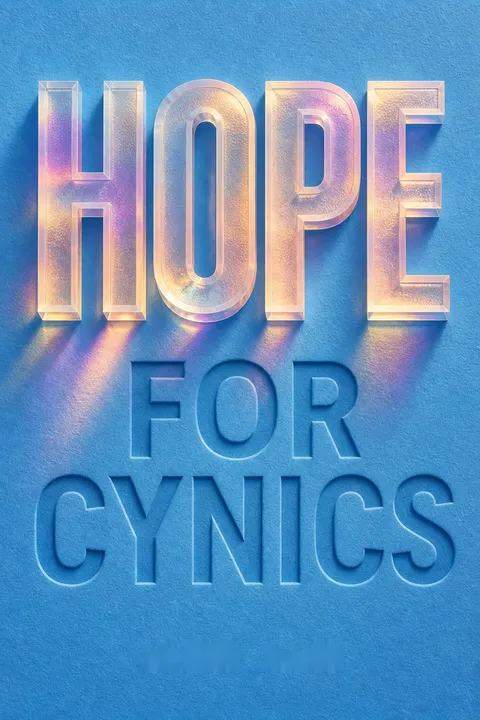


Key Takeaways
Replace blanket distrust with evidence-based hope, not blind optimism
A better alternative. Cynicism assumes people are selfish and dishonest; skepticism questions that assumption and looks for evidence. Hope is not a prediction that things will improve. It is the belief that improvement remains possible, and a reason to act. Together, these ideas form hopeful skepticism: a humane outlook that stays curious and updates when the facts change.
Emile’s example. Psychologist Jamil Zaki describes his friend Emile Bruneau, a peace researcher who held on to hope after a terminal brain cancer diagnosis. Bruneau had seen conflict and suffering up close, yet continued building community and working for peace. Meanwhile, US trust in “most people” fell from nearly 50 percent in 1972 to 33 percent in 2018. Zaki argues that declining trust can be challenged by examining what people actually do, rather than trusting the bleakest story.
Hopeful skepticism is a useful middle path between credulity and reflexive suspicion. It treats beliefs as revisable models, not badges of intelligence or loyalty. That stance matters because social judgments are often made from incomplete samples: a betrayal is vivid, while dozens of ordinary acts of reliability pass without notice. Hope here does not require minimizing harm. Its discipline is to keep the verdict proportional to the evidence, and to leave room for people and conditions to change.
Treat painful experiences as evidence about individuals, not all humanity
Pain can overgeneralize. Zaki calls the leap from being hurt by someone to expecting harm from everyone pre-disappointment. It is an understandable defense, but it can close off relationships that might disprove the fear. Early attachment experiences can shape expectations of safety, yet they do not dictate every later relationship.
A safer connection helps. Megan, an isolated progressive who embraced QAnon in 2020, found belonging in the conspiracy community after repeated disappointments and pandemic isolation. Her partner, Thomas, did not endorse her beliefs, but continued to treat her with care. That relationship helped her examine QAnon’s claims more closely and leave. Bruneau also grew up with a mother whose schizophrenia prevented her from raising him, but his father’s steady care and his mother’s affectionate visits helped him see suffering without reducing people to it.
This account helps explain why misinformation can offer emotional shelter as well as false explanations. Belonging and certainty can be especially compelling when a person feels powerless or alone. Responding with ridicule may deepen the very isolation that made the belief attractive. Still, understanding a person’s needs does not make harmful claims harmless, nor does every relationship deserve continued access. Compassion is most useful when paired with boundaries and attention to evidence.
Notice when your self-protection is teaching others to distrust you
Suspicion changes behavior. Preemptive strikes are actions taken against others because harm is expected, such as monitoring, accusing, or withholding cooperation. They can provoke the very response they were meant to prevent. In Boston, a fire department treated sick-day abuse as widespread and imposed stricter controls. After firefighters received a fixed allowance of fifteen sick days, department-wide sick leave rose from about 6,400 days to more than 13,000.
Trust can be a signal. In trust games, investors send money to a stranger, who can return some of it. Across studies, people tend to return a larger share when they receive a larger initial investment. This pattern is called earned trust: people may respond to a sign of confidence by acting more trustworthy. It is not a promise that everyone will reciprocate. It is a reason to consider small, proportionate chances before treating a new person as a proven threat.
The feedback loop is the striking point: expectations do not merely describe relationships; they help shape them. This resembles a basic problem in measurement, where observing a system can alter what is observed. Yet trust is not a universal solvent. In unequal relationships, the person taking the risk may bear much greater costs, and repeated exploitation is meaningful evidence. A practical approach is calibrated vulnerability: start with a manageable act of trust, observe the response, and revise the level of access accordingly.
Balance your attention before bad news becomes your theory of humanity
Badness grabs the mind. Negativity bias is the tendency to notice and remember threats more readily than positive events. It can make rare wrongdoing feel typical. In Toronto, people guessed that only about one-quarter of lost wallets would be returned. In a city test, 16 of 20 wallets came back. A larger international study also found that most lost wallets were returned in many countries.
The trend may be less bleak than it feels. During the first pandemic years, volunteering, charitable giving, and helping strangers increased, though many people believed kindness had declined. Across decades, people commonly report that morality is worsening, while a review of cooperation studies found cooperation increased by 9 percent between 1956 and 2017. Asset-framing, describing people through their goals and capacities rather than only their problems, can make overlooked human agency visible without denying hardship.
Attention is a limited resource, and information systems compete to capture it. The corrective is not to replace a stream of alarming stories with cheerful fiction. It is to ask whether the stories being seen are representative, and to seek accounts that show both problems and responses. This matters especially when reporting on people in poverty or crisis, who can otherwise appear only as victims or threats. A balanced picture is not neutral in effect: it helps people imagine what action could accomplish.
Test social fears with real conversations before retreat becomes a habit
The imagined interaction often looks worse. Social shark attacks are feared social encounters that loom larger in imagination than they usually do in practice. Studies comparing predictions with real interactions find that people often expect conversations with strangers, requests for help, or personal compliments to go poorly. In one exercise, people who spoke with strangers later expected roughly 80 percent would welcome a conversation, up from an initial expectation of about 50 percent.
The same mismatch appears in groups. Zaki’s Stanford research found that students generally reported wanting new friends and enjoying helping peers, yet thought the average student was cold and judgmental. This mistaken view was linked to less willingness to talk or share difficulties. A practical test is encounter counting: predict how an interaction will feel, have it, then record what actually happened. Repeated experiences can give fear better data than another round of guessing.
This is a modest but consequential intervention: replace mind-reading with observation. It echoes behavioral experiments in therapy, where a person tests a belief through a small action rather than arguing endlessly with the thought. The method works best when the experiment is genuinely safe and the result is interpreted carefully. One pleasant exchange cannot prove universal friendliness, just as one awkward pause cannot prove rejection. The point is to build a more representative sample of social life.
Design schools and workplaces around cooperation, not suspicion
Environments train expectations. Brazilian lake fishermen worked mostly alone and became less trusting over time. Ocean fishermen relied on crews and became more cooperative, because teamwork was essential to their work. The two groups began with similar levels of trust, suggesting that social conditions can shape how people act.
Rules can bring out different people. At Microsoft, a forced ranking system pushed employees to compete for status, hoard information, and sabotage colleagues. CEO Satya Nadella replaced it with reviews that also rewarded helping others. At a troubled Syracuse middle school, principal LaJuan White reduced reliance on punishment and introduced restorative discipline, which focuses on repairing harm and understanding its causes. Suspensions fell by more than 15 percent in her first year. These examples suggest that shared goals, voice, and fair accountability can make collaboration practical rather than merely aspirational.
The comparison shifts the question from “Who is selfish?” to “What behavior does this system reward?” That is a powerful move for managers and educators because it directs attention toward alterable rules. Cooperation still needs structure: shared tasks, clear responsibilities, and fair ways to address harm. Otherwise, generosity can become unpaid labor or a cover for unequal power. The strongest cultures make mutual support valuable while keeping accountability visible and consistent.
When trust collapses, examine inequality and institutional conduct too
Mistrust has causes beyond personality. Zaki describes inequality, abuses of power, and market creep, the spread of scorekeeping and commercial logic into relationships and everyday life, as conditions that can make people more suspicious. After East Germany’s secret police dissolved, towns once heavily watched by the Stasi remained less trusting and civically engaged. The surveillance had damaged relationships beyond its own lifetime.
Doubt can be rational and costly. In Oakland’s Fruitvale neighborhood, residents had reasons to distrust health authorities, including unequal treatment and fears that vaccine clinics could expose undocumented immigrants to immigration enforcement. That mistrust contributed to lower vaccination than in nearby Piedmont. The lesson is not to scold people into trusting institutions. Trust must be earned through transparent, fair conduct, while local organizations with established relationships can bridge gaps that distant authorities cannot.
This is where personal psychology meets political economy. A call for greater trust can become an unfair demand if it asks people harmed by institutions to ignore their experience. Trust is both a feeling and an assessment of how power is used. The more useful question is not simply how to persuade the public, but what institutions must change to become worthy of confidence. Community intermediaries can help, but they should strengthen accountability rather than substitute for it.
Meet political rivals as people before treating them as a hostile bloc
Political pictures are distorted. False polarization is the tendency to imagine political opponents as more extreme and hostile than they are. Research found that Democrats and Republicans often overestimated how many people on the other side supported violence, and missed broad agreement on issues such as campaign finance reform and clean energy. In one study, more than a hundred Americans with opposing views held short video conversations. Participants reported positive experiences, and their dislike of the other party fell, with the change persisting for months.
Better information can humanize. In Colombia, filmmakers interviewed former FARC members and showed their stories to other citizens. Viewers became more supportive of reintegration and more likely to believe the former combatants wanted peace. This does not erase responsibility for violence or mean every conflict is symmetrical. The practical lesson is to ask about the stories behind an opinion, name real common ground, and keep justice distinct from mere civility.
Political misinformation often concerns not only what opponents believe, but what they think of one another. Correcting that second-order misperception can lower the temperature without requiring agreement on policy. Personal contact also gives people information that abstract group labels cannot carry. Still, dialogue has limits: it can be unsafe, unequal, or strategically useless when one side seeks domination rather than understanding. Productive contact is an option, not a duty owed to every antagonist.
Pair anger at injustice with a credible way to act together
Hope needs agency. Creative maladjustment, a term Martin Luther King Jr. used for refusing to accept injustice as normal, joins moral anger to the conviction that action can matter. Anger without that sense of efficacy can become paralysis; efficacy without anger can leave people comfortable with the status quo. Václav Havel and other Czech dissidents kept organizing under Communist rule, and the 1989 Velvet Revolution brought the regime down with little large-scale violence.
People can find strength in numbers. Katie Fahey began a Michigan campaign against partisan gerrymandering with a simple online invitation. Volunteers then held town halls, collected signatures, and helped pass a 2018 ballot measure creating an independent redistricting commission. The effort required more than 300,000 signatures. Such stories show why hope is not passive reassurance: it helps people test whether others share their concern, then gives that concern a practical route into collective action.
The pairing of anger and efficacy avoids two familiar traps: treating calm as virtue when injustice persists, and treating outrage as sufficient by itself. Organizing supplies feedback that private conviction cannot: people discover that others are willing to participate, and institutions become answerable to that participation. The threshold for change is rarely predictable, however, and success stories can hide years of failure or unequal risk. Their value is not as a guarantee, but as evidence that collective action is possible.
Treat shared resources as a cooperation problem, not a verdict on human nature
The commons can be governed. Garrett Hardin’s famous pasture imagined that self-interested herders would overuse shared land until it was ruined. Political scientist Elinor Ostrom tested that grim theory against real communities. She found farmers, fishers, and water users who protected common resources by agreeing on rules, monitoring use, and applying measured penalties to repeated violations. Trust helped those rules work because people were more willing to invest in a shared future.
Climate action needs both systems and solidarity. Zaki argues that despair can discourage action and obscure widespread public support for environmental protection. Individual choices matter, but they are shaped by infrastructure and corporate decisions. The book therefore pairs personal participation with collective pressure, institutional accountability, and multiple approaches to reducing emissions and removing carbon. Hope here means acting under uncertainty, not assuming the crisis will resolve itself.
Ostrom’s work offers a sharper alternative to both naive faith and fatalism: communities can cooperate when they have workable rules, meaningful participation, and ways to address cheating. That insight scales unevenly. A village can monitor water use more directly than a global climate system can monitor industrial emissions. Large-scale cooperation therefore requires institutions as well as goodwill. The environmental argument is strongest when hope expands the menu of actions without excusing powerful polluters or weakening regulation.
Analysis
Hope for Cynics makes a distinctive argument: distrust is not automatically realism, and hope is not automatically denial. Its central contribution is to separate cynicism from skepticism. Cynicism reaches a broad conclusion about people before examining enough evidence; skepticism treats that conclusion as testable. Hope then becomes less a mood than a willingness to act while outcomes remain uncertain. Emile Bruneau’s life gives this model emotional force, while studies and reported interventions show how beliefs can shape relationships, institutions, and collective behavior.
The book’s strongest explanatory move is to connect individual expectations with social design. A suspicious manager, punitive school, or sensational media environment does not merely reflect a cynical view of people. It can help produce the behavior that appears to confirm that view. Conversely, trust can invite cooperation, especially when people share goals and have fair ways to address failure. This shifts the remedy from personal positivity alone toward changing the conditions under which people meet.
The argument is most persuasive when it distinguishes justified caution from sweeping mistrust. People facing discrimination, surveillance, or unequal treatment may have good reasons to distrust particular institutions. A universal appeal to trust would risk blaming them for responding accurately to harm. Zaki’s attention to power and inequality helps prevent that mistake, though the tension remains: interpersonal goodwill cannot substitute for structural reform.
The book also handles evidence with welcome care. Its appendix rates claims and acknowledges uneven support, including research on news effects, changing loneliness, and several proposed interventions. That transparency matters because many findings are associations, and results from a lab or local program may not generalize automatically. The practical exercises are best understood as experiments, not cures: gather better social data, make small and safe bids for connection, and revise beliefs in response. The result is a grounded case for hope as disciplined openness, joined to action and accountability.
Review Summary
Hope for Cynics receives mostly positive reviews, with readers praising its blend of scientific research and personal anecdotes. Many found it inspiring and practical, offering tools to combat cynicism and foster hope. Readers appreciated Zaki's approach to reframing cynicism as "hopeful skepticism" and his emphasis on community-building. Some critiqued the book's US-centric focus and occasional political bias. Overall, reviewers found the book timely and valuable for navigating current societal challenges, though a few felt it lacked depth in certain areas.
People Also Read





Glossary
Hopeful skepticism
Curiosity with a hopeful defaultA way of judging people that combines openness to human goodness with a willingness to question assumptions and look for evidence. Unlike blind trust, it updates when someone behaves badly. Unlike cynicism, it does not treat isolated harms as proof that people in general are selfish or dishonest.
Pre-disappointment
Expecting harm before it happensA defensive expectation that people will let someone down, often formed after painful experiences. Rather than limiting mistrust to the person who caused harm, pre-disappointment generalizes it to strangers, relationships, or institutions. It can feel protective, but may prevent new experiences from correcting the expectation.
Preemptive strikes
Defensive actions that provoke distrustActions taken against others because harm is expected, such as surveillance, accusations, threats, or withholding cooperation. These measures can communicate suspicion and invite resentment or retaliation. The resulting behavior may then appear to confirm the original fear, creating a self-reinforcing cycle.
Earned trust
Trust repaid through behaviorA pattern in which people who receive an initial sign of confidence become more likely to act in trustworthy ways. In trust games, larger initial investments tend to prompt trustees to return a greater share. The term describes a tendency, not a guarantee, so trust still needs judgment and proportionate boundaries.
Reciprocity mindset
Seeing trust as mutual influenceThe view that people’s conduct is not fixed in advance and can be shaped by how others treat them. Someone using this mindset considers whether a modest act of confidence might encourage another person to cooperate, while remaining alert to evidence that trust is misplaced.
Cynical genius illusion
Mistaking cynicism for intelligenceThe widespread belief that suspicious people are sharper, more competent, or better at detecting dishonesty than trusting people. Research discussed in the book challenges this stereotype: cynicism is associated with poorer performance on some cognitive measures and less accurate detection of liars.
Negativity bias
Greater attention to negative informationA tendency to notice, remember, and weigh bad events more heavily than positive ones. It can be useful for detecting danger, but it also makes harmful behavior seem more common than it is. In social life, it can cause people to overlook generosity, cooperation, and everyday trustworthiness.
Asset-framing
Describe people beyond their deficitsA way of telling stories about people that recognizes their goals, capacities, and agency while still naming the obstacles they face. It contrasts with descriptions that define people only by vulnerability or need. Asset-framing is meant to preserve a person’s dignity without minimizing injustice or hardship.
Social shark attacks
Overestimated dangers of interactionThe feared social disasters people imagine when considering a conversation, request, compliment, or disclosure. These possible rejections can feel vivid and likely, even though research often finds actual interactions are more pleasant and meaningful than people predict. Avoiding them can keep those fears untested.
Market creep
Commercial logic entering daily lifeThe spread of measurement, competition, and transactional thinking beyond paid work or shopping into relationships and personal experience. Counting likes, rankings, productivity, or sleep scores can make ordinary life feel like a contest. The book argues that this can displace less measurable forms of connection and enjoyment.
Task interdependence
Shared outcomes require collaborationA work structure in which people’s results depend on one another rather than on isolated individual performance. When teams have genuinely shared goals, members have stronger reasons to exchange knowledge, coordinate, and support one another. The book contrasts this with systems that reward internal competition.
False polarization
Imagining opponents as more extremeThe tendency to overestimate how far political opponents stand from one’s own views and how hostile they are. Research described in the book finds that people often picture the other side as more extreme or more supportive of violence than it really is, obscuring both shared beliefs and opportunities for dialogue.
Creative maladjustment
Refusing to accept injusticeMartin Luther King Jr.’s term for a morally active refusal to become comfortable with injustice. In the book’s account, it combines anger about wrongdoing with a belief that people can act to change it. It differs from cynicism because it treats injustice as a reason to organize, not a reason to give up.
Naikan
Structured reflection on relationshipsA Japanese practice of self-reflection that asks people to examine what they have received from others, what they have given, and what difficulties they have caused. In the book, artist Atsushi Watanabe uses it to challenge one-sided judgments and notice both his own pain and the perspectives of people around him.
Hikikomori
Prolonged social withdrawalA Japanese term for people who withdraw from society and remain in near-total isolation for at least six months. The book describes it as a response that can involve family conflict, depression, anxiety, and a sense that the outside world is unsafe. Similar patterns have been reported beyond Japan.
FAQ
What’s Hope for Cynics: The Surprising Science of Human Goodness by Jamil Zaki about?
- Explores cynicism and hope: The book investigates why cynicism is so prevalent today and how hope can be a wiser, more practical response to social challenges.
- Blends science and stories: Jamil Zaki combines neuroscience, psychology, and real-life narratives to examine human goodness and the roots of mistrust.
- Focuses on social health: The book frames cynicism as a disease that erodes trust, relationships, and society, offering strategies to rebuild hope and compassion.
- Personal and cultural journey: Zaki shares his own struggles with cynicism and draws inspiration from figures like Emile Bruneau to chart a path toward hopeful skepticism.
Why should I read Hope for Cynics by Jamil Zaki?
- Understand cynicism’s impact: The book reveals how cynicism harms mental and physical health, relationships, and even democracy, while explaining why it’s so widespread.
- Learn practical hope: Zaki offers actionable tools to replace blanket mistrust with evidence-based, hopeful skepticism, helping readers navigate social complexity.
- Inspiring real-life examples: Through stories of individuals and communities who rebuilt trust, the book motivates readers to take positive action in their own lives.
- Grounded in rigorous science: The advice and insights are backed by extensive research in psychology, neuroscience, and social science.
What are the key takeaways from Hope for Cynics by Jamil Zaki?
- Cynicism is costly: It leads to poorer health, social isolation, and stagnation in organizations and societies.
- Hopeful skepticism works: Adopting a mindset of hopeful skepticism—being open to evidence and giving others a chance—improves relationships and cooperation.
- Trust is self-fulfilling: When we trust others, they are more likely to act in trustworthy ways, creating positive feedback loops.
- Social connection heals: Genuine interactions and constructive disagreement can overcome loneliness and mistrust, fueling resilience and progress.
How does Jamil Zaki define cynicism and hopeful skepticism in Hope for Cynics?
- Modern cynicism: Defined as a mindset of preemptive distrust and negative assumptions about others’ motives, often leading to withdrawal and conflict.
- Hopeful skepticism: Involves questioning cynical beliefs, remaining open to new evidence, and balancing healthy doubt with optimism and trust.
- Pre-disappointment: Zaki introduces the concept of “pre-disappointment,” where people expect to be let down before giving others a chance.
- Transformative mindset: Shifting from cynicism to hopeful skepticism breaks negative cycles and fosters more positive social interactions.
What myths about cynicism does Jamil Zaki debunk in Hope for Cynics?
- Cynicism isn’t clever: Research shows cynics perform worse on cognitive tests and are less able to detect lies, contrary to the “cynical genius” stereotype.
- Cynicism isn’t safe: Avoiding trust may prevent betrayal but also shuts down opportunities for love, collaboration, and community.
- Cynicism isn’t moral: While some see cynicism as a response to injustice, it often leads to disengagement and serves the status quo rather than challenging it.
- Cynicism is self-defeating: It blinds people to evidence of goodness and forecloses on the possibility of positive change.
How does Hope for Cynics by Jamil Zaki explain the relationship between trust, hope, and cynicism?
- Trust as social glue: Trust is the willingness to be vulnerable and is essential for healthy relationships, communities, and democracy.
- Hope as practical action: Hope is believing that positive change is possible, motivating action even amid uncertainty.
- Cynicism’s corrosive effects: Cynicism erodes trust and hope, leading to isolation, depression, and societal dysfunction.
- Skills to cultivate: Both hope and trust are skills that can be developed to counter cynicism and build stronger social bonds.
What scientific evidence does Jamil Zaki present about human goodness and trust in Hope for Cynics?
- Humans wired for kindness: Behavioral science and neuroscience show people naturally cooperate and help others, even strangers.
- Trust improves outcomes: Higher trust is linked to better health, stronger communities, and faster recovery from disasters.
- Self-fulfilling trust: Experiments demonstrate that when people are trusted, they tend to behave more generously and responsibly.
- Correcting misperceptions: Interventions that reveal others’ kindness and intentions can reduce prejudice and support peacebuilding.
How does Hope for Cynics by Jamil Zaki address the impact of inequality and poverty on trust and cynicism?
- Inequality breeds cynicism: Economic disparities correlate with declining trust, especially among marginalized groups facing systemic barriers.
- “Constitution for knaves”: Poor people often encounter systems that assume dishonesty, leading to humiliating bureaucratic hurdles.
- Cash transfers as trust: Programs providing direct aid without suspicion show that when trusted, people invest wisely and improve their lives.
- Redistributing trust: Zaki argues for shifting societal trust toward the many, holding the wealthy accountable, and empowering the poor.
What does Jamil Zaki say about the role of media and gossip in spreading cynicism in Hope for Cynics?
- Negativity bias in media: Media outlets amplify bad news, feeding a cycle of fear and mistrust and distorting public perception.
- Gossip’s double edge: While gossip can enforce norms, it often focuses on negative behavior, making selfishness seem more common than it is.
- Asset-framing and solutions journalism: Highlighting positive stories and community strengths can counteract negativity bias and inspire hope.
- Reader’s role: Zaki encourages seeking and sharing stories of human goodness to balance the cynicism machine.
How does Hope for Cynics by Jamil Zaki address political polarization and conflict?
- Overestimating rivals’ negativity: People exaggerate the bad qualities of political opponents, fueling division and hostility.
- Cross-party conversations: Structured dialogues between rivals reduce animosity and increase openness, even when disagreements persist.
- Media’s amplifying role: Negative coverage intensifies fear and mistrust, but asset-framed media can promote peace and understanding.
- Constructive disagreement: The book offers practical steps for better disagreement, such as asking questions and seeking common ground.
What insights does Jamil Zaki offer about the climate crisis and human nature in Hope for Cynics?
- Doomerism challenged: Fatalistic beliefs about climate change and human selfishness undermine motivation to act.
- Misplaced blame: The “carbon footprint” narrative was popularized by fossil fuel companies to shift responsibility from major polluters.
- Cooperation is possible: Research shows people often work together to manage shared resources sustainably, defying “tragedy of the commons” assumptions.
- Hope fuels action: Young activists and communities demonstrate that hope, combined with efficacy, drives meaningful environmental progress.
What practical strategies and habits does Jamil Zaki recommend in Hope for Cynics to overcome cynicism and cultivate hope?
- Reality testing and experiments: Use cognitive behavioral techniques to test cynical beliefs against real-world evidence and revise assumptions.
- Build safe relationships: Secure attachments and supportive communities foster trust, curiosity, and openness.
- Leaps of faith and reciprocity: Small acts of trust encourage others to reciprocate, creating virtuous cycles of cooperation.
- Balance media and stories: Seek out positive, asset-framed stories to counteract negativity bias and reinforce hope.
What are the best quotes from Hope for Cynics by Jamil Zaki and what do they mean?
- “Trust is a leap of faith, but it’s also a powerful form of social influence.” This highlights how trusting others not only requires courage but also inspires them to act more trustworthily.
- “Cynicism is a disease of social health.” Zaki frames cynicism as a contagious mindset that harms individuals and societies, not just a personal attitude.
- “Hope is not optimism; it’s the belief that something good could happen, even if it’s not guaranteed.” This distinguishes hope as an active, motivating force rather than passive wishful thinking.
- “We become the people our environments expect us to be.” The book emphasizes how social and cultural conditions shape our trust, cynicism, and capacity for goodness.
- “Change happens through new habits and experiments, not overnight.” Zaki encourages readers to take small, practical steps to shift from cynicism to hope.
About the Author
Other books by Jamil Zaki

Download PDF
Download EPUB
.epub digital book format is ideal for reading ebooks on phones, tablets, and e-readers.








