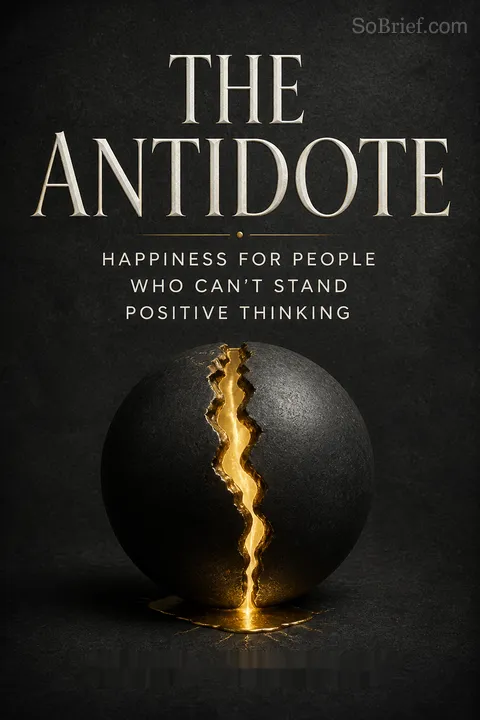


Key Takeaways
Trying to banish bad thoughts can make them louder, not happier
Positivity can backfire. At a huge San Antonio motivation seminar, pastor Robert Schuller urged thousands to remove the idea of impossibility from their vocabularies. Months after Burkeman attended, the glass Crystal Cathedral filed for bankruptcy protection, a reminder that confidence cannot repeal practical limits.
The mind keeps checking. Psychologist Daniel Wegner's ironic process theory describes how trying to suppress a thought can make it more persistent. The mind monitors whether the unwanted thought has returned, keeping it in view. In studies, people told not to feel sad after hearing bad news felt worse than people given no such instruction. Repeating a positive affirmation also lowered the mood of participants with low self-esteem when it clashed with how they already saw themselves.
The important distinction is between optimism and compulsory optimism. Hope can support persistence, but demanding a particular mood adds a second task: people must act and continually judge whether their thoughts are positive enough. That self-audit can turn ordinary sadness into evidence of personal failure. A useful response is not to replace every negative thought with a cheerful one, but to notice the thought without treating its presence as a crisis. That leaves room for realistic hope without making emotional cheerfulness another performance standard.
Rehearse the feared outcome until it becomes finite, not monstrous
Practice facing the worst. Stoic philosophers used negative visualisation, the deliberate imagining of loss or difficulty, to prepare for what could go wrong. The aim was not to expect disaster, but to see that feared events are often painful without being infinitely unbearable. Remembering that valued things are temporary can also restore appreciation for what routine has made easy to overlook.
Test the prediction. Psychotherapist Albert Ellis adapted this idea into exercises that let people encounter manageable embarrassment. Burkeman tried announcing London Underground station names aloud, expecting humiliation. Passengers mostly ignored him, and his panic eased as the imagined catastrophe failed to arrive. Ellis called similar tasks shame-attacking exercises. The Stoic distinction is between accepting reality and giving up: a person can calmly recognize a bad situation and still take practical steps to change it.
This approach resembles exposure: feared situations become less overwhelming when a person meets them in a controlled way and discovers what actually happens. Its strength is specificity. Rather than relying on vague reassurance, it asks what the feared outcome would involve and what could be done next. But imagining danger can become rumination if it never leads to clearer judgment or action. The useful test is whether the exercise makes the fear more concrete and manageable, not whether it produces a perfectly calm feeling.
Act with reluctance beside you instead of waiting to feel ready
Observe without clinging. Buddhist non-attachment means experiencing thoughts and feelings without gripping the pleasant ones or fighting the unpleasant ones. During a silent meditation retreat, Burkeman found his mind full of pop lyrics, then became intensely annoyed by another meditator's breathing. The practice was not to force calm, but to notice distraction and gently return attention to the breath.
Feelings need not lead. Morita Therapy, a Japanese approach influenced by Buddhism, teaches people to accept their present feelings while continuing purposeful action. Its logic challenges the belief that motivation must come first. Writers' routines offer a practical example: Anthony Trollope wrote at set times and produced forty-seven novels, without waiting for inspiration to arrive. Brief meditation studies described in the book also found reduced reported pain, suggesting that attention and judgment can shape how an unpleasant sensation is experienced.
Acceptance is often mistaken for passivity, yet this section makes a practical distinction: a feeling can be present without being in charge. That idea is useful wherever mood fluctuates, including work, exercise, and difficult conversations. The meditation example also shows that attention is trainable, though reduced reported pain does not mean an injury has vanished or needs no care. Non-attachment is better understood as loosening the grip of mental reactions, not withdrawing from responsibility or denying what the body is telling someone.
Set goals lightly enough to turn back when reality changes
Beware the summit. In the 1996 Everest disaster, climbers pressed toward the summit despite delays that had already put them beyond safe turnaround times. Eight climbers died during a single day. Management scholar Christopher Kayes argued that some had become so identified with reaching the top that warnings threatened their sense of themselves, not just their plan.
Notice goalodicy. Kayes used this term for the defense of a goal in the face of evidence against it. The same pattern can appear in business: a target becomes a badge of commitment, and bad news is treated as a reason to invest more. Goals can focus effort, but in complex situations they can also narrow attention, encourage short-term fixes, and make quitting feel like personal defeat. The skill is to keep a goal revisable when the evidence changes.
A goal can coordinate effort, but it can also become a lens that edits out inconvenient facts. This is especially risky when conditions change quickly, as they do in mountaineering, business, and health. A useful safeguard is to decide in advance what evidence would justify revising or abandoning a plan. That keeps persistence from being confused with wisdom. The lesson is not to avoid ambition; it is to separate commitment to a worthwhile purpose from loyalty to one route or milestone.
Start with what you have, and let experiments shape where you go
Use available means. Researcher Saras Sarasvathy calls effectuation a way of acting that begins with existing resources, skills, and relationships, then lets possible goals emerge through action. In interviews, experienced entrepreneurs often described trying an early sale or using what was already at hand, rather than writing a detailed plan for a distant endpoint.
Limit the downside. Two principles make this approach concrete. The bird-in-hand principle says to begin with what is already available. The affordable-loss principle asks whether the cost of a small experiment would be tolerable if it failed, rather than fixating on an imagined jackpot. This does not mean acting randomly. It means learning from real responses and adjusting direction before a speculative plan consumes too much time or money.
Effectuation treats the future as something partly discovered through action, rather than fully specified in advance. That fits creative work and entrepreneurship, where customers, collaborators, and constraints can reshape the opportunity. It also counters perfectionism: a small test can produce information that a polished plan cannot. Still, improvisation works best with boundaries. Affordable loss requires an honest account of the downside, and a broad direction can prevent flexibility from becoming mere drift.
Watch your thoughts without mistaking their narration for a permanent self
Question the inner narrator. Eckhart Tolle described how people can identify so closely with their mental chatter that they experience every thought as an expression of who they are. After a crisis in his twenties, he said, that identification fell away and he felt a lasting calm. His account is unusual, but the basic exercise is ordinary: notice a thought as it appears instead of automatically obeying its story.
The self is less simple. Philosopher David Hume reported finding sensations, emotions, and thoughts when he searched inward, but no separate, unchanging self behind them. Split-brain research also showed that different parts of a brain can act somewhat independently. These arguments do not prove that people are unreal. They suggest that identity may be more like an ongoing process than a single, solid object. Tolle's further claim that a truer self lies beneath thought remains a matter of interpretation.
Treating thoughts as events rather than commands can create useful psychological distance. It does not require settling the metaphysical question of whether a deeper self exists. The practical gain is smaller and sturdier: a person can notice self-criticism, fear, or ambition without letting any one of them define the whole person. At the same time, identity has real social and ethical uses. A flexible sense of self should make people more responsive to experience, not less accountable for choices.
Choose real safety over rituals that merely soothe fear
Separate feeling from protection. Security expert Bruce Schneier called measures that mainly create an impression of safety security theatre. He argued that some post-9/11 airport restrictions imposed significant inconvenience without addressing the deeper risk of a determined attacker. In his account, stronger cockpit doors and passengers' willingness to resist mattered more than an expanding list of forbidden objects.
Do not romanticize hardship. The book also visits Kibera, a Nairobi settlement facing severe poverty and danger. Some residents describe community, work, and family as sources of happiness, and surveys have sometimes found high self-reported optimism in poorer countries. That is not evidence that deprivation is harmless or that poverty makes people happy. It does suggest that material security and emotional well-being are not identical, and that the pursuit of perfect safety can crowd out connection and participation.
The distinction between actual protection and the feeling of protection applies beyond airports. People may avoid honest conversations, emotional risk, or unfamiliar communities because avoidance feels safer in the short term. Yet the effort to eliminate every vulnerability can also eliminate closeness and new information. The example of Kibera needs particular care: resilience under hardship is not an argument for tolerating preventable hardship. Security measures should be judged by what they protect, while social well-being should not be reduced to a single happiness score.
Treat failure as evidence about a method, not a verdict on a person
Look at the misses. A research company in Michigan keeps shelves of consumer products that failed, from breakfast cola to ill-fated personal-care products. The collection exists because companies often discard failed experiments rather than preserve what they can teach. Scientists do something similar: researcher Kevin Dunbar observed that experiments frequently produced confusing or unwanted results, which researchers sometimes repeated, explained away, or set aside.
Correct the success story. Survivor bias occurs when attention goes to the winners while comparable failures remain unseen. That makes it easy to mistake a trait found among successful entrepreneurs, such as persistence, for a recipe for success, even if it also appears among people who lost everything. Psychologist Carol Dweck's work adds a personal lesson: when ability is treated as developable, mistakes can show where practice is needed rather than prove permanent incapacity.
Failure is informative only when it is examined honestly. A product that flops may reveal a bad assumption, poor timing, or a mismatch with customers; the failure itself does not identify which explanation is correct. The same caution applies to personal setbacks. Treating every disappointment as growth can become another forced-positive story, while treating it as shame blocks learning. The more useful stance is curiosity: preserve the evidence, ask what it can support, and avoid drawing a sweeping verdict from one outcome.
Let mortality clarify what deserves today's attention
Remember the limit. Memento mori means practices that keep death in view. Ernest Becker argued that people often organize their lives around symbolic projects that promise lasting importance. Experiments on mortality salience, meaning reminders of one's own death, found that such reminders could intensify attachment to existing political or moral beliefs rather than make people reflective automatically.
Make the reminder usable. In Mexico, Day of the Dead gatherings bring families to cemeteries to remember deceased relatives together. The ritual does not erase grief; it gives memory a place in ordinary life. A simpler exercise in the book asks people to imagine being eighty and consider what they wish they had spent more or less time doing. The point is not to panic or seize every pleasure, but to let a finite life help sort urgent distractions from lasting priorities.
Mortality can sharpen attention because it makes the cost of postponement harder to ignore. But reminders of death are not guaranteed to produce wisdom. They can also intensify defensiveness, as the experiments suggest, or overwhelm someone already dealing with grief or anxiety. Ritual and reflection offer different routes: one makes remembrance communal, the other personal. The strongest use of mortality awareness is practical and proportionate, helping someone choose what matters without turning every day into a frantic race against time.
Practice staying with uncertainty instead of forcing every question closed
Make room for the unresolved. Poet John Keats used negative capability for the ability to remain with uncertainty, mystery, and doubt without urgently forcing an explanation. Burkeman uses it to gather the book's varied approaches: Stoic preparation for setbacks, Buddhist observation of mental states, action without waiting for motivation, and openness to failure.
Use the tools lightly. The point is not to adopt a single doctrine or become pessimistic for its own sake. Burkeman describes small practices instead: pause before blaming a frustrating situation, spend a few minutes observing thoughts, or begin a task without first trying to feel inspired. The aim is less control over every emotion and outcome, and more capacity to participate in life while its uncertainties remain unresolved.
Negative capability is compelling because it describes a skill rather than a complete belief system. It allows people to borrow useful practices without pretending that Stoicism, Buddhism, and modern psychology are identical. That flexibility is also a constraint: acceptance should not become an excuse to endure abuse, ignore injustice, or stop planning where planning helps. The value lies in distinguishing what can be influenced from what cannot, then acting without demanding that uncertainty disappear first.
Analysis
The book's central move is not to praise negativity, but to question the assumption that well-being follows from controlling inner experience. Its examples range from thought-suppression experiments to Everest, silent meditation, security policy, consumer failures, and death rituals. Together they suggest a recurring trap: when a desired feeling or outcome becomes mandatory, people monitor themselves for failure, interpret contradictory evidence defensively, and may intensify the very distress they hope to escape.
The strongest synthesis is behavioral. A person need not first feel calm to take a useful step, nor feel certain before making a limited experiment. Stoic examination of judgment, Buddhist observation of thought, and effectual action all loosen the demand for a guaranteed emotional state. This overlaps with contemporary acceptance-based therapies, which emphasize acting in line with values while allowing difficult feelings to be present. It also resembles scientific inquiry at its best: hypotheses remain revisable, and disconfirming evidence is treated as information rather than insult.
The traditions should not be collapsed into one doctrine. Stoicism emphasizes rational judgment and tranquility. Buddhist non-attachment questions clinging to experience. Tolle and Watts make more ambitious claims about the self and reality. These differ in their metaphysical commitments and in what they consider a good life. The book's practical usefulness does not depend on resolving those disagreements, but readers should notice them rather than treat every technique as interchangeable.
There is also an ethical boundary. Acceptance can help someone stop wasting energy on what cannot be controlled, but it must not be used to normalize preventable harm or inequality. The discussion of Kibera rightly warns against romanticizing poverty, yet reported happiness cannot substitute for rights, health, or material security. The most defensible lesson is therefore neither relentless optimism nor resignation. It is flexible attention: face facts, revise goals, tolerate feelings, and act where action can matter.
Review Summary
The Antidote receives mostly positive reviews for its exploration of alternative approaches to happiness, challenging the positive thinking movement. Readers appreciate Burkeman's engaging writing style, humor, and insights into stoicism, Buddhism, and mindfulness. Many find the book thought-provoking and refreshing, offering a realistic perspective on contentment. Some critics note a lack of depth in certain areas and question the effectiveness of the proposed methods. Overall, reviewers recommend the book for those seeking a different perspective on happiness and personal growth.
People Also Read







Glossary
the backwards law
Effort can reverse itselfAlan Watts's name for the paradox that trying too hard to secure a desired inner state can produce the opposite. Attempts to suppress worry, force happiness, or guarantee certainty may intensify distress because attention stays fixed on what must be avoided. The idea is a counterweight to constant striving, not a claim that all effort or optimism is harmful.
ironic process theory
Suppression strengthens unwanted thoughtsPsychologist Daniel Wegner's account of why attempts to suppress a thought can make it more persistent. The mind checks whether the unwanted thought is absent, which keeps monitoring it and makes it more likely to return to awareness. The effect can be stronger when someone is tired, stressed, or mentally overloaded.
negative visualisation
Rehearse possible lossesA Stoic practice of deliberately imagining the loss of valued things or the possibility of an adverse outcome. It is intended to reduce exaggerated fear and renew appreciation for what is currently present. The exercise does not require expecting disaster or giving up; it helps distinguish a painful event from an imagined catastrophe.
non-attachment
Experience without clingingA Buddhist way of relating to thoughts, feelings, and circumstances without grasping at pleasant experiences or fighting unpleasant ones. Non-attachment is not apathy, withdrawal, or emotional suppression. It means allowing experiences to arise and pass without treating them as permanent requirements or as commands that must determine one's actions.
Morita Therapy
Accept feelings, act purposefullyA Japanese therapeutic approach founded by Shoma Morita and influenced by Buddhist ideas. It treats feelings as experiences that need not be eliminated before a person can act. Rather than making emotional comfort the condition for living effectively, Morita Therapy emphasizes accepting the present feeling state while taking appropriate, purposeful action.
goalodicy
Defending goals against evidenceChristopher Kayes's term for the process of preserving commitment to a goal despite evidence that the goal or strategy may be unwise. A goal can become tied to a person's identity, making warnings feel like personal threats. People may then reinterpret setbacks as reasons to invest more heavily, increasing the danger of the original pursuit.
effectuation
Let means shape possible endsSaras Sarasvathy's model of entrepreneurial action that begins with available means, such as skills, resources, and relationships, rather than a fixed endpoint and detailed plan. People take manageable steps, learn from their consequences, and allow goals to develop. Its affordable-loss principle asks whether a potential failure is tolerable before acting.
ego
Identity fused with thoughtIn Eckhart Tolle's specialized usage, the ego is the sense of self built through identifying with a continuous stream of thoughts, judgments, and personal narratives. Tolle argues that this identification fuels dissatisfaction by opposing the present and projecting happiness into a future state. This meaning differs from the technical meanings of ego in other psychological theories.
security theatre
Safety measures that reassureBruce Schneier's term for visible security measures designed mainly to make people feel protected, even when they do little to reduce actual danger. Such measures can waste time and resources, distract from more effective protections, or create false confidence. The concept distinguishes the subjective feeling of safety from measurable security.
survivor bias
Learning only from visible winnersA reasoning error that occurs when successful cases are examined while comparable failures are overlooked or inaccessible. It can make traits shared by winners seem like causes of success, even if unsuccessful people share those traits too. In business and personal advice, accounting for unseen failures changes how confidently success stories can be copied.
memento mori
Remember that life endsA practice or ritual that keeps mortality in awareness. Traditions discussed in the book use reminders of death to encourage attention to present life, relationships, and conduct. Memento mori is not necessarily an attempt to welcome death or deny grief; it makes finitude part of ordinary reflection rather than a subject kept out of sight.
mortality salience
A reminder of one's deathA psychological research term for making a person's own death more noticeable, often through questions or prompts about dying. Experiments described in the book found that such reminders could strengthen existing cultural, political, or moral commitments. Awareness of death does not automatically produce calm or insight and may instead provoke defensiveness.
negative capability
Remain open amid uncertaintyJohn Keats's term for the capacity to stay with uncertainty, mystery, and doubt without urgently forcing resolution. Burkeman extends it to a practical orientation that includes tolerating difficult feelings, revising goals, facing failure, and acting without certainty. It is a flexible skill, not a single comprehensive philosophy or a demand to avoid planning.
FAQ
What's The Antidote: Happiness for People Who Can't Stand Positive Thinking about?
- Challenges positive thinking: The book critiques the conventional pursuit of happiness through positive thinking, suggesting it often leads to greater unhappiness.
- Negative path to happiness: Burkeman introduces the idea of embracing negative emotions and uncertainties as a more authentic path to happiness.
- Philosophical roots: The approach is rooted in philosophies like Stoicism and Buddhism, advocating for confronting life's challenges directly.
- Real-life applications: The author shares personal experiences and insights to illustrate how accepting negativity can lead to a more fulfilling life.
Why should I read The Antidote?
- Unique perspective: Offers a refreshing take on happiness that contrasts with mainstream self-help literature.
- Practical insights: Provides actionable advice based on philosophical teachings and psychological research.
- Challenges societal norms: Encourages readers to embrace a more nuanced view of life, leading to greater resilience.
- Philosophical depth: Engages with profound questions about life and happiness, making it a thought-provoking read.
What are the key takeaways of The Antidote?
- Embrace negativity: Accepting negative emotions can lead to a more profound sense of happiness.
- Law of reversed effort: The harder we try to achieve happiness, the more elusive it becomes.
- Mindfulness and presence: Emphasizes the importance of being present and mindful, aligning with practices in Buddhism and Stoicism.
- Value of uncertainty: Acknowledging life's inherent uncertainty can lead to a more fulfilling existence.
What are the best quotes from The Antidote and what do they mean?
- “The effort to try to feel happy is often precisely the thing that makes us miserable.”: Suggests that acceptance of life's challenges may be a more effective path to contentment.
- “Insecurity is the result of trying to be secure.”: Highlights the paradox of seeking security and stability in life.
- “When you try to stay on the surface of the water, you sink; but when you try to sink, you float.”: Illustrates the concept of the "backwards law," emphasizing letting go of control.
- “The desire for security and the feeling of insecurity are the same thing.”: Suggests that seeking to fortify against uncertainties creates insecurity.
What is the "negative path" to happiness in The Antidote?
- Acceptance of negative emotions: Involves embracing negative feelings and experiences rather than avoiding them.
- Philosophical foundations: Rooted in Stoicism and Buddhism, teaching that confronting life's uncertainties fosters resilience.
- Practical applications: Encourages engaging with fears and insecurities for personal growth and a meaningful existence.
How does The Antidote relate to Stoicism and Buddhism?
- Stoic principles: Emphasizes confronting worst-case scenarios to cultivate tranquility and resilience.
- Buddhist teachings: Incorporates concepts like non-attachment and mindfulness, emphasizing presence and acceptance.
- Common themes: Both philosophies advocate for embracing discomfort and uncertainty to achieve deeper happiness.
What is the "law of reversed effort" mentioned in The Antidote?
- Definition of the law: Suggests that the harder we try to achieve something, the more likely we are to fail.
- Illustrative examples: Demonstrates the futility of trying to suppress negative thoughts and the benefits of letting go.
- Philosophical roots: Echoed in works by philosophers like Alan Watts, emphasizing acceptance and surrender.
How does Oliver Burkeman critique the self-help industry in The Antidote?
- Ineffectiveness of self-help: Argues that many self-help books fail to deliver on their promises of happiness and success.
- The "eighteen-month rule": Highlights the cyclical nature of the self-help market and its limited effectiveness.
- Call for deeper understanding: Advocates for a more nuanced approach to happiness beyond quick fixes.
What role does mindfulness play in The Antidote?
- Mindfulness as a practice: Presented as a key component of the negative path to happiness.
- Benefits of mindfulness: Helps develop tolerance for discomfort and uncertainty, leading to increased resilience.
- Connection to philosophical traditions: Links mindfulness to Stoic and Buddhist teachings, informing modern approaches to happiness.
How does The Antidote address the concept of failure?
- Embracing failure: Argues that failure should be embraced rather than feared, leading to personal growth.
- The Museum of Failure: Celebrates the value of errors and setbacks, encouraging a healthier relationship with failure.
- Cultural implications: Critiques societal attitudes towards failure, suggesting a shift in perspective to normalize it.
What is the concept of "negative capability" in The Antidote?
- Definition of negative capability: Refers to the ability to remain in uncertainty and doubt without needing immediate resolution.
- Importance in happiness: Allows individuals to accept life's complexities, leading to a more authentic experience of happiness.
- Practical application: Helps navigate challenges effectively, fostering resilience and adaptability.
What is the significance of "memento mori" in The Antidote?
- Reminder of mortality: Encourages living more fully and authentically by contemplating the inevitability of death.
- Cultural practices: Explores traditions like the Day of the Dead, highlighting the importance of remembering those who have passed.
- Transformative perspective: Cultivates a sense of urgency and purpose, leading to more meaningful choices.
About the Author


Download PDF
Download EPUB
.epub digital book format is ideal for reading ebooks on phones, tablets, and e-readers.








